OPERATIONS
– Process that either provide services or create
goods.
– Take place in every business organization.
– Core of what a business organization does.
– Part of business organizations that is responsible
for producing goods and/or services.
GOODS
– Physical items produced by business organization.
SERVICES
– Activities that provide some combination of time,
location, form and psychological value.
OPERATION FUNCTION
– Collective success or failure of companies’
operations functions has an impact on the ability
of a nation to compete with other nations, and on
the nation’s economy.
– Excess supply or excess capacity is wasteful and
costly
– Little means lost opportunity and possible
customer dissatisfaction.
BUSINESS ORGANIZATION
– Have three basic functional areas.
– Finance, marketing, and operations.
– All business organizations have these three basic
functions.
FINANCE
– Responsible for securing financial resources at
favorable price
– Allocating resources throughout the organization.
– Budgeting, analyzing investment proposals, and
providing funds for operations.
MARKETING
– Responsible for assessing consumer wants and
needs
– Selling and promoting the organization’s goods or
services.
OPERATIONS
– Responsible for producing the goods or services
offered by the organizations.
OPERATION MANAGEMENT
– Responsible for managing the business core
– Management of systems or processes that create
goods and/or provide services.
– Operation and supply chains ae intrinsically linked,
and no business could exist without both.
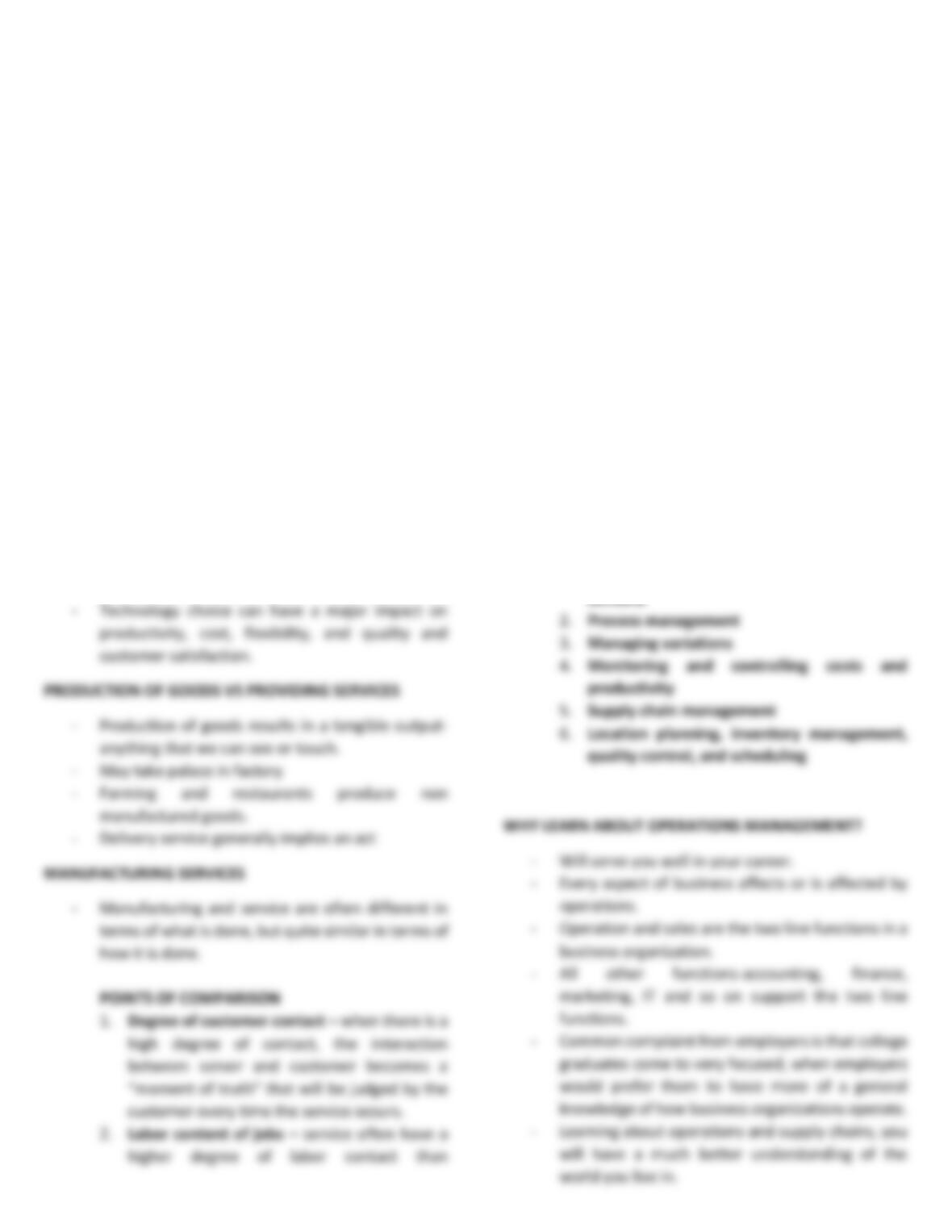
SUPPLY CHAIN
– Sequence of organizations-their facilities,
functions, and activities that are involved in
producing and delivering a product or service.
– Sequence begins with basic suppliers of raw
materials and extends all the way to the final
customer.
– It is like a chain
– If one fails it can interrupt the flow
– Both external and internal to the organization
– External parts are the raw materials
– Internal parts are the operations function itself.
OPERATION FUNCTION
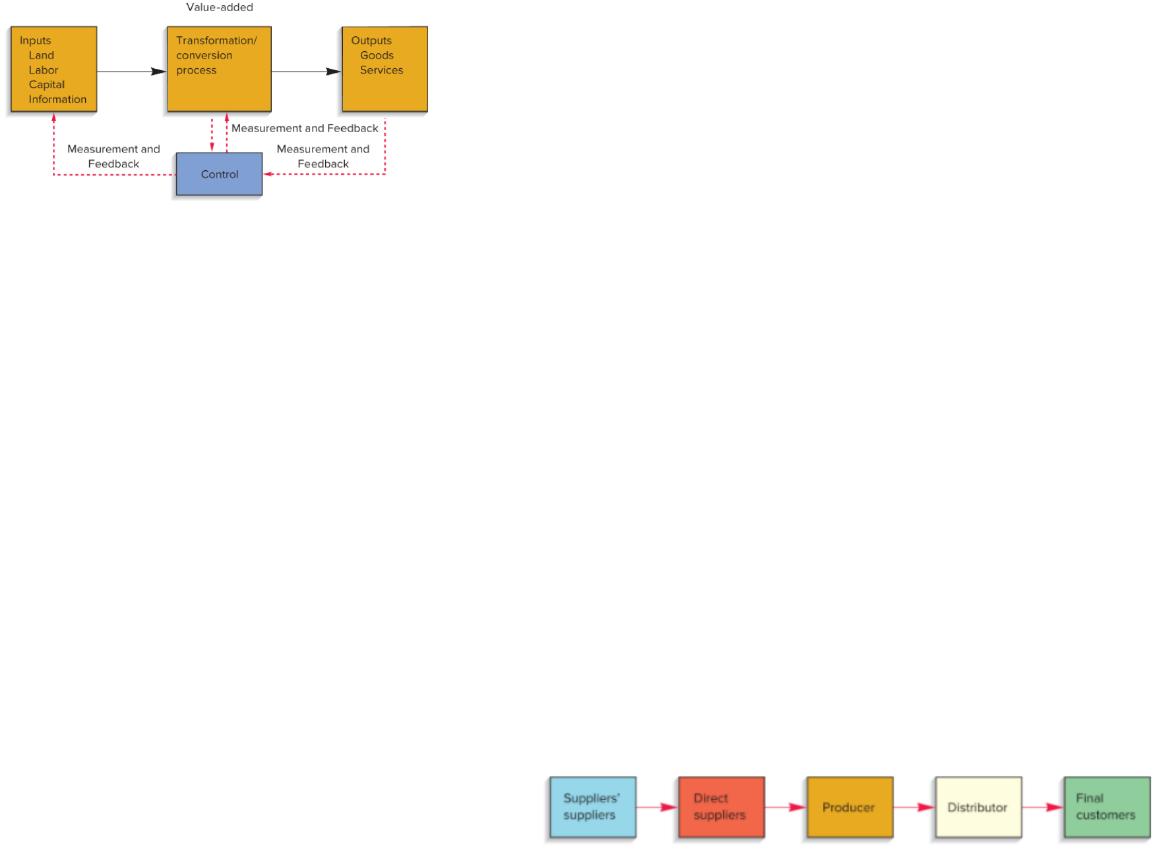
– Creation of goods or services involves
transforming or converting inputs into outputs.
– Inputs such as capital, labor, and information used
to create goods or services using one or more
transformation process.
– To ensure outputs are obtaining, organization
takes measurement at various points in
transformation process (FEEDBACK).
– Then compare them with previously established
standard to determine whether corrective action
is needed (CONTROL)
VALUE-ADDED
– Essence of the operations function is to add value
during the transformation process.
– Term used to describe the difference between the
cost of inputs and the value or price of outputs.
– Value of outputs is their value to society, the
greater the value-added, the greater the
effectiveness of these operations (NON PROFIT
ORGANIZATION)
– Value of outputs is measured by the prices that
customers are willing to pay for those goods or
services. (FOR-PROFIT ORGANIZATION)
– The greater the value-added, the greater the
amount of funds available for these purposes.
– Can be psychological, as in branding.
FACTORS AFFECT THE DESIGN AND MANAGEMENT OF
OPERATIONS SYSTEM
– Degree of involvement of customers in the process
– Degree to which technology is used to produce
and/or deliver a product or service
– Greater the degree of customer involvement, the
more challenging it can be to design and manage
the operation.
manufacturing jobs do, although automated
service are an exception.
3. Uniformity of inputs– often subject to a higher
degree of variability inputs.
4. Measurement of productivity– can be more
difficult for service jobs due largely to the high
variations of inputs.
5. Quality assurance– usually more challenging
for services due to the higher variation in
input, and because delivery and consumption
occur at the same time.
6. Inventory – Many service tend to involve less,
so the cost of having inventory on hand are
lower than they are for manufacturing.
7. Wages – manufacturing jobs are often well
paid and have less wage variation than service
jobs.
8. Ability to patent – product design is often
easier to patent than service design and some
services cannot be patented, making them
easier for competitors to copy.
SIMILARITIES
1. Forecasting and capacity to match supply and