Operations Management 1 – Chapter 8 – Handouts 1
Compiled by Sambil C. Mukwakungu Page 1 of 14
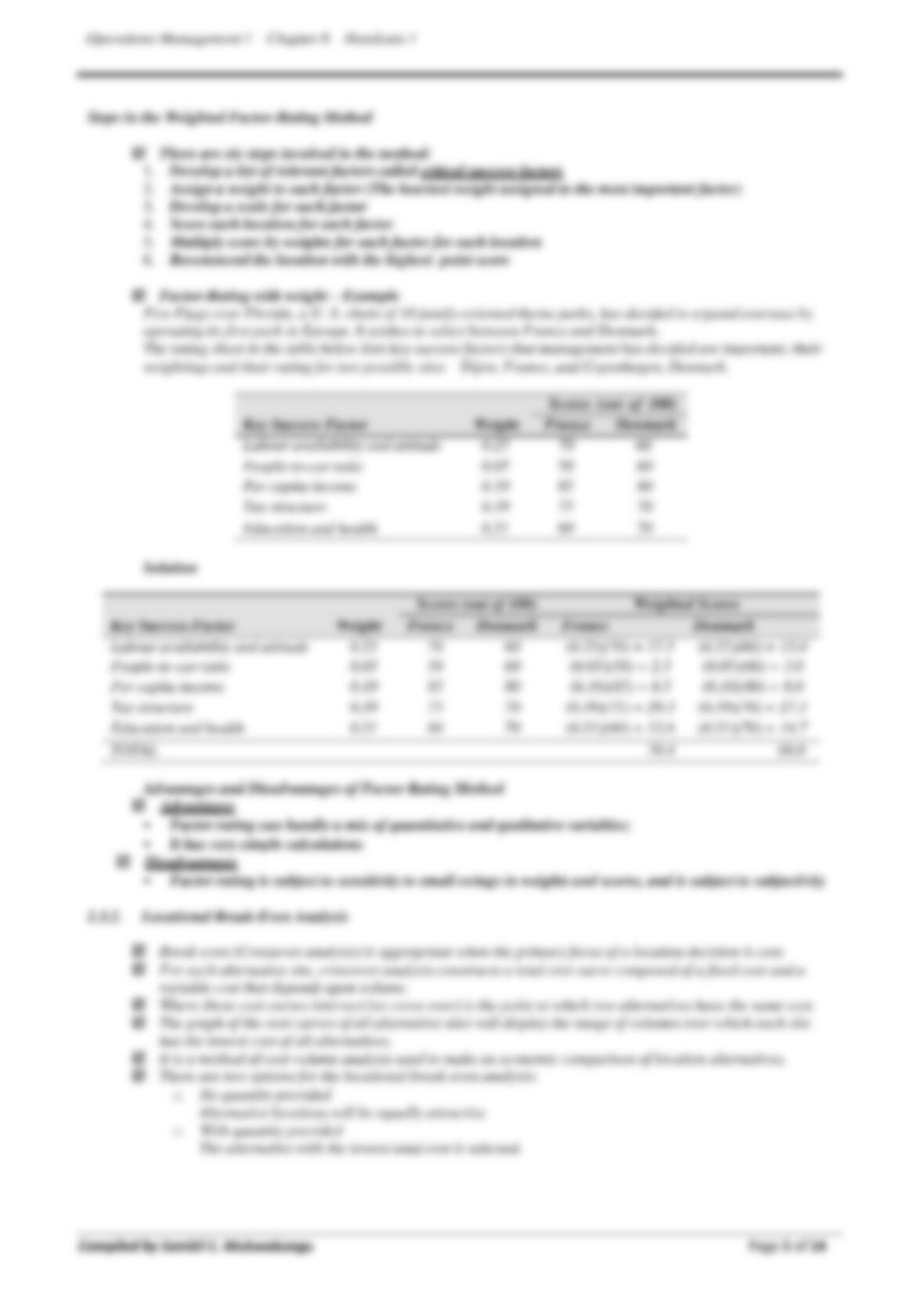
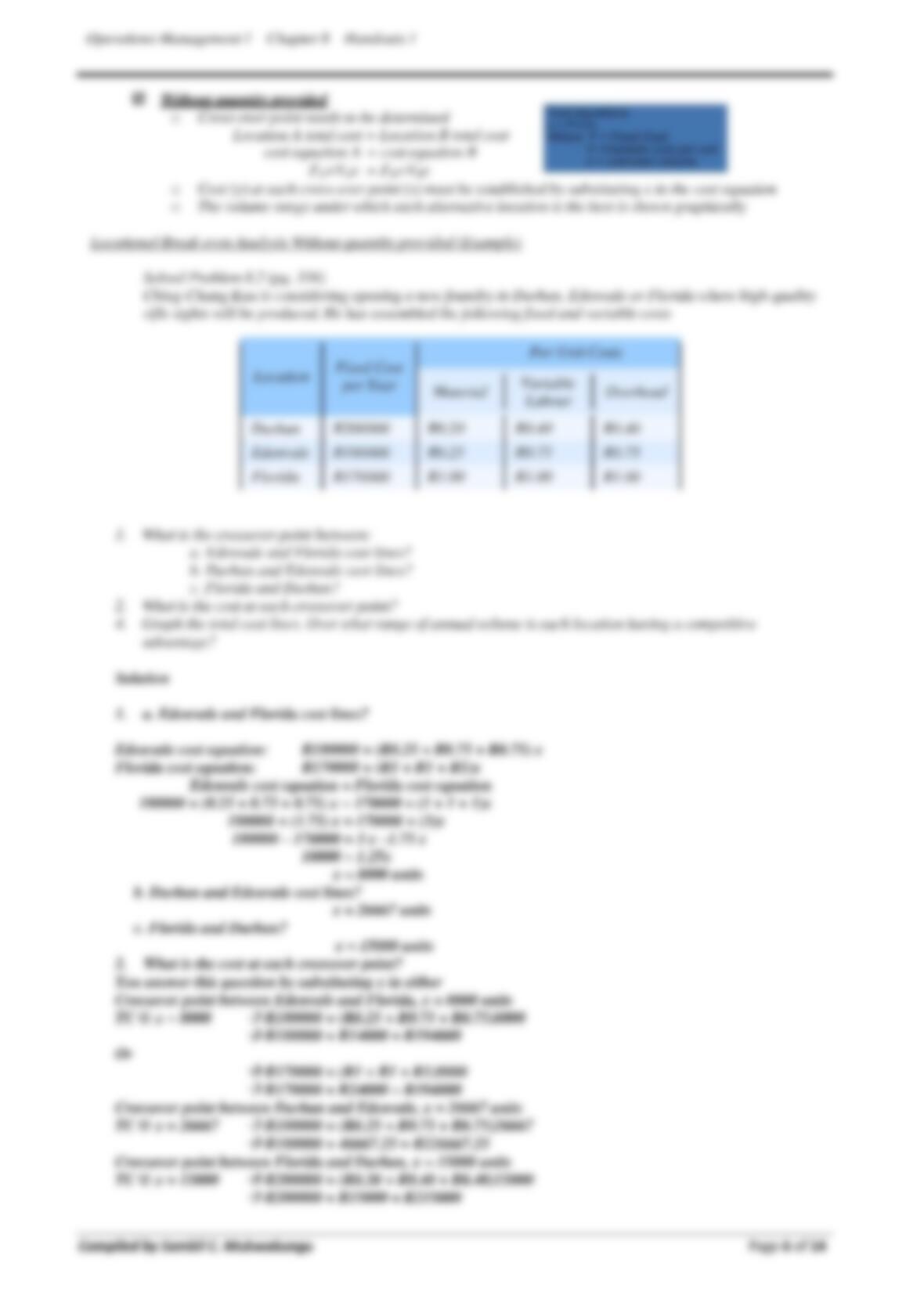
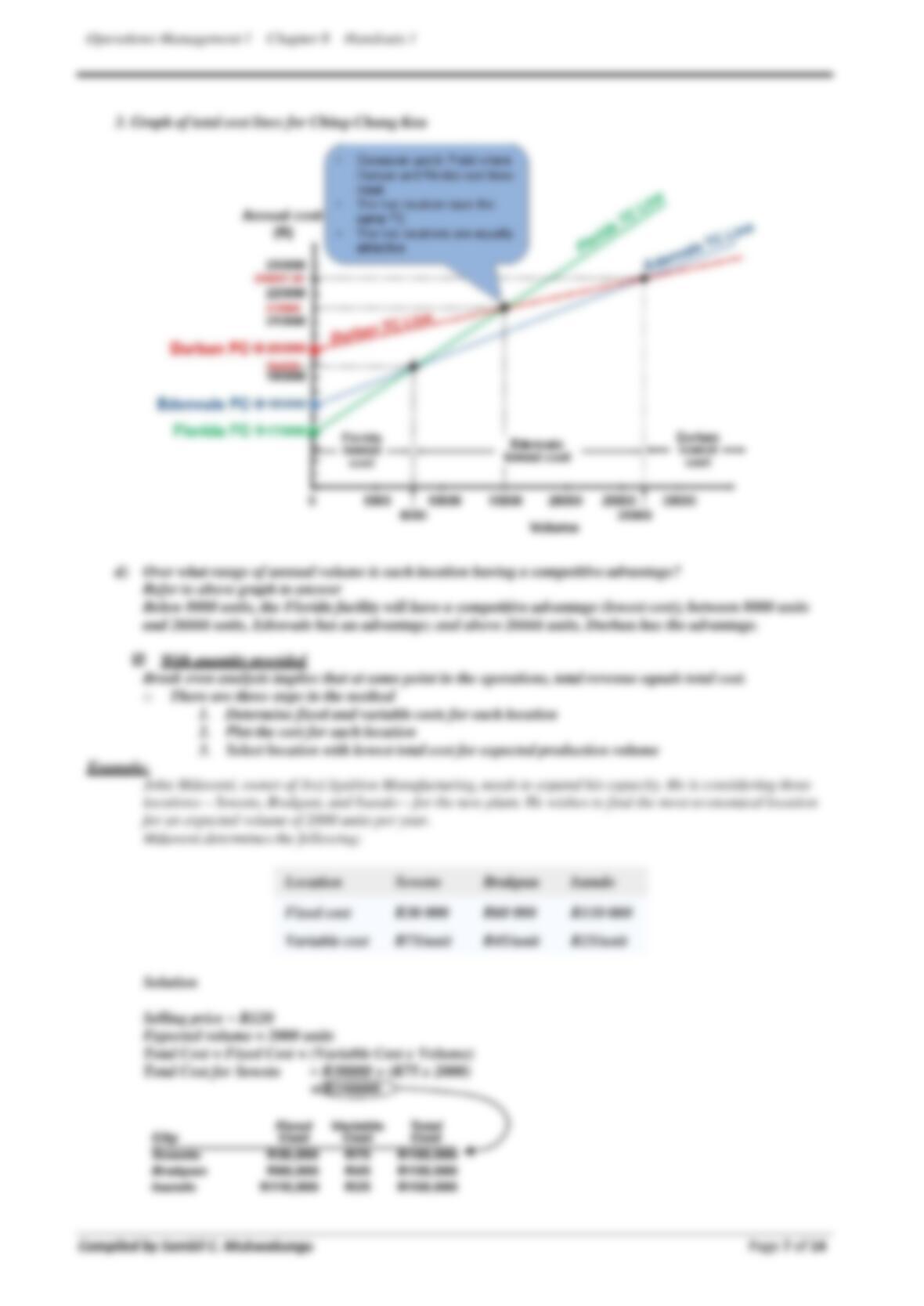
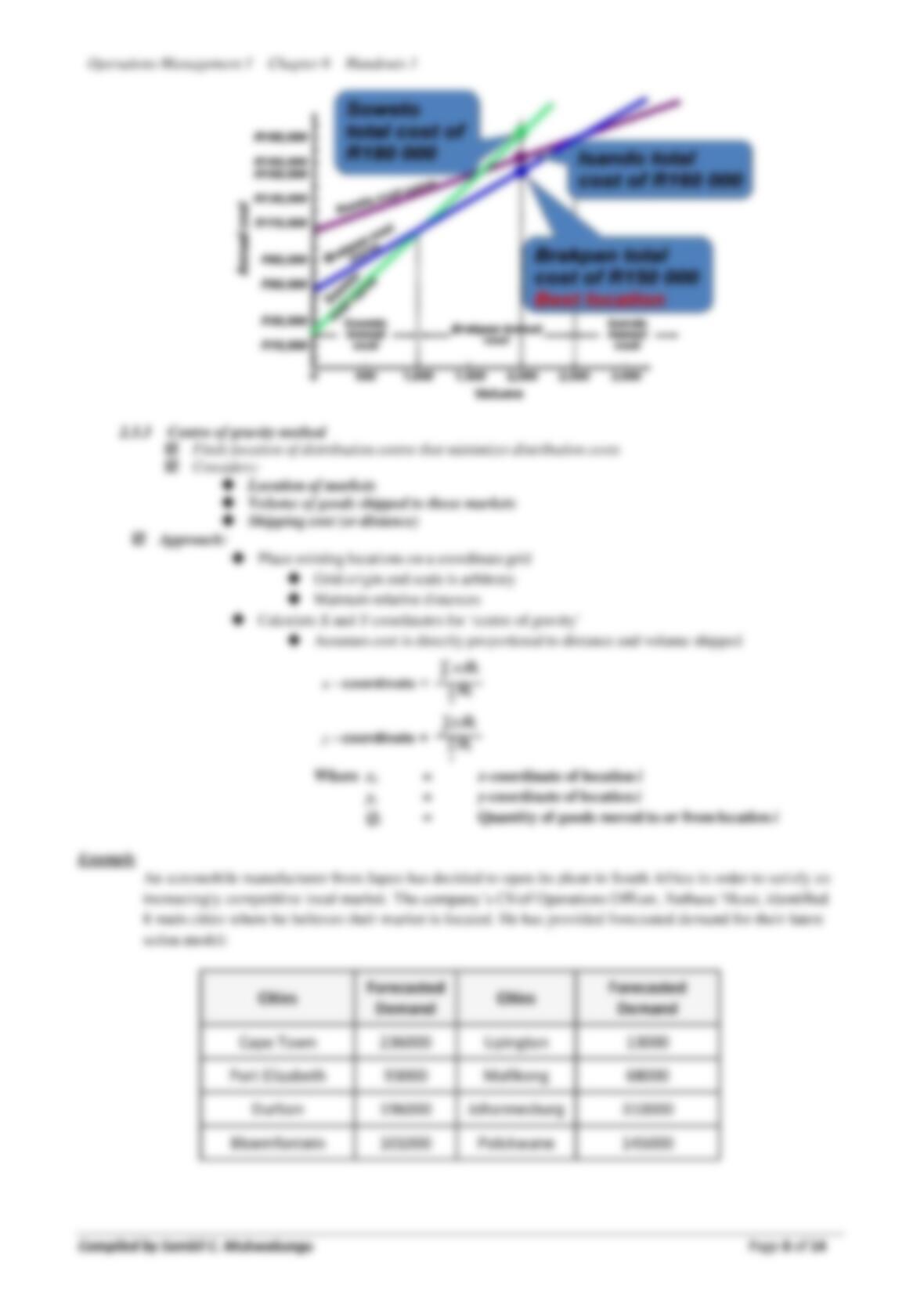
Manufacturing/Distribution
Service/Retail
Cost Focus
Revenue focus
Transportation modes/costs
Demographics: age, income, etc
Energy availability, costs
Population/drawing area
Labor cost/availability/skills
Competition
Building/leasing costs
Traffic volume/patterns
Customer access/parking
OPERATIONS MANAGEMENT 1 – HANDOUTS No
1
Chapter 8 – Location
Strategy
1. Strategic Importance of Layout Strategy
Why Location Strategy?
One of the most important decisions a firm makes
Before a location for a plant is selected, long range forecasts should be made anticipating future needs of the
company
Decisions made relatively infrequently
Significant impact on fixed and variable costs
• For industrial location decisions: the focus is frequently on minimizing cost
• Service location decisions: the focus on maximizing revenues.
The need for selecting a suitable location arises because of three situations:
1. When starting a new organisation, i.e., location choice for the first time.
2. In case of existing organisation, i.e. expansion.
3. In case of Global Location, i.e., going global.
Location decision depends on the type of business
The objective of the location strategy is to maximize the benefit of location to the firm
Comparison of Service and Manufacturing Considerations
Location decisions affect processes and departments:
• Marketing
• Human resources
• Accounting and finance
• Operations
• International operations
Critical success factors must be considered
3 levels of decision: country, regional, and site
Characteristics of location decision:
Long-term decisions
Decisions made infrequently
Decision greatly affects both fixed and variable costs
Once committed to a location, many resource and cost issues are difficult to change
Key attribute when strategy is based on innovation:
High-quality and specialized inputs
An environment that encourages investment and local rivalry
A sophisticated local market
Local presence of related and supporting industries
Operations Management 1 – Chapter 8 – Handouts 1
Compiled by Sambil C. Mukwakungu Page 2 of 14
2. Selecting the suitable location
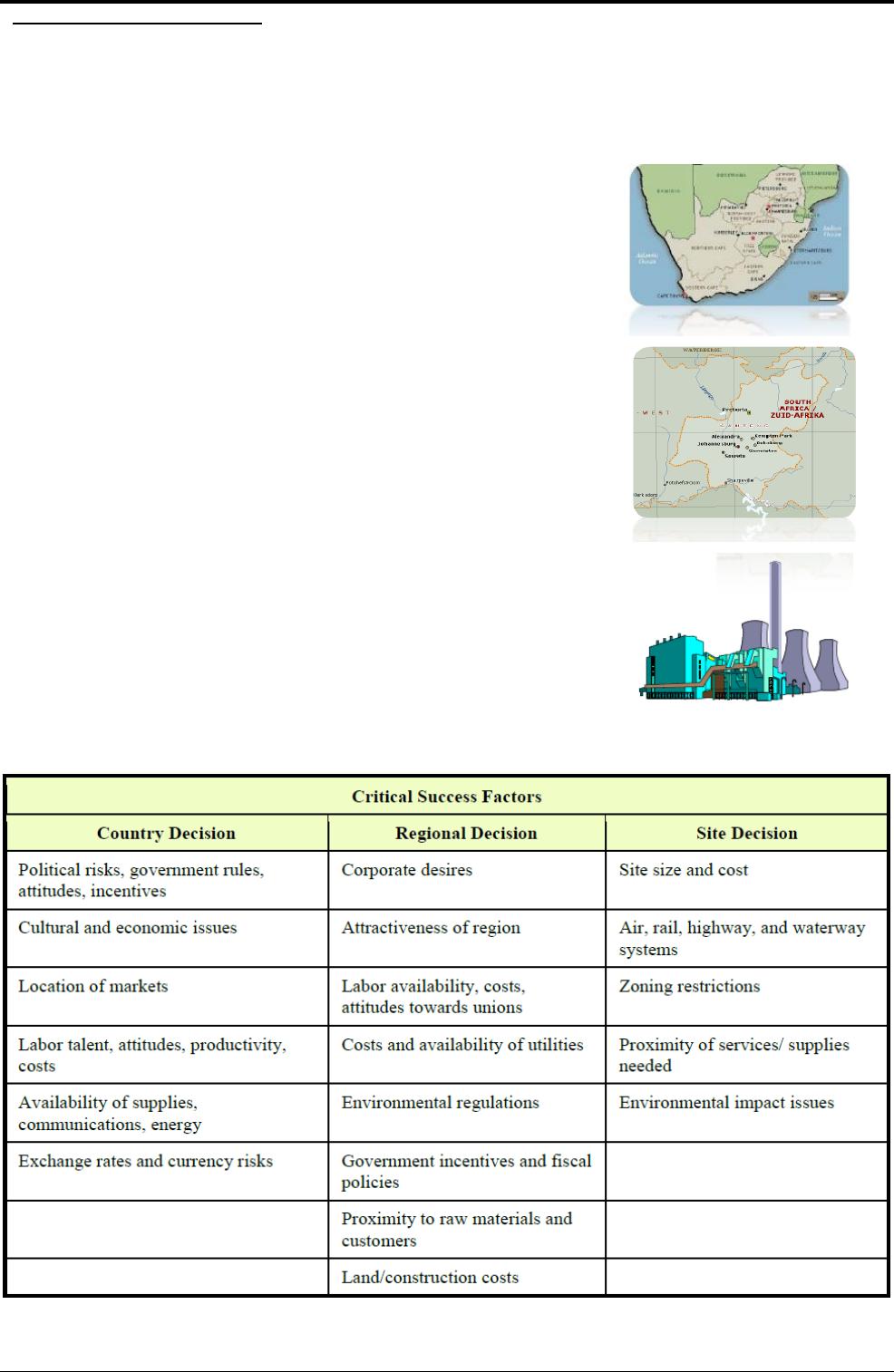
2.1. Critical Success Factors
Factors which need to be taken into account during the location decision process. These factors will determine
the success or failure of the organization. Let’s consider the three level of decision and their factors:
@ Country level
o Political risks, government rules, attitudes, incentives
o Cultural and economic issues
o Location of markets
o Labour talent, attitudes, productivity, costs
o Availability of supplies, communications, energy
o Exchange rates and currency risks
@ Regional level
o Corporate desires
o Attractiveness of region
o Labour availability, costs, attitudes towards unions
o Costs and availability of utilities
o Environmental regulations
o Government incentives and fiscal policies
o Proximity to raw materials and customers
o Land/construction costs
@ Site level
o Site size and cost
o Air, rail, highway, and waterway systems
o Zoning restrictions
o Proximity of services/ supplies needed
o Environmental impact issues
Summary of Critical Success Factors

Operations Management 1 – Chapter 8 – Handouts 1
Compiled by Sambil C. Mukwakungu Page 3 of 14
2.2. Factors That Affect Location Decisions
Location decisions for all types of organization are affected by seven factors which have been grouped in two
categories, controllable and uncontrollable factors:
Controllable Factors:
o Labour and wages (Labour Productivity)
Labour costs vary from one location to another
Wage rates are not the only cost
Lower productivity may increase total cost
It is always preferable to locate the plant in an area where skilled, semi-skilled, an unskilled
labour are available
It is also desirable to have no labour problem.
Location of facility will also depend on the prevalent wage rate, facilities for labour, history
of relationship between trade-union and management in the area under consideration.
o Proximity to Markets
Depending on the product/service
Need to provide goods and services at the right time and at reasonable price
Locating near to customers is the primary location factor for service organisations
Nearness to the market ensures a consistent supply of goods to customers and reduces the
cost of transportation.
Examples??? Hospital, police, pharmacy, banks…
Locating nearer to the market is preferred if
a) The products are delicate and susceptible to spoilage.
b) After sales services are promptly required very often.
c) Transportation cost is high and increase the cost significantly.
d) Shelf life of the product is low.
Many services must be close to their markets.
o Proximity to Suppliers
Very essential for the organization to get raw material in right qualities and time in order to
have an uninterrupted production.
Reasons to locate close to suppliers:
a) Perishability Bakeries, dairy plants need to be close to suppliers because they
process perishable raw materials
b) Transportation cost Steel producers using coal and iron need to transport
material in huge quantity
c) Bulk Large quantities of raw material need to be transported from the
suppliers to the plant.
o Proximity to Competitors (Clustering)
Called clustering
Occurs because of the presence of major resource in the region such as critical mass of
information, talent, venture capital, or natural resources.
Found in both manufacturing and service industries
Why clustering?
Because several firms close together create a larger total market than the same firms
separated.
Uncontrollable Factors:
o Exchange Rates and Currency Risks
Can have a significant impact on cost structure
Rates change over time
Kinds and amounts of taxes (e.g., excise duty, sales tax, income tax, etc.) levied by a state
should also be considered in locating a plant.
The kinds of taxes and the basis for fixing them should be investigated beforehand. Some
states and territories offer tax exemption for a stipulated period of time to attract the
investors to set up their plants to produce certain priority products.
o Costs
Tangible – readily identifiable and precisely measured costs such as utilities, labour,
materials, taxes
Intangible – less easy to quantify and include education, public transportation, community,
quality-of-life
o Political Risk, Values, and Culture
Associated with national, state, local governments attitudes toward private and intellectual
property, zoning, pollution, employment stability may change
Worker attitudes towards turnover, unions, absenteeism may vary from country to country
Globally cultures have different attitudes towards punctuality, legal, and ethical issues such
bribery which may affect your supply chain
Operations Management 1 – Chapter 8 – Handouts 1
2.3. Methods of evaluating location alternatives
Several methods exist which hep managers select the suitable location for their organisation
Factor-rating method*
Locational break-even analysis*
The centre-of-gravity method*
Transportation model
* Methods covered in this module
2.3.1. Factor-Rating Method
Many factors – qualitative and quantitative – to consider when choosing the location of a business.
Some factors are more important than others therefore managers will use weightings to make the decision
process more objective.
Factor-rating method is a popular method because a wide variety of factors can be included in the analysis.
Factor-rating method is a location method that adds gradually objectivity into the process of identifying hard–
to-evaluate costs.
Two factor rating methods exist – without and with weights
Steps in the Factor-Rating Method – Without
weights
There are six steps involved in the method:
1. Identify the important location factors.
2. Rate each factor according to its relative importance, i.e., higher the ratings is indicative of prominent
factor.
3. Assign each location according to the merits of the location for each factor.
4. Calculate the rating for each location by multiplying factor assigned to each location with basic factors
considered.
5. Find the sum of product calculated for each factor and select best location having highest total score.
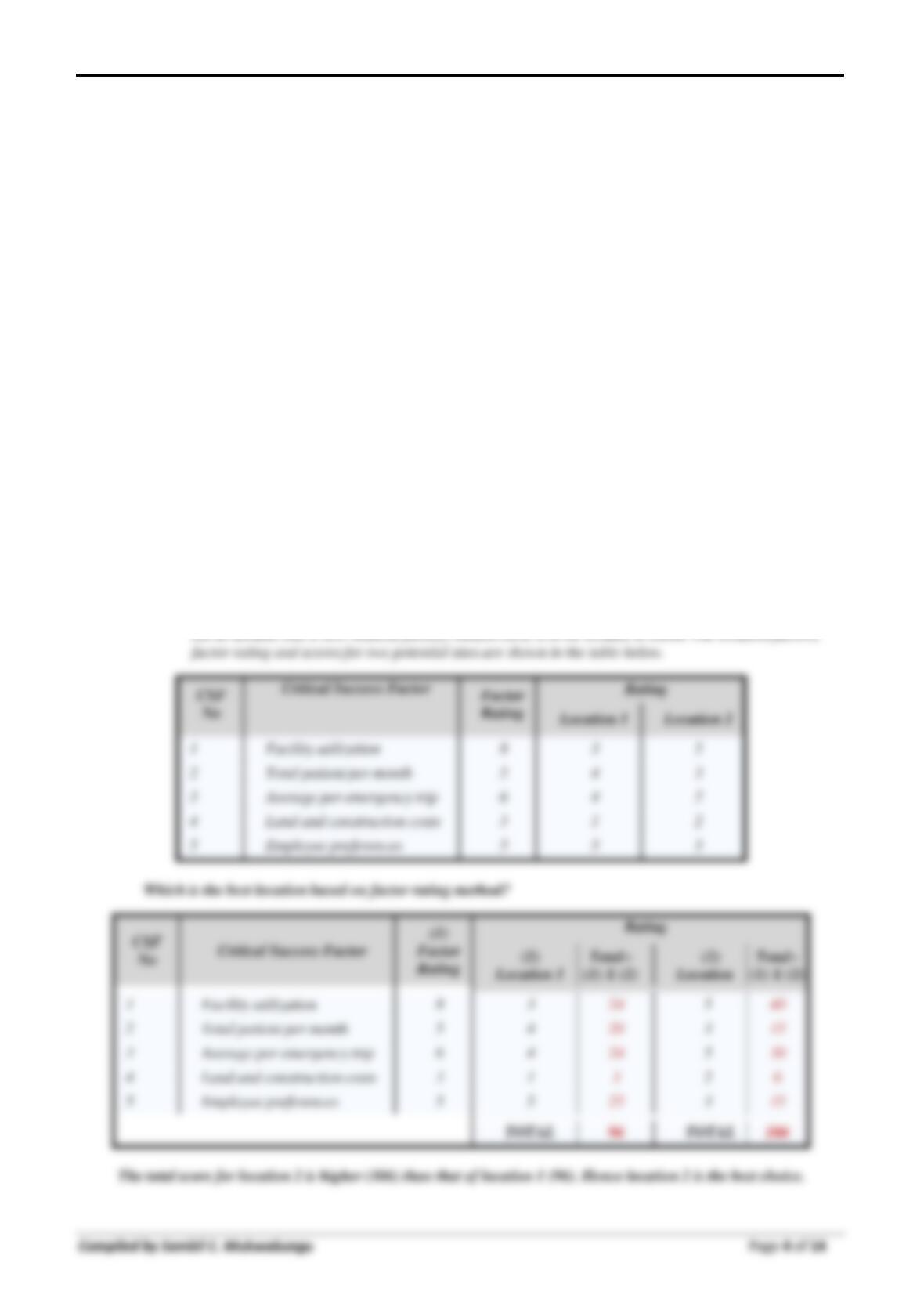
Factor-Rating without weight –
Example