a
ue
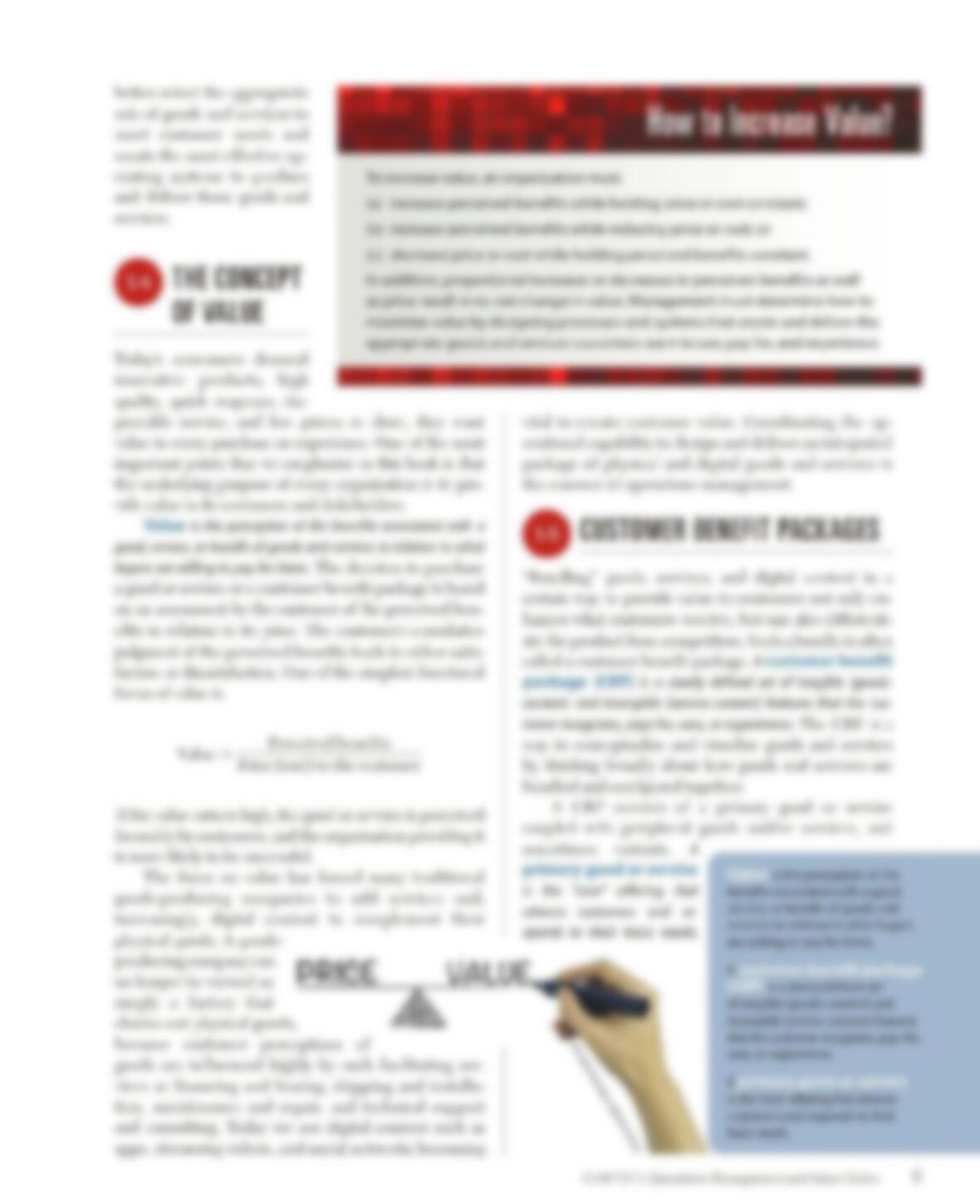
LEARNING
OBJECTIVES
After studying this
chapter,
you
sh
ould
be
ab
le to:
• Explain
the
concept
and
importance
of
operations
management
.
• Describe
what
operations
managers
do.
• Explain
the
differences
between
goods
and
services.
• Define
the
concept
of
value
and
explain
how
the
value
of
goods
and
services
can
be
enhanced.
After
you
finish
this chapter go
to
PAGE
26
for
STUDY
TOOLS
.
• Describe a
customer
benefit
package.
• Explain
the
difference
between
value
chains
and
supply
chains,
and
identify
three
general
types
of
processes
in
a
business
.
•
Contrast
the
three
different frameworks for
descnbing
value
chains.
e
Summarize
the
historical
development
of
OM.
Describe
key
challenges
facing
OM.
Apple h
as
mastered
the
art
of
blending physical
goods with services to
create
val
ue
for its
customers. Think iPod + iTunes, iPhone/iP
ad
+
apps, A
pp
le
st
ores + Genius Bar; well, you get
the
picture. M
anag
ing all
operat
ions
involved-f
rom
t
he
creation
of
goods a
nd
services
through
their
delivery to
the
customer
and
postsale
serv
ices–is
one
of
Ap
ple’s core competencies.
“Operations
expert
ise is
as
big
an
asset
for
Apple
as
product innovation
or
marketing,” says
Mike Fawkes,
the
former supply
chain
chief
at
Hewlett-Packard. “They’ve taken operational
excellence to a level never seen before
.”
Managers
and
engineers
often
work
at
global
supplier
and
manufacturer
sites to refine
their
operations,
and
designers work
with
suppliers
to
WHAT
DO
YOU
THINK?
create
new
tooling eq
uip
men
t.
When
the
iPad 2
debuted, Apple employees monitored every
handoff
point-supp
li
er
s, production, loading doc
k,
airport,
truck
depot,
and
distribution
cen
t
er-to
make
su
re
each
unit
was
accounted for
and
of
the
highest quali
ty
.
Apple’s retail stores give it a final operational
advantage. The company
can
track
d
emand
by
the
store a
nd
by
the
hour,
and
adj
ust
production
forecasts daily. lf it becomes
clear
that
a given
part
will
run
out,
teams
are
deployed
and
given
approval to spend millions
of
dollars
on
extra
equipment
Lo
undo
the
bottleneck. Apple’s
significant profit
margins
are
in
large
part
due
to
this
focus on its global supply
chain
and
operational excellence.1
Cite
some
other
examples
in
which
digital
content
has
been
combined
with a
physical
good
.
How
does
this
change
the
way
companies
must
manage
their
operations?
2
PA
RT
ON
E:
Basi
c
Co
ncepts of
OM
and Value
Cha
ins
OPERATIONS
MANAGEMENT
Cre
at
ing
anu
de
li
vering g
omls
and
servi
ces
to
cu
s
tom
ers
depe
nd
s 011 an cf
fc<.:t
ive
sy
st
em
of
linked t:tciliti
cs
and
pro
ces
s
es,
a
nd
lhc <thility
to
ma
na
ge
them
ef
fe
di
vely
aro
u
nd
the
wo
rld. Appl
e,
for exa
mpl
e,
mana
ges
a lar
ge,
gl
oba
ln
ctwo
rk
of
su
ppliers in
co
untJi
es
such
as Malaysia
a
nu
I
ndo
n
esia,
and factories in the U nit
cd
States,
Ch
ina,
am
l
other
co
u
ntries
to
pro
du
ce
its physical
goods,
wh
ich
must
be
coord
i
nated
with
the
de,·elopme
nt
and
produc-
tion
of
software
and
other
digital
content.
r
etail
sales,
and
service
and
suppo
r
t.
As
the
open
i
ng
anecdote
sug
–
gests,
coord
i
nating
these
goods-produc
i
ng
and
scn·
i
cc-
p
roviding
procc•sscs
can
he
challengi
ng. Operations
management
(OM)
is
the science
and
art
of
ensu
ri
ng
that
goods and
se
rv
ices
are created
and
delivered successfully to
customer
s.
OM i
ncludes
t
he
des
ign
of
go
od
s,
services
, and
the
pr
oc(‘SSCs th
at
crea
te
them; the day-
to-d
oty
11
u
11
w
ge-
lll
~ml
of those
pr
ocesses;
and
the
co
ntinua
l
imp
rove
men t
o
-f
th
ese
goo
d
s,
se
rvi
ces,
a
nd
pro
cesse
s.
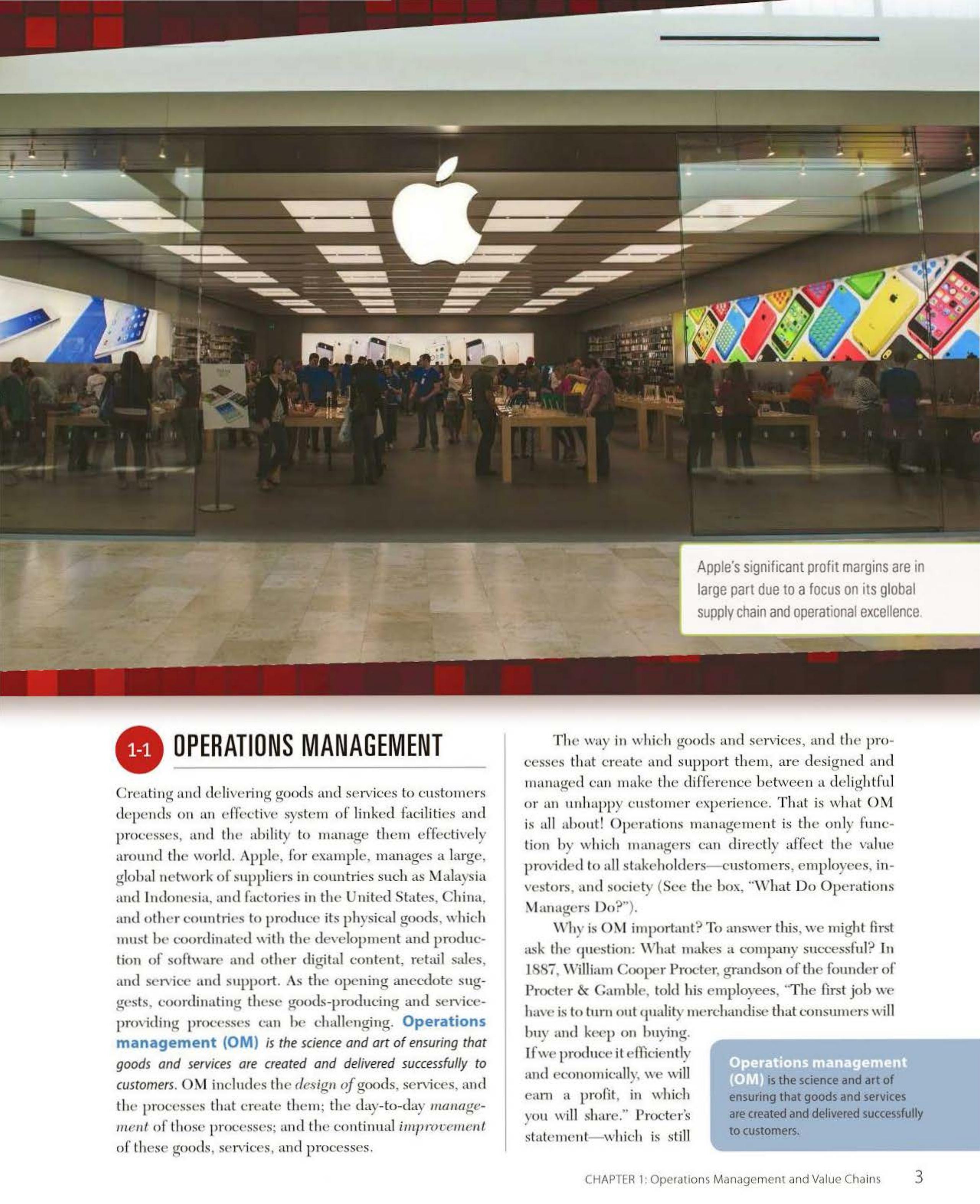
App
l
e’s
si
gnificant
profit
margins
are
in
large
part
due
to
a
focus
on
its
global
supply
chain
and
operational
excellence
Th
o
wa
y in which g
ood
s and
se
rvices, and the
pro
–
cesses
that
cr
ea
te a
nd
support
th
e
m,
ar
e de
si
gned .
and
mana
ge
d can
rn
ake the
diff
ere
nc
e
betw
ee
n a deliglltful
or an ttnhappy c usto
me
r experie
nc
e. T
hat
is w
hat
OM
is all a
bou
t!
Op
e
rat
i
ons
111ana
gc
me
nt
i~
the
on
ly Func–
ti
on
by
which
nu
m
age
rs
ca
n dir
ect
ly
af
f
ect
the v
al11
e
pr
ovided
to a
ll
st
ake
hol
de
rs– cu
stome
rs,
emp
l
oyees,
in–
vesto
rs, and
society
(
Sec
th
e box,
”W
hat
D o O
pera
ti
ons
M
anagcrs
Do?”).
\Vhy
is
O M
impo
r
tant?
To
answe
r this,
we
miuht
fi
r
st
(:>
ask the question: \ Vhat
makes
a
company
successful? In
1887, \
ViJ
liam
Cooper
Procter
,
grandson
of
the
founder
of
Procter
&
Gamble
, told
hjs
employees,
“T
he
first
job
we
have is
to
turn
out
cpu1lity
me
r
chandise
th
at
consume
rs ·
wi
ll
buy
and
keep
on buying.
l f
we
pr
od
u
ce
il
efficiently
and
eco
nom
ically,
we
will
earn
a pro
fl
t, in
whk
h
you
wi
ll share.”
Pr
oc
ter‘s
slat
emc
nl
– which is still
•
is
the science and art of
ensuring that goods and services
are created and delivered
successfully
to customers.
CHAPTER
1:
Operations Management and
Value
Cha
i
ns
3
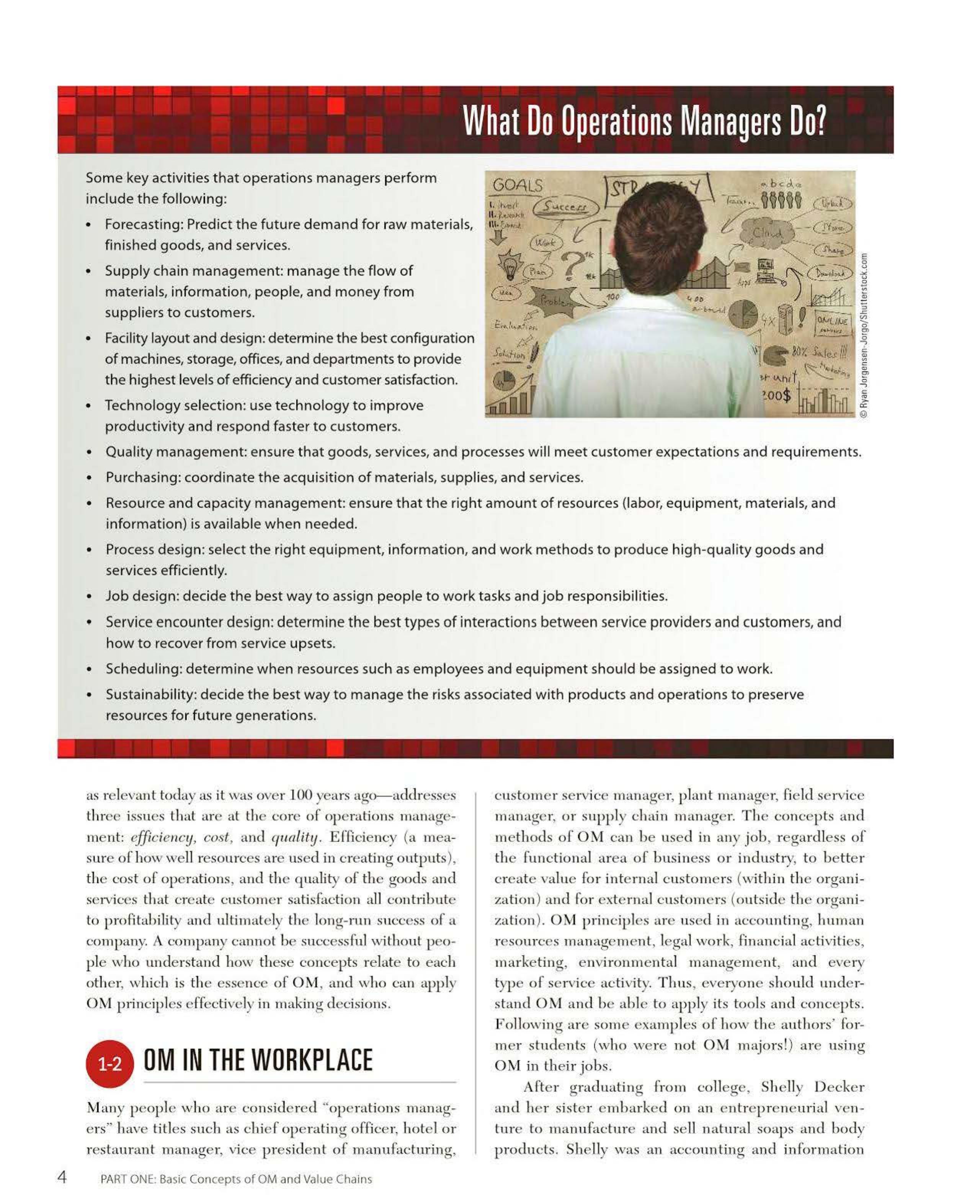
Some
key activities
that
operation
s
manager
s
perform
include
the
following:
o Forecasting: Predict
the
future
demand
for raw
mate
rial
s,
finished
goods,
and
services.
o Supply chain
management:
manag
e
the
flow
of
materia
ls
, information,
people,
and
money
from
suppliers
to
customers.
o Facility layout
and
de
sign:
determine
the
best
configuration
of
machine
s,
storage, offices,
and
de
partm
ents
to
provide
the
highest levels
of
efficiency
and
customer satisfaction.
o Technol
ogy
selection: use
techno
l
ogy
to
improve
produ
ctivity
and
respond fa
ster
to
cust
omers
.
o Quality
management:
ensure
that
goods,
services,
and
processes will
meet
custom
er e
xpectations
and
requirements.
o Purchasing:
coordinate
the
acquisi
tion
of
materials, supplies,
and
services.
o Resource
and
capacity
managem
ent:
ensure
that
the
right
amount
of
resources
(l
abo
r,
equipm
e
nt
, materials,
and
information)
is
available
when
ne
e
ded.
o Process
design
:
select
t
he
right
equ
i
pment,
information,
and
work me
thod
s
to
produ
ce
high-qua
li
ty
good
s
and
services efficientl
y.
o
Job
design
:
decide
the
best
way
to
assign
peop
le
to
work tasks
and
job
responsibilities.
•
Service
encounter
de
sign: determine the
be
st types
of
interactions betwe
en
ser
v
ice
providers a
nd
customers,
an
d
how
to
re
cov
er from service
ups
ets.
o Scheduling:
determine
when
resources
such
as
employees
and
equipment
shou
ld
be
assigned
to
work.
o Sustainability:
decide
the
best
way
to
manage
the
risks associated with
produc
ts
and
operations
to
preserve
resources for future generations.
as releva
nt
today
as
it was over
10
0 years
ago-add
resses
thr
ee
issues
that
arc at the
co
re of
op e
rat
i
o
n
~
manage-
men
t:
e
ffici
ency, cost, and qua
l-
ity. EHlciency (a
mea
–
s
ur
e
of
h
ow
wel
l resources are u
sed
in
crea
ting out
pu
ts),
the cost
of
ope
rations,
and
the quality
of
the
goods
and
services
that
cre
at
e customer sa
ti
sfaction a
ll
con
tr
ibute
to profitabi
li
ty and ultimately the long-run success
of
a
company. A company cannot be success
ful
without
peo
–
ple w
ho
understand
ho
w t
hese
co
ncepts relate
to
each
other, which is the essence
of
OM
,
and
who can apply
OM principles e
ff
ectively in ma
ki
ng
decisions.
OM
IN
THE
WORKPLACE
Many pe
ople
who
ar
e considered “
ope
rations man ag-
ers” have titles such as
ch
ief
op
erating officer,
hot
el or
restaurant
manager
, vice
pr
esid
en
t
of
manufacturing,
4
PA
RT
ON
E:
Basic
C
on
cepts
of
OM
and Value
Cha
in
s
custome r service
manag
er,
plant
manag
er, fi
eld
servi
ce
mana
ger, or supply chain
manag
e
r.
Th
e
conc
epts
and
me
thod
s
of
OM can
be
used
in any
job
,
regard
le
ss
of
t
he
func
ti
onal ar
ea
of
bus
iness or i
ndust
r
y,
to
be
tter
‘
creat
e value for
int
ernal customers (within the organ
i-
za
ti
on)
and
f
or
external
cu
sto
rn
ers (
ou
tside the organi–
zation). OM prineiples
ar
e used in accounting,
huma
n
re
sou
rces manageme
nt
, legal work, financi
al
act
i
vit
ies,
marke
ti
ng, envir
onmen
tal
managemen
t, and every
type
of
servi
ce
ac
ti
vity. T
hu
s, every
on
e sh
ou
ld
und
e
r-
s
tand
OM
and be
able
to
ap
ply its tools a
nd
con
cepts
.
Fo
ll
ow
i
ng
are some examples
of
hovv
th<
~
authors
‘ f
or
–
mer
students
(who were
not
OM
ma
j
or
s!)
are
using
OM in
their
jobs.
After gr
adua
ting from co
ll
ege,
Shelly Decker
and
her sister e
mba
rked on an e
nt
repre neurial ven–
tur
e to
manufactur
e
and
se
ll
n
at
ural soaps
and
body
products
. Shelly was
an
accounting
and
information
syst
ems
major
in
college,
but
she
was
using
OM
skills
eve
ry
day
:
..,..
Process d
es
i
gn
: vV
hen
a n
ew
product
was
to
be
introduc
ed, the b
es
t
way
to pr
oduc
e it h
ad
to be
determined.
This
involved
chart
i
ng
the
d
eta
iled
steps
needed
to
make
the
product.
I
nven
tory management:
Inv
en
tor
y was ti
ghtly
cont
ro
ll
ed
to
keep c
ost
down
and
to avoid
production
that
wasn’t
n
eede
d.
Inv
ento
ry was
tak
en
eve
ry
four
w
eeks
a
nd
ad
jus
ted
in
t
he
inv
ent01y
managemen
t
system
according
l
y.
Scheduling:
Producti
on sche
dules
were
creat
ed
to e
nsure
that
e
nough
product
was available
for
both
retail
and
wholesal
e cu
stomer
s, taking
into
ac
count
such
facto
rs
as
current
invent01y
and
soap
produc
tio
n
capacity
.
Qual
it
y management:
Each
p
rodu
ct
was
inspected
a
nd
had
to
conform
to
th
e
high
e
st
quality
standards.
If
a
produ
ct
did
not
conform
to
standards
(e
.g.,
wrong
color,
improp
er
packaging
,
improp
er labelin
g,
impro
p
er
weigh
t,
si
ze
,
or
sh
ape
), it was removed from
in
ven
tor
y to
de
termine
where
the
proc
ess
brok
e
down
an
d to
initiate
correc
ti
ve
action .
Withou
t
an
und
erst
an
din
g
of
OM
, the
compan
y
would
ne
ve
r
ha
ve
go
tt
en
off
th
e gr
ound!
Torn James s
tart
ed
as
a senior so
ftv;
r
ar
e developer for
a small sofru,
arc
develop
rn
e
nt
company
that
creates sales
pr
oposa
l automation software. Ton1 uses
OM
skills in deal–
ing
with
quality
and
c
ustom
er service is
su
es
relat
ed to
the
soft\
x.ra
re
produ
cts,
and
he is also extensi
ve
ly involved in
project mana
gemen
t
ac
tivities related
to
the devel
opmen
t
proc
ess, including ide
nt
ifying
t<Lsks
, assigning
dev
el
op
ers
to
ta
s
ks
, estimating the time
and
cost to
comp
l
ete
pro
jects,
and
studying
th
e variance b
etween
the
estimate
d and
actua
l
time
it
took
to
comp
lete
the
project. H e is also in-
vo
lved in continuous irnprove
rn
e
nt
proj
e,.:
cts;
for
exampl
e,
he s
ee
ks
to re
duc
e dev
el
opm
e
nt
time
and
in
cr
ea
se
th
e ef–
ficie
ncy
of
the devel
opm
e
nt
t
eam
.
Tom
was
an
information
techno
logy
and
mana
gem
ent
major
in
college.
Brooke
vVils
on
b
egan
as a
process
manager
for
JPM
organ
Chas
e in the
credit
card
division. After several
United
Performance
Metals:
The
Life
of
an
Operations
Manager
Un
i
ted
Performance
Metals, formerly
known
as Ferguson Metal
s,
located in Hamil
ton
, Ohio,
is
a
suppl
i
er
of
stainless
stee
l
and
hi
gh-temperature
alloys for the
specia
l
ty
metal
market
.
Fe
r
guson’s
primary
pr
oduct
i
on
operat
i
ons
include
slitting coil
stock
and
cutting
sh
eet
stee
l
to
customer
specifications with rapid
turnar
o
und
times
from
order
to
delivery.
With
on
ly
78
emp
loy
ees,
about
ha
lf
of
whom
are
in
operations,
the
director
of
operations
and
q
ua
lity
is
involved in a
variety
of
daily
ac
t
iv
ities t
hat
draw
upon
knowle
dg
e
of
not
on
ly
OM
and
engineering,
but
also finance, acc
oun
ting,
organizational behavior,
and
other
subjects.
He
typically
spends
about
50
percent
of
his ti
me
working with foremen,
supervisors,
salespeople,
and
other
staff discussing
such
issues as
whether
or
not
the
company
has
the
capabi
li
ty
to
accomp
li
sh
a
spe
cific
customer
request,
as
well as ro
ut
i
ne
production,
qual
ity,
and
shipping
issues.
Th
e remai
nder
of
hi
s
time
is
spe
nt
inve
stigat
ing
such
issues as
the
tec
hn
ical feasibility
and
cost
i
mp
lications
of
new
capital
equipment
or
changes
to
exist
ing
pr
ocess
es, trying
to
reduc
e costs,
seeking
and
facilitating
design
imp
r
ov
eme
nts
on
the
shop
floor,
and
motivating
the
workforce. T
he
ability
to
understand
customer
needs,
motivate
employees,
work with
other
departments,
and
i
ntegrate
processes
and
technology
are
ski
lls
that
all
operations
managers
need.
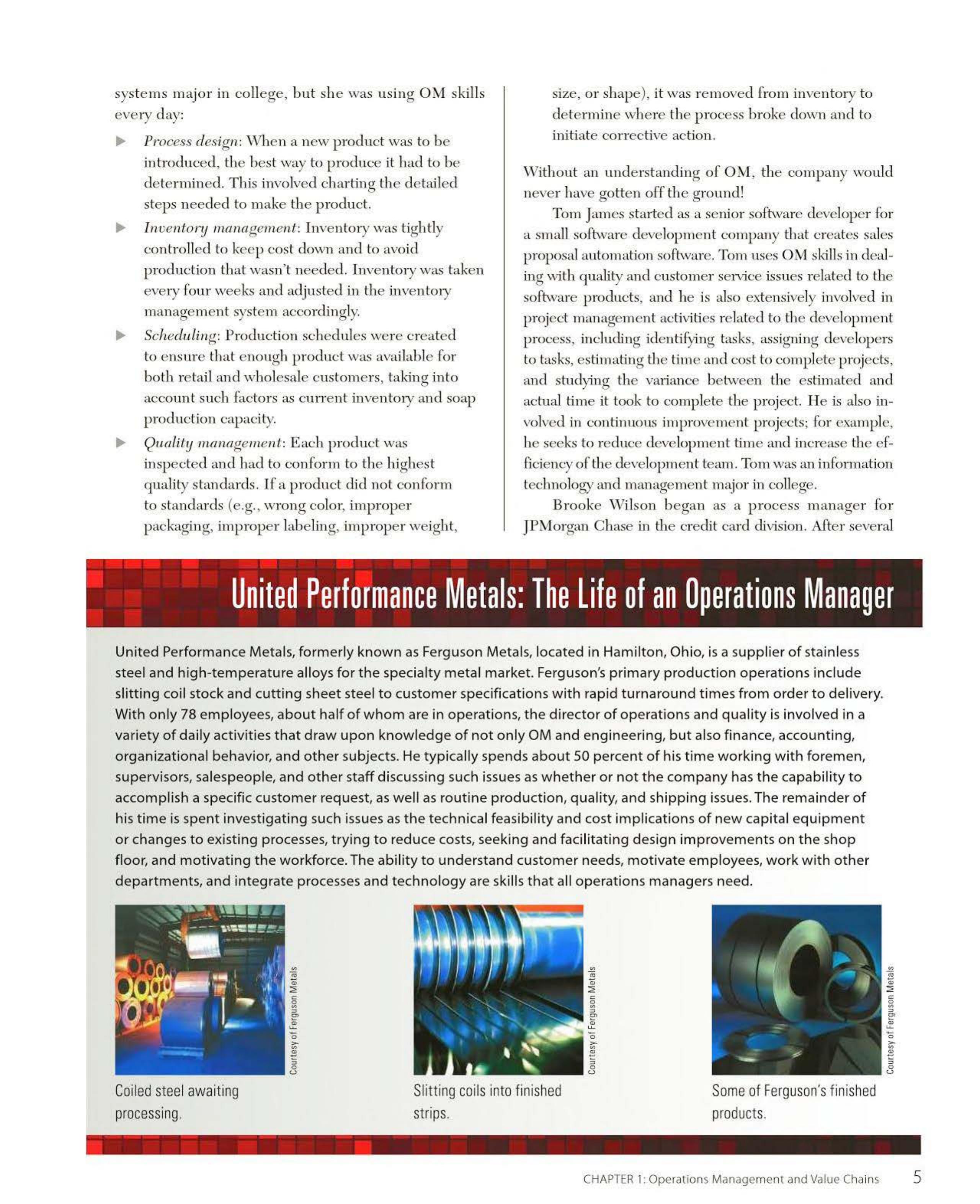
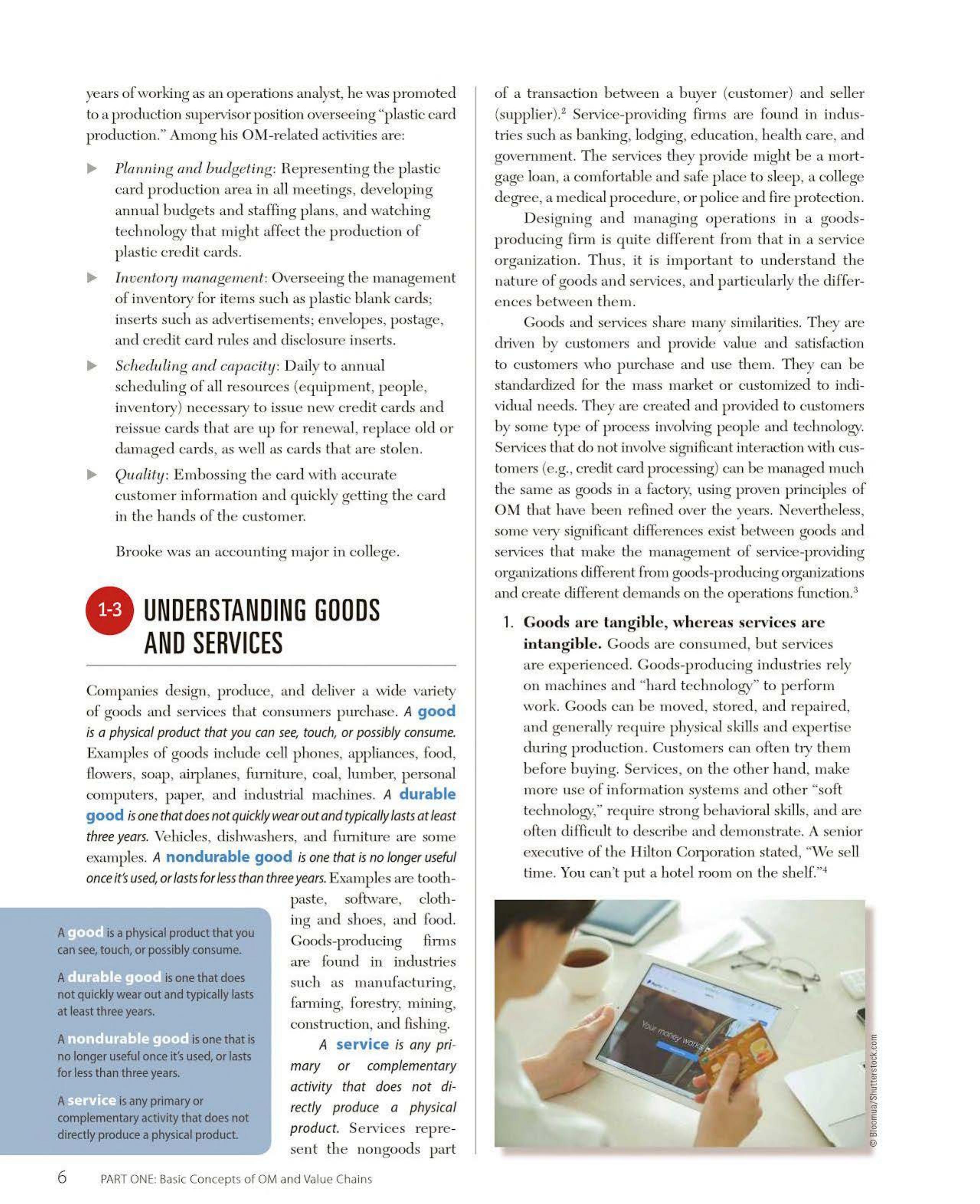
C
oiled
st
ee
l
await
i
ng
.
pr
ocess
1ng
.
Sl
itti
ng
co
il
s in
to
fini
shed
stri
ps.
Some
of F
erg
uson’
s
fin
i
shed
pr
oducts
.
CHAPT
ER
1: Operations Managemem and
Value
Cha
ins 5
years
of
working
as
an operations anal
ys
t, he was
promoted
to a production supervisor position overs
ee
in
g “plastic card
production.” Among his
OM
–related activities
are
:
Planning
and
budg
eting: He
pr
ese
nting
the plastic
card
produclion
area
in
all meetings, developing
annua
l
budg
ets
and
staffing plans,
and
watching
t
ec
hnology
that
mi
ght
affect the
produdion
of
plastic
cr
e
dit
cards.
Inventory manageme
nt
:
Ov
e
rs
eeing
th
e management
of
inventory for it
ems
such
as
plastic blank
ca
rds;
inserts such as advertisements; envelopes, postage,
and
credit
card
r
ul
es
and
disclosure
i
nst
~
rts.
Scheduling
and
capacit:y:
Dail
y to annual
scheduling
of
all resources
(equipmen
t,
people
,
in
ventor
y)
necessary
to
issue new credit
cards
and
reissue
ca
rds
th
at
arc
up
for ren
ewa
l, replace old or
damag
ed
ca
rds,
as
well as
cards
that
are stolen.
Quality: Embossing the
card
with accurate
customer information
and
quickly
gett
ing t
he
card
in
the
hands
of
the
customer
.
Brooke was
an
accounli.ng
major
in college.
UNDERSTANDING
GOODS
AND
SERVIC
ES
Companies design,
produce
,
and
deliver a \\•
id
e va
ri
ety
of
goods
and
services that con
sum
ers purchase. A good
is
a
phys
ical
product
that
you
can
see
,
touch,
or
possibly
consume.
Examples
of
goods include
ce
ll
phon
es, apphances, food,
flowers, soap, airplanes, furniture, coal, lumber, personal
comput
er
s,
paper
, and industrial machines. A durable
good
is
one
that
does
not
quickly
wear
out
and
typically
lasts
at
lea
st
three
years
. Vehicles, dishwashers,
and
fumit
ur
e
ar
e some
examples. A nondurable good
is
one
that
is
no
longe
r
usefu
l
once
it’s
us
ed,
or
lasts
for
less
than
three
years
. Examples are tooth–
A • • • •
is
a
physical
product that
you
can
see,
touch, or
possib
ly
consume.
A • . • • • • • •
is
one
that
does
not quickly
wear
out
and
typically
lasts
at
least
three
years.
no longer
usefu
I
once
it’s
used,
or
lasts
for
less
than
three
years
.
A · •
is
any
primary or
complementary activity that
does
not
directly produce a
physical
product.
paste, software, cloth-
ing
and
shoe
s,
and
food.
Goods–producing
:6.m1s
are found in industlies
such
as
manufacturing
,
farming, fore
shy
, mining,
con
stmction,
and
fi
shing.
A service
is
any
pri
–
mary
or
complementa
ry
activity
tha
t
does
not
di
–
rect
ly
produce
a
physical
product.
Services
re
pre
–
sent
the
nongoods
part
6
PA
RT
ON
E:
Basic
Con
cepts
of
OM
and
Value
Cha
in
s
of
a transaction
betwe
en a
buyer
(
customer
)
and
seller
(supplier).2 Service-providing firms are found
in
indus-
tri
es
such as banking, lodging, education, health care,
and
gov
ern
ment.
The
services
th
ey
provide might be a
mOlt
–
gage loan, a comfortable
and
safe pl
ace
to sleep, a college
d
eg
r
ee
, a
med
ical procedure,
or
po
li
ce
and
fire protection.
Designi
ng
and
managing
op
er
at
i
ons
in a goods–
producing
f
inn
is
quite
di11’erent fi-om
that
in
a service
organization.
Thus
,
it
is
important
to
unders
t
and
th
e
nature
of
goo
ds
and
services,
and
particularly t
he
differ
–
enc
es
betv
vee
n t
hem
.
Goods
and
services share many sirnihui
ti
e
s.
Th
ey
ar
e
d1iv
en
by
customers
and
provide value
and
satist
~1C
tion
to customers
who
purchase
and
us
e
th
e
m.
Th
ey
can
be
standardized for
the
mass
ma
rket
or
customized to indi-
vidual needs.
They
are created
and
provided to customers
by some type
of
proc
es
s involving people
and
t
ec
hn
ology.
Setvices that do not involve signincan t interacl
io
n with cus–
tomers
(e
.g., credit card processing) can be managed much
the
same
as
goods in a
fact01y,
using
pro
ven principles
of
OM
that have
be
en r
d1ned
over the years. Nevertheless,
sorne vmy significant differences exist betw
ee
n goods
and
se
1vi
.ces that make
the
manag
eme
nt
of
service-providing
organizations differe
nt
from goods–producing organizations
and
cr
ea
te different d
ema
nds
on
the
operations function.3
1.
Goods
are
ta
ngibl
e,
wh
ereas
sen·
i
ces
a
r·
e
i
ntangible.
Goods
ar
e
consum
ed,
bu
t se1vices
are
ex
perienced
. Goods–pr
oducing
industries rely
on machines
and
“
hard
t
echno
l
og
y” to pe1form
work. Goods can be move
d,
:;tm·ed,
and
r
epair
ed,
and
gene
r
a.lly
re
qu
ire physical skj
Ji
s
and
e
xp
e
rti~
e
dUJing
producl
ion.
Custom
ers
can
often
hy
them
before
buying
. Services, on the
othe
r
hand,
make
mor
e use
of
information systems
and
oth
er “
soft
technology,” re<Juire strong behavioral skills,
and
arc
often d
if
ficult to desc
li
be
and
de
monstrat
e. A senior
executive
of
the Hilton Corporation stated, “We
se
ll
time.
You
can’t
put
a
hotel
room
on
the
shelf.”4
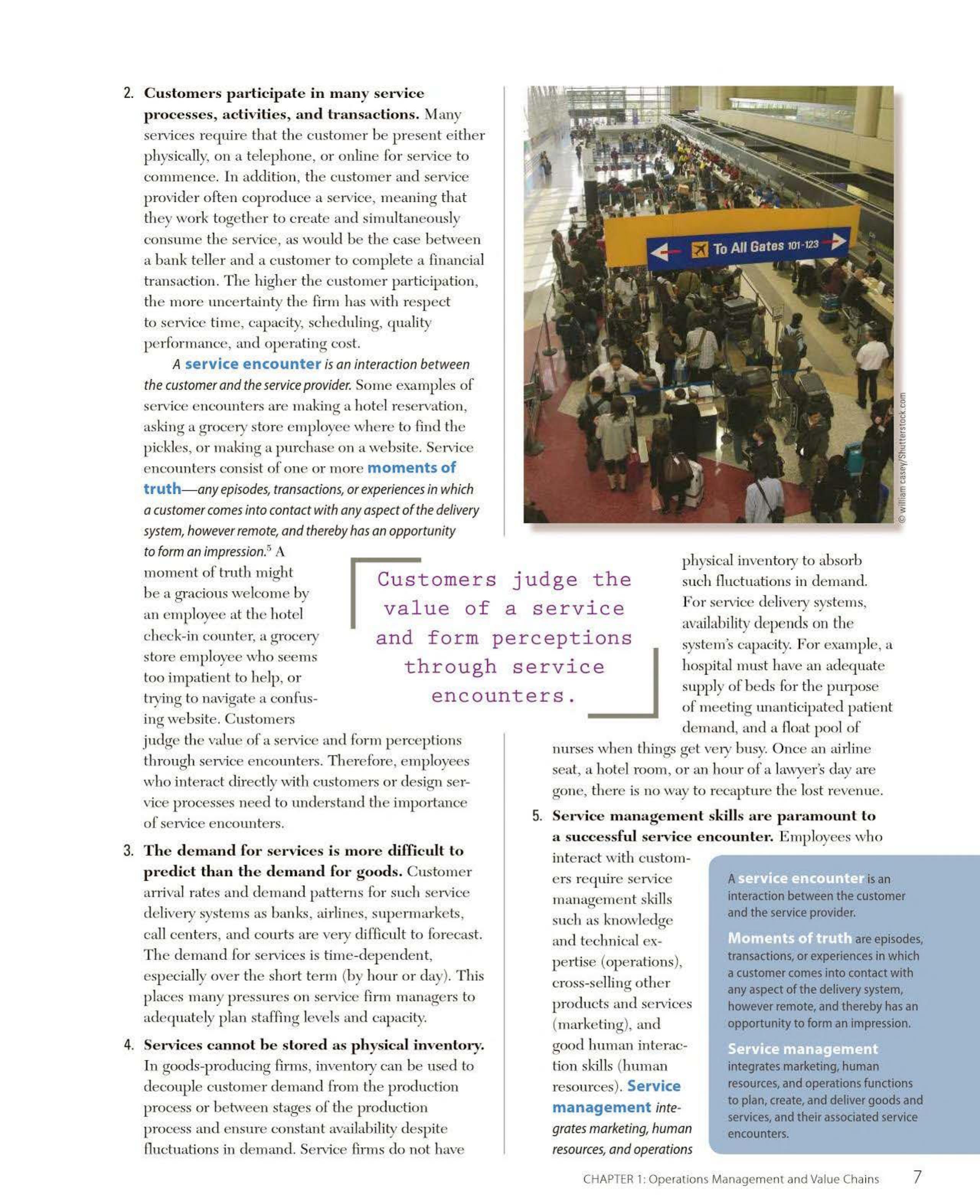
2. Cus
tom
ers pa
rti
ci
p at e
in
many servi
ce
pr
ocesses
,
ac
ti
vi
ti
es,
a
nd
tr
an
sactio
ns.
Many
services
requir
e
that
the
customer
be
pres
en
t
either
physically,
on
a
telep
h
one
,
or
on
li
ne
for service to
commence
.
In
ad
di
tion,
the
cust
omer
and
service
prov
id
er
of
t
en
cop
ro
du
ce
a
se
rvi
ce
, meaning t
hat
th
ey
wo
rk
tog
ether to cr
eate
and
si
mu
ltaneously
consume
the service,
as
wou
ld be
the
case
betw
ee
n
a
bank
teller
and
a
customer
to
comple
te a financial
transaction.
The
higher
the
cust
ome
r
par
ticipation,
the
mo
re uncertainty t
he
fim1 has with r
espect
to
se
rvice time, ca
pac
it
y,
scheJul
ing, quality
performan
ce
,
and
op
erating cost.
A
service
encounter
is
an
inte
ra
ct
io
n between
t
he
custo
m
er
and
the
serv
ic
e
provider.
Some
examples
of
servi
ce
encoun
te
rs are making a
ho
tel reservation,
asking a groce‘)‘ store employ
ee
where to fi
nd
the
pickles, or making a
pu
rchase
on
a website. Service
e
ncounte
rs consist
of
on
e
or
more
moments
of
truth
-an
y
episodes,
tran
s
actions,
or
ex
pe
ri
en
c
es
in
whi
ch
a
customer
comes
into
contact
with
any
aspe
ct
of
the
del
i
very
system
,
however
remote
, and
thereb
y
has
an
opportunity
to
form
an
impress
i
on.
5 A
moment
of
truth
mi
ght
be a gracious welcome by
an
emp
lo
yee
at
the h
ot
el
ch
e
ck
–in
count
e
r,
a gr
oc
ety
stor
e employ
ee
who s
ee
ms
too i
mpatient
to
help
,
or
hying
to navigate a confus–
ing website.
Cu
s
tom
ers
Customers
j
udge
the
va
l
ue
of
a
serv
i
ce
and
form
perceptions
through
serv
i
ce
ph
ysical inventOJ)’ to absorb
such fluctuations
iJ
1
deman
d.
Fo
r
se
rvice de
li
very sy
st
ems,
availabi
li
ty depends
on
the
system‘s capacity.
For
example, a
hospital must have an ad
equa
te
supply
of
be
ds for t
he
pu
rpose
of
m
ee
ting unanticipated patie
nt
encounters.
judg
e the value
of
a service
and
form perceptions
throu
gh
service e
ncount
ers.
Therefore
, e
mp
loyees
who
int
eract directly with
custom
ers
or
design ser-
vice
proc
esses n
ee
d to understand the importance
of
service e
ncount
ers.
3.
T he d
ema
nd
for
se
r
vic
es
is
mor
e
diffi
c
ult
to
pr
e
dict
than
th
e d ema
nd
for
go
od
s.
Cus
t
ome
r
a
rr
ival r
at
es
and
demand
patte
rns
fo
r su
ch
se
rvice
del
iv
erv svstcms as banks, airlines, suJ>eJ
ma
rkets,
/ /
~
call centers,
and
courts
are
very
dinlcu
lt
to forecast.
Th
e d
emand
for services is ti
me
–
dependen
t,
especia
ll
y over the sho
rt
term (
by
ho
ur or day).
Th
is
places many pressur
es
on serviee
fi
rm managers to
ad
eguately plan staff
in
g levels
and
capaeity.
4.
Se
ni
ces
c
annot
be stored
as
ph
ys
ical
in
ve
nto
ry.
In goods-producing firms, invent01y
can
be used to
d
ec
ouple
customer
demand
from
the
production
proc
ess
or
betw
een
stages
of
the
pr
o
duc
tion
pr
oc
ess
and
e
nsur
e constant ava
iJ.
abilily despite
fluctuations in d
em
and
. Service firms
do
not
have
demand,
and
a float pool
of
nu
rses
wh
en
th
ings
get
ve
l)
‘ bus
y.
Onc
e
an
airline
seat, a
hot
el
room,
or
an
hour
of
a
la
v.
‘Yer
‘s day
are
gone, there is no way to recapture the lost revenue.
5.
Serv
i
ce
man
age
me
nt
skills are
param
o
unt
to
a s
uc
cess
ful serv
ic
e enc
ount
er.
Emp
loy
ee
s
who
interact with cust
om
–
. .
ers r
equ
1re ser\llce
management ski
ll
s
sucl1 as knowle
dg
e
and
technical ex-
pertise (operations),
cross–se
ll
ing other
products
and
services
(marketing),
and
good
human
interac–
tion skills (
human
resources). Service
management
inte–
gra
tes
marketing
,
human
resour
ces, and
ope
ratio
ns
A · • · is an
interaction between
the
customer
and the service provider.
• • are episodes,
transaction
s,
or experiences in which
a customer comes
in
to contact with
any aspect of the
de
livery system,
however remote, and thereby has an
oppo
rtunity to form an impression.
• • •
integrates marketing, human
resources, and
operat
ions functions
to
plan, create, and deliver goods and
services, and their associated service
encounters.
CHAPT
ER
1: Operations Management and
Value
Cha
ins 7
fu
nct
i
ons
to
p
lan
,
creat
e,
and
deliver
go
od
s and
services
, and
t
hei
r
associate
d
service
encoun
t
ers
. 0 M plinciples are
useful in designing ser
vic
e enco
unt
ers a
nd
su
pport–
ing market
in
g
obj
e c
ti
ve
~.
7.
Pate
nt
s
do
not
protect
se
rv
ice
s. A pate
nt
on
a
phys
i
ca
l
good
or
so
f
twar
e
cod
e
ca
n
provid
e
prot
e
ction
from
comp
etitors. The int
angib
le
natur
e of a service
ma
kes
it
mor
e diffi
cu
lt
to k
ee
p a
comp
etit
or
fr
om
cop
yi
ng
a b us
in
ess
conc
ept, faci
li
ty
la
yout, or service e
ncount
er
des
ign.
Fo
r exarnple, rest
au
rant chains are
quick
to
cop
y n
ew
menu
it
em
s
or
driv
e–
throu
gh co
nc
e
pt
s.
6. Service faciliti
es
ty
picall
y n
ee
d to
be
in
clo
se
p•
·
oximit
y
to
th
e cus
tomer.
Wh
en cust
ome
rs
must ph
ys
i
ca
ll
y i
nt
er
act
with a service facilit
y-fo
r
example,
p
o~t
offices,
ho
teb , and branch banks–
they
must
be
in
a location
conv
enie
nt
to cu
stom
ers.
A
manufact
m
ing
facility,
on
th
e other
han
d,
can
be located
on
th
e
oth
er side
of
th
e globe, as long
as
goods are de
li
vered to
c
ust
om(
~
r
s
in
a ti
rn
ely
fashion. In today’s 1
nt
ernet age,
ma
ny services
ar
e
only a few
mous
e clic
ks
aw
ay
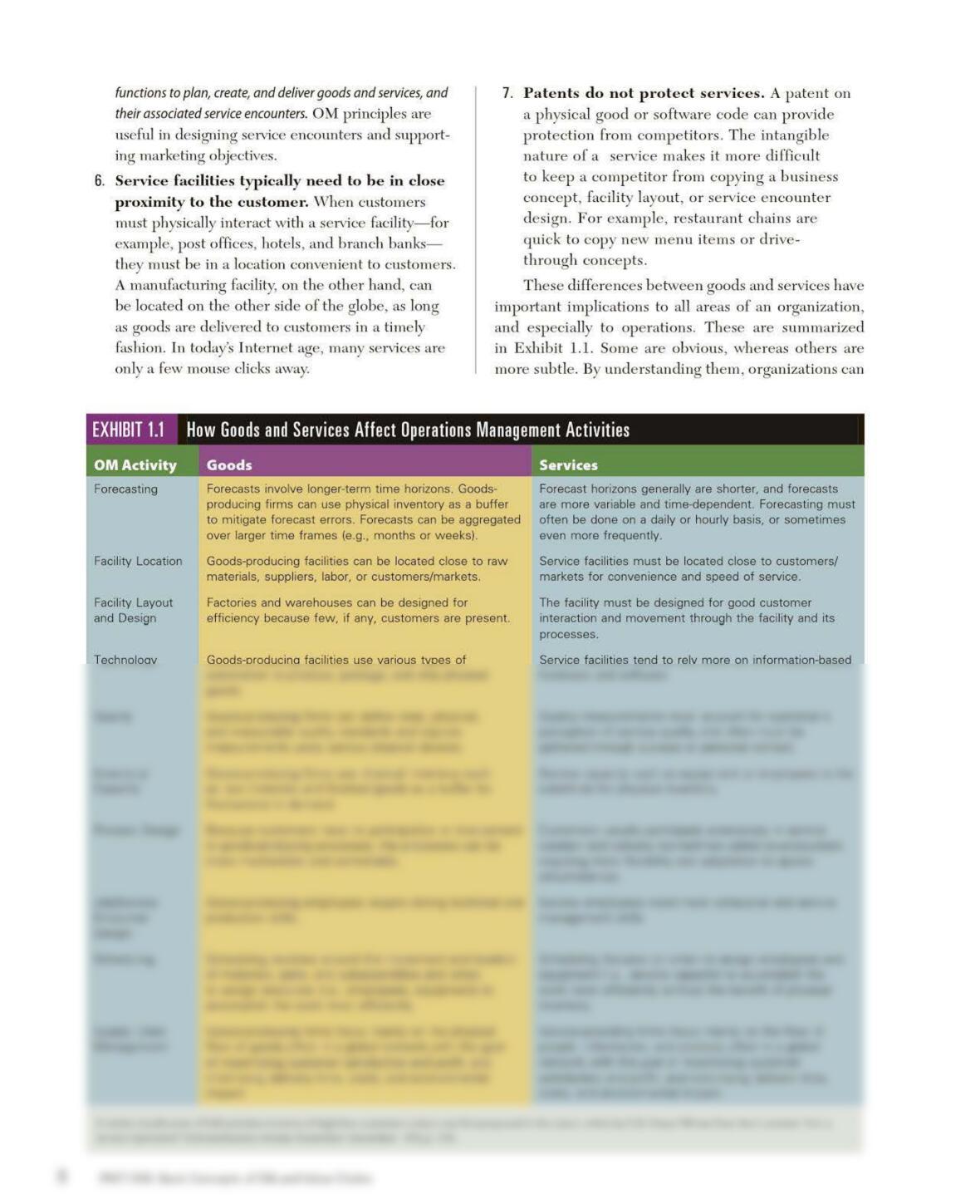
The
se
di
fferences
be
tw
ee
n goods a
nd
services have
i
mportant
implications to all
ar
eas
of
an
org
aniza
tion
,
and
e
sp
ec
ia
lly to
op
erations.
Th
ese
are
sum
ma
ri
ze
d
in
Exhibit 1.1.
Som
e are obv
iou
s, whereas others
ar
e
more
sub
tl
e. By
und
erst
an
di
ng
them
, or
gan
izations
can
Forecasting
Facili
ty
Loc
at
ion
Facili
ty
Layout
an
d Design
Forecasts i
nvo
lve longer-t
erm
ti
me
horizons. Goods–
producing f
ir
ms
can use physi
cal
inv
en
tory
as
a
buffer
to mitigate
fo
recast errors. Forecasts can be aggregated
over larger time frames
(e
.g., months
or
weeks).
Goods–producing f
ac
ilities can be located close to r
aw
ma
te
rials, supplie
rs
, labor, or cust
ome
rs/markets.
Fac
tories
an
d warehouses can be designed
fo
r
efficiency because
few,
if any, customers are present.
F
or
ecast horizons
ge
nerally are shorter, and forecasts
are more vari
ab
le and t
im
e–dependent. Forecasting
must
often be done on a d
ai
ly or hourly basis, or s
om
et
i
mes
even more frequently.
Service facilities
mu
st
be located close to cust
om
ers/
marke
ts
for convenience and s
pee
d
of
service.
The
fa
cili
ty
must be designed for
goo
d customer
interaction
an
d
moveme
nt
th
rough
th
e facili
ty
and
it
s
processes.