Operations
Scheduling
and
Sequencing
LEARNING
OBJECTIVES
After
studying
this
chapter,
you
should
be
able
to:
(I) Explain
the
concepts
of
scheduling
and
sequencing.
0 Describe
staff
scheduling
and
appointment
system
decisions.
0 Explain
sequencing
performance criteria
and
rules.
After
you
finish
this chapter
go
0 Describe
how
to solve single-
and
two-resource sequencing problems.
0 Explain
the
need
for monitoring schedules
using
Gantt charts.
to
PAGE
312
for
STUDY
TOOLS.
(I
Describe
how
to
use
the
Clarke-Wright
method
for vehicle routing
and
scheduling.
Jean Rowecamp, clinical coordinator of nursing
services, was faced with a deluge of complaints by
her
nursing
staff
about their work schedules
and
complaints by floor supervisors about inadequate
staffing. The nurses complained they were having
too
many
shift changes each month. Supervisors
said
they
had
too
many
nurses during
the
days
and
not enough at night
and
on
the
weekends.
It
seemed
that
nothing she did would satisfy everyone.
WHAT
DO
YOU
THINK?
Creating schedules
is
not
easy.
The chapter-opening
nursing example highlights the complexity
of
scheduling
in service organizations.
For
example, union workforce
rules and special requests can complicate
th
e scheduling
process. And in contrast with manufacturing, wide fluc-
tuations in demand during the course
of
a day or week
makes scheduling quite difficult. Nevertheless, good
schedules have to be developed to provide high leve
ls
of
patient care and to minimize costs.
290
PART
THREE
: Managing
Operat
ions and Supply Chains
The nurses were unionized, so she couldn’t schedule
them
for more
than
seven consecutive working
days,
and
the
nurses required
at
least
16
hours
between shift changes. Nurses were constantly
making “special requests” for personal time
off,
despite
the
negotiated procedures for bidding for
shifts
and
vacation times. Jean
lamented
that
she
became
an
administrator
and
longed for
the
days
before she
had
these responsibilities.
Scheduling and sequencing are fairly common activi-
ties that operations managers perform every day in every
business. They are fundamental to
all
thr
ee leve
ls
of
ag-
gregation and disaggregation planning that we described
in the previous chapter. Good schedules and sequences
lead to efficient execution
of
manufacturing and service
plans and better customer service. It’s one thing to prom-
ise great customer service and another to actually achieve
it.
For example, having the right number of employees at
L
a call center at different times
of
the day and week will
ensure that customers
do
not have to wait long. Good
scheduling
of
jobs in a factory will ensure that customers
rece
ive
their orders
as
promised, and increase productivity
and efficiency.
•
UNDERSTANDING
SCHEDULING
AND
SEQUENCING
Scheduling
refers
to
the
assignment
of
start
and
completion
times
to
particular
jobs,
people,
or
equipment.
For
example,
fast–food restaurants, hospitals, a
nd
call centers need to
schedule employees for work shifts; doctors, dentists,
and stockbrokers need to schedule patients and custom-
ers; airlines must schedule crews and flight attendants;
sports organizations must schedule teams and officials;
court systems must schedule hearings and trials; fac-
tory managers
need
to schedule jobs on machines and
preventive maintenance work; and salespersons
need
to schedule customer deliveries and visits to potential
customers. Many schedules are repeatable over the long
term, such
as
those for retail store staff and assembly-line
employees. Others might change on a monthly, weekly,
or even daily basis,
as
might
be
th
e case with call
center
employees, nurses, or salespeople.
A concept related to scheduling
is
sequencing.
Sequencing
refers
to
determining
the
order
in
which
jobs
or
tasks
are
processed.
For example, triage nurses must decide on the
order in which emergency patients are
tr
eate
d;
housekeep–
ers in hotels must sequence the order of rooms to clean;
operations managers who run an automobile assembly line
must determine the sequence by which different models
are produced; and airport managers must sequence out-
going flights on runways. Note that in
all
these situations,
processing takes place using a common resource with
limited capacity. Thus,
th
e sequence will ultimately deter-
mine how well the resource
is
used to achieve an objective
such
as
meeting demand or customer due dates. Gener-
all
y,
a sequence specifies a schedule, and we will see this in
various examples lat
er
in
this chapter.
Scheduling and se–
quencing in back-office or
low-contact service pro-
cesses are similar to those
for goods-producing pro-
cesses. The same sched-
uling
and
sequencing
P-J1ti:l,•I•IIIIH,J
refers
to
the
assignment
of
start
and
completion
times
to
particular
jobs,
people
,
or
equipment.
CHAPTER
14:
Operations Scheduling and Sequencing
291
Telling
Umpi
r
es
\/\/here
to
Go
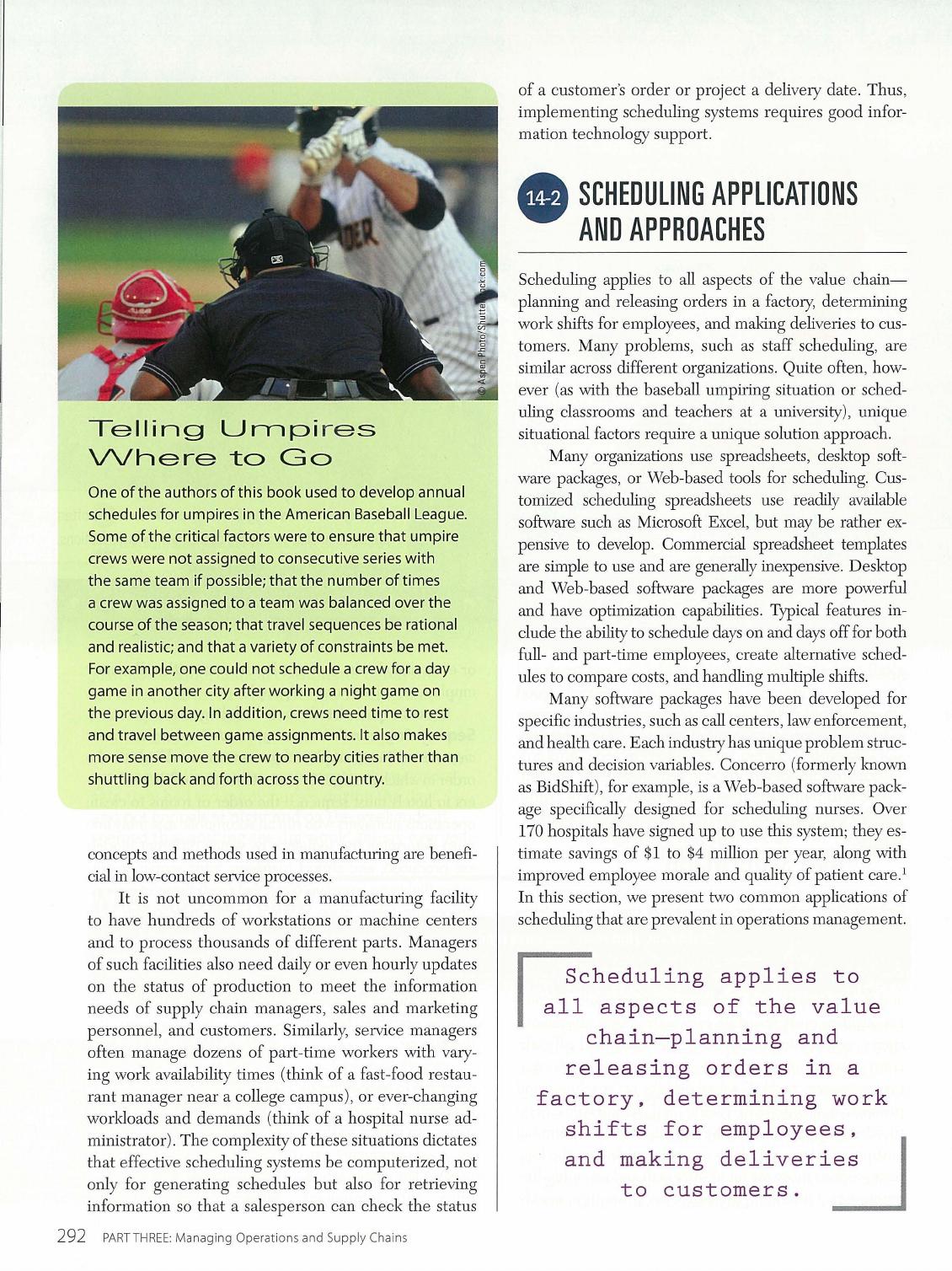
One
of
the authors
of
this
book
used
to
develop annual
schedules for
ump
ir
es
in the American Baseball League.
Some
of
the critical factors were
to
en
sure
that
ump
i
re
crews were
not
assigned
to
consecutive series
with
the
same team
if
possible;
that
the
number
of
times
a crew w
as
assigned
to
a team
was
balanced over the
course
of
the season;
that
travel sequences be rational
and realistic; and
that
a variety
of
constraints
be
met
.
For example, one could
not
sc
hedule a crew for a day
game in another city after
wor
king a
night
game on
the
previous
da
y.
In
a
ddition
, crews need
time
to
rest
and travel between game
ass
i
gnment
s.
It
al
so makes
more sense move the crew
to
nearby cities rather than
sh
uttling
back and
forth
across the country.
concepts and methods used in manufacturing are benefi-
ci
al
in low–contact service processes.
It
is
not uncommon for a manufacturing facility
to have
hundreds
of
workstations or machine centers
and
to process thousands
of
different parts. Managers
of
such facilities also
need
daily or even
hour
ly updates
on
the
status
of
production to
meet
the
information
needs
of
supply chain managers, sales and marketing
personnel, and customers. Similarly, service managers
often manage dozens
of
part
–time workers with vary–
ing work availability times (think
of
a fast-food restau–
rant manager
near
a college campus),
or
ever–changing
workloads
and
demands (think
of
a hospital nurse ad–
ministrator).
The
complexity
of
these situations dictates
that effective scheduling systems
be
computerized, not
only for generating schedules
but
also for retrieving
information so that a salesperson can check
the
status
292
PART
THREE:
Managing
Operations and Supply Chains
of
a customer’s
order
or project a delivery date. Thus,
implementing scheduling systems requires good infor–
mation technology support.
•
SCHEDULING
APPLICATIONS
AND
APPROACHES
Scheduling app
li
es to a
ll
aspects
of
the
value chain–
planning and releasing orders in a factory, determining
work shifts for employees, and making deliveries to cus–
tomers. Many problems, such
as
staff schedu
li
ng, are
similar across different organizations. Quite often, how–
ever
(as
with the baseba
ll
umpiring situation or sched–
u
li
ng classrooms and teachers at a university), unique
situational factors require a unique
so
lution approach.
Many organizations use spreadsheets, desktop soft–
ware packages, or Web–based tools for scheduling. Cus–
tomized schedu
li
ng spreadsheets use readily available
software such
as
Microsoft Excel,
but
may be rather
ex
–
pensive to develop. Commercial spreadsheet templates
are simple to use and are generally inexpensive. Desktop
and Web-based software packages are more powerful
and have optimization capabilities.
Typ
ical features in–
clude the ability to schedule
days
on and days off for both
full–and part–time employees, create alternative sched–
ules to compare costs, and handling multiple shifts.
Many software packages have
been
developed for
specific industries, such
as
call centers, law enforcement,
and health care. Each industry has unique problem struc-
tures and decision variables. Concerro (formerly known
as
BidShift), for exampl
e,
is
a Web–based software pack-
age specifically designed for scheduling nurses. Over
170 hospitals have signed up to use this system; they es–
timate savings
of
$1
to
$4
million
per
yea
r,
along with
improved employee morale and quality
of
patient care.1
In
this section, we prese
nt
two common applications
of
scheduling that are preval
ent
in operations management.
~
heduling
applies
to
I
all
aspects
of
the
value
chain-planning
and
releasing
orders
in
a
factory
,
determining
work
shifts
for
employees,
and
making
deliveri
:J
s
to
customers.
Soft:vvare
t:o
Schedule
Anyvvhere
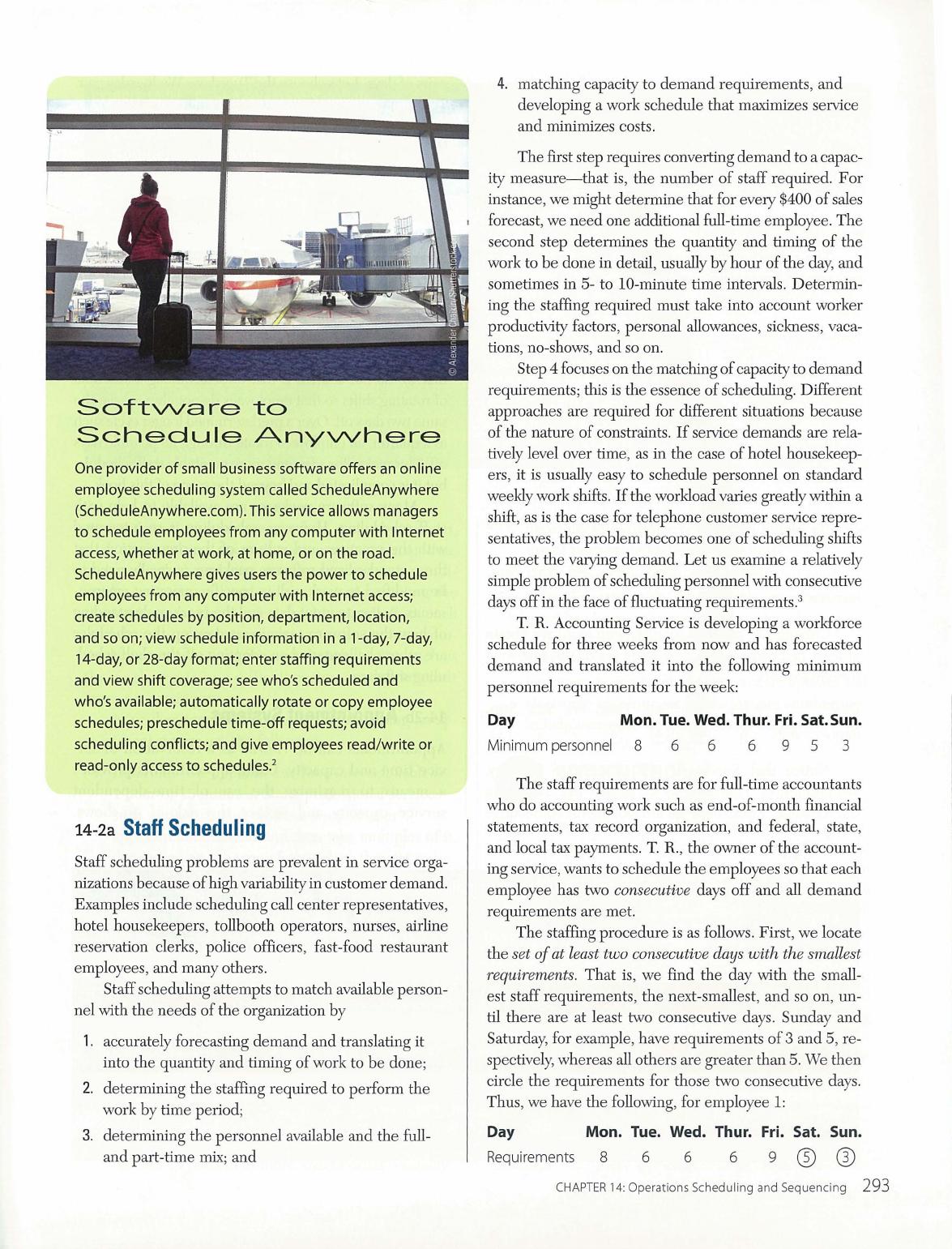
One provider
of
small business software offers
an
online
employee scheduling system called ScheduleAnywhere
(ScheduleAnywhere.com). This service allows managers
to
schedule employees from any
computer
with
Internet
access,
whethe
r at work, at home,
or
on
the
road.
ScheduleAnywhere gives users
the
power
to
schedule
employees from any computer
with
Internet
access
;
create schedules by position, department, location,
and
so
on;
view
schedule information in a 1-day, 7-day,
14-day,
or
28-day format; enter staffing requirements
and view shift coverage;
see
who’s scheduled and
who
‘s available; automatically rotate or copy employee
schedules; preschedule
time-off
requests; avoid
scheduling conflicts; and give employees read/
write
or
read-only
access
to
schedules.2
14–2a
Staff
Scheduling
Staff scheduling
prob
lems are preval
en
t in service orga-
nizations
beca
use
of
high variability in cust
omer
demand.
Examples inclu
de
sch
ed
uling call
center
representa
tives,
ho
tel housekeepers, toll
booth
operators, nurses, airline
reservation clerks, police
of
ficer
s,
fast–food restaurant
employees,
and
many
others.
Staff sch
edu
li
ng
att
empts
to
matc
h available
person
–
nel with
the
needs
of
the
organization
by
1.
accurately forecasting
demand
and
translating it
into
the
quantity
and
timing
of
work to
be
done
;
2.
determining
the
staffing
requ
i
red
to
perform
the
work
by
time
period
;
3.
determining
the
personnel
available
and
the
full–
and
part
–time mix;
and
4.
matching capacity to
demand
requirements,
and
developing a work
schedule
that
maximizes service
and
minimizes cost
s.
The
first step
requ
ires converti
ng
demand
to a capac–
ity
measure-tha
t is,
the
number
of
st
aff
required.
For
instance,
we
might
de
t
ermine
t
hat
fo
r every $400
of
sales
forecast, we
need
one
additional full-time
emp
loyee.
The
second st
ep
determines
th
e qu
an
tity and timing
of
the
work to
be
d
one
in
detail, usually
by
h
our
of the day,
and
sometimes in 5– to 10–minu
te
time i
nt
erval
s.
De
termin-
i
ng
the
staffing
req
uir
ed
must
take into account worker
pr
od
uctivity factors,
pe
rsonal allowances, sickness, vaca-
tions, no-shows,
and
so on.
Step 4 focuses on
the
ma
tching
of
capacity to
demand
requ
i
remen
t
s;
this is
the
essence
of
scheduling. Different
approaches are requi
red
for different si
tu
ations because
of
th
e
na
t
ure
of
constraints.
If
service
dema
n
ds
are rela–
tively level over time,
as
in
th
e case of
ho
tel housekeep-
ers, it
is
usually easy to schedule personnel on standard
weekly work shifts .
If
the workload varies gr
ea
tly within a
shift,
as
is
th
e case for tel
ep
hone cust
omer
service
repre
–
se
nt
atives, the probl
em
becomes one
of
schedu
li
ng
shifts
to
mee
t
th
e varying d
eman
d. Let us exami
ne
a
re
latively
simple
pro
bl
em
of
scheduli
ng
person
nel with consecutive
d
ays
off in the face
of
fluc
tu
ating
req
u
iremen
t
s.
3
T.
R.
Accounti
ng
Service
is
developi
ng
a workforce
schedule
fo
r
thr
ee
wee
ks from now and has forecasted
d
eman
d
and
transl
ated
it into t
he
following mini
mu
m
personnel requi
reme
nt
s for t
he
week:
Day Mon. Tue. Wed. Thur.
Fri.
Sat. Sun.
Minimum personnel 8 6 6 6 9 5 3
The st
aff
req
u
iremen
ts are f
or
full-
time
accountants
who do accounting work such as
end
–
of
–
mon
th
fi
n
anc
ial
stat
emen
ts, tax r
ecor
d organization,
and
federal, state,
and local t
ax
paymen
t
s.
T.
R.,
th
e
owner
of
th
e accou
nt
–
ing service,
wan
ts to sch
ed
ule the
em
ployees so that each
emp
loyee has two consecutive days
off
and
all
demand
req
uir
emen
ts are me
t.
The staf
fi
ng pr
ocedure
is as
fo
llows.
Fi
rst, we locate
the set
of
at least two consecutive days with the sma
ll
est
requirements.
Tha
t
is
,
we
find the day with
the
sma
ll-
est
s
taff
requiremen
ts,
the
next–
sma
llest,
and
so
on
,
un
–
til t
here
are at least two consecutive days. Sunday
and
Saturday, for example, have
req
u
iremen
ts
of
3
and
5, re–
spectivel
y,
whereas all others are
greater
than
5.
We
then
circle
the
requirements
for those two consecutive days.
Thus
,
we
have t
he
following, for employee
1:
Day M
on.
Tu
e. Wed. Thur.
Fri.
Sat. Sun.
Requirements 8 6 6 6 9 @ ®
CHAPTER
14:
Operations Scheduling and Sequencing
293
I
i
I
I II
294
We
assign
accountant
1 to work
on
all days
that
are
not
circled,
that
is
, Monday
through
Friday.
Then
we
subtract
1 from
the
requirement
for each
da
y
that
ac–
countant
will work. This gives us
the
following require-
ments
that
remain:
Day Mon. Tue. Wed.
Thur.
Fri.
Sat. Sun.
Requirements 7 5 5 5 8 5 3
The
procedure
is
repeated
with this
new
set
of
re-
quirements
for accountant
2.
Day Mon. Tue. Wed.
Thur.
Fri.
Sat. Sun.
Requirements 7 ® ® ® 8 ® ®
When
there
are several alternatives,
as
in
this case,
we
do
one
of
two things. First, we try to choose a
pair
of
days with
the
lowest total
requirement.
If
there
are still
ties,
we
are
to choose
the
first available pair
that
makes
the
most sense to
the
scheduler.
Hence,
we
again use
Saturday
and
Sunday as days
off
for accountant 2, since
this
pair
has
the
smallest total
requirement
of
8.
We
sub-
tract
1 from
each
working day’s
requirement
, yielding
th
e following:
Day Mon. Tue. Wed.
Thur.
Fri.
Sat. Sun.
Requ
ir
ements 6 4 4 4 7 5 3
Circling
the
sma
ll
est
requirements
until we obtain
at
least two consecutive days again yields
the
following
for
emp
loyee
3:
Day Mon. Tue. Wed.
Thur.
Fri.
Sat. Sun.
Requirements 6
@)@)@)
7 5 ®
Notice
that
Sunday
is
not
adjacent to Tuesday,
Wednesday,
or
Thursday
, so we
cannot
use Sunday in
the
schedu
le.
Remember
we
ar
e looking for consecutive
pairs
of
days. Let’s choose
the
Tuesday-
Wednesday
pair.
The
remaining re
quirements
ar
e as follows:
Day Mon. Tue. Wed.
Thur.
Fri.
Sat. Sun.
Requirements 5 4 4 3 6 4 2
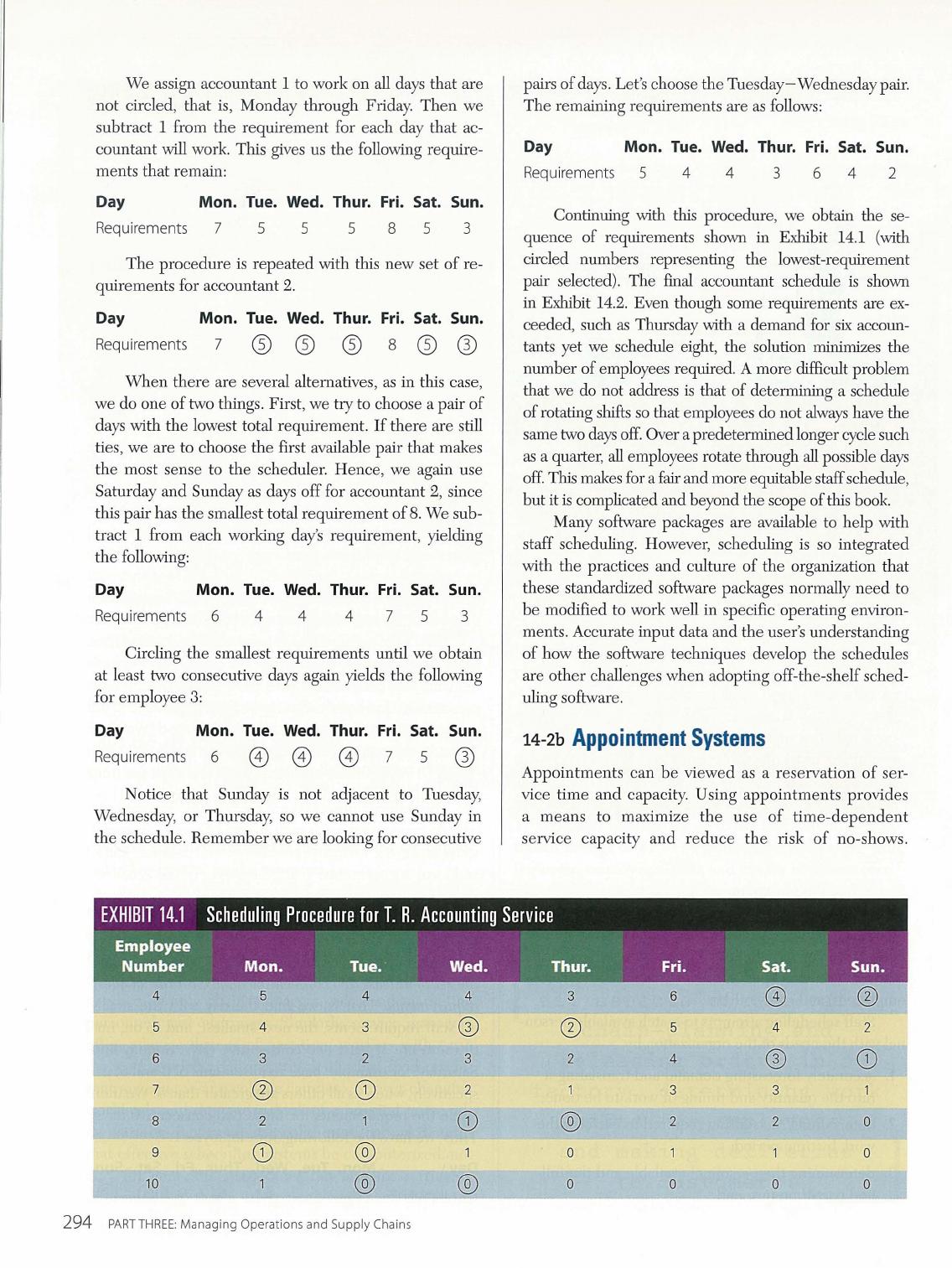
Continuing with this procedure, we obtain
the
se-
qu
ence
of
requirements shown in Exhibit 14.1 (with
circled numbers representing
the
lowest-requirement
pair selected).
The
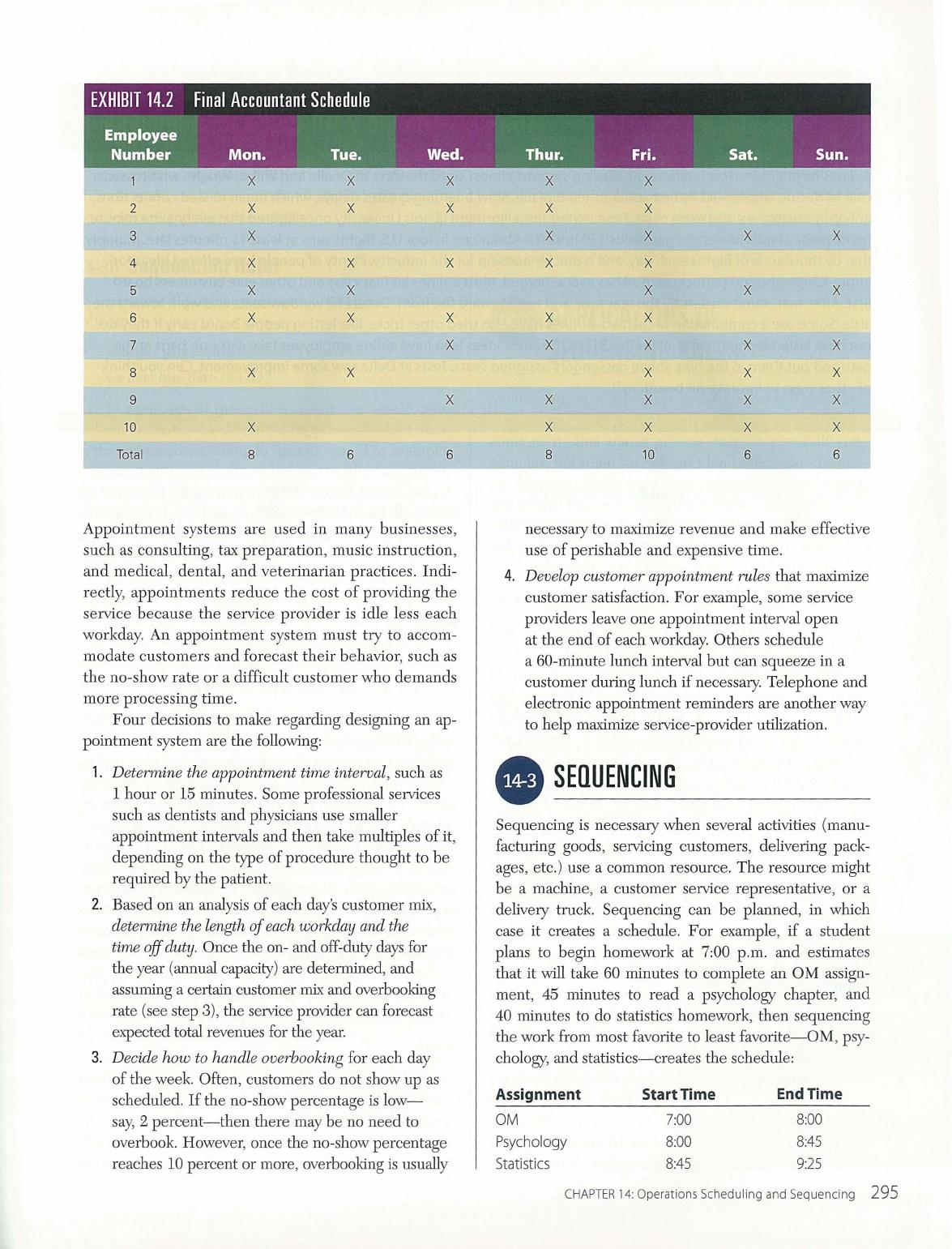
final accountant schedule
is
shown
in Exhibit 14.2. Even though some requirements are
ex-
ceeded
, such
as
Thursday with a
demand
for
six
accoun-
tants yet we schedule eight,
the
solution minimizes
the
number
of
emp
loyees required. A more difficult problem
that we do not address
is
that
of
determining a schedule
of
rotating shifts so that
emp
loyees do not always have
the
same two days off. Over a predetermined longer cycle such
as
a quarter, all
emp
loyees rotate through all possible days
off. This makes for a fair and more
eq
uitable staff schedule,
but
it
is
comphcated and beyond
the
scope
of
this book.
Many software packages are available to
help
with
staff scheduling.
However
, scheduling
is
so
integrated
with
the
practices
and
culture
of
the
organization
th
at
these standardized software packages normally
need
to
be modified to work well
in
specific operating environ-
ments. Accurate
input
data
and
the
user
‘s
understanding
of
how
the
software techniques develop
the
schedu
les
are
other
challenges wh
en
adopting off-the-shelf sched-
uling software.
14-2b
Appointment
Systems
Appointments
can
be
viewed
as a
reservation
of
ser-
vice
time
and
capacity. Using
appointments
provides
a
means
to
maximize
th
e
use
of
time-d
e
pendent
service capacity
and
reduce
the
risk
of
no-shows.
EXHIBIT
14.1
Scheduling
Procedure
forT.
R.
Accounting
Service
Employee
Number
5
6
-•
_____
.._
7
8
9
10
Mon.
4
3
0
2
CD
1
Tue.·
3
2
——
–
-·—-
CD
-·
1
___
..
_ .
—
—
®
–. ––
®
P
ART
THR
EE:
Managing
Op
erations and Supply Chains
Wed. Thur. Fri. Sat. Sun.
0 0
0 0 5 4 2
3 2 4 0
CD
2 1 3 3
CD
® 2 2 0
1 0 1 1 0
—-
® 0 0 0 0
2
3 X
4 X X X
5 X X –
6 X X X
7 X
8 X X
9 X
10 X
Total 8 6 6
Appointment
systems
are
used
in many businesses,
such
as
consulting, tax
preparation,
music
instruction
,
and
medical,
dental
,
and
veterinarian
practices.
Indi-
rectly,
appointments
reduce
the
cost
of
providing
the
service
because
the
service
provider
is
idle less
each
workday. An
appointment
system
must
try to accom-
modate
customers
and
forecast
their
behavior
, such
as
the
no-show
rate
or
a difficult
customer
who
demands
more
processing time.
Four
decisions to make regarding designing an ap–
pointment
system are
the
following:
1.
Determine the appointment tirne interval, such
as
1
hour
or
15 minutes. Some professional services
such
as
dentists and physicians use smaller
appointment intervals and
then
take
mu
ltiples
of
it,
depending on
the
type
of
procedure thought to
be
required by
the
patient.
2.
Based on an analysis
of
each day’s customer mix,
determine the length
of
each workday and the
time
off
duty. Once the on- and off–duty days for
the year (annual capacity) are detennined, and
assuming a certain customer
mix
and overbooking
rate (see step 3), the service provider can forecast
expected total revenues for the year.
3. Decide
how
to handle overbooking for each day
of
the
week. Often, customers do not show
up
as
scheduled.
If
the
no-show percentage
is
low-
say,
2
percent-th
en
there
may be no
need
to
overbook. However, once
the
no-show percentage
reaches 10 percent
or
more, overbooking
is
usually
X X X X
X X
X X X
X X
X X X X
X X X
·-
X X X X
X X X X
8
10
6 6
necessary to maximize
revenue
and
make effective
use
of
perishable
and
expensive time.
4. Develop customer appointment rules
that
maximize
customer satisfaction.
For
example, some service
providers leave
one
appointment interval
open
at
the
end
of
each workday. Others schedule
a 60-minute lunch interval
but
can squeeze in a
customer during lunch
if
necessary. Telephone
and
electronic appointment reminders are another way
to help maximize service–provider utilization.
•
SEQUENCING
Sequencing
is
necessary
when
several activities (manu–
facturing goods, servicing customers, delivering pack-
ages, etc.) use a common resource.
The
resource might
be
a machine, a customer service representative,
or
a
delivery truck. Sequencing can
be
planned
, in which
case it creates a schedule.
For
example,
if
a
student
plans to begin homework at 7:00 p.m. and estimates
that
it will take 60 minutes to complete an
OM
assign-
ment, 45 minutes to read a psychology
chapter
, and
40 minutes to do statistics homework,
then
sequencing
the
work from most favorite to least
favmite-OM
, psy-
chology, and
statistics-creates
the
schedule:
Assignment Start Time End Time
OM
7:00
8:00
Psychology
8:00
8:45
Statistics
8:45
9:25
CHAP
T
ER
14
: Operations Schedul ing and Sequencing 295
L,
Airlines have tinkered
with
different boarding systems almost since
the
days
of
Orville and Wilbur Wright,
who
tossed a
coin
to
decide
who
would
fly first aboard their biplane. Slow boarding creates delays, which mean missed connections,
unhappy customers, and extra costs. Researchers from Northern Illinois University once figured
that
every extra
minute
that
a plane stands idle at the gate adds $30 in costs.
About
one in four
U.S.
flights runs at least
15
minutes late.
Multiply
that
by thousands
of
flights each
day,
and
it
quickly adds up for
the
industry. Plenty
of
people have offered ideas for
improvement,
but
no perfect
method
has
ever emerged. Most airlines let first-class and other elite customers board
first. After that, some carriers fill
the
rear rows and
work
toward the front. Others fill
window
seats and
work
toward
the
aisle. Some
use
a combination
of
the two. Airlines have also tried other tricks, like letting people board early
if
they
do
not
have aisle-clogging, carry-on bags. One
of
the
latest ideas
is
to
have airline employees take carry-on bags at the
gate and
put
them
in the bins above passengers’ assigned
seats.
Tests
at Delta saw some improvement.
Can
you
think
of
other ways
to
improve air boarding?4
14-3a
Sequencing
Performance
Criteria
In
selecting a specific scheduling or sequencing rule,
a manager must first consider
th
e criteria on which to
evaluate schedule
s.
These criteria are often classified
into
thr
ee categorie
s:
1.
process–
fo
cused performance criteria,
2.
–customer-focused due date criteria, and
3.
cost-based criteria.
Th
e applicability of the various crite1ia depends on the
availability of data. Later we will show how
th
ese perfor-
mance measures are applied to various sequencing rules.
Makespan
is
the
time
needed
to
process
a
given
set
of
jobs. A short makespan aims to achieve high equip-
me
nt
utilization a
nd
resources by getting all jobs
out
of
the
shop quickly. Makespan
is
comput
ed using
Equation
14.2.
M=C-S
where
M = makespan
of
a group
of
jobs
C = completion time
of
la
st job in the group
S = start time
of
first job in
th
e group
[14.2]
Du
e-date crite
1ia
pertain to custome
rs
‘ required due
dates or internally determined shipping date
s.
Common
i……_
…..1
ill
~