GRADUATE SCHOOL
UNIVERSITY OF CEBU
Reporter : Kenny Mark C. Fresco
Topic : Introduction of Operations Management
Competitiveness, strategy, and productivity
Date : December 14, 2019
Professor : Dr. Eddie E. Llamedo
Chapter 1 and Chapter 2
Prayer:
Let us pray…
Lord make me an instrument of your peace
Where there is hatred let me sow love
Where there is injury, pardon
Where there is doubt, faith
Where there is despair, hope
Where there is darkness, light
And where there is sadness, joy.
Amen.
Energizer:
Banana Dance
Words of Wisdom:
“Just keep moving forward.”
– The Robinson’s Family –

Topic Objectives:
At the end of the discussion fellow masterands should be able to understand the
following:
– Meaning of operations management,
– Identify the three major areas of organizations and describe how they
interrelate,
– Compare and contrast service and manufacturing operations,
– Describe the operations function and the nature of the operations manager’s
job,
– Differentiate between design and operation of production system,
– Describe the key aspects of the operations management decision making,
– Briefly describe the historical evolution of operations management,
– And identify current trends in business that impacts the operations
management.
Chapter 1 Summary:
Introduction
Operations refer to the part of an organization which is responsible for the
production of goods or services. Goods are physical items and services are activities
you do for others in exchange of payment. Operations define the success or failure
of a company as well as this affects the competitiveness of a nation from another
nation and on the nation’s economy.
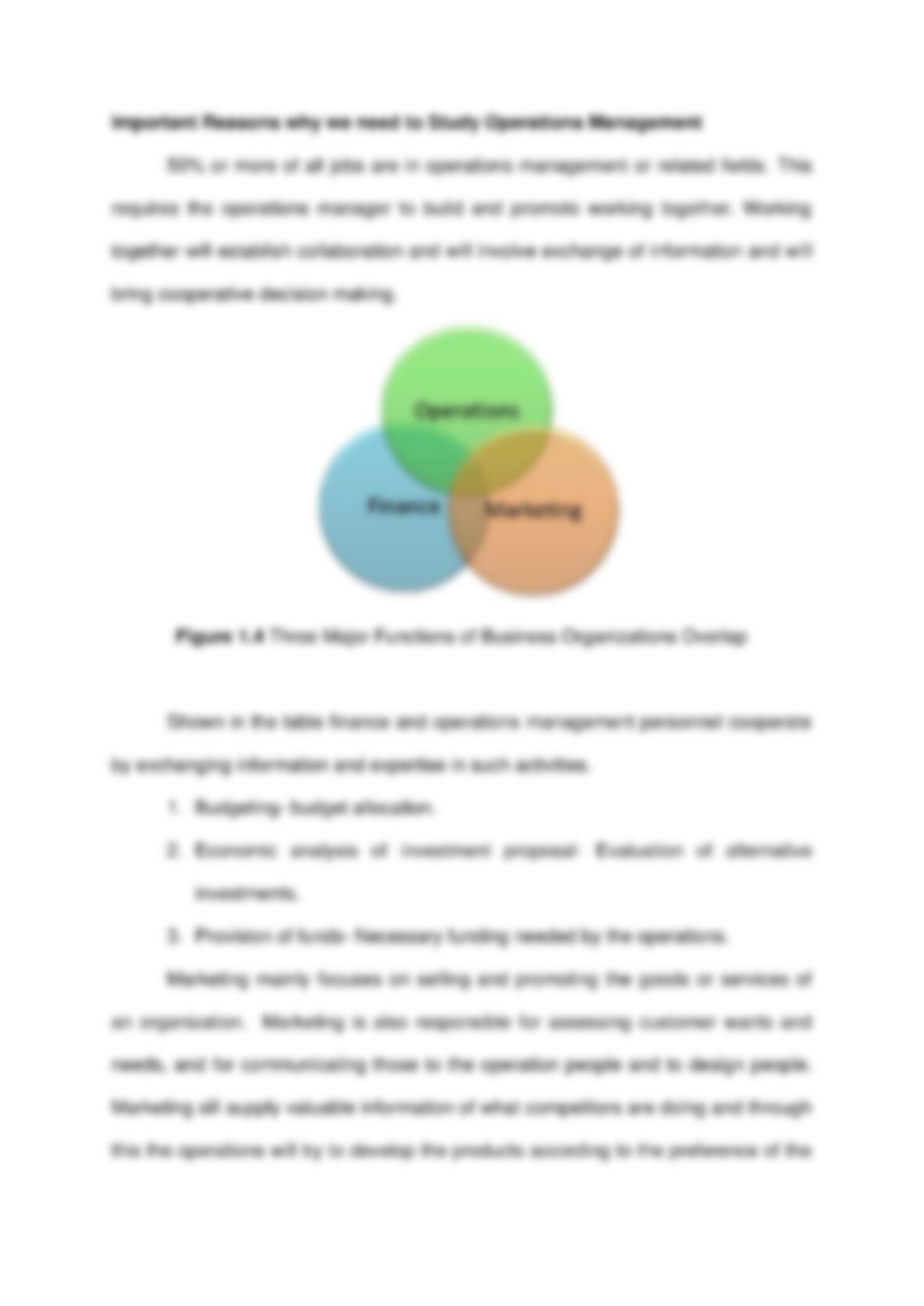
All business organizations have three (3) basic functions. Finance is
responsible in securing and managing financial resources including the budget
scheme and analyzing investments. Marketing and operations are the primary, or
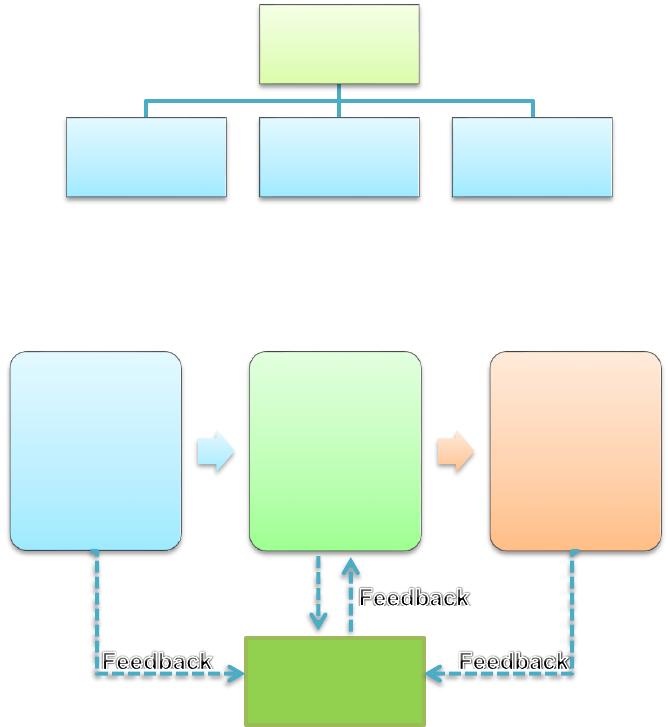
“line”, function. Marketing is responsible for assessing customers’ needs and wants,
selling and promoting the organization’s goods and services. Operations are
responsible for the production of goods or providing services. We consider the
operation as the core of an organization and that operations management is the
management system or the process in creating goods and/or provides services.
The creation of goods or services involves transforming or converting inputs
into outputs known as transformation process. In ensuring the quality of the product
feedbacks are used to compare previous product to the current whether corrective
actions are needed.
Figure 1.1 Three Basic Functions of Business Organizations
Figure 1.2 The operations function involves the conversion of inputs into outputs
Organization
Finance Operations Marketing
Inputs:
Land
Labor
Capital
Information
Transformation
/Coversion
Process
Outputs:
Goods
Servies
Control
The essence of the operations function is to add value during the
transformation. The value-added is the difference between the cost of inputs and the
value or price of outputs. The value of the outputs are measured based on the
consumers capacity to buy or buying powers. Thus, money generated from the value
added is used by the firms for product development, research, additional
investments like facilities and equipment, and employee salary.
Inputs
Transformation
Outputs
Land
Processes:
– Cutting, Drilling
– Transporting
– Teaching
– Farming
– Mixing
– Packing
– Copying
High Goods Percentage:
– Houses
– Automobiles
– Clothing
– Computers
– Machines
– Televisions
– Food Products
– Textbooks
– CD players
High Service Percentage:
– Health Care
– Entertainment
– Car Repair
– Delivery
– Legal
– Banking
– Communication
Others:
– Innovation
Human:
– Physical Labor
– Intellectual Labor
Capital
Raw Materials:
– Energy
– Water
– Metals
– Wood
Equipment:
– Machine
– Computers
– Trucks
– Tools
Facilities:
– Hospitals
– Factories
– Retail Stores
Other:
– Information
– Time
– Legal Constraints
– Government Regulations
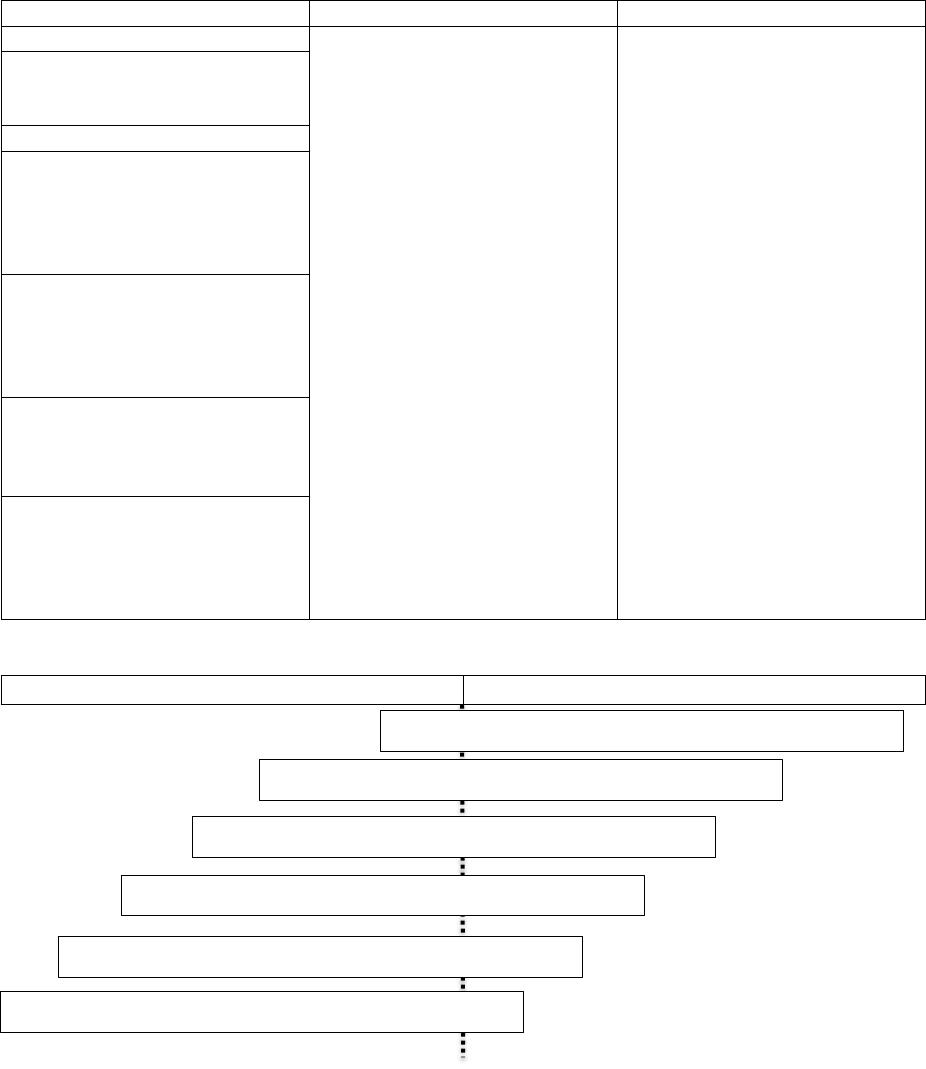
Table 1.1 Examples of Inputs, Transformation, and Outputs.
Goods
Services
Figure 1.3
The goods-service continuum
Automobile assembly, steelmaking
Home remodeling, retail sales
Automobile repair, fast food
Computer repair, restaurant meal
Songwriting, software development
Surgery, teaching

Base on the figure the greater the customer is involve, the more challenging
the operation design and management is.
Production of Goods versus Delivery of Services
Goods and services often work hand in hand but the two have basic
differences. Goods are tangible outputs-anything that we can see or touch, on the
other hand, services generally implies as an act.
Food Processor
Inputs
Processing
Output
– Raw veggies
– Metal steels
– Water
– Energy
– Labor
– Building
– Equipment
– Cleaning
– Making cans
– Cutting
– Cooking
– Packing
– Labeling
– Canned veggies
Hospital
Inputs
Processing
Output
– Doctors, nurses
– Hospital
– Medical supplies
– Equipment
– Laboratories
– Examination
– Surgery
– Monitoring
– Medication
– Therapy
– Treated patient
Table 1.2 Illustration of the Transformation Process
Manufacturing and service are often different in terms of what is done but are
similar in terms of how it is done and manufacturing is goods-oriented, while service
is act-oriented.
Characteristics
Manufacturing
Service
1. Degree of customer
contact
– Less contact
– Higher contact
2. Uniformity of inputs
– Carefully controlled
variability
– Greater variability of
inputs
3. Labor content of jobs
– Less labor
– Higher labor
4. Uniformity of outputs
– Smooth and efficient
– Slow and awkward
5. Measurement of
productivity
– Straightforward with high
degree of uniformity
– Demand intensity and
difficult to measure
6. Production and delivery
– Runs through the
distribution channel
– Receive the service right
away
7. Quality assurance
– Manageable and can be
corrected prior to
customer consumption
– More challenging when
production and
consumption takes place
at the same time
8. Amount of inventory
– More inventory
– Less inventory
9. Evaluation of work
– Interval between
– Less demanding

production and delivery
10. Ability to patent design
– Easier to patent
– Service design cannot be
patented
The Scope of Operations Management
The operation function includes forecasting, capacity planning, scheduling,
managing inventories, assuring quality, motivating employees, deciding where to
locate facilities, and more.
Realm of operations management:
1. Forecasting – ability to predict possible outcomes.
2. Capacity planning – ability to maintain the company cash flow and make
profit.
3. Scheduling – ability to set the schedule of manpower for efficiency.
4. Managing Inventories – ability to monitor the supplies needed for the
operation.
5. Assuring Quality – ability to check and maintain the operation for
standardization.
6. Motivating and Training Employees – ability to boost the morale of your
teammates.
7. Locating Facilities – ability of a manager to decide which cities is best for
major and minor hubs.
Types of Operations
1. Goods Producing
2. Storage/transportation
3. Exchange
4. Entertainment
5. Communication
What is System Design?
Involves decisions that relate to system capacity, the geographic location of
facilities, arrangement of departments and placement of equipment within the
physical structures, product and service planning, and acquisition of equipment.
Strategic decisions which involves management of personnel, inventory planning
and controlling, scheduling, project management and quality assurance. Tactical and
operational decisions and this is not possible without the operations manager who is
a vital stake in this system. System design determines the parameters of the whole
operation.