Monetary Economics,
2nd Edition
This successful text, now in its second edition, offers the most comprehensive overview of
monetary economics and monetary policy currently available. It covers the microeconomic,
macroeconomic and monetary policy components of the field. The author also integrates the
presentation of monetary theory with its heritage, stylized facts, empirical formulations and
econometric tests.
Major features of the new edition include:
• Stylized facts on money demand and supply, and the relationships between monetary
policy, inflation, output and unemployment in the economy.
• Theories on money demand and supply, including precautionary and buffer stock models,
and monetary aggregation.
• Cross-country comparison of central banking and monetary policy in the US, UK and
Canada, as well as consideration of the special features of developing countries.
• Competing macroeconomic models of the Classical and Keynesian paradigms, along
with a discussion of their validity and consistency with the stylized facts.
• Monetary growth theory and the distinct roles of money and financial institutions in
economic growth in promoting endogenous growth.
• Excellent pedagogical features such as introductions, key concepts, end-of-chapter
summaries, and review and discussion questions.
This book will be of interest to teachers and students of monetary economics, money and
banking, macroeconomics and monetary policy. Instructors and students will welcome the
close integration between current theories, their heritage and their empirical validity.
Jagdish Handa is Professor of Economics at McGill University in Canada and has taught
monetary economics and macroeconomics for over forty years.

Monetary Economics,
2nd Edition
Jagdish Handa
First published 2000
Second edition published 2009
by Routledge
2ParkSquare,MiltonPark,Abingdon,OxonOX144RN
Simultaneously published in the USA and Canada
by Routledge
270 Madison Ave, New York, NY 10016
Routledge is an imprint of the Taylor & Francis Group,
an informa business
© 2000, 2009 Jagdish Handa
All rights reserved. No part of this book may be reprinted or reproduced or utilized
in any form or by any electronic, mechanical, or other means, now known or
hereafter invented, including photocopying and recording, or in any information
storage or retrieval system, without permission in writing from the publishers.
British Library Cataloguing in Publication Data
A catalogue record for this book is available
from the British Library
Library of Congress Cataloging in Publication Data
Acatalogrecordforthisbookhasbeenrequested
ISBN10:0-415-77209-5(hbk)
ISBN10:0-415-77210-9(pbk)
ISBN 10: 0-203-89240-2 (ebk)
ISBN13:978-0-415-77209-9(hbk)
ISBN 13: 978-0-415-77210-5 (pbk)
ISBN 13: 978-0-203-89240-4 (ebk)
This edition published in the Taylor & Francis e-Library, 2008.
“To purchase your own copy of this or any of Taylor & Francis or Routledge’s
collection of thousands of eBooks please go to www.eBookstore.tandf.co.uk.”
ISBN 0-203-89240-2 Master e-book ISBN
To Sushma, Sunny and Rish
Contents
Preface xxv
Acknowledgments xxviii
PART I
Introduction and heritage 1
1. Introduction 3
1.1 What is money and what does it do? 5
1.1.1 Functions of money 5
1.1.2 Definitions of money 5
1.2 Money supply and money stock 6
1.3 Nominal versus the real value of money 7
1.4 Money and bond markets in monetary macroeconomics 7
1.5 A brief history of the definition of money 7
1.6 Practical definitions of money and related concepts 12
1.6.1 Monetary base and the monetary base multiplier 14
1.7 Interest rates versus money supply as the operating target
of monetary policy 15
1.8 Financial intermediaries and the creation of financial assets 15
1.9 Different modes of analysis of the economy 18
1.10 The classical paradigm: the classical group of
macroeconomic models 20
1.11 The Keynesian paradigm and the Keynesian set of
macroeconomic models 24
1.12 Which macro paradigm or model must one believe in? 26
1.13 Walras’s law 28
1.14 Monetary policy 28
1.15 Neutrality of money and of bonds 29
1.16 Definitions of monetary and fiscal policies 30
Conclusions 31
Summary of critical conclusions 32
Review and discussion questions 32
References 33
viii Contents
2. The heritage of monetary economics 34
2.1 Quantity equation 35
2.1.1 Some variants of the quantity equation 38
2.2 Quantity theory 39
2.2.1 Transactions approach to the quantity theory 40
2.2.2 Cash balances (Cambridge) approach to the quantity
theory 45
2.3 Wicksell’s pure credit economy 49
2.4 Keynes’s contributions 52
2.4.1 Keynes’s transactions demand for money 54
2.4.2 Keynes’s precautionary demand for money 55
2.4.3 Keynes’s speculative money demand for an individual 56
2.4.4 Keynes’s overall speculative demand function 58
2.4.5 Keynes’s overall demand for money 60
2.4.6 Liquidity trap 61
2.4.7 Keynes’s and the early Keynesians’ preference for fiscal
versus monetary policy 62
2.5 Friedman’s contributions 63
2.5.1 Friedman’s “restatement” of the quantity theory of money 63
2.5.2 Friedman on inflation, neutrality of money and monetary
policy 65
2.5.3 Friedman versus Keynes on money demand 66
2.6 Impact of money supply changes on output and employment 67
2.6.1 Direct transmission channel 69
2.6.2 Indirect transmission channel 69
2.6.3 Imperfections in financial markets and the lending/credit
channel 70
2.6.4 Review of the transmission channels of monetary effects in the
open economy 70
2.6.5 Relative importance of the various channels in financially
less-developed economies 71
Conclusions 71
Summary of critical conclusions 73
Review and discussion questions 73
References 74
PART II
Money in the economy 77
3. Money in the economy: General equilibrium analysis 79
3.1 Money and other goods in the economy 80
3.2 Stylized facts of a monetary economy 83
3.3 Optimization without money in the utility function 84
Contents ix
3.4 Medium of payments role of money: money in the utility function
(MIUF) 88
3.4.1 Money in the utility function (MIUF) 89
3.4.2 Money in the indirect utility function (MIIUF) 90
3.4.3 Empirical evidence on money in the utility function 93
3.5 Different concepts of prices 93
3.6 User cost of money 94
3.7 The individual’s demand for and supply of money and other goods 95
3.7.1 Derivation of the demand and supply functions 95
3.7.2 Price level 95
3.7.3 Homogeneity of degree zero of the demand and supply
functions 96
3.7.4 Relative prices and the numeraire 97
3.8 The firm’s demand and supply functions for money and other goods 97
3.8.1 Money in the production function (MIPF) 98
3.8.2 Money in the indirect production function 98
3.8.3 Maximization of profits by the firm 100
3.8.4 The firm’s demand and supply functions for money and
other goods 101
3.9 Aggregate demand and supply functions for money and other goods in
the economy 101
3.10 Supply of nominal and real balances 102
3.11 General equilibrium in the economy 103
3.12 Neutrality and super-neutrality of money 105
3.12.1 Neutrality of money 105
3.12.2 Super-neutrality of money 105
3.12.3 Reasons for deviations from neutrality and
super-neutrality 107
3.13 Dichotomy between the real and the monetary sectors 109
3.14 Welfare cost of inflation 112
Conclusions 115
Summary of critical conclusions 116
Review and discussion questions 117
References 118
PART III
The demand for money 119
4. The transactions demand for money 121
4.1 The basic inventory analysis of the transactions demand
for money 122
4.2 Some special cases: the profitability of holding money and bonds for
transactions 125
xContents
4.3 Demand for currency versus demand deposits 127
4.4 Impact of economies of scale and income distribution 128
4.5 Efficient funds management by firms 129
4.6 The demand for money and the payment of interest on demand
deposits 130
4.7 Demand deposits versus savings deposits 131
4.8 Technical innovations and the demand for monetary assets 132
4.9 Estimating money demand 133
Conclusions 135
Summary of critical conclusions 136
Review and discussion questions 136
References 137
5. Portfolio selection and the speculative demand for money 138
5.1 Probabilities, means and variances 140
5.2 Wealth maximization versus expected utility maximization 142
5.3 Risk preference, indifference and aversion 144
5.3.1 Indifference loci for a risk averter 145
5.4 The expected utility hypothesis of portfolio selection 145
5.5 The efficient opportunity locus 147
5.5.1 Expected value and standard deviation of the portfolio 147
5.5.2 Opportunity locus for a riskless asset and a risky asset 148
5.5.3 Opportunity locus for risky assets 148
5.5.4 Efficient opportunity locus 151
5.5.5 Optimal choice 151
5.6 Tobin’s analysis of the demand for a riskless asset versus
a risky one 154
5.7 Specific forms of the expected utility function 158
5.7.1 EUH and measures of risk aversion 158
5.7.2 Constant absolute risk aversion (CARA) 159
5.7.3 Constant relative risk aversion (CRRA) 162
5.7.4 Quadratic utility function 164
5.8 Volatility of the money demand function 165
5.9 Is there a positive portfolio demand for money balances in
the modern economy? 165
Conclusions 167
Appendix 1 167
Axioms and theorem of the expected utility hypothesis 167
Appendix 2 169
Opportunity locus for two risky assets 169
Summary of critical conclusions 172
Review and discussion questions 172
References 174
Contents xi
6. Precautionary and buffer stock demand for money 175
6.1 An extension of the transactions demand model to precautionary
demand 177
6.2 Precautionary demand for money with overdrafts 181
6.3 Precautionary demand for money without overdrafts 183
6.4 Buffer stock models 184
6.5 Buffer stock rule models 186
6.5.1 The rule model of Akerlof and Milbourne 186
6.5.2 The rule model of Miller and Orr 188
6.6 Buffer stock smoothing or objective models 191
6.6.1 The smoothing model of Cuthbertson and Taylor 191
6.6.2 The Kanniainen and Tarkka (1986) smoothing model 193
6.7 Empirical studies on the precautionary and buffer stock models 196
Conclusions 201
Summary of critical conclusions 202
Review and discussion questions 203
References 203
7. Monetary aggregation 205
7.1 The appropriate definition of money: theoretical considerations 206
7.2 Money as the explanatory variable for nominal national income 207
7.3 Weak separability 208
7.4 Simple sum monetary aggregates 210
7.5 The variable elasticity of substitution and near-monies 212
7.6 User cost of assets 216
7.7 Index number theory and Divisia aggregates 217
7.8 The certainty equivalence monetary aggregate 219
7.9 Judging among the monetary aggregates 220
7.9.1 Stability of the money demand function 221
7.9.2 Controllability of the monetary aggregate and policy
instruments and targets 221
7.9.3 Causality from the monetary aggregate to income 221
7.9.4 Information content of economic indicators 223
7.9.5 The St Louis monetarist equation 224
7.9.6 Comparing the evidence of Divisia versus simple-sum
aggregation 225
7.10 Current research and policy perspectives on monetary
aggregation 228
Conclusions 228
Appendix: Divisia aggregation 230
Measuring prices by the user costs of liquidity services 232
Adjustments for taxes on rates of return 233
Summary of critical conclusions 234
xii Contents
Review and discussion questions 234
References 235
8. The demand function for money 237
8.1 Basic functional forms of the closed-economy money demand
function 238
8.1.1 Scale variable in the money demand function 240
8.2 Rational expectations 241
8.2.1 Theory of rational expectations 241
8.2.2 Information requirements of rational expectations:
an aside 243
8.2.3 Using the REH and the Lucas supply rule for predicting
expected income 245
8.2.4 Using the REH and a Keynesian supply function for predicting
expected income 247
8.2.5 Rational expectations – problems and approximations 248
8.3 Adaptive expectations for the derivation of permanent income and
estimation of money demand 249
8.4 Regressive and extrapolative expectations 251
8.5 Lags in adjustment and the costs of changing money balances 252
8.6 Money demand with the first-order PAM 254
8.7 Money demand with the first-order PAM and adaptive expectations of
permanent income 255
8.8 Autoregressive distributed lag model: an introduction 256
8.9 Demand for money in the open economy 257
8.9.1 Theories of currency substitution 258
8.9.2 Estimation procedures and problems 261
8.9.3 The special relation between Mand M∗in the
medium-of-payments function 264
8.9.4 Other studies on CS 266
Conclusions 267
Summary of critical conclusions 268
Review and discussion questions 268
References 269
9. The demand function for money: Estimation problems, techniques and
findings 270
9.1 Historical review of the estimation of money demand 271
9.2 Common problems in estimation: an introduction 275
9.2.1 Single equation versus simultaneous equations estimation 276
9.2.2 Estimation restrictions on the portfolio demand functions for
money and bonds 276
9.2.3 The potential volatility of the money demand function 277
Contents xiii
9.2.4 Multicollinearity 278
9.2.5 Serial correlation and cointegration 278
9.3 The relationship between economic theory and cointegration analysis:
a primer 279
9.3.1 Economic theory: equilibrium and the adjustment to
equilibrium 279
9.4 Stationarity of variables: an introduction 280
9.4.1 Order of integration 282
9.4.2 Testing for non-stationarity 283
9.5 Cointegration and error correction: an introduction 284
9.5.1 Cointegration techniques 286
9.6 Cointegration, ECM and macroeconomic theory 288
9.7 Application of the cointegration–ECM technique to money demand
estimation 288
9.8 Some cointegration studies of the money-demand function 289
9.9 Causality 292
9.10 An illustration: money demand elasicities in a period of
innovation 292
9.11 Innovations and the search for a stable money-demand function 293
Conclusions 294
Summary of critical conclusions 296
Appendix 297
The ARDL model and its cointegration and ECM forms 297
Review and discussion questions 298
References 300
PART IV
Monetary policy and central banking 303
10. Money supply, interest rates and the operating targets of monetary
policy: Money supply and interest rates 305
10.1 Goals, targets and instruments of monetary policy 306
10.2 Relationship between goals, targets and instruments, and difficulties
in the pursuit of monetary policy 308
10.3 Targets of monetary policy 309
10.4 Monetary aggregates versus interest rates as operating targets 309
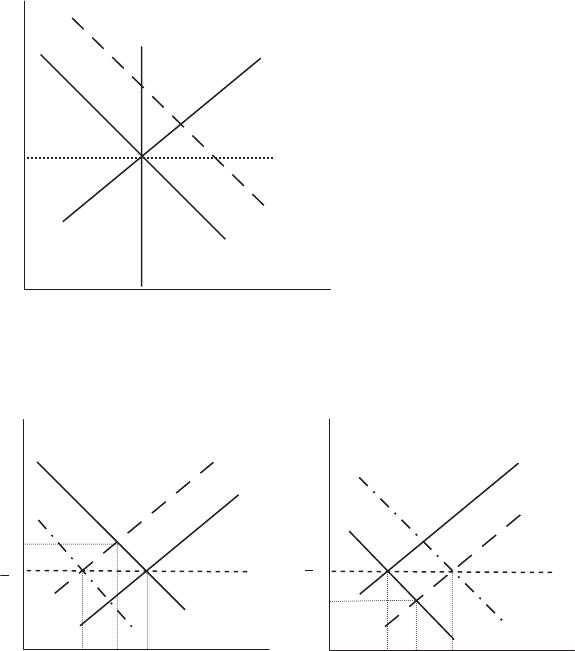
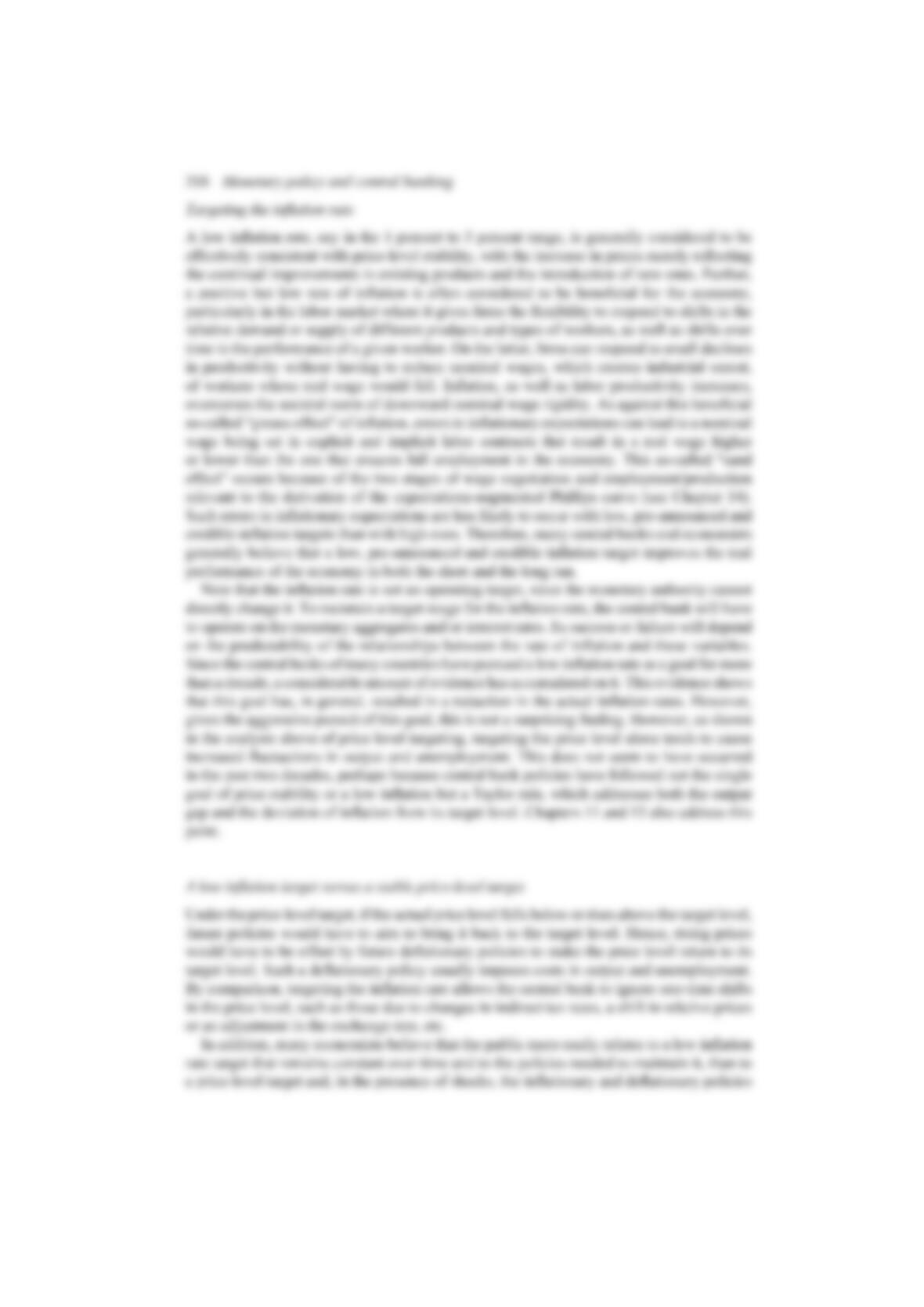
10.4.1 Diagrammatic analysis of the choice of the operating target of
monetary policy 310
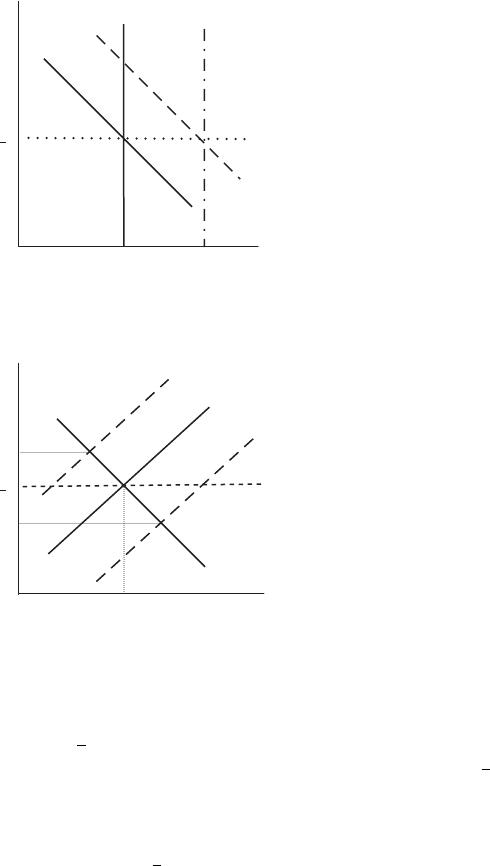
10.4.2 Analysis of operating targets under a supply shock 313
10.5 The price level and inflation rate as targets 316
10.6 Determination of the money supply 319
10.6.1 Demand for currency by the public 319
10.6.2 Commercial banks: the demand for reserves 322
xiv Contents
10.7 Mechanical theories of the money supply: money supply
identities 325
10.8 Behavioral theories of the money supply 327
10.9 Cointegration and error-correction models of the money
supply 331
10.10 Monetary base and interest rates as alternative policy
instruments 331
Conclusions 333
Summary of critical conclusions 334
Review and discussion questions 334
References 336
11. The central bank: Goals, targets and instruments 338
11.1 Historic goals of central banks 339
11.2 Evolution of the goals of central banks 342
11.3 Instruments of monetary policy 345
11.3.1 Open market operations 345
11.3.2 Reserve requirements 346
11.3.3 Discount/bank rate 348
11.3.4 Moral suasion 351
11.3.5 Selective controls 351
11.3.6 Borrowed reserves 352
11.3.7 Regulation and reform of commercial banks 352
11.4 Efficiency and competition in the financial sector: competitive supply
of money 353
11.4.1 Arguments for the competitive supplies of private monies 353
11.4.2 Arguments for the regulation of the money supply 354
11.4.3 Regulation of banks in the interests of monetary policy 354
11.5 Administered interest rates and economic performance 356
11.6 Monetary conditions index 357
11.7 Inflation targeting and the Taylor rule 358
11.8 Currency boards 359
Conclusions 360
Summary of critical conclusions 361
Review and discussion questions 361
References 362
12. The central bank: Independence, time consistency and credibility 364
12.1 Choosing among multiple goals 365
12.2 Conflicts among policy makers: theoretical analysis 368
12.3 Independence of the central bank 370
12.4 Time consistency of policies 373
12.4.1 Time-consistent policy path 374
12.4.2 Reoptimization policy path 376
Contents xv
12.4.3 Limitations on the superiority of time-consistent policies over
reoptimization policies 377
12.4.4 Inflationary bias of myopic optimization versus intertemporal
optimization 381
12.4.5 Time consistency debate: modern classical versus Keynesian
approaches 381
12.4.6 Objective functions for the central bank and the economy’s
constraints 382
12.5 Commitment and credibility of monetary policy 387
12.5.1 Expectations, credibility and the loss from discretion versus
commitment 387
12.5.2 Credibility and the costs of disinflation under the EAPC 391
12.5.3 Gains from credibility with a target output rate greater
than yf393
12.5.4 Analyses of credibility and commitment under supply shocks
and rational expectations 395
12.6 Does the central bank possess information superiority? 398
12.7 Empirical relevance of the preceding analyses 398
Conclusions 399
Appendix 401
Myopic optimal monetary policy without commitment in a
new Keynesian framework 401
Intertemporal optimization with commitment in a new
Keynesian framework 403
Summary of critical conclusions 403
Review and discussion questions 404
References 405
PART V
Monetary policy and the macroeconomy 407
13. The determination of aggregate demand 409
13.1 Boundaries of the short-run macroeconomic models 410
13.1.1 Definitions of the short-run and long-run in
macroeconomics 410
13.2 The foreign exchange sector of the open economy and the
determination of the exchange rate under floating exchange rates 411
13.3 The commodity sector 413
13.3.1 Behavioral functions of the commodity market 415
13.4 The monetary sector: determining the appropriate operating target of
monetary policy 418
13.5 Derivation of the LM equation 419
13.5.1 The link between the IS and LM equations: the Fisher equation
on interest rates 421
xvi Contents
13.6 Aggregate demand for commodities in the IS–LM model 421
13.6.1 Keynesian–neoclassical synthesis on aggregate demand in the
IS–LM model 424
13.7 Ricardian equivalence and the impact of fiscal policy on aggregate
demand in the IS–LM model 424
13.8 IS–LM model under a Taylor-type rule for the money supply 429
13.9 Short-run macro model under an interest rate operating
target 429
13.9.1 Determination of aggregate demand under simple interest rate
targeting 434
13.9.2 Aggregate demand under the Taylor rule 435
13.9.3 Aggregate demand under the simple interest rate target and
Ricardian equivalence 436
13.9.4 The potential for disequilibrium in the financial markets under
an interest rate target 436
13.10 Does interest rate targeting make the money supply
redundant? 439
13.11 Weaknesses of the IS–LM and IS–IRT analyses of aggregate
demand 440
13.12 Optimal choice of the operating target of monetary policy 441
Conclusions 444
Appendix 444
The propositions of Ricardian equivalence and the evolution of
the public debt 444
Summary of critical conclusions 446
Review and discussion questions 446
References 449
14. The classical paradigm in macroeconomics 451
14.1 Definitions of the short run and the long run 453
14.2 Long-run supply side of the neoclassical model 454
14.3 General equilibrium: aggregate demand and supply analysis 458
14.4 Iterative structure of the neoclassical model 461
14.4.1 The rate of unemployment and the natural rate of
unemployment 463
14.4.2 IS–LM version of the neoclassical model in a diagrammatic
form 465
14.5 Fundamental assumptions of the Walrasian equilibrium analysis 467
14.6 Disequilibrium in the neoclassical model and the non-neutrality
of money 468
14.6.1 Pigou and real balance effects 468
14.6.2 Causes of deviations from long-run equilibrium 470
14.7 The relationship between the money supply and the price level: the
heritage of ideas 471
Contents xvii
14.8 The classical and neoclassical tradition, economic liberalism and
laissez faire 472
14.8.1 Some major misconceptions about traditional classical and
neoclassical approaches 474
14.9 Uncertainty and expectations in the classical paradigm 475
14.10 Expectations and the labor market: the expectations-augmented
Phillips curve 476
14.10.1 Output and employment in the context of nominal wage
contracts 476
14.10.2 The Friedman supply rule 481
14.10.3 Expectations-augmented employment and output
functions 482
14.10.4 The short-run equilibrium unemployment rate and
Friedman’s expectations-augmented Phillips curve 483
14.11 Price expectations and commodity markets: the Lucas supply
function 485
14.12 The Lucas model with supply and demand functions 488
14.13 Defining and demarcating the models of the classical paradigm 492
14.14 Real business cycle theory and monetary policy 495
14.15 Milton Friedman and monetarism 497
14.16 Empirical evidence 501
Conclusions 503
Summary of critical conclusions 504
Review and discussion questions 505
References 507
15. The Keynesian paradigm 510
15.1 Keynesian model I: models without efficient labor markets 514
15.1.1 Keynesian deficient-demand model: quantity-constrained
analysis 517
15.2 Keynesian model II: Phillips curve analysis 522
15.3 Components of neoKeynesian economics 525
15.3.1 Efficiency wage theory 525
15.3.2 Costs of adjusting employment: implicit contracts and labor
hoarding 527
15.3.3 Price stickiness 528
15.4 New Keynesian (NK) macroeconomics 532
15.4.1 NK commodity market analysis 533
15.4.2 NK price adjustment analysis 534
15.4.3 Other reasons for sticky prices, output and employment 537
15.4.4 Interest rate determination 539
15.4.5 Variations of the overall NK model 543
15.4.6 Money supply in the NK model 544
15.4.7 NK business cycle theory 548
xviii Contents
15.5 Reduced-form equations for output and employment in the Keynesian
and neoclassical approaches 549
15.6 Empirical validity of the new Keynesian ideas 551
Conclusions 552
Summary of critical conclusions 556
Review and discussion questions 557
References 561
16. Money, bonds and credit in macro modeling 563
16.1 Distinctiveness of credit from bonds 570
16.1.1 Information imperfections in financial markets 570
16.2 Supply of commodities and the demand for credit 575
16.3 Aggregate demand analysis incorporating credit as a
distinctive asset 577
16.3.1 Commodity market analysis 577
16.3.2 Money market analysis 577
16.3.3 Credit market analysis 579
16.3.4 Determination of aggregate demand 581
16.4 Determination of output 582
16.5 Impact of monetary and fiscal policies 583
16.6 Instability in the money and credit markets and monetary
policy 585
16.7 Credit channel when the bond interest rate is the exogenous monetary
policy instrument 587
16.8 The informal financial sector and financial underdevelopment 588
16.9 Bank runs and credit crises 588
16.10 Empirical findings 589
Conclusions 591
Appendix A 592
Demand for working capital for a given production level in
a simple stylized model 592
Appendix B 593
Indirect production function including working capital 593
Summary of critical conclusions 595
Review and discussion questions 595
References 596
17. Macro models and perspectives on the neutrality of money 599
17.1 The Lucas–Sargent–Wallace (LSW) analysis of the classical
paradigm 600
17.2 A compact (Model II) form of the LSW model 605
17.3 The Lucas critique of estimated equations as a policy tool 606
Contents xix
17.4 Testing the effectiveness of monetary policy: estimates based on the
Lucas and Friedman supply models 607
17.4.1 A procedure for segmenting the money supply changes into
their anticipated and unanticipated components 608
17.4.2 Separating neutrality from rational expectations: Mishkin’s
test of the Lucas model 610
17.5 Distinguishing between the impact of positive and negative money
supply shocks 611
17.6 LSW model with a Taylor rule for the interest rate 612
17.7 Testing the effectiveness of monetary policy: estimates from
Keynesian models 615
17.7.1 Using the LSW model with a Keynesian supply
equation 615
17.7.2 Gali’s version of the Keynesian model with an exogenous
money supply 616
17.8 A compact form of the closed-economy new Keynesian model 618
17.8.1 Empirical findings on the new Keynesian model 619












































t.





































































t).