1
MODULE 6
Onboarding, Training, and Developing Employees
INTRODUCTION
When we talk about onboarding, socializing, orienting, training, and developing
employees, we refer to a process of helping new employees adapt to their organizations and
work responsibilities. These programs are designed to help employees understand what
working is about in the organization and help them become fully productive as soon as
possible. Research shows that when the socialization or onboarding process is done
correctly, the results include higher employee job satisfaction, lower turnover, better
performance, and lowered stress for new employees.
In this chapter, we’ll explore the arena of socializing, orienting, training, and
developing employees. We’ll first look at the socialization process and what organizations
should do when employees first join them. We’ll then explore training and development
efforts designed to ensure a supply of highly skilled employees.
Onboarding
Onboarding or socialization, frequently called socialization, refers to the process of
helping employees adapt to a new job and new organizational culture. It includes new
employee orientation, but is a more comprehensive approach aimed at helping new
employees make a connection right away in order to reduce costly turnover. Organizations
with effective onboarding procedures not only reduce turnover, they also increase new
employee productivity, engagement, and success.
HRM’s Role in the Onboarding Process
As soon as job offers are made and accepted, HRM should begin the process of helping
new employees assimilate into the organization. New employees have many concerns and
questions and HRM needs to initiate communication with the new employee as quickly as
possible. Most organizations prepare a package for new employees. This package generally
focuses on important decisions a new employee must make such as health insurance plans,
setting up direct deposit of paychecks, and tax‐withholding information. More
comprehensive onboarding plans also communicate the organization’s culture and extend
the process of orientation and socialization beyond the first few days on the job.
Onboarding and Socialization
Through the recruiting process, the new hire developed an impression of the
employer’s employment brand. As soon as the employment offer is accepted, the new hire
starts to evaluate whether the reality of the new job matches the brand and claims of the
recruiter. Socialization is the part of the onboarding process that assists new employees to
become familiar with the organizational culture, or what it’s really like to be part of the
organization. Several assumptions underlie the process of socialization: socialization
strongly influences employee performance and organizational stability, new members suffer
from anxiety, socialization needs to be consistent with culture and individuals adjust to new
situations in remarkably similar ways. Let’s look a little closer at each of these assumptions
Socialization Strongly Influences Employee Performance
Your work performance depends to a considerable degree on knowing what you
should or should not do. Understanding the organizational culture promotes positive work
behaviors and a good fit with coworkers.
Learning Culture through Socialization
Organizational cultures are the values and behaviors that make it unique, much the
same way people have personalities. Organizational culture is a system of shared meaning.
2
Just as countries, ethnic groups, and religions have cultures that dictate how each member
should act toward fellow members and outsiders, organizations have cultures that govern
how their members should behave. An employee who has been properly socialized to the
organization ’ s culture understands how work is done, what matters, and which work‐
related behaviors and perspectives are or are not acceptable and desirable. In most cases,
this involves input from many individuals.
Socializing new employees with a new organizational culture can be thought of as a
three‐stage process made up of three stages: pre‐arrival, encounter, and metamorphosis. 6
These three stages ultimately affect new employees’ productivity on the job, their
commitment to the organization’s goals, and their decision to remain with the organization
Pre‐arrival
The pre‐arrival stage recognizes that each individual arrives with a set of
expectations about organizational values, attitudes, and culture. Effective recruiting and
selection help ensure that the employee chosen will fit the organization’s culture and
mission. Employee B ’ s employer understood that it is important to keep the new hire
interested by initiating contact as soon as the job offer is accepted. Ways to maintain contact
and begin the onboarding process can include mailing small gifts such as shirts or backpacks
emblazoned with the company logo, but it doesn’t take a large employer with a big budget to
start the onboarding process effectively.
Encounter
During the encounter stage, new hires may compare expectations about the job,
coworkers, supervisors, and the organization with the reality of working there. Hopefully,
reality fulfills those expectations. If expectations and reality differ, the socialization process
may explain the importance of the culture in accomplishing organizational objectives and
core values. Socialization, however, cannot solve all expectation differences. At the extreme,
some new members may become totally disillusioned with the actualities of their jobs and
resign. Proper selection, including realistic job previews and education about the company
mission and culture, can significantly reduce this.
Metamorphosis
Finally, the new members must work out any problems discovered during the
encounter stage. This may mean going through changes, called the metamorphosis stage,
meaning the point when new members become comfortable with the organization and their
work teams. They internalize coworker and organization norms, and feel accepted by their
peers as trusted and valued individuals. They will feel competent to complete their jobs
successfully. They have an understanding of what criteria will be used to measure and
appraise their work. Consequently, successful metamorphosis should have a positive effect
on new employees’ productivity, the employee’s commitment to the organization, and
should reduce the likelihood that the employee will leave the organization any time soon.
New‐Employee Orientation
New‐employee orientation is the part of the onboarding process that introduces the
new employee to the organization and to the individuals in his or her work unit. It expands
on information received during the recruitment and selection stages and helps reduce the
initial anxiety employees usually feel when beginning a new job.
For example, an orientation program should familiarize the new member with the
organization’s objectives, history, philosophy, procedures, and rules; communicate relevant
HRM policies such as work hours, pay procedures, overtime requirements, and company
benefits; review the specific duties and responsibilities of the new member’s job; provide a
tour of the organization’s physical facilities; and introduce the employee to his or her
manager and coworkers. Who is responsible for orienting the new employee? This can be
3
done by the new employee’s supervisor, by the people in HR, through computer‐based
programs, or by some combination of methods. In many medium‐sized and most large
organizations, HRM takes charge of explaining such matters as overall organizational
policies and employee benefits. In other medium‐sized and most small firms, new employees
will receive their entire orientation from their supervisor or be exposed to an orientation
program online via the HRIS system.
If orientation becomes the responsibility of the supervisor, there should be some
training for that supervisor to ensure that the new employee has a thorough orientation that
goes beyond where to park and when payday is. Remember, even small organizations need
to understand the benefits of effective onboarding.
Designing Employee Training
Employee training is a learning experience that teaches new skills, knowledge,
attitudes, and behaviors necessary for successful job performance. Training focuses on
enhancing those specific skills and abilities needed to perform currently held positions. For
example, suppose you enter the job market during your senior year of college, pursuing a job
as a marketing representative. Despite your degree in marketing, you will need some
training to learn the company’s policies and practices, product information, and other
pertinent selling practices. This is job‐specific training, designed to make you more effective
in your current job.
As jobs and job descriptions are designed to fulfill the organizational goals and
strategy, training must be designed to provide employees with the skills and attitudes
necessary for success in those jobs. For example, a technology company that depends on
innovative and creative employees must recruit, hire, and train individuals capable of
successfully meeting the challenge of those jobs. One model of instructional design used to
focus training efforts on strategy is the ADDIE model, which stands for Analyze, Design,
Develop, Implement, and Evaluate.
1. Analyze
Once jobs have been designed to align with the organizational strategy, HRM needs
to determine how effectively employees in those jobs are accomplishing the necessary tasks.
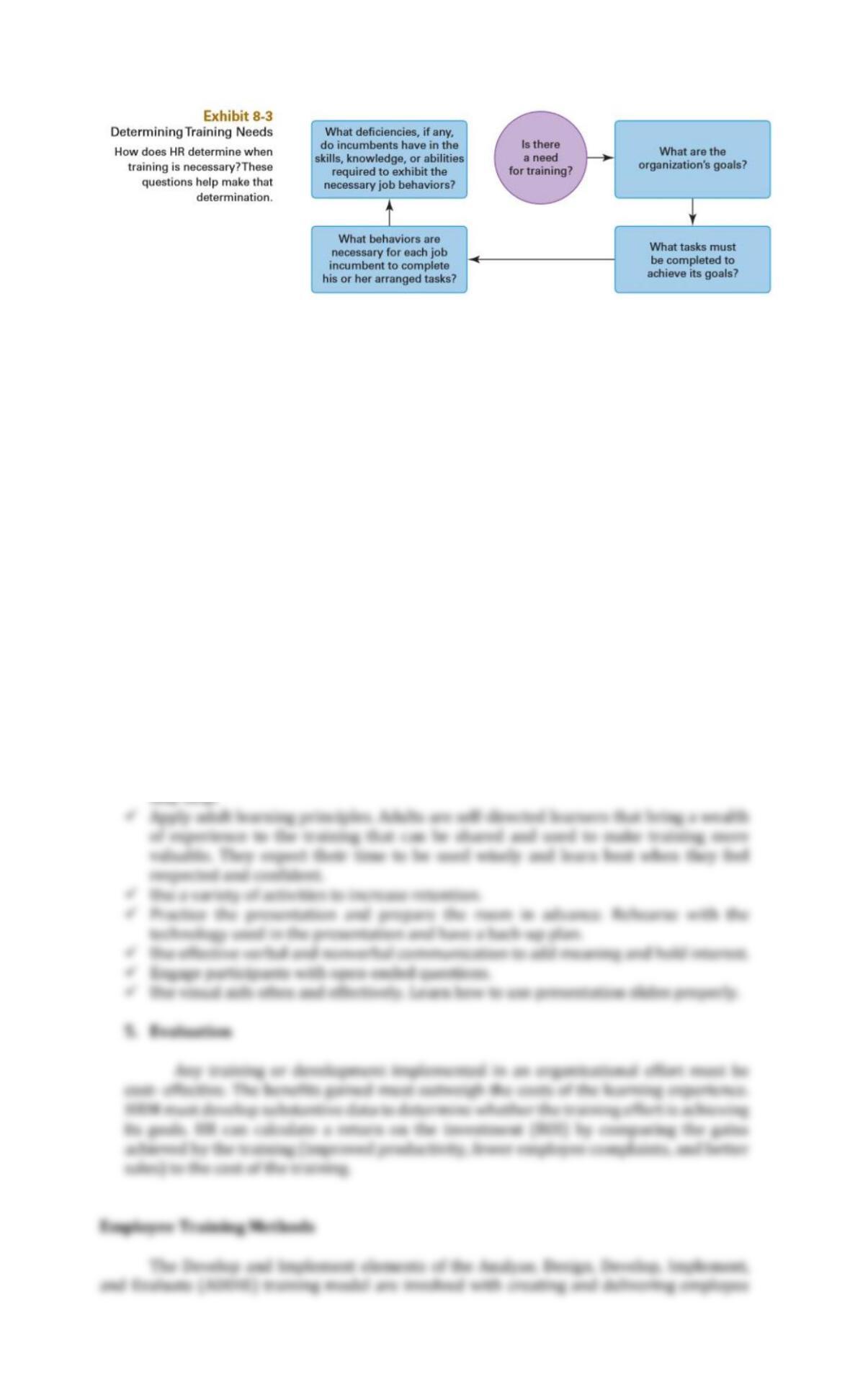
If deficiencies are discovered, HRM may conduct a task analysis on the job itself to determine
if the tasks are appropriate to complete the job successfully. A person analysis may also be
conducted to determine which employees need additional training. The questions in Exhibit
8-3 suggest the kinds of signals that can warn a manager when training may be necessary.
Decreased production, lower quality, more accidents, and higher scrap or rejection rates are
indicators that worker skills need to be fine‐tuned. Changes imposed on employees as a
result of job redesign or improved technology also require training.
2. Design
The results of the analysis are used to plan training that corrects deficiencies.
Effective training design establishes training objectives that will be used to measure the
results of the training, much the same way the learning objectives at the beginning of each
chapter of this textbook are used to plan and evaluate student learning. It is not adequate to
say we want change in employee knowledge, skills, attitudes, or behavior; we must clarify
what is to change and by how much. These goals should be tangible, verifiable, timely, and
measurable.
4
3. Develop
HRM then develops a format to deliver the training in the most effective way,
considering the tasks to be learned and the target audience for the training. Instructional
materials are created or purchased and an appropriate setting is selected. Trainers should
be selected and coached in effective training methods. The old saying, “If the only tool you
have is a hammer, then you tend to see every problem as a nail,” is quite applicable to
employee training. If you’re familiar with one type of training, such as classroom lectures, it
may seem to be a good way to deliver training for many types of topics. However, what works
best for teaching one type of skill may not work well for another. For example, teaching
employees computer skills necessary for a newly automated process would require much
different training methods than teaching employees about the skills and attitudes necessary
for better customer service, diversity training, or preventing sexual harassment.
4. Implement
This step is where the actual training takes place. Trainers conduct the selected
training activities with employees needing to learn specific skills and attitudes. A few basic
principles can make training more effective.
Know the audience. Understanding the age, gender, background, attitudes, education,
and training needs will help trainers tailor the training session to their needs. If the
information isn’t available prior to training, introductions or an ice‐breaker activity