2. 3.
Sample Questions from previous final problem sets 574 – 2021
1. The SlowState (SloSt) provides express small package delivery overnight. Airplanes arrive 24/hrs a day
at its national hub, where their contents are unloaded onto small 4-wheeler trucks, each capable of
holding 1,000 packages. The trucks transport the packages to the sorting center. After being sorted,
another fleet of trucks transports the packages to the outgoing planes. From here on, we will restrict
ourselves to the receiving process only.
During the day (6am-6pm), airplanes arrive at a high rate providing an approximately continuous arrival
flow of packages with an average rate of 25,000 parcels/hour. During the night (6pm-6am), however, air
landings are slower, resulting in an average arrival rate of 5,000 parcels/hour. SloSt runs two 12-hour
shifts for its sorting center: the day shift starts at regular business opening time of 8am and leaves by
8pm [crews are staggered in four-day weeks]. The day shift has the largest amount of employees and
can process up to 20,000 parcels/hour. The night shift, on the other hand, is smaller and can process up
to 10,000 parcels/hour from 8pm-8am. It is known that the trucks typically had to wait to unload at the
sorting center during a portion of the day shift. This happens when the total storage area (designed to
store up to 50,000 parcels) of the unloading zone at the sorting center is full. Truck drivers were paid
$10/hour, benefits included.
Two former Rice MBA students fondly recalled their operations class and proposed two possible
improvements:
1. Increase the unloading storage area so that it can store an additional 15,000 parcels.
2. Run 3 shifts: 2 new days shifts (8am-4pm and 4pm-10pm) processing 20,000 parcels/hour and 1
new night shift (10pm-8am) processing 10,000 parcels/hour.
Questions:
a. On the grid, draw the parcel inventory build-up diagram of SloSt’s receiving process under
current operating procedures AND under the two proposals (identify the three scenarios).
b. As soon as the storage bins are full, trucks must wait. When does the first truck wait under each
scenario?
c. Qualitatively, how do the two proposals impact the total truck waiting time?
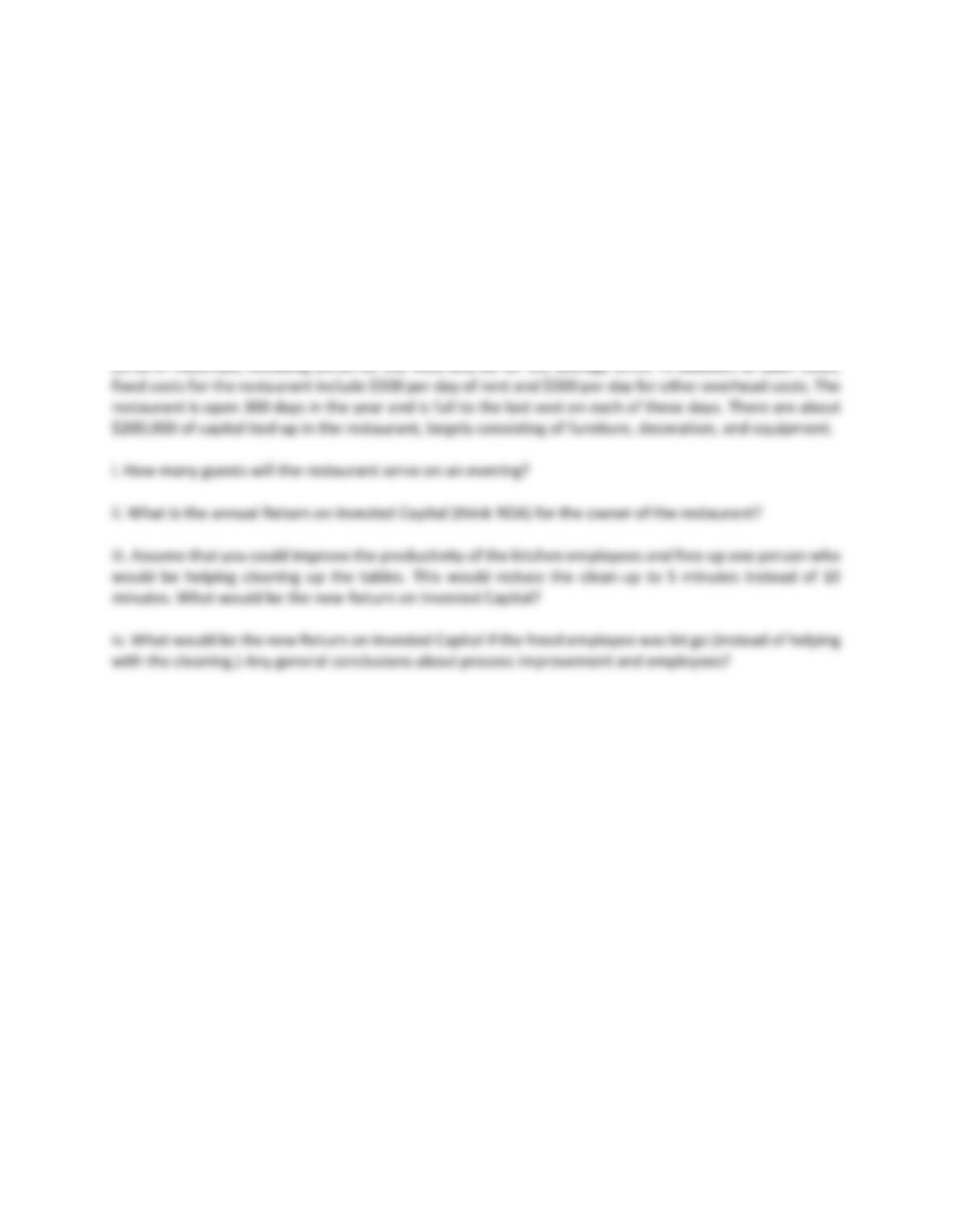
2. Penne Pesto is a small restaurant in the Montrose area. Customers order from a variety of pasta dishes.
The restaurant has 50 seats and is always full during the four hours of operations in the evening.
It is not possible to make reservations at Penne, most guests show up spontaneously on their way home
from work. If there is no available seat, guests simply move on to another place. On average, a guest
spends 50 minutes in the restaurant, which includes 5 minutes until the waiter has taken the order, an
additional 10 minutes until the food is served, 30 minutes to eat, and 5 minutes to handle the check-out
(including waiting for the check, paying, and leaving). It takes the restaurant another 10 minutes to clean
the table and have it be ready for the next guests (of which there are always plenty).The average guest
leaves $20 at Penne, including food, drink, and tip (all tips are collected by the restaurant, employees get
a fixed salary). The restaurant has 10 waiters and 10 kitchen employees, each earning $90 per evening
(including any preparation, the 4 hours the restaurant is open, and clean-up). The average order costs