23-Aug-16
1
BITS Pilani
Pilani Campus
Fluid Mechanics (CHE F212)
Amit Jain, Ph.D.
Dept. of Chemical Engg.
BITS Pilani – Pilani Campus
BITS Pilani
Pilani Campus
Introduction

23-Aug-16
2
amitjain@pilani.bits-pilani.ac.in
3
•Fluid mechanics is the discipline that is concerned
with the behavior of liquids and gases at rest or in
motion.
•Traditional applications:
• Design of canals and dams;
• Design of pumps, compressor, pipes and ducts; etc.
•Other exciting applications:
• Energy generation from ocean waves;
• Biomechanics (e.g. artificial hearts and valves)
• Smart fluids (e.g. military uniform)
• Microfluids (e.g. extremely precise drug administration)
Introduction
amitjain@pilani.bits-pilani.ac.in
4
•A solid is “hard” and not easily deformed,
whereas a fluid is “soft” and is easily deformed.
•A closer look at the molecular level:
• Solid has densely packed molecules with large
intermolecular cohesive forces that allow the solid to
maintain its shape, and to not be easily deformed.
• Fluid molecules are spaced farther apart, the
intermolecular forces are smaller than for solids, and
the molecules have more freedom of movement.
Solids Vs Fluids
23-Aug-16
3
amitjain@pilani.bits-pilani.ac.in
5
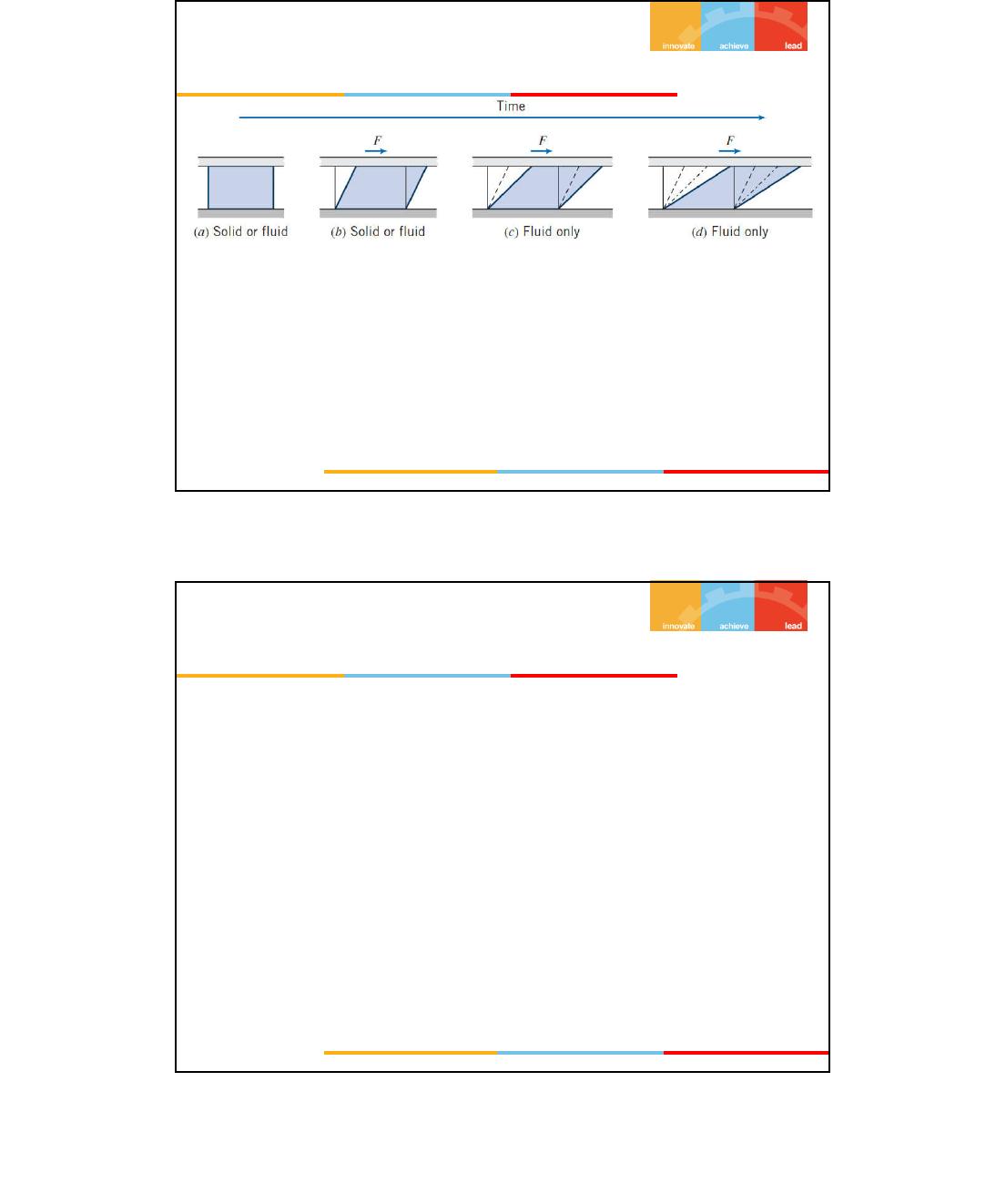
•A fluid is a substance that deforms continuously
under the application of a shear (tangential) stress
no matter how small the shear stress may be.
OR
A fluid is any substance that cannot sustain a
shear stress when at rest.
Defining: Fluid
amitjain@pilani.bits-pilani.ac.in
6
•Note: A fluid in contact with a solid surface does
not slip – it has the same velocity as that surface
because of the no-slip condition, an experimental
fact.
•Solids are referred to as elastic, whereas fluids
being viscous.
•Few substances are both springiness and friction
and are viscoelastic.
No–Slip Condition

23-Aug-16
amitjain@pilani.bits-pilani.ac.in
7
The basic laws, which are applicable to any fluid,
are:
1. The conservation of mass
2. Newton’s second law of motion
3. The principle of angular momentum
4. The first law of thermodynamics
5. The second law of thermodynamics
Applicable Laws
8
System Approach Vs