CHAPTER 1: THE CORPORATION AND FINANCIAL MARKETS
➢ THREE TYPES OF FIRMS
▪ Sole Proprietorships: business owned and run by one person, small in terms of revenues
and profits produced and people employed.
Characteristics:
✓ Advantage: straightforward to set up.
✓ Principal limitation: no separation between the firm and the owner, business income is
taxed at the personal level. If there are other investors, they cannot hold an ownership
stake in the firm.
✓ Owner has unlimited personal liability for any of the firm’s debts. If the firm defaults on
any debt payment, the lender can (and will) require the owner to repay the loan from
personal assets.
✓ The life of the business is limited to the life of the owner.
▪ Partnerships: similar to a sole proprietorship but it has more than one owner.
Characteristics:
✓ Income is taxed at the personal level and split among partners according to their
ownership in the partnership.
✓ All partners has unlimited personal liability.
✓ The partnership ends on the death or withdrawal of any single partner. However,
liquidation can be avoided if the partnership agreement provides alternatives.
→ Limited partnership: partnership with two kinds of owners: general partners (personally
liable for the firm’s debt obligations) and limited partners (have limited liability, it is limited
to their investment).
▪ Corporations: legally defined, artificial being (a judicial person or legal entity), separate from
its owners. Owners have limited liability, not liable for any obligations.
✓ Formation: articles of incorporation must be filled with the relevant registrar of
corporations.
✓ Ownership: no limit on the number of owners a corporation can have. The entire
ownership stake of a corporation is divided into shares known as stock. Shareholders
are entitled to dividend payments and usually receive voting rights and dividend rights
proportional to the amount of stock they own.
→ Tax implication for corporate entities: shareholders of a corporation pay taxes twice
(corporate tax rate and tax rate on dividend income outside the tax-free savings account
TFSA).
→ Canada allowed and exemption from double taxation for certain flow through entities:
– Business income trust: holds all the debt and equity securities of a corporation
in trust for the trust’s owners, called the unit holders.
– Energy trust: either holds resource properties directly or holds all the debt and
equity securities of a resource corporation within the trust.
– Real State investment trust (REIT): either holds real state properties directly or
holds all the debt and equity securities of a corporation that owns real state
properties.
➢ OWNERSHIP VERSUS CONTROL OF OPERATIONS
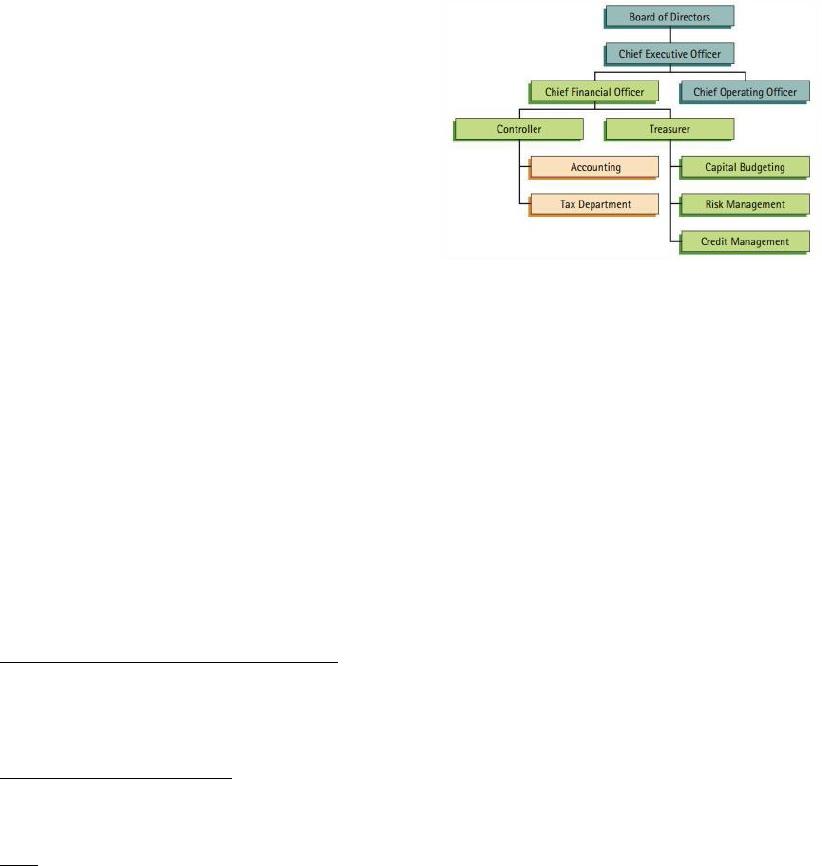
In a corporation, direct control and ownership are
often separate. The board of directors and CEO
possess direct control of the corporation. CFO
responsibilities: investment decisions, financing
decisions, cash management. Goal that unites
shareholders: shareholder wealth maximization
(they all benefit from a higher stock price).
Principal-agent problem: when managers put their
own self-interes ahead of the interest of shareholders.
CEO’s performance: when the stock performs poorly, the BoD might react by replacing CEO.
Shareholders vs stakeholders: each have an interest in how the corporation operates. The
stakeholder satisfaction view is the idea of corporate social responsibility.
Corporate bankruptcy: management is given the opportunity to reorganize the firm and
renegotiate with debt holders. If this process fails, control of the corporation generally passes
to the debt holders. Liquidation: shutting down the business and selling off its assets.
➢ THE STOCK MARKET
Private companies: have a limited set of shareholders and their shares are not traded regularly
Public companies: their shares are trade on organized markets called stock markets (or stock
exchanges). These markets provide liquidity and determine a market price for the company’s
shares.
▪ Primary and secondary stock markets: Primary market: when a corporation itself issues new
shares of stock and sells them to investors. Secondary market: after that initial transaction,
shares continue to trade in a secondary market between investors without involvement of
the corporation.
▪ The largest stock markets: New York Stock Exchange (NYSE), Japan Exchange Group (Tokyo),
the Shanghai Stock Exchange and the Hong Kong Exchange. In Canada: TSX (11th largest
exchange).
▪ TSX: is an electronic exchange. Bid price: highest price being quoted to buy a stock. Ask
(offer) price: lowest price being quoted to sell a stock.
→ Dark pools: alternative trading systems where limit order books are not visible.
➢ FINTECH: FINANCE AND TECHNOLOGY
→ Blockchain technology allows a transaction to be recorded in a publicly verifiable way without
the need for a trusted third party to certify the authenticity of the transaction.
→ Bitcoin: the world’s first cryptocurrency. All bitcoin transactions are recorded in a public
ledger using blockchain technology, allowing individuals to create and trade bitcoins and to
verify those transactions digitally.
→ Computer assisted trading system CATS: first fully automated trading system.
→ Robo-advisors: human financial advice replacement.
→ Big Data: use of data and technology to predict price changes in the market (use of pattern
recognition softwares, computer algorithms).
→ Machine learning: start ups in lending and insurance industries (use of basic credit scores).
CHAPTER 3: ARBITRAGE AND FINANCIAL DECISION MAKING
➢ VALUING DECISIONS
1. Analyzing cost and benefits: identify, quantify, compare and evaluate them in the same terms:
cash today.
2. Using market prices to determine cash values: whenever a good trades in a competitive market,
that price determines the cash value of the good. By evaluating costs and benefits using
competitive market prices, we can determine whether a decision will make the firm and its
investors wealthier.
→ Valuation Principle: the value of an asset to the firm or its investors is determined by its
competitive market price. The benefits and costs of a decision should be evaluated using these
market prices, and when the value of the benefits exceeds the value of the costs, the decision will
increase the market value of the firm.
When competitive market prices are not available, it can depend on people’s preferences for the
good.