MGT2LQM – Leadership, What Matters Notes
Lecture 1: Overview
‘Leadership is about making others better as a result of your presence and making sure that impact
lasts in your absence’ – Harvard Business School 2013
Effective Leaders:
o Ability to inspire & stimulate others to achieve worthwhile goals
• Focus attention through a compelling vision
• Communicate meaning to their followers
• Develop trust through reliability and integrity
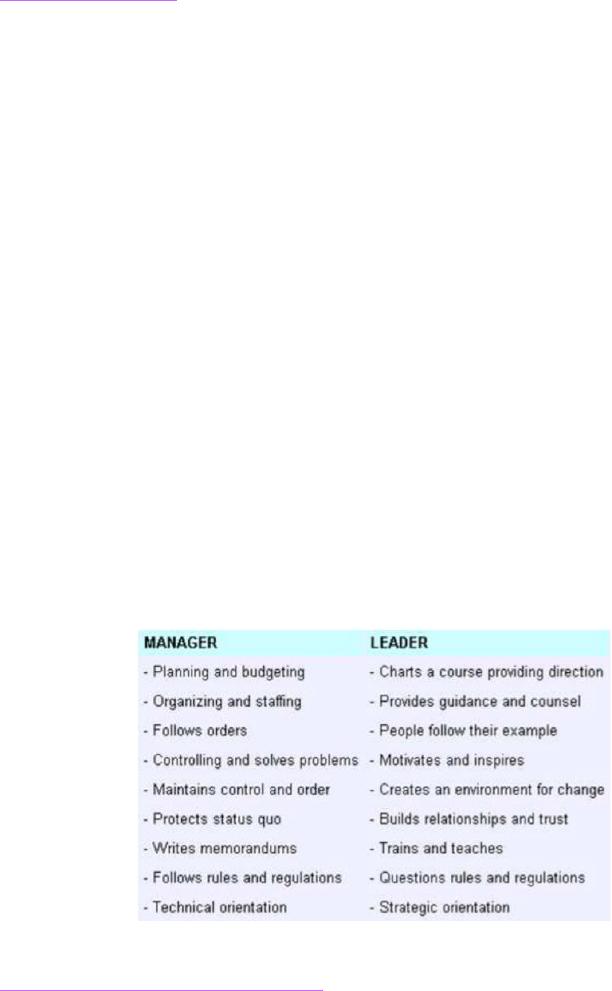
Management VS Leadership
Management:
o An explicit set of tools and techniques (i.e. planning & budgeting)
o Implementing vision
Leadership:
o Having a creative vision of what the org can become
o Focuses on people, motivating and inspiring
o Produces change
Lecture 2: Leadership characteristics
LEADERSHIP CHALLENGES IN GLOBAL CONTEXT
• IT revolution
• Cross-culture nature of business activity
• Increased concerns about social responsibility and the environment
• Expectation that the leader is the hero who will save the day (ego)
• Globalisation
ATTRIBUTION THEORY
Theory – logical argument/framework designed to explain why certain things happen.
** Assumptions underlie the belied that leaders affect the performance of organisations
• Leadership is based on perception
• Attribution is our judgement about whether a person is a leader or not
Theory explains the process we go through to understand organisational events
Explanation – Attribute causality to leaders (i.e. if a company is doing well then it is largely because
the leader is effective – Leader’ causes’ company success
Vice versa – If a company is performing poorly then people attribute this to failings in the leadership.
That is, the company is doing badly because the leader is ineffective)
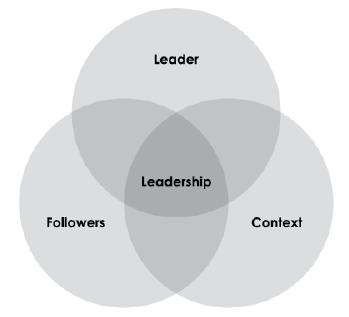
FRAMEWORK FOR UNDERSTANDING LEADERSHIP
1. Leadership theoretical approaches:
1990-1940s –
o Great man Theory/Trait Theory
1940s-1950s –
o Behavioural theories
1960s-
o Contingency theories
1970s- 1990s –
Transactional and Transformational leadership
2000s – Values based leadership
2. Followers (stakeholders)
What followers expect from leaders
o Ability to see the long term and communicate well
o Self-awareness; trustworthiness
o Ability to create vision
o Understanding of organisational culture
o Integrity, enthusiasm, ability to take and give feedback
3. Context (situation)
Factors influence type of leadership required at any time
o Internal/external environment
o Stable/Unstable, uncertain, constantly changing
o Centralised/decentralising
o Formal/Informal
o Complex/simple
Responsible Leadership
– Generate sustainable value for business and society at large – work for an inclusive and
sustainable global economy
– Embody the values of global social responsibility as portrayed an international initiative (UN
Global Compact)

– Create sustainable social, environmental and economic value
– Actively explore how to meet the challenges of meeting social and environment.
Responsibilities
– Act in a socially and environmentally responsible way
LEADERSHIP THEORETICAL APPROACHES/ EARLY VIEWS
1990’S 1940S – Great man/ Trait theory
Suggests that to be a leader one needs to be:
– Be born with a certain set of leadership characteristics
– Characterised by a list of whether you’re a leader or not
– Leaders rise when confronted with the appropriate situation
TRAIT THEORY
• Traits – personal/individual features or characteristic combined to make up a
personality.
‘Personality is a consistent psychological pattern that describes the way we interact with other sand
situations’.
Identifying measurable traits: 2 approaches
1. Traits of leaders against followers
2. Traits of effective leaders against ineffective leaders
FLAWS OF THIS THEORY
• One size doesn’t fit all, characteristics vary/ not one official list
• Can’t develop as a leader
COMPONENTS OF LEADERSHIP
BE – KNOW – DO
• BE – character- what you stand for
• KNOW – Interpersonal, conceptual, technical and tactical skills
• DO – Practice – Inspire, Care, Challenge
o Leadership skills can be developed
o Learning self-discipline, from experience & education
o Leadership development programs (feedback, skill-based programs, personal growth
programs)
o Mentoring (informal relationship)
o Executive coaching (focuses on specific, clearly articulated outcomes)
UNDERSTANDING LEADERSHIP – THEORETICAL APPROACHES
– Traits/Individual characteristics – cognitive, motivational and personally
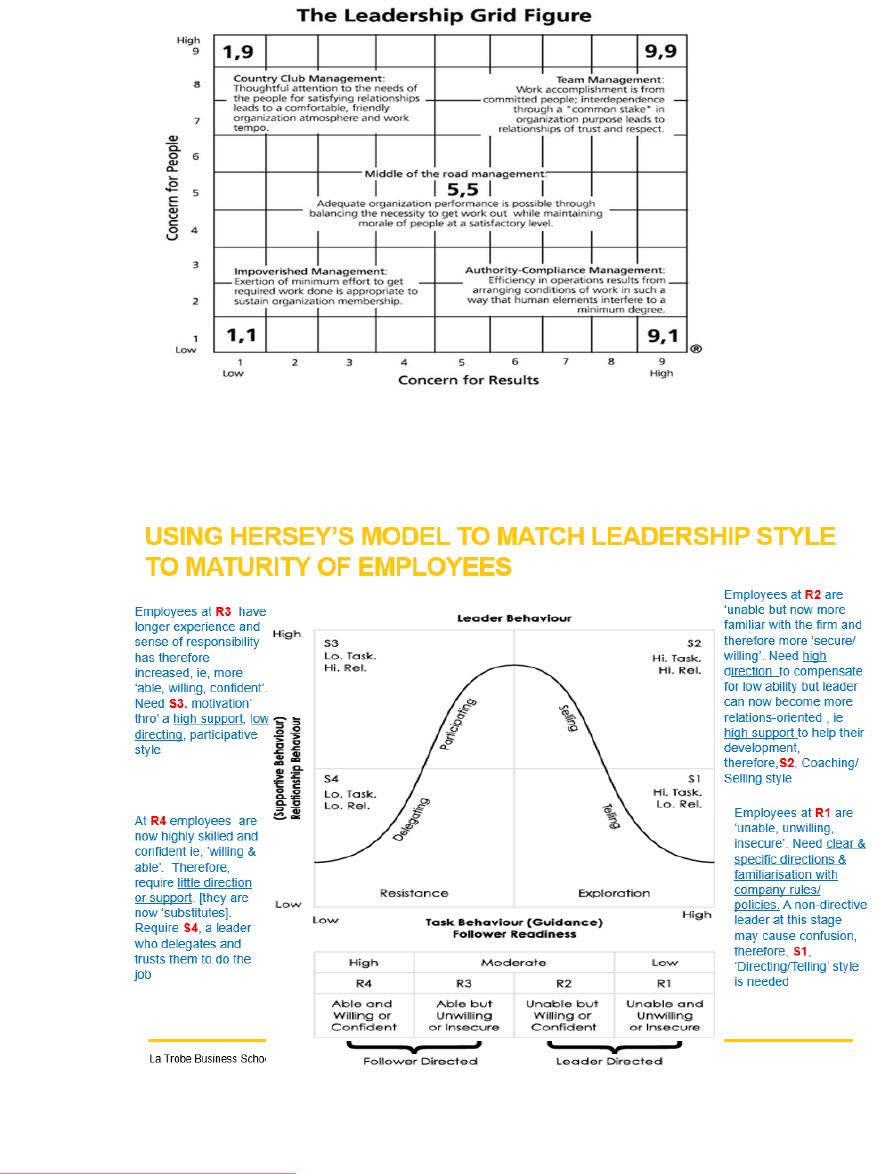
– Blake and Mouton 1995: Leader behaviour styles (managerial grid)
–
– Contingency/situational approaches (Hersey-Blanchard Situational leadership Model 98’)
Lecture 3: Behavioural leadership
BEHAVIOURAL/STYLE APPROACH
‘Consistent behaviours or actions that are seen by others as representing a leader’s style’.
1. Relationship/people- orientated behaviours – concern for people and building relationships.
2. Production/task orientated behaviours – concerned for production
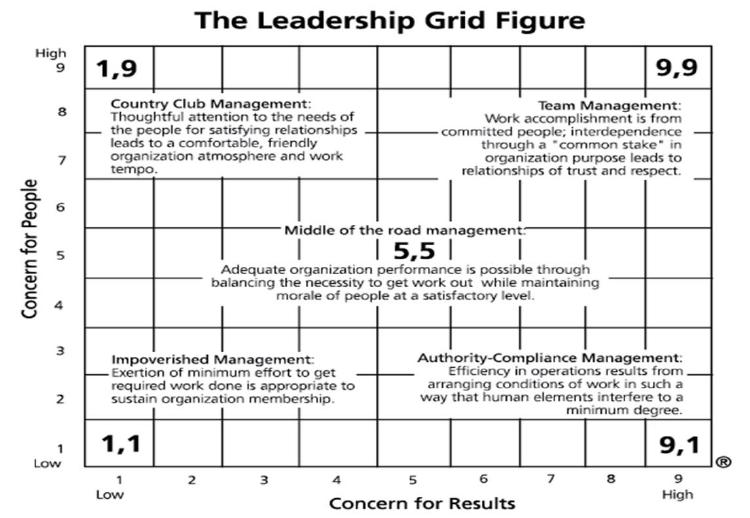
LEADERSHIP GRID
– Leaders can examine how behaviours promote or hinder organisational performance
o Team management (9,9) is often considered the most effective style and is recommended
because organisation members work together to accomplish tasks.
o Country club management (1,9) occurs when primary emphasis is given to people rather than
to work outputs.
o Authority-compliance management (9,1) occurs when efficiency in operations in the
dominant orientation.
o Middle-of-the-road management (5,5) reflects a moderate amount of concern for both
people and production.
o Impoverished management (1,1) means the absence of a leadership philosophy; leaders exert
little effort on interpersonal relationships or work accomplishment.
LIKERT’S SYSTEM OF LEADERSHIP MODEL
Devised by Likert in 1967
– Same basic factors of concern for production and people
– Devised a 4-level model of leader effectiveness by classifying behaviour into ‘4 systems’ –
System 1 (Autocratic) – Manager is authoritarian and exploitive of the work team members
System 2 (Benevolent) – Manager is paternalistic in style – withholding delegation in the best
interests of the work team.
System 3 (Participative) – Manager is participative in style. The manager consults with team members
but retains the right to make the final decision
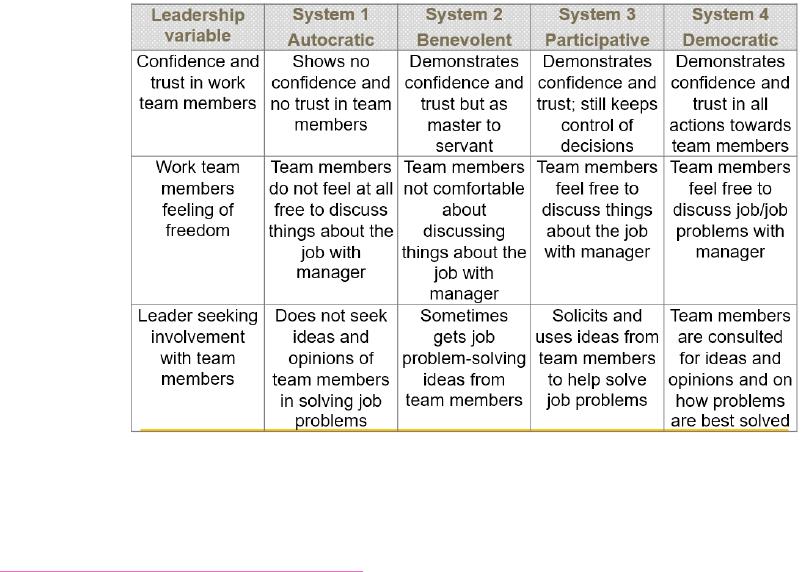
System 4 (Democratic) – Manager is democratic in style – The manager leads by giving direction to
the work team and allowing team members to make decisions by consensus.
Lecture 4: Situational leadership theories
FIELDERS CONTIGENCY MODEL 1967 (LEAST PREFERRED CO-WORKER)
Match between leader’s style of interacting with their followers and the degree to which the situation
allows the leader to control and influence others
– Key factor in leadership success was an individual’s basic leadership style, either task or
relationship oriented
– Either style can be successful if used in the appropriate situation
– Fielder’s questionnaire (Least Preferred Co–worker) ID’s whether the leader is relationship or
task orientated.
3 contingency dimensions that defined the key situational factors for determine leader effectiveness
were:
1. Leader – member relation (how well they get along)
2. Task structure (clear procedures, Goals of the jobs are defined)
3. Position power (level of leader’s authority)
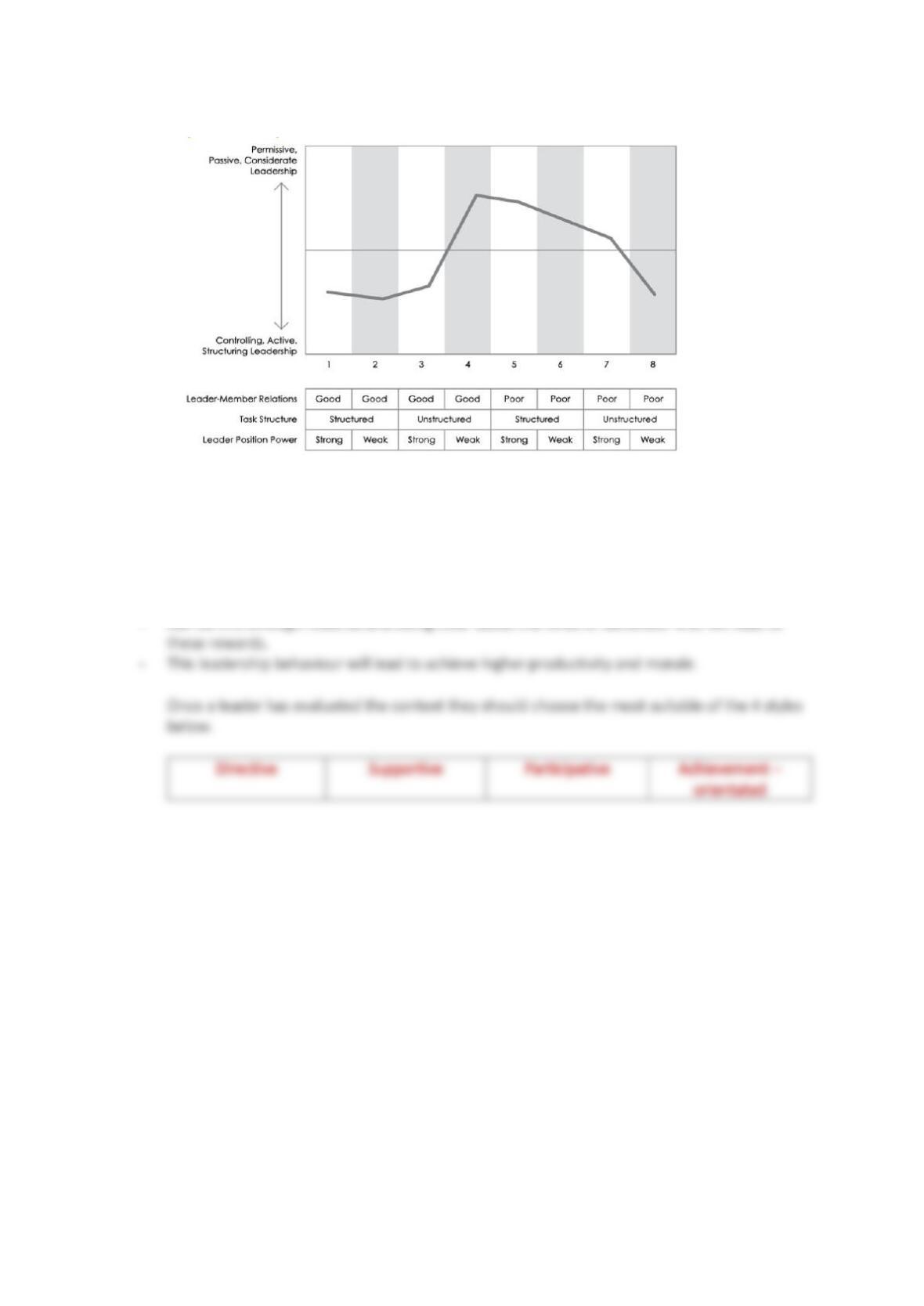
Least Preferred Co-worker Model (Fielder)
SITUATIONAL/CONTINGENCY APPROACH – THE PATH GOAL MODEL (HOUSE & MITCHELL
1974)
Specifies the leader’s role as needing to clarify for workers the best path to achieve particular
goals.
– Goals include completing a particular task, locating information, disseminating knowledge,
improving work processes.