Chapter 6 : Interest Rates and Bond Valuation
• The interest rate is usually applied to debt instruments such as bank loans
or bonds; the compensation paid by the borrower of funds to the lender;
from the borrower’s point of view, the cost of borrowing funds.
• The required return is usually applied to equity instruments such as
common stock; the cost of funds obtained by selling an ownership interest.
• Several factors can influence the equilibrium interest rate:
• Inflation, which is a rising trend in the prices of most goods and
services.
• Risk, which leads investors to expect a higher return on their
investment
• Liquidity preference, which refers to the general tendency of
investors to prefer short-term securities
Interest Rates and Required Returns: The Real Rate of Interest
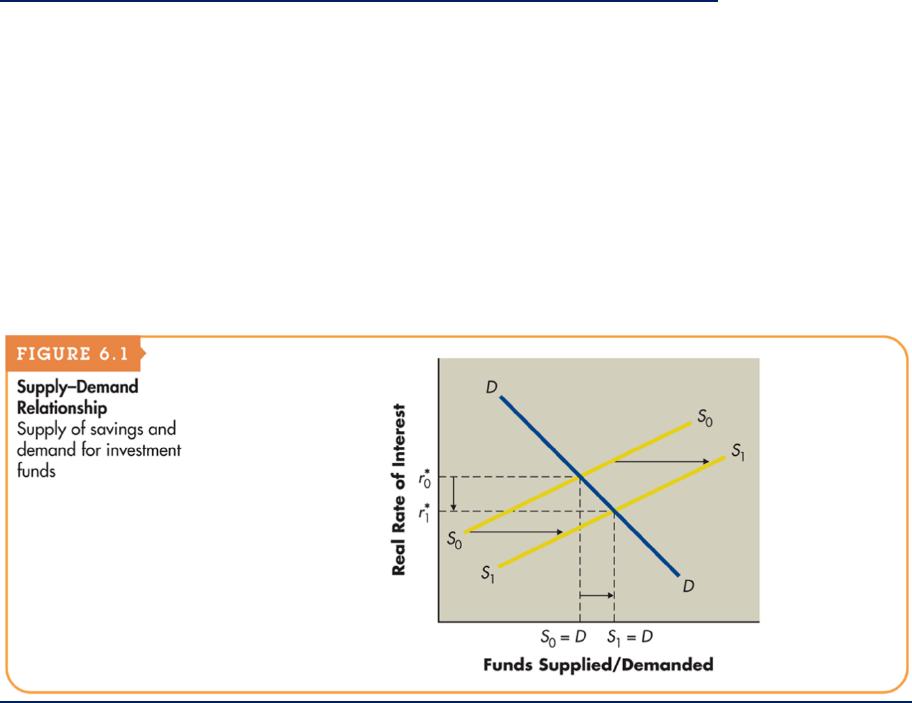
• The real rate of interest is the rate that creates equilibrium between the
supply of savings and the demand for investment funds in a perfect world,
without inflation, where suppliers and demanders of funds have no liquidity
preferences and there is no risk.
• The real rate of interest changes with changing economic conditions, tastes,
and preferences.
• The supply-demand relationship that determines the real rate is shown
below:
• The nominal rate of interest is the actual rate of interest charged by the
supplier of funds and paid by the demander.
• The nominal rate differs from the real rate of interest, r* as a result of two
factors:
– Inflationary expectations reflected in an inflation premium (IP), and
– Issuer and issue characteristics such as default risks and contractual
provisions as reflected in a risk premium (RP).
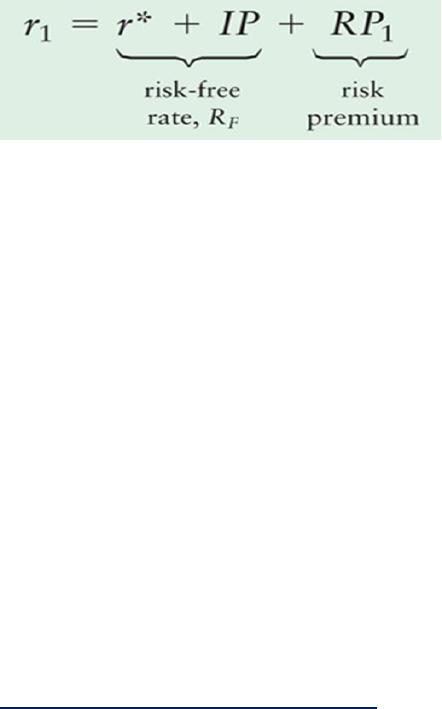
• The nominal rate of interest for security 1, r1, is given by the following
equation:
• The nominal rate can be viewed as having two basic components: a risk-
free rate of return, RF, and a risk premium, RP1:
r1 = RF + RP1
Example:
• Marilyn Carbo has $10 that she can spend on candy costing $0.25 per piece.
She could buy 40 pieces of candy ($10.00/$0.25) today. The nominal rate of
interest on a 1-year deposit is currently 7%, and the expected rate of
inflation over the coming year is 4%.
• If Marilyn invested the $10, how many pieces of candy could she buy in one
year?
– In one year, Marilyn would have (1 + 0.07) $10.00 = $10.70
– Due to inflation, one piece of candy would cost (1 + 0.04) $0.25 =
$0.26
– As a result, Marilyn would be able to buy $10.70/$0.26 = 41.2 pieces
– This 3% increase in buying power (41.2/40) is Marilyn’s real rate of
return
Term Structure of Interest Rates:
• The term structure of interest rates is the relationship between the
maturity and rate of return for bonds with similar levels of risk.

• A graphic depiction of the term structure of interest rates is called the yield
curve.
• The yield to maturity is the compound annual rate of return earned on a
debt security purchased on a given day and held to maturity.
• A normal yield curve is an upward-sloping yield curve indicates that long-
term interest rates are generally higher than short-term interest rates.
• An inverted yield curve is a downward-sloping yield curve indicates that
short-term interest rates are generally higher than long-term interest rates.
• A flat yield curve is a yield curve that indicates that interest rates do not
vary much at different maturities.
Expectations Theory:
• Expectations theory is the theory that the yield curve reflects investor
expectations about future interest rates; an expectation of rising interest
rates results in an upward-sloping yield curve, and an expectation of
declining rates results in a downward-sloping yield curve
Liquidity Preference Theory:
• Liquidity preference theory suggests that long-term rates are generally
higher than short-term rates (hence, the yield curve is upward sloping)
because investors perceive short-term investments to be more liquid and less
risky than long-term investments. Borrowers must offer higher rates on long-
term bonds to entice investors away from their preferred short-term
securities.
Market Segmentation Theory:
Market segmentation theory suggests that the market for loans is segmented on
the basis of maturity and that the supply of and demand for loans within each
segment determine its prevailing interest rate; the slope of the yield curve is
determined by the general relationship between the prevailing rates in each
market segment.
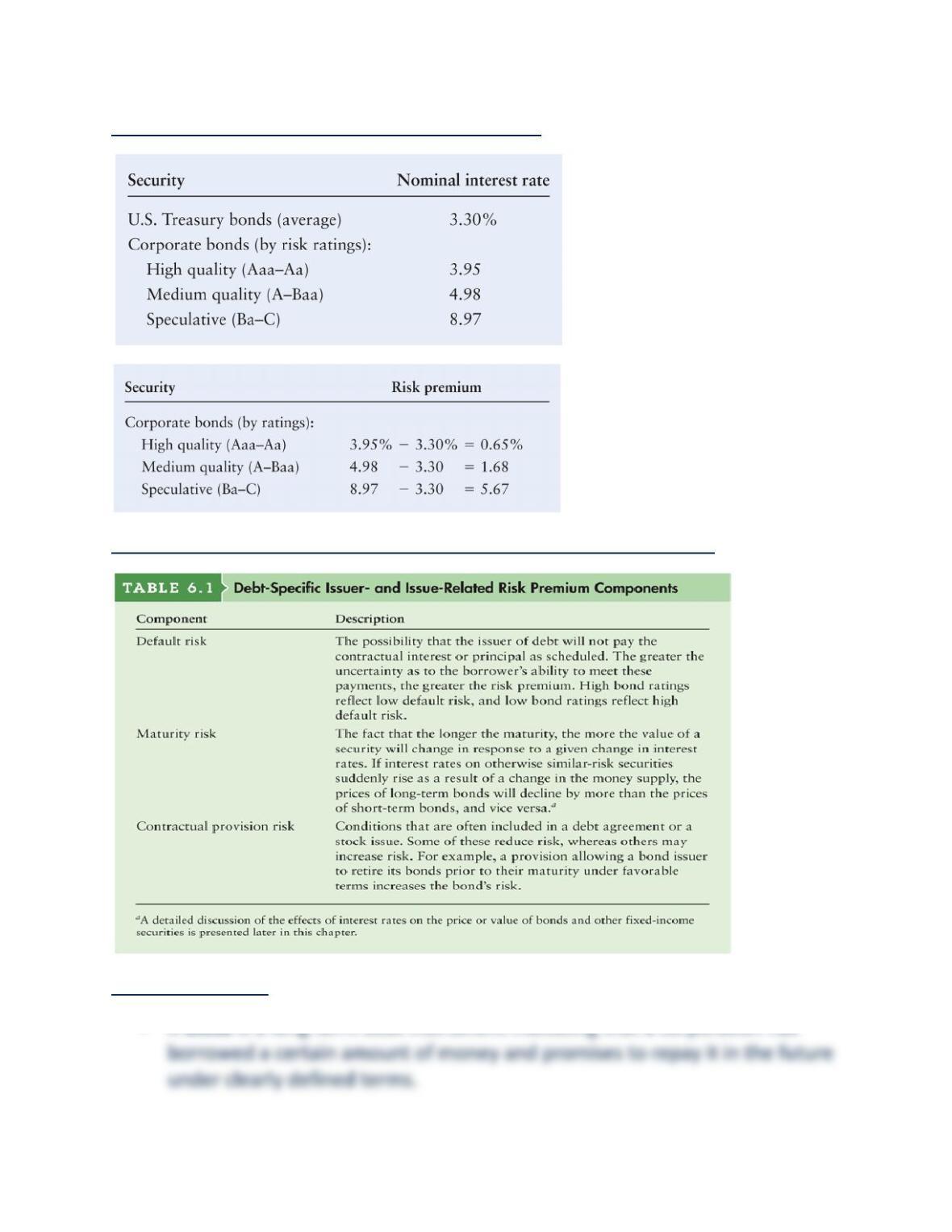
Risk Premiums: Issue and Issuer Characteristics:
Debt–Specific Issuer– and Issue-Related Risk Premium Components:
Corporate Bonds: