Nomenclature Handout
Part 5
Alkenes
These compounds are all named in the same fashion, using the general IUPAC format of
listing substituents before the determined parent name. Because the location of the double bond
(which defines the molecule as an alkene) can vary, its location is included through the use of a
number and included as part of the parent name.
Parent name is based on the length of the longest, continuous chain which contains the
double bond(s). The numerical prefixes (1-10) you learned for alkanes are used here with the
new suffix to indicate the specific carbonyl group present. The “ane” of the alkane name is
dropped and replaced by the associated suffix: “ene” for alkenes.
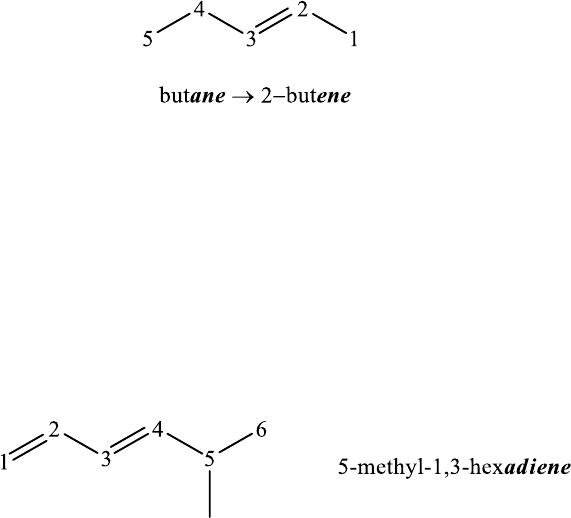
When including the number to locate the double bond, use the smaller number of the two
covered by the bond itself – this indicates that the double bond starts there and continues toward
the next carbon in the chain. For 2-butene the double bond is located between carbons 2 & 3 of
the chain.
Multiple double bonds are commonly found in these molecules. If more than one double
bond is present a quantity prefix (di, tri…) is included directly in front of the suffix with an “a”
included for phonetics. The numbers are listed in front, separated by commas to complete the
full parent name.
Substituents are treated the same here as we did for alkanes and alcohols. You will
encounter the alkyl, alkoxy and halo substituents you have seen before.
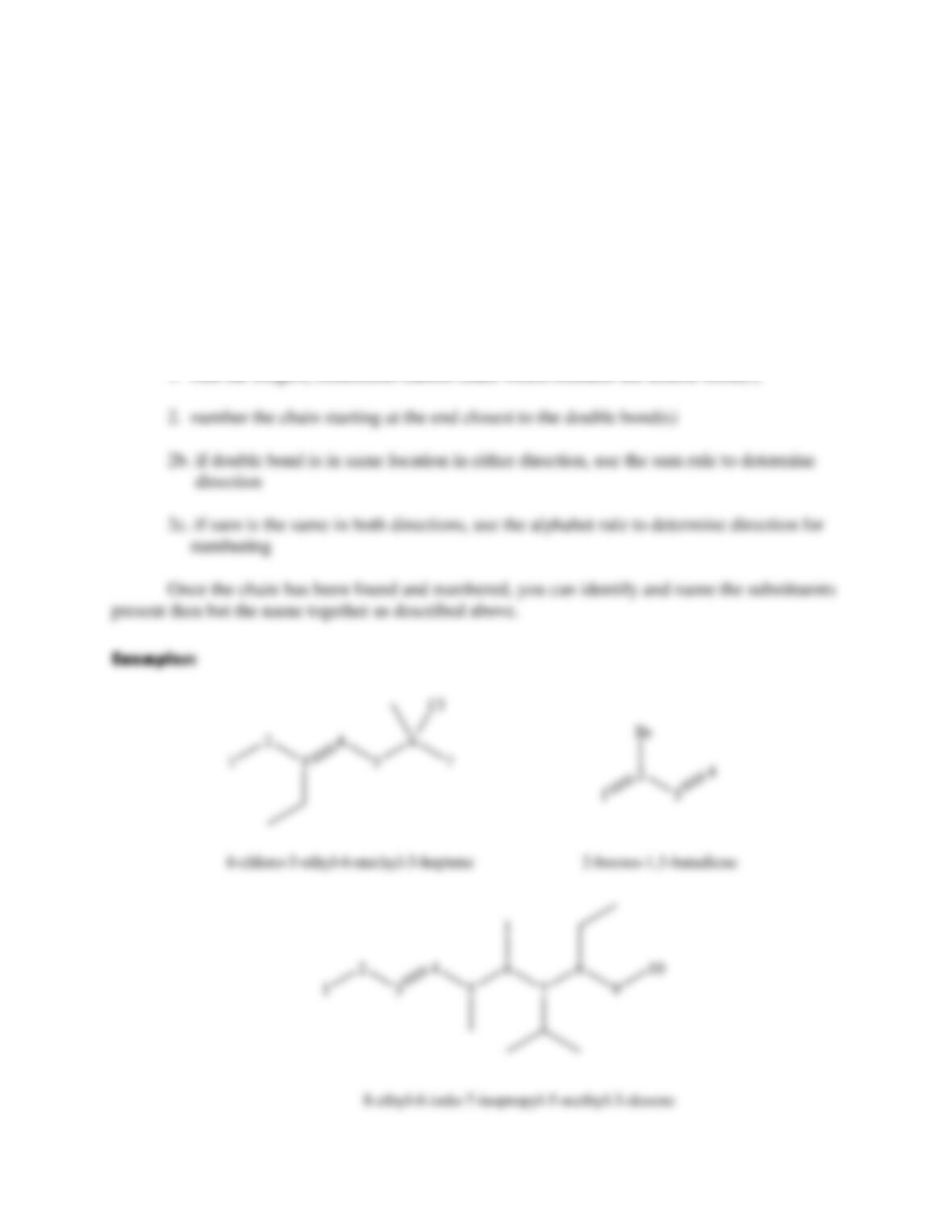
Putting it together…requires listing the substituents in front of the parent with numbers
to locate them along the chain. The location of the C=C is also included as a number
immediately preceding the parent name – this is the priority “substituent” with the smallest
possible number going to the bond over any group (see example above)
# – sub. – # – sub – # – parent
As with alkanes if multiple of the same substituents exist, use a quantity prefix (di – 2, tri – 3,
tetra – 4…) directly in front of the substituent name. Make sure to include a number for each
group, even if they are located on the same carbon! DO NOT alphabetize these prefixes, use the
substituents name.
#,# – disub – # – subparent
IUPAC System
Small changes have been made to the alkane rules to emphasize the presence of the
carbon-carbon double bond, specifically how to number is more narrowly defined to favor the
C=C.