Volume 1, Issue 3, October 2011, 11-31 International Review of Social Research
No Measure without Concept.
A Critical Review on the
Conceptualization and Measurement
of Environmental Concern
André SCHAFFRIN•
University of Cologne
Abstract: Environmental concern is a highly relevant concept in the context of environmental
change and increasing demand for political regulation of environmental protection. In order
to prevent climate change, loss in global biodiversity or other highly critical environmental
issues, we need to understand why (and why not) citizens support environmental politics.
However, there is no measure without a concept, and empirical results might be biased if they
are not operationalized according to well defined (theoretical and methodological) criteria.
This research endeavor focuses on historical and more recent developments of the concept
of individual environmental concern. It will be demonstrated that environmental concern is
not only a distinct concept excluding behavior and knowledge, but is also rather complex
addressing geographical as well as temporal issues. Most recent developments suggesting a
hierarchical multi-dimensional character will be discussed and examples of the most relevant
empirical measures and scales will be evaluated.
Keywords: environmental concern, climate change, measurement construction.
Introduction
During the last decades, environmental
protection became an urgent and
relevant topic in public and political
debates. Global warming, the depletion
of natural resources, habitats, and the
overall biodiversity are issues that are
subject to international agreements
and negotiations but are also highly
© University of Bucharest, October 2011
NTERNATIONAL REVIEW of SOCIAL RESEARCH
I
IRSR
•e-mail: schaffrin@wiso.uni-koeln.de. André Schaffrin is Doctoral Candidate in the Research Training Group
‘Social Order and Life-Chances’ (SOCLIFE) at University of Cologne (Germany). He holds a Masters degree in
Social Science from Mannheim University (Germany) and studied Sociology at Flinders University (Australia).
‘(…) environmental concern is a broad concept that refers to a wide
range of phenomena – from awareness of environmental problems to
support for environmental protection – that reflect attitudes, related
cognitions, and behavioral intentions towards the environment’
(Dunlap and Jones, 2002: 484-485).
DOI: 10.1515/irsr-2011-0018
Unauthenticated
Download Date | 4/20/18 8:56 PM
discussed by domestic political
elites in Western Europe. Driven by
environmental movements on the
global and local scale as well as the
electoral success of green parties
throughout European parliaments,
national governments now have the task
to set up extensive policy programs and
regulation in order to meet ambitious
international agreements such as the
Kyoto Protocol and EU environmental
directives (e.g. the EU Climate and
Energy Package). Since electoral
support is one of the central influence
factors of policy making in democracies
(Burstein, 2003), environmental
concern of the general public plays
an important role in supporting the
government to foster environmental
policies, and are, therefore, of major
interest for social research (Marquart-
Pyatt, 2007). In order to understand
recent developments in public support
for environmental politics on the
domestic and the international level, we
have to investigate whether and how
individuals think, feel, and act on issues
which are related to the environment.
Following this line of argument,
it seems crucial to understand the
character and diversity of individual
environmental concern in a first step
before we can analyze its impact on
political decision making in the second
step. Thus, to provide 1) a general
concept and 2) reliable measurement
instruments of environmental concern
is of major importance for research on
the individual-nature relationship and
will be subject of this research article.
dd1) Until the 1960s, scholars from
different social science disciplines
conceptualized and operationalized
environmental concern rather diverse.
This variety of concepts is often
misleading. In order to provide
a research basis on individual
environmental concern, it is crucial to
discuss a more general concept which
combines similarities and differences
in environmental research across social
science disciplines.
ddAnother issue is the changing
character of the object we are
concerned about: the environment as
a basic element of human being in the
temporal and geographical dimension.
Thus, the environment itself is a
rather complex construct. It can be
global but also local in character
reflecting specific problems of short-
term nature but also long-term stable
developments. It might include high
numbers of actors and often has no
straightforward solution. The concept
of environmental concern must reflect
these characteristics in order to address
the full complexity of nature and the
environmental problems society faces.
dd2) On the ground of these
conceptual debates, there has also been
a development in measures and scales
targeting on individual environmental
concern. Empirical research on
environmental concern, however, only
provides reliable and valid evidence
if the underlying theoretical concept
sufficiently addresses all possible
options and characteristics of the real
concept. Recent developments on
measurement and scale construction
integrate a range of environmental
characteristics and make assumptions
about underlying dimensions on
individual aspects of concern,
knowledge, attitudes, and values. The
article will discuss several measures
and evaluates the more recent
development of the environmental
attitudes inventory by Milfont and
12 | IRSR Volume 1, Issue 3, October 2011
Unauthenticated
Download Date | 4/20/18 8:56 PM
ANDRE SCHAFFRIN No Measure without Concept | 13
Duckitt (2010).
ddFollowing this line of argument, the
paper will present a distinct formulation
of the concept of environmental
concern. In the first section, I outline
both aspects of environmental concern,
the substantive issue of environment
and the more theoretical perspective
of different expressions of concern.
The discussion will illustrate different
developments and peculiarities of both
aspects. At the end of this section, I
will highlight different definitions and
suggest a conceptualization which tries
to combine all remarks. The analysis
proceeds with a discussion on examples
of general operationalization practices
and the most relevant measures. This
section will conclude with recent scale
developments of Milfont and Duckitt
(2010). The final section concludes
with general remarks for future
research developments.
Environmental Concern: The Two
Concepts’ Formulation
Dunlap and Jones (2002) suggested
a distinction between the substantive
part (environment) and the theoretical
aspect (concern) of the concept of
environmental concern. These two
categories precisely address the two-
dimensional character of the theoretical
concept: the object of concern which is
all facets of the physical or constructed
environment, and the expression of
concern which regards all aspect of
feelings, attitudes, values, and norms
an individual can engage with (Dunlap
and Jones, 2002).
Environmental Concern for Substantive
Issues: The Object of Concern
Research on environmental con-
cern can focus on very different
environmental issues which makes
general conceptualization difficult (for
a more detailed discussion see Dunlap
& Jones, 2002). I will discuss only
two basic aspects of the substantive
issue of environmental concern in
more detail which seem to capture the
most relevant dimension for social
science research: 1) the geographical
and 2) the temporal dimension of the
environment.
dd1) Comparing environmental
concern across people living in very
different geographical circumstances
of environmental pollution is
problematic (Dunlap and York, 2008).
People might not have coherent
beliefs about environmental issues
generally but instead choose particular
environmental problems that they
care more about (Ignatow, 2006).
Hence, scholars of environmental
attitudes (Inglehart, 1995; Franzen
and Meyer, 2004; Gelissen, 2007)
distinguish between concern about
‘objective problems’ and more general
‘subjective values’. On the one
hand, environmental concern of an
individual very much depends on its
spatial background like the weather,
but also geographical vulnerability
from sea-level rise and natural hazards
(‘objective problems’) (Hamilton,
Colocousis and Duncan, 2010).
Following Wynnveen, Kyle & Sutton
(2010), it is the change in the physical
settings and personal experiences
combined with place identity or place
dependence which affects individuals’
concern for the environment. On the
Unauthenticated
Download Date | 4/20/18 8:56 PM
14 | IRSR Volume 1, Issue 3, October 2011
other hand, Milfont, Sibley and Duckitt
(2010) argue that there is more general
concern for global environmental
problems like climate change than
for local changes because they are
interpreted as more serious (‘subjective
values’) (also called ‘environmental
hyperopia’ in Uzzell, 2000). Following
this line of argument, it is crucial to
consider the spatial component in the
concept of environmental concern in
order to avoid bias in measurement.
dd2) A second important dimension
is the temporal perspective of
environmental issues. As Dietz, Dan
and Shwom (2007) state, ‘individuals
vary in how much they think about
the future and how far into the future
they think’ (ibid: 188). In general, we
find a conflict between individuals’
short- vs. long-term interests (Milfont
and Gouveia, 2006). On the one hand,
concern for the environment can be
understood as a reaction towards local
threats for health and economic well
being. On the other hand, environment
is a space for next generations and
present environmental pollution will
lead to negative consequences in future.
Individuals who are concerned about
environmental problems that harm, for
example, their physical health status
are not necessarily worried about the
environment of their grandchildren.
Consequently, protest against water
pollution of local rivers is motivated
quite differently than support of
domestic policies for greenhouse gas
emission reduction. Water pollution
instantly affects individual well being
whereas domestic climate policies such
as taxes on carbon intensive energy
production and fuels serves to prevent
global warming in the long run, but
affects electricity prices in short term.
Individuals focusing on short term
interests would be more likely to
protest for higher standards in water
quality but would reject policies which
are likely to increase electricity prices.
Given these arguments, it is crucial to
consider the time perspective in the
concept of environmental concern in
order to avoid bias in measurement.
ddIn order to address both the
temporal and geographical issue of the
environment, research should focus
on individuals’ general relationship
to nature protection, their specific
experiences and spatial attachment but
also on their time perspective in short-
vs. long-term interests. Interest-based
concern mostly derives from past
or present experiences of the direct
individual environment (Shwom, Dan
and Dietz, 2008). Taking individuals’
general value orientations for
future generations into account and
measuring their place attachment and
personal experiences with the physical
environment reflect a more precise
measure of environmental concern.
Environmental Concern as a
Theoretical Conceptualization: The
Expression of Concern
Two different historical perspectives
on the expression of concern can
be distinguished in the literature
(Dunlap and Jones, 2002). The first
one comes from political science
and is aiming at individual attitudes
towards environmental policies (e.g.
Heberlein, 1981). Applied dimensions
or attributes which can be derived
from this research stream is the
question of causes for environmental
problems, for responsibility, and
individuals’ suggestion and beliefs
Unauthenticated
Download Date | 4/20/18 8:56 PM
about possible solutions. The political
science approach further asks for the
individuals’ evaluation of seriousness
of specific environmental problems and
whether they would support policies
or even become actively involved in
environmental protection (Dunlap and
Jones, 2002).
The theoretical perspective as the
second historical approach with the
focus on individuals’ expression of
concern comes from psychology and
attitude theory (e.g. Ester, 1981).
In general, attitudes or individual
concern is categorized along four
components: a cognitive, affective,
conative, and behavioral dimension.
Cognitive aspects are knowledge,
believes, or norms, whereas the
affective dimension refers to emotive
and evaluative individual stages. The
conative dimension is an expression
of behavior intention. Both actual
behavior and behavior intention
refer to policy support as well as to
personal action in order to protect the
environment.
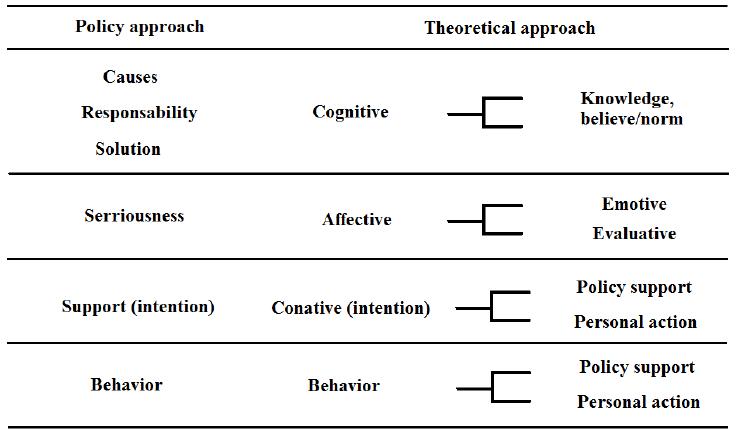
Table 1. Similarities between the policy and the theoretical approach of individual concern
Both approaches are discussed by
Dunlap and Jones (2002). However,
I argue that they can be combined by
looking at the similarities between
the components of both concepts.
Table 1 gives an overview of the
suggested parallel interlink. Thus,
individual knowledge about causes,
responsibilities, and solutions are
clearly cognitive aspects which include
a searching process for information
as well as selective filtering into
predefined cognitive categories such
as believes or norms. Furthermore,
asking respondents whether they think
of specific environmental problems
as a serious threat means asking
for an evaluation of that process
which might also be influenced by
emotional aspects. Looking at the
ANDRE SCHAFFRIN No Measure without Concept | 15
Source: Own conceptualization based on Dunlap and Jones (2002).
Unauthenticated
Download Date | 4/20/18 8:56 PM
16 | IRSR Volume 1, Issue 3, October 2011
rows of policy support (as a conative
component) and behavior, similarities
between both approaches are rather
obvious. Consequently, we end up
with very distinct attributes which
constitute a more general definition of
environmental concern.
Definition
Having discussed both sub-concepts
of environmental concern, which
is the environment and concern,
we now develop a definition of the
overall concept. One definition which
includes all components discussed
so far is provided by van Liere and
Dunlap (1980). The authors define
environmental concern as ‘perceiving
environmental problems as serious,
supporting efforts by government to
protect environmental quality’ and
as ‘engaging in behaviors aimed at
improving environmental quality’
(van Liere and Dunlap, 1980: 188).
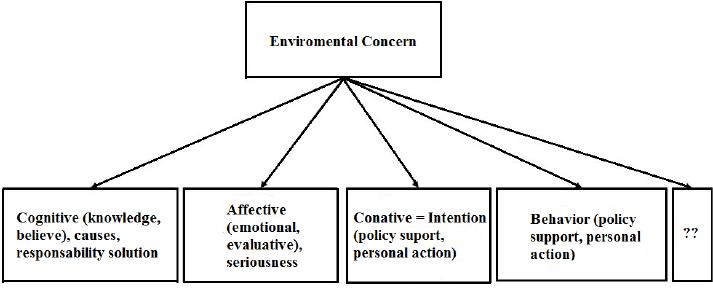
Following this definition and from the
discussion above, we can summarize
this definition in a scheme as indicated
in Figure 1 where environmental
concern consists of four separate
components. The cognitive component
is personal knowledge and believes
about causes, responsibilities, and
solutions for environmental problems.
The affective component adds an
emotional or evaluative part where
individuals decide whether postulated
consequences from environmental
problems are good or bad (more or
less seriousness) on the basis of their
knowledge and believes (cognitive
component). This evaluation activates
the conative component of behavior
intention which is either support for
environmental policies or personal
action to prevent personal harm. The
final step is to transpose the intention
into real action which is the fourth
component of environmental concern.
As indicated by the direction of the
arrows in Figure 1, all components
serve as measures for the overall latent
construct of environmental concern but
do not constitute necessary/sufficient
parts of it. During the years of research,
this understanding changed by focusing
on single components and investigating
whether they are necessary for the
concept of environmental concern.
Following, I will discuss two major
issues concerning specific attributes of
the concept.
Figure 1. The concept of environmental concern – first version
Source: Own illustration based on van Liere and Dunlap (1980).
Unauthenticated
Download Date | 4/20/18 8:56 PM

ddOne important issue is the exclusion
of knowledge as a cognitive attribute of
the concept definition. Bord, O’Connor
and Fisher (2000) state that accurate
knowledge about consequences of,
for example, global warming is a
precondition in order to be actively
engaged in the mitigation of climate
change. In contrast, accurate knowledge
is not necessary in order to stimulate
general concern. Several studies find
knowledge to be a very distinct aspect
from environmental concern since it
significantly explains environmental
behavior, but not beliefs or attitudes
(Bord, et al. 2000, Dietz et al., 2007,
Milfont and Gouveia 2006). Moreover,
knowledge might serve as an additional
link between environmental concern
and environmental behavior: someone
who is very much concerned about the
environment in general will be more
active if the person knows what to do
serves as an indicator for individuals’
media consumption or general interest
in science. This line of argument
leads to the distinct conclusion that
knowledge is not part of the overall
concept of environmental concern.
ddThe second important issue concerns
individual behavior. Correlational
measures indicate only a moderate
relationship between environmental
attitudes and environmental behavior
which is discussed by a high number
of studies (e.g. Diekmann and
Preisendörfer, 1992; Franzen, 1995;
Diekmann, 1996; Diekmann and
Preisendörfer, 1998; Kühnel and
Bamberg, 1998; Quandt and Ohr,
2004; Best, 2009). Further analyses
point to the distinction between
environmental behavior and behavior
intention (e.g. Urban, 1986; Takács-
Sánta, 2007). A very important
argument for not considering behavior
ANDRE SCHAFFRIN No Measure without Concept | 17