This document is authorized for use only in Prof. Anshul Jain and Prof. Prageet Aeron’s Fintech/ PGPM at Management Development Institute – Gurgaon from Dec 2020 to Mar 2021.
SMU567
NIUM: LEVERAGING FINTECH TO DISRUPT CROSS-BORDER
REMITTANCE SERVICES
Remittances are a lifeline to low– and middle-income countries and an effective way to alleviate
poverty because they go directly to families.
– The World Bank1
October 2019. The long queues that formed daily outside the money transfer agents in Little India,
an ethnic district in Singapore, was a common sight. Nothing seemed to deter the lines of people,
mostly migrant workers, queuing patiently to send money back to their loved ones in their homeland.
If they knew about digital remittance, perhaps the queues would disappear one day?
On a mission to disrupt the traditional remittance industry was one such fintech outfit named Nium
(originally branded as Instarem, short for Instant Remittance). Founded in 2014 by Prajit Nanu and
Michael Bermingham, the two friends were confident they could give the banks and brick-and-mortar
money transfer operators a run for their money by offering low transaction fees, zero-margins on
foreign exchange rates and fast speed of settlement. They saw a huge potential to unravel the
difficulties posed by incumbent institutions, which were entrenched in practices of charging high
agent fees with inflated foreign exchange spread, slow processing due to multiple intermediaries, and
at times, the bureaucracy that caused extra inconvenience to customers.
By capitalising on razor-thin margins per transaction, an emerging crop of digital-only remittance
start-ups, including Nium, were hoping to undercut the industry titans. Since its founding, Nium was
on a high growth trajectory after raising US$59.5 million in three rounds of equity funding, and was
named as one of Singapore’s hottest start-ups in 2018.2 Headquartered in Singapore, Nium had
emerged the leader in cross-border payments in Southeast Asia with a presence across North America
(US and Canada), Europe and Asia Pacific (Singapore, Hong Kong, Australia, India, and Malaysia).
As Nium diversified its service offerings and grew its institutional client base in the years ahead,
what role would remittance play in its business? While an IPO was in the pipeline in 2022-23, what
would be the other ways to move forward?
The Fintech Revolution
Reshaping Financial Services
Fintech, an abbreviation for financial technology, was broadly referred to as the use of innovative
1 Donna Barne and Florina Pirlea, “Money Sent Home by Workers Now Largest Source of External Financing in Low– and Middle-
Income Countries (Excluding China)”, World Bank Blogs, July 02, 2019, https://blogs.worldbank.org/opendata/money-sent-home-
workers-now–largest-source-external-financing-low-and-middle-income, accessed June 2019.
2 Singapore Business Review, “Singapore’s Hottest Startups 2018”, March 2018,
https://sbr.com.sg/sites/default/files/singaporebusinessreview/print/SBR_FEBMAR18-18–28–31.pdf, accessed June 2019.
This case was written by Professor Annie Koh, Professor David Fernandez and Dr Cheah Sin Mei at the Singapore
Management University. The case was prepared solely to provide material for class discussion. The authors do not intend to
illustrate either effective or ineffective handling of a managerial situation. The authors may have disguised certain names and
other identifying information to protect confidentiality.
Copyright © 2019, Singapore Management University Version: 2019–05–10

SMU–19-0040
Nium: Leveraging Fintech to Disrupt Cross-Border Remittance Services
This document is authorized for use only in Prof. Anshul Jain and Prof. Prageet Aeron’s Fintech/ PGPM at Management Development Institute – Gurgaon from Dec 2020 to Mar 2021.
technologies to deliver financial services that could potentially disrupt the way traditional financial
institutions (such as banks) function.
It wasn’t until the aftermath of the financial crisis in 2008 that fintech began to rise to prominence.
Fintech companies, a new breed of financial institutions, were widely believed to be born out of the
global financial meltdown resulting from the collapse of the US subprime mortgage market and the
public’s loss of confidence in the well-established banking systems.3
For a long time, banks’ monopoly of the financial market had enabled them to charge high
commissions, hike up foreign exchange rates and embed hidden transaction fees. With few or almost
no other viable alternatives, consumers were at the mercy of banks until the emergence of fintech
start-ups in the late 2000s.
Then, the tide turned in favour of the brave and bold. Entrepreneurs leaped at the opportunity to
innovate, which was enabled by the combination of smartphone launch (iPhone, in particular, in
2007), mass mobile adoption by the younger generation, and emerging technologies (such as
cryptocurrency, blockchain, etc.).
Fintech had come to play an increasingly important role in the financial lives of people by serving
their needs in four key areas – bill payment and fund transfer, credit lending, savings and investment,
and insurance solutions. 4 Payment and transfer functions were among the earliest waves of
development in fintech. Most of the fintech companies offering e-payments and e-wallets were
business-to-business operators serving e-commerce merchants. The next wave that swept the fintech
market was money lending. Fintech start-ups in the lending space were leveraging on technologies
to assess and monitor credit-worthiness, aggregate and compare credit options, and enable peer-to–
peer borrowing. Insurance was a newcomer to the fintech scene but was quickly gaining traction in
the late 2010s.5
By offering fee reduction, cost transparency, and fast transactions, fintech companies were re–
establishing trust with consumers, and in the process, upstaging retail banks and other traditional
financial institutions. Diverting from the traditional business model of the financial world, fintech’s
value proposition was sufficiently compelling to attract hordes of investors.
The Global Fintech Market
In 2016, US$24 billion worth of investments were poured into the global fintech industry, of which
Asia devoured the biggest piece of the pie of US$14 billion with the bulk going to China and India.6
Southeast Asia, in particular, saw a jump of 33% in investments from US$190 million in 2015 to
3 Rob Braileanu, “How the Global Financial Crisis Gave Birth to Fintech”, Revolut Blog, September 13, 2018,
https://blog.revolut.com/how-the-global-financial-crisis-gave-birth-to-fintech/, accessed June 2019.
4 Omidyar Network, “Breaking New Ground in Fintech: A Primer on Revenue Models that Create Value and Build Trust”, 2018,
https://www.omidyar.com/sites/default/files/file_archive/Breaking_New_Ground_FinTech/Breaking%20New%20Ground%20in%20Fin
Tech%20v2.pdf, accessed June 2019.
5 Mark Suckling, “New Developments in Fintech are Hitting Southeast Asia in Waves”, March 27, 2019, https://e27.co/new-
developments-in-fintech-are-hitting-southeast-asia-in-waves-20190327/, accessed June 2019.
6 United Overseas Bank Limited, “State of Fintech in ASEAN”, 2017, https://www.uobgroup.com/techecosystem/pdf/UOB-State-of–
FinTech-in-ASEAN.pdf, accessed June 2019.
2/17

SMU–19-0040
Nium: Leveraging Fintech to Disrupt Cross-Border Remittance Services
This document is authorized for use only in Prof. Anshul Jain and Prof. Prageet Aeron’s Fintech/ PGPM at Management Development Institute – Gurgaon from Dec 2020 to Mar 2021.
US$252 million in 2016.7 Singapore was the leader among the Southeast Asian hotbeds; in 2017 the
country had the highest e-wallet penetration at 23.3%, the highest volume of cashless payments on
consumer purchases at 69%, and over a hundred fintech start-ups out of 367 in the region.8
By 2018, the booming global fintech market was valued at US$113 billion, after doubling its revenue
from US$55 billion in 2015.9 The trend of substantial growth at a compound annual growth rate
(CAGR) of 22% was expected to continue into 2023, reaching a forecasted value of US$306 billion
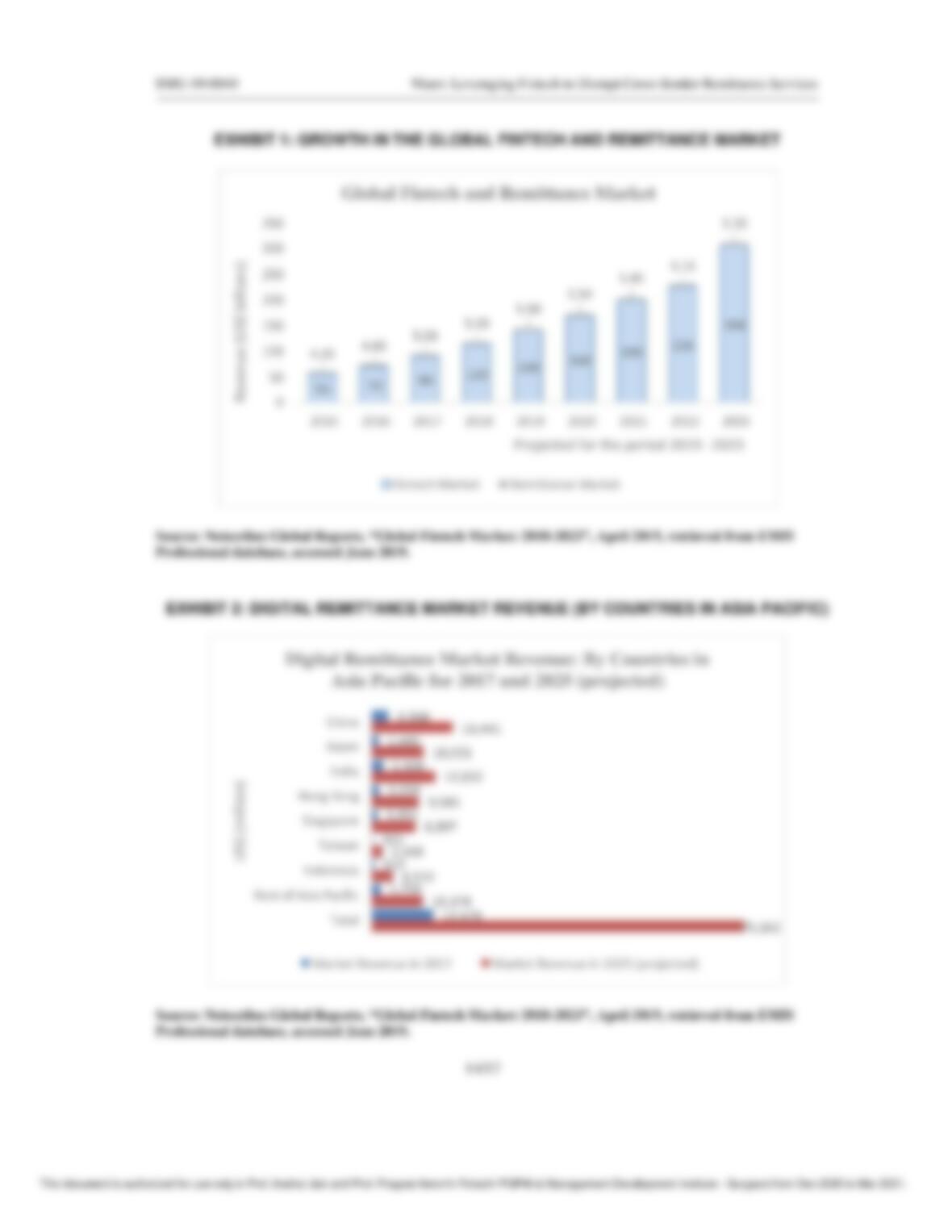
(see Exhibit 1 for the projected growth in the global fintech market).10
Towards Fintech–friendliness
While tighter regulations were imposed on banks after the global financial crisis to prevent another
market crash, fintech start-ups around the globe had enjoyed strong regulatory support. Given the
huge potential of fintech and its impact on economic development, various regulators and
policymakers of developed nations were implementing initiatives to encourage a fintech-friendly
environment.
Some countries, for example, Singapore, had adopted a ‘regulatory sandbox’ that provided a space
for fintechs to experiment with innovative financial solutions under relaxed legal and regulatory
requirements.11 Others had established a special economic zone to incubate fintech start-ups, such
as the Fintech City in the Philippines.12 To top it all, the UK had grown to become the fintech capital
in the world in providing the best regulatory support for new entrants and tax support for corporations
and investors.13
The Digital Remittance Landscape
Remittance, an Economic Lifeline
Remittance, or money transfer, was a major financial trade since the history of cross-border human
migration. An estimated 258 million migrants were living outside of their country of origin14 and
the global remittances made by diaspora communities reached US$528 billion in 2017, according to
7 Ibid.
8 Ibid.
9 Netscribes Global Reports, “Global Fintech Market: 2018–2023”, April 2019, retrieved from EMIS Professional database, accessed
June 2019.
10 Ibid.
11 Monetary Authority of Singapore, “Regulatory Sandbox”, June 27, 2019, https://www.mas.gov.sg/development/fintech/regulatory-
sandbox, accessed June 2019.
12 Philip Keller, “Philippines Fintech Push makes it a Compelling Market to watch”, Regulation Asia,
https://www.regulationasia.com/philippines-fintech-push-makes-it-a-compelling-market-to-watch/, accessed June 2019.
13 EY, “UK FinTech: On the Cutting Edge”, February 24, 2016,
https://assets.publishing.service.gov.uk/government/uploads/system/uploads/attachment_data/file/502995/UK_FinTech_–
_On_the_cutting_edge_-_Full_Report.pdf, accessed June 2019.
14 William Lacy Swing, “How Migrants Who Send Money Home Have Become a Global Economic Force”, Weforum, June 14, 2018,
https://www.weforum.org/agenda/2018/06/migrants-remittance-global-economic-force/, accessed June 2019.
3/17

SMU–19-0040
Nium: Leveraging Fintech to Disrupt Cross-Border Remittance Services
This document is authorized for use only in Prof. Anshul Jain and Prof. Prageet Aeron’s Fintech/ PGPM at Management Development Institute – Gurgaon from Dec 2020 to Mar 2021.
the United Nations.15 For some developing countries, the inflow of remittances had even exceeded
official development assistance and foreign direct investment to become the largest source of external
financing.16
On a macro level, financial remittance played a major role as an economic vehicle by boosting the
Gross Domestic Product (GDP) of developing countries. In smaller and/or poorer developing nations,
remittances made up a sizeable portion of their GDP – up to 40% in Tonga, for example – as reported
by World Bank.17
As an economic lifeline, remittance was a way to lift people in developing countries out of poverty
through funds channelled into improving health, education and housing conditions, as well as for the
pursuit of entrepreneurship opportunities. As many as 800 million people in the world were
financially dependent on remittances received from family members and relatives working abroad.18
Developing countries could potentially be enriched by greater remittance inflows if not for the high
cost of money transfers. The global average transaction rate for transferring US$200 stood at 7% in
2017, and the goal of United Nations Sustainable Development was to bring it down to 3% by 2030.19
World Bank estimated that a reduction of 5% could add US$16 billion a year to the current flows to
receiving countries.20
The Move to Digital and Cashless
With the fintech revolution unfolding, the remittance industry began to shift gear to digital, albeit a
gradual move. Digital channels had a tiny nibble of the market share (6%) while cash, which had
traditionally dominated the cross-border transfer market held on to a chunky share (94%), as of
2014.21
Among the fintech segments, the remittance market was the third-largest (US$5.33 billion) after
payment (US$68 billion) and mortgage (US$6.64 billion) in 2018 (see Exhibit 1 for the projected
growth in the global remittance market).22 Geographically, the North American region dominated
with a market value of US$2.45 billion, followed by Europe (US$0.85 billion) and Asia Pacific
(US$0.58 billion) in 2018. 23 In the Asia Pacific region, Southeast Asia’s emerging market
15 United Nation, “International Day of Family Remittances: 16 June”, https://www.un.org/en/events/family-remittances-day/, accessed
June 2019.
16 OECD, “Non–ODA Flows to Developing Countries: Remittances”, 2019, https://www.oecd.org/dac/stats/beyond-oda-
remittances.htm, accessed June 2019.
17 Remittances to Tonga, a Polynesian sovereign state in the Oceania, was 40.7% of GDP in 2018.
Source: The World Bank, “Personal Remittances, Received (% of GDP)”, 2019,
https://data.worldbank.org/indicator/BX.TRF.PWKR.DT.GD.ZS?most_recent_value_desc=true, accessed June 2019.
18 William Lacy Swing, “How Migrants Who Send Money Home Have Become a Global Economic Force”, Weforum, June 14, 2018,
https://www.weforum.org/agenda/2018/06/migrants-remittance-global-economic-force/, accessed June 2019.
19 United Nations, “Sustainable Development Goal 10: Reduce Inequality Within and Among Countries”, 2018,
https://sustainabledevelopment.un.org/sdg10, accessed June 2019.
20 The World Bank, “Remittance Prices Worldwide”, 2015, https://remittanceprices.worldbank.org/en, accessed June 2019.
21 Business Insider Intelligence, “The Digital Remittance Report: The New Platforms Disrupting a $600 Billion Industry”, Yahoo News,
November 5, 2018, https://sg.finance.yahoo.com/news/digital-remittance-report-platforms-disrupting-160300615.html, accessed June
2019.
22 Netscribes Global Reports, “Global Fintech Market: 2018–2023”, April 2019, retrieved from EMIS Professional database, accessed
June 2019.
23 Ibid.
4/17
SMU–19-0040
Nium: Leveraging Fintech to Disrupt Cross-Border Remittance Services
demonstrated enormous potential due to a massive population of 438 million of unbanked people
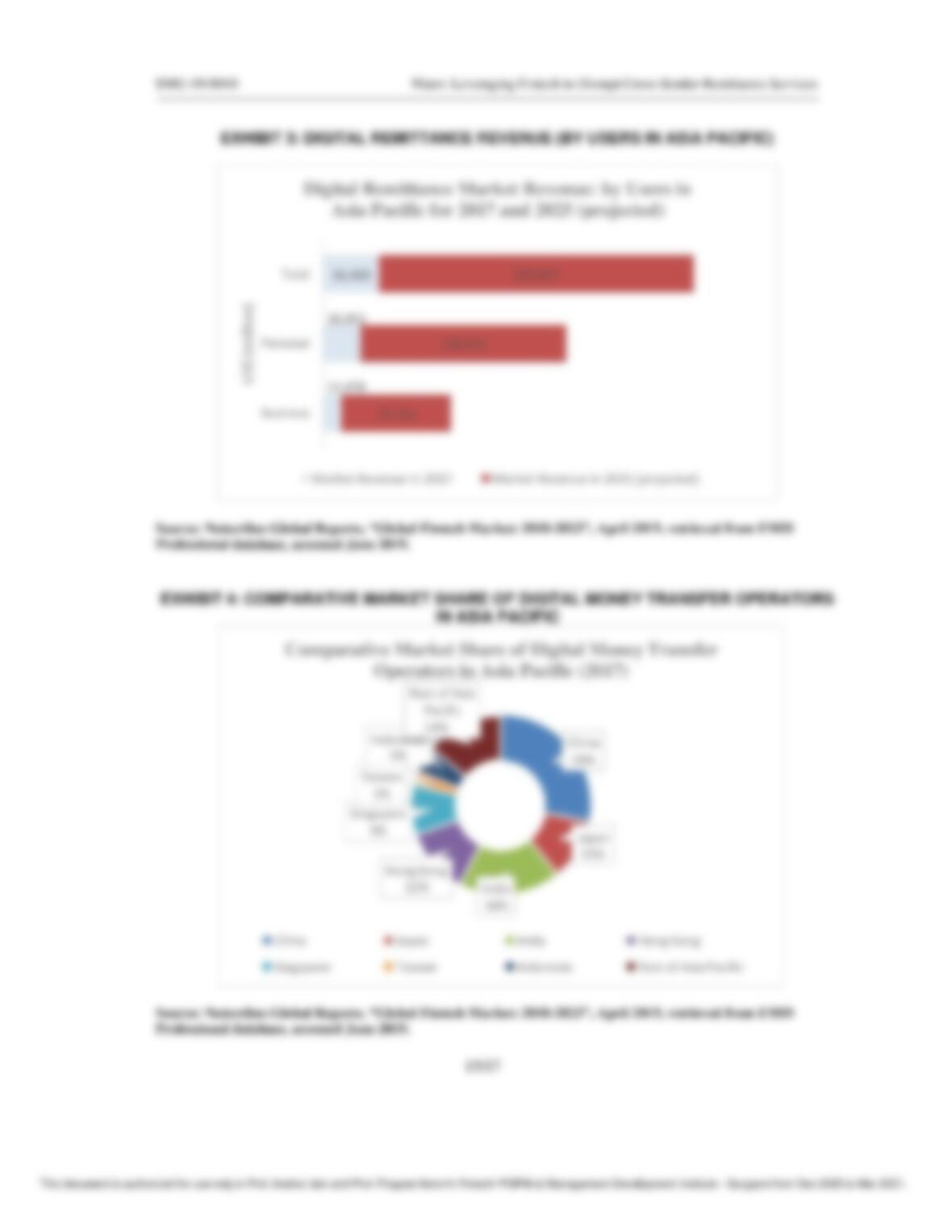
(refer to Exhibits 2 and 3 for the digital remittance market revenue).24
Digital remittance operators could play a vital role in accelerating financial inclusion, defined as “the
delivery of formal financial products and services to all segments of a population irrespective of their
economic situation”. 25 By providing last-mile access to financial services for the underserved
community who did not own bank accounts and/or those living in rural areas without retail bank
branches, digital financial solution providers could fulfil some of the unmet needs for payment,
transfer, savings, credit and insurance services.
Within Asia Pacific, Singapore stood out as the most promising market for digital money transfer
operators with the highest forecasted CAGR (26.7%) for the period 2019 to 2025, ahead of Japan
(26.0%), Hong Kong (23.8%), India (21.9%) and China (19.8%) 26 (refer to Exhibit 4 for a
breakdown of the Asia Pacific market as of 2017).
As at the second quarter of 2019, across remittance channels, banks were the most expensive at an
average fee of 10%, followed by post offices at 8% and money transfer operators at 6%, with the
cheapest being mobile operators at 3%.27
Nium: Bridging Currency Borders
Born Out of Inconvenience
Founded in August 2014 by two friends, Prajit Nanu and Michael Bermingham (Mike), Nium was
the brainchild of Prajit, who conceived the idea of a start-up while trying to organise a bachelor party
for another friend in Phuket, the idyllic resort-island in Thailand. It was then that he stumbled upon