Communications of AIS, Volume 5, Article 1 1
NIBCO’s “Big Bang” by Carol V. Brown and Iris Vessey
Volume 5, Article 1
January 2001
NIBCO’S “BIG BANG”
Carol V. Brown
Iris Vessey
Kelley School of Business
Indiana University
cbrown@iupui.edu
TEACHING CASE

Communications of AIS, Volume 5, Article 1 2
NIBCO’s “Big Bang” by Carol V. Brown and Iris Vessey
NIBCO’S “BIG BANG”
Carol V. Brown
Iris Vessey
Kelley School of Business
Indiana University
cbrown@iupui.edu
ABSTRACT
NIBCO, Inc., a mid-sized manufacturer of valves and pipe fittings headquartered
in the U.S. with $460 million annual revenues, implemented SAP R/3 across its
10 plants and 4 new distribution centers with a Big Bang approach in December
1997. NIBCO management agreed with the Boston Consulting Group
recommendation to “cut loose” from its existing legacy systems and replace them
with common, integrated systems for finance, materials management,
production, and sales/distribution, such as offered in the ERP packages of major
vendors by the second half of the 1990s. However, the company leaders chose
not to heed the advice of their consultants, or the current trade press, about
taking a slower, phased-in approach. Instead, they developed plans for a Big
Bang implementation of all modules (except HR) with a $17 million budget and a
project completion date 15 months later that allowed for only a 30-day grace
period.
The project is led by a triad of NIBCO managers with primary accountabilities for
business process, IT, and change management. The case describes the legacy
IT environment, the ERP purchase and implementation partner choices, the
selection and composition of what came to be called the TIGER team, the
workspace design for the project team (TIGER den), the key issues addressed
Communications of AIS, Volume 5, Article 1 3
NIBCO’s “Big Bang” by Carol V. Brown and Iris Vessey
by each project sub-team, the incentive scheme, and the complexity added by a
distribution center consolidation initiative that runs behind schedule. The case
story ends shortly after the Go Live date, with the project leaders replaying their
warnings to the executive team about initial dips in productivity and profits.
This case study can be used to demonstrate the tradeoffs between Big Bang
versus slower ERP implementation approaches that allow time for organizational
learning. Students can identify the technology and organizational risks
associated with ERP projects in general, and Big Bang implementations in
particular, and then assess how well NIBCO’s leaders manage these risks over
the life of the project. Specific examples of communications and training
initiatives, including ways to achieve employee buy-in, are detailed in the case so
that students can better understand change management practices in the context
of a major system implementation.
Editor’s Note: This case was the winner of Best Teaching Case award at the International
Conference on Information Systems, 2000 that was held December 11-13 in Brisbane Australia.
This article will also be published in: Martin, E.W., C.V. Brown, D.W. DeHayes, J.A. Hoffer, and
W.C. Perkins. Managing Information Technology, 4th edition, Prentice Hall, 2001.
I. INTRODUCTION
December 30, 1997 was the Go Live date at NIBCO INC., a privately held mid-
sized manufacturer of valves and pipe fittings headquartered in Elkhart, Indiana.
In 1996 NIBCO had more than 3,000 employees (called “associates”) and annual
revenues of $461 million. Although many of the consultants they had interviewed
would not endorse a Big Bang approach, the plan was to convert to SAP R/3 at
all ten plants and the four new North American distribution centers at the same
time. The price tag for the 15-month project was estimated to be $17 million.
One-quarter of the company’s senior managers were dedicated to the project,
including a leadership triad that included a former VP of Operations (Beutler), the
Information Services director (Wilson), and a former quality management director
(Davis).
Communications of AIS, Volume 5, Article 1 4
NIBCO’s “Big Bang” by Carol V. Brown and Iris Vessey
One of the major drivers of the whole thing was that Rex Martin said ‘I
want it done now.’ That really was the defining moment—because it
forced us to stare down these implementation partners and tell them
‘…we’re going to do this Big Bang and we’re going to do it fast’.
Scott Beutler, Project Co-Lead, Business Process
We took ownership: it was our project, not theirs. We used the
consultants for what we needed them for and that was technology skills,
knowledge transfer, and extra hands.
Gary Wilson, Project Co-Lead, Technology
It was brutal. It was hard on families, but nobody quit, nobody left….
Professionally I would say it was unequivocally the highlight of my career.
Jim Davis, Project Co-Lead, Change Management
II. COMPANY BACKGROUND
NIBCO’s journey to the Go Live date began about three years earlier, when a
significant strategic planning effort took place. At the same time a cross-
functional team was charged with reengineering the company’s supply chain
processes to better meet its customers’ needs (see Timeline in Figure 1). One of
the key conclusions from these endeavors was that the organization could not
prosper with its current information systems. The firm’s most recent major
investments in information technology had been made over five years earlier.
Those systems had evolved into a patchwork of legacy systems and reporting
tools that could not talk to each other.
After initial talks with several consulting firms, top management brought in the
Boston Consulting Group (BCG) in August 1995 to help the company develop a
strategic information systems plan to meet its new business objectives.

Communications of AIS, Volume 5, Article 1 5
NIBCO’s “Big Bang” by Carol V. Brown and Iris Vessey
Table 1. NIBCO’s Big Bang Timeline
Timeframe MILESTONE
Early 1995 Cross-functional teams charged with developing NIBCO’s strategic plan
and reengineering supply chain processes determined that company could
not prosper with its current information systems.
May, 1995 Gary Wilson hired as new head of IS department.
August –
December, 1995 Boston Consulting Group conducted strategic IT planning study.
Recommended that NIBCO replace its legacy systems with integrated
enterprise system on client-server platform over a 3- to 5-year timeframe
January 1, 1996 Restructured corporation into cross-functional matrix organization. Scott
Beutler, former VP of Operations–Residential Division, given responsibility
for business system strategic planning, including selection of an ERP
package.
July, 1996 Committee recommended purchase of SAP R/3 and “Big Bang”
implementation. Approved by Executive Leadership Team (ELT) and
Board of Directors.
August, 1996
Contracts signed with SAP for R/3 modules and IBM as implementation
partner.
Wilson, Beutler, and Davis form triad leadership team.
September, 1996
Completion of project team selection and September 30th project kickoff.
Begin Preparation phase.
December, 1996 Final project scope and resource estimates presented to ELT and Board
with Go Live date of Monday, November 29, 1997 (30-day grace period
allowed). Final scope included North America only and consolidation of
warehouses to a number yet to be determined. Final project budget was
$17 million.
March, 1997 Decision to consolidate warehouses from 17 to 4 by September, 1997.
Incentive pay bonus in place a few months after project initiated.
April, 1997 Installation of PCs for customer service associates completed.
Weekly newsletter via e-mail initiated.
May, 1997 Business Review lead for materials management leaves company; role
filled by Business Review lead for production planning.
Summer, 1997 Maintenance of legacy systems discontinued except for emergency
repairs.
September, 1997 User training begins at NIBCO World Headquarters and at remote sites.
Sandbox practice system becomes available.
November, 1997 Go Live date moved from Monday following Thanksgiving to December 30
due to delays in completion of warehouse consolidation and master data
load testing.
December 30, 1997 Go Live without consultants
Communications of AIS, Volume 5, Article 1 6
NIBCO’s “Big Bang” by Carol V. Brown and Iris Vessey
BCG brought in a team and what they instantly did was to start going
through each of the functional areas of the company to determine the
need for changes….And so they went into each little nook and cranny of
the company and sorted out whether we really needed to change every
system we had.
Jim Davis, Project Co-Lead, Change Management
The consensus among NIBCO’s management team was that the company was
“information poor” and needed to be “cut loose” from its existing systems. There
were also major concerns about being able to grow the company and become
more global without an integrated information capability. The December 1st BCG
recommendation was that NIBCO replace its legacy systems with common,
integrated systems that could be implemented in small chunks over a 3- to 5-year
timeframe.
They told us ‘you really need to look at integration as a major factor in
your thought processes—the ability to have common systems with
common communication for the manufacturing area, the distribution area,
across the enterprise.’
Scott Beutler, Project Co-Lead, Business Process
The company began to reorganize into a cross-functional, matrix structure in
January 1996. It also initiated a new cross-functional strategic planning process.
Scott Beutler was relieved of his line management responsibilities to focus on the
development of a new IT strategy. Beutler had joined NIBCO in early 1990 as
general manager of the retail business unit. When this business unit was
restructured, he became the VP of Operations—Residential Division. Beutler was
charged with learning whether a new type of integrated systems package called
enterprise resource planning systems (ERP) would be the best IT investment to
move the company forward.
III. INFORMATION SYSTEMS AT NIBCO
Gary Wilson was hired as the new head of the IS department in May 1995 and
became a member of the BCG study team soon after. Wilson had more than 20
years of IS experience, including managing an IS group in a multi-divisional
company and leading four major project implementations. He reported to Dennis
Parker, the Chief Financial Officer.
Wilson inherited an IS department of about 30 NIBCO IS specialists, including
those who ran mainframe applications on HP3000 and IBM/MVS platforms.
About one-half were COBOL programmers. The IS payroll also included a
number of contractors who had been at NIBCO for up to five years.
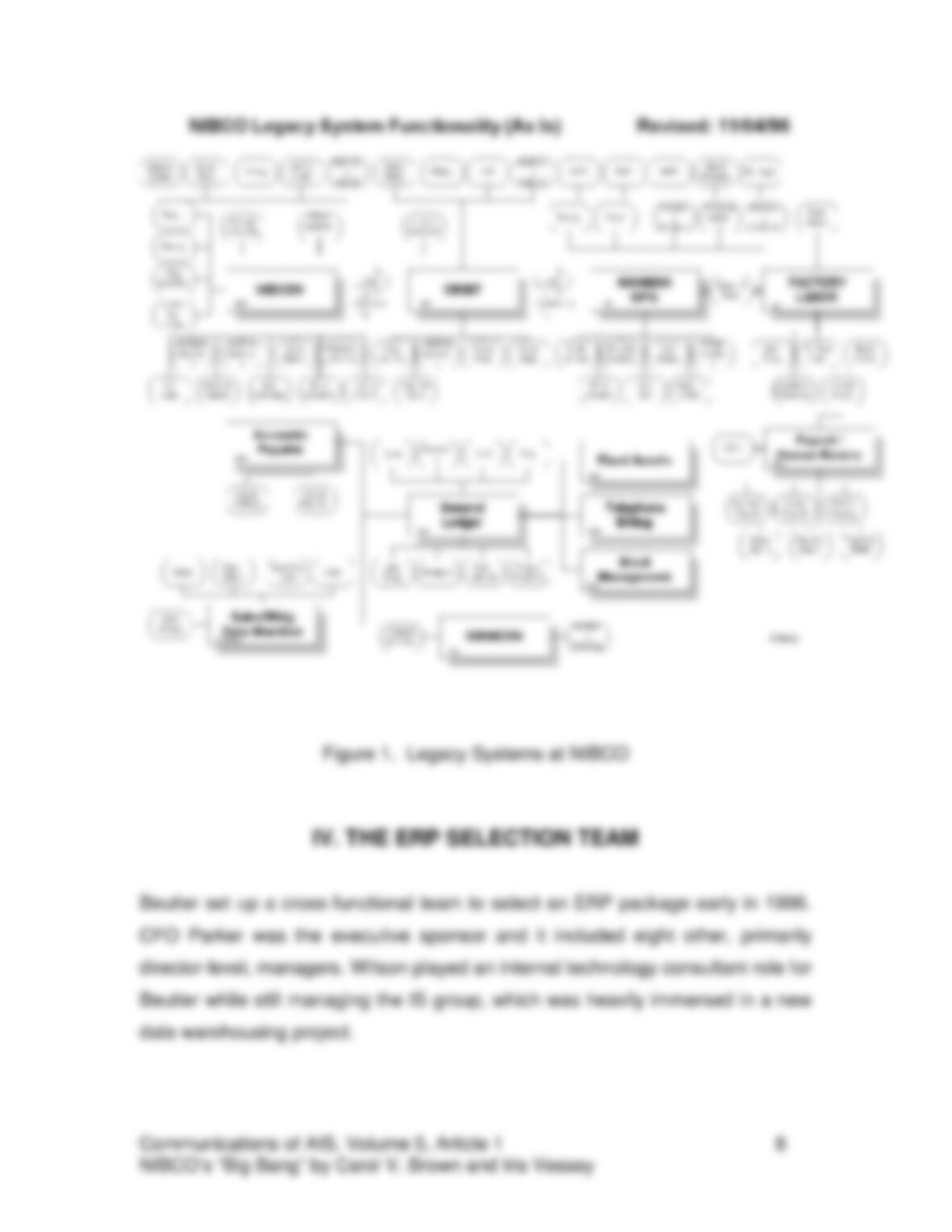
Four major legacy systems supported the order entry, manufacturing,
distribution, and accounting functions (Figure 1). The business units had
purchased their own packages for some applications and plants were running
their own versions of the same manufacturing software package with separate
databases.
We had a neat manufacturing package that ran on a Hewlett Packard, an
accounting system that ran on an IBM, and a distribution package that