Hanen Fernandez
Invent an Organism Paper
Biology II
26 March 2013
New Island, New Species
I’m sure we all know what an owl is; those birds with the dark feathers and the characteris*cally
large eyes that go woo in the night. While that is the most common descrip*on of an owl, not all of them
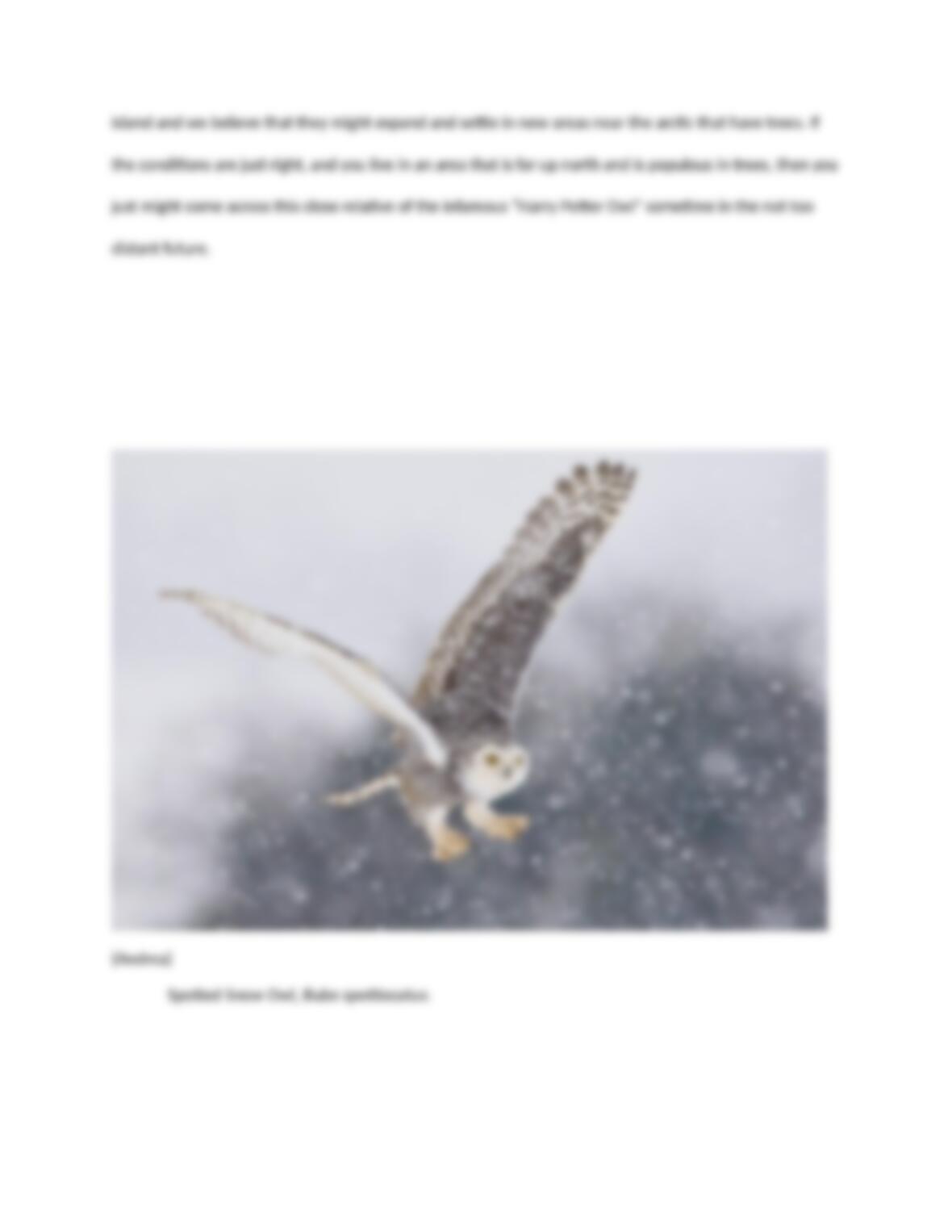
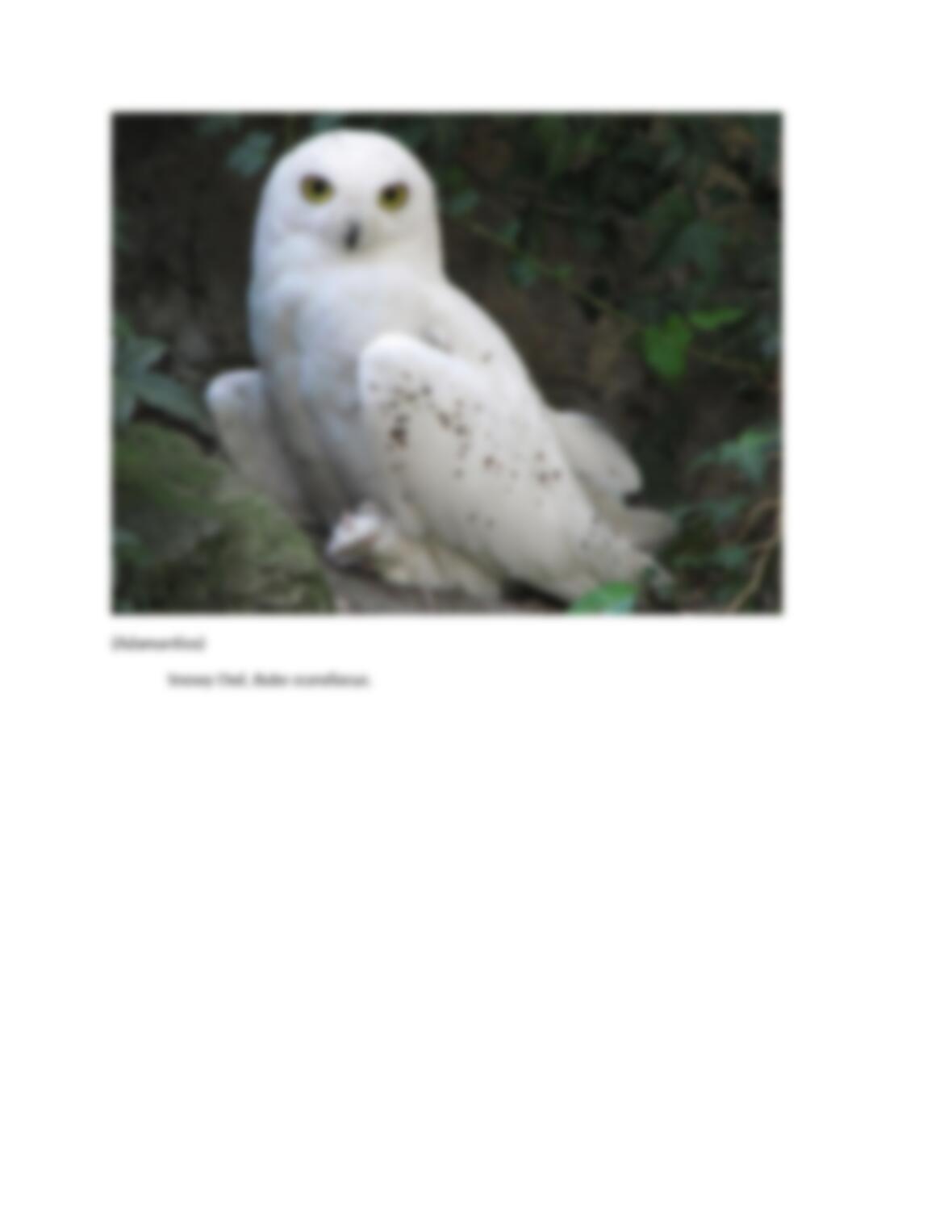
are strictly nocturnal, or dark in color. The Snowy Owl is one of those excep*ons. It is an owl that is
mostly diurnal, ac*ve during the day but sometimes during the night as well, and is covered with white
feathers. Although most of us refer to them as, “Hedwig from Harry Poffer”, or simply, “the Harry Poffer
owl”, the Snowy Owls are formally known as Bubo scandiacus. The Snowy Owl has a typical average
weight of about four pounds, making it the largest owl, be weight, in North America (Snowy Owl). As
hatchlings, they are covered in white down with black markings that slowly begin to fade as they get
older, and although the females never fully lose all of their markings, some of the males do (Lewis).
These are mostly migratory birds, spending their summers and winters in di6erent loca*ons.
During winter, they can be found throughout Canada and some of the northern states in North America.
As summer approaches, they make their way further north towards the Arc*c Tundra. Tundra is a place
where there is li1le tree growth. The Snowy Owls like to be in a place where there is a lot of open space
for them to hunt along the ground. Their white plumage helps them blend in with the snow and makes
them very well hunters, it also acts as an insulator, allowing them to keep warm in the rigid cold
temperatures they live in (Snowy Owls).

The birds begin expressing courtship behaviors well before breeding season, in the midwinter
months up through March and April. The males put on an array of displays that show o6 their great
quali*es. They will :u6 their feathers, bow, and strut around with wings spread out in order to impress
the females. The male will also kill prey and show it o6 to the females o;en *mes feeding her as well.
Breeding season starts in May, and the brood size is greatly dependent on the popula*on numbers of
lemmings, small rodents that are the preferred prey of a Snowy Owl. The average size for a clutch is
anywhere between <ve to eight eggs but can be as high as fourteen eggs in *mes of large lemming
numbers. The male and female owl work as a pair, the male brings the female food as she incubates her
eggs, for a period of about 32-34 days. As the young are born and learning to take care of themselves,
the male and female work together to take care of their young. They are very protec*ve of their nest,
and may even a1ack an intruder that is as far as 1 kilometer away from the nest. Even though the Snowy
Owl prefers to eat Lemmings, they will eat any small mammal. They are opportunis*c feeders, and in