sustainability
Review
Review of Online Food Delivery Platforms and their
Impacts on Sustainability
Charlene Li 1,2, Miranda Mirosa 1,2 and Phil Bremer 1,2,*
1Department of Food Science, University of Otago; PO Box 56, Dunedin 9054, New Zealand;
charlene.li@postgrad.otago.ac.nz (C.L.); miranda.mirosa@otago.ac.nz (M.M.)
2New Zealand Food Safety Science Research Centre
*Correspondence: phil.bremer@otago.ac.nz; Tel.: +64-3-479-5469
Received: 10 June 2020; Accepted: 6 July 2020; Published: 8 July 2020
Abstract:
During the global 2020 COVID-19 outbreak, the advantages of online food delivery (FD)
were obvious, as it facilitated consumer access to prepared meals and enabled food providers to keep
operating. However, online FD is not without its critics, with reports of consumer and restaurant
boycotts. It is, therefore, time to take stock and consider the broader impacts of online FD, and what
they mean for the stakeholders involved. Using the three pillars of sustainability as a lens through
which to consider the impacts, this review presents the most up-to-date research in this field, revealing
a raft of positive and negative impacts. From an economic standpoint, while online FD provides
job and sale opportunities, it has been criticized for the high commission it charges restaurants and
questionable working conditions for delivery people. From a social perspective, online FD affects
the relationship between consumers and their food, as well as influencing public health outcomes
and traffic systems. Environmental impacts include the significant generation of waste and its high
carbon footprints. Moving forward, stakeholders must consider how best to mitigate the negative
and promote the positive impacts of online FD to ensure that it is sustainable in every sense.
Keywords:
online food delivery (online FD); sustainability; economic impacts; social impacts;
environmental impacts
1. Introduction
Economic growth and increasing broadband penetration are driving the global expansion of
e-commerce. Consumers are increasingly using online services as their disposable income increases,
electronic payments become more trustworthy, and the range of suppliers and the size of their delivery
networks expand.
Online to offline (O2O) is a form of e-commerce in which consumers are attracted to a product or
service online and induced to complete a transaction in an offline setting. An area of O2O commerce
that is expanding rapidly is the use of online food delivery (online FD) platforms. All around the
world, the rise of online FD has changed the way that many consumers and food suppliers interact,
and the sustainability impacts (defined by the three pillars of economic, social and environmental [
1
])
of this change has yet to be comprehensively assessed. Part of the difficulty in assessing its impact has
been that scholars are approaching this topic from a range of different disciplines. Thus, the objectives
of this review are threefold: (1) To conduct an interdisciplinary review that brings together academic
research on the broad range of areas impacted upon by the increased use of online FD; (2) to discuss the
opportunities and challenges these impacts pose; and (3) to highlight the opportunities for action by all
stakeholders, including online FD industry practitioners, policy-makers, consumers, and academics,
to maximize its positive and reduce its adverse impacts. Before presenting the review, it is important
Sustainability 2020,12, 5528; doi:10.3390/su12145528 www.mdpi.com/journal/sustainability

Sustainability 2020,12, 5528 2 of 17
to overview the online food delivery sector (Section 2) to help contextualize the results outlined in the
review (Sections 4–6).
2. Overview of the Online Food Delivery Sector
2.1. E-commerce Market Size
The e-commerce market has experienced strong growth over the past decade, as customers
increasingly move online. This shift in how consumers shop has been driven by a wide range of diverse
factors, some being market or country dependent, others occurring as a result of worldwide changes.
These changes include: an increase in disposal income, particularly in developing nations; longer work
and commuting times; increased broadband penetration and improved safety of electronic payments;
a relaxing of trade barriers; an increase in the number of retailers having an online presence; and a
greater awareness of e-commerce by customers [2].
The strongest growth of e-commerce over the last few years has occurred in China, where, in
2019, sales were worth US$1.935 trillion—an amount which was more than three times higher than
that spent in the United States (US$586.92 billion), the second largest market. On its own, China
represents 54.7% of the global e-commerce market, a share nearly twice the market share of the next
five highest countries (US, UK, Japan, South Korea, Germany) combined [
3
]. The rise of e-commerce in
the Asia-Pacific region is demonstrated in Table 1, which highlights the massive increase in the amount
spent during key online shopping days between 2015 and 2019. Of particular note is the US$38.4
billion spent on Singles Day (11.11) in the Asia-Pacific region in 2019, an amount which is more than
double the total sum of the US$9.4 billion spent on Black Friday in North America and much of Europe
and the US$7.4 billion spent on Cyber Monday in North America. The leading e-commerce platforms
worldwide differ by region and include platforms which are now household names, such as Amazon
(U.S.), Alibaba (China), and Flipkart (India).
Table 1. Regional sales value of featured online shopping days from 2015–2019 [4].
Sales volume (US$ billion) 2015 2016 2017 2018 2019
Black Friday (North America and much of Europe) 2.7 3.3 5.0 6.2 7.4
Cyber Monday (North America) 3.1 3.4 6.6 7.9 9.4
Singles Day (Asia-Pacific region) 14.3 17.8 25.3 30.8 38.4
2.2. Online to Offline Business and Online FD
The rapid growth of e-commerce has spawned many new forms of business, such as B2B (business
to business), C2C (customer to customer), B2C (business to customer), and O2O (online to offline) [
5
,
6
].
The business of O2O is a marketing method based on information and communications technology
(ICT) whereby consumers place orders for goods or services online and receive the goods or services at
an offline outlet [7,8].
One of the significant developments driving the O2O commerce explosion has been the proliferation
of smartphones and tablets and the development of infrastructures to support payment and delivery.
In 2019 there were 5.2 billion smartphone connections, and by the end of 2020, it has been predicted
that half of the people in the world will have access to mobile internet services [9].
O2O services have emerged in various fields, including the purchase of diverse product and service
categories, such as food, hotel rooms, real estate, or car rentals [
10
]. Online FD refers to the process
whereby food that was ordered online is prepared and delivered to the consumer. The development
of online FD has been underpinned by the development of integrated online FD platforms, such as
Uber eats, Deliveroo, Swiggy, and Meituan. Online FD platforms serve a variety of functions including
providing consumers with a wide variety of food choices, the taking of orders and the relaying of these
order to the food producer, the monitoring of payment, the organization of the delivery of the food and
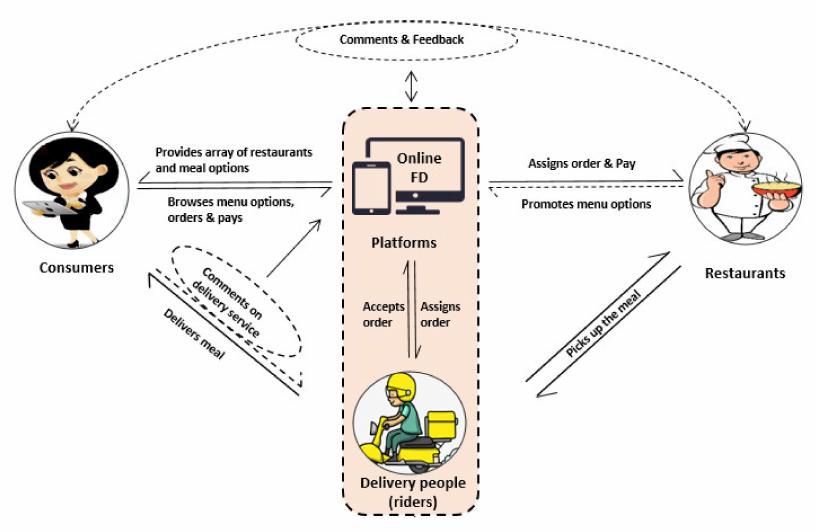
Sustainability 2020,12, 5528 3 of 17
the provision of tracking facilities (Figure 1) [
11
]. Food delivery applications, or ‘apps’, (FDA) function
within the broader context of online FD as they enable the ordering of food through mobile apps [
12
].
Figure 1.
The functions associated with online food delivery (FD) platforms. Arrows indicate movement
of information or logistic; lines indicate necessary routes; dotted lines indicate optional routes.
2.3. Online FD Providers and their Delivery System
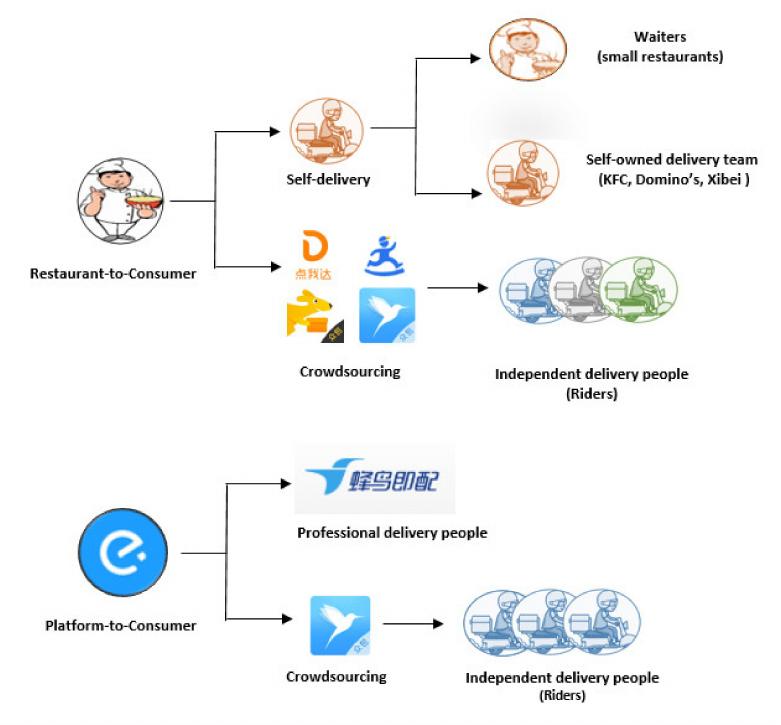
Food delivery providers can be categorized as being either Restaurant-to-Consumer Delivery or
Platform-to-Consumer Delivery operations [
13
]. Restaurant-to-Consumer Delivery providers make
the food and deliver it, as typified by providers, such as KFC, McDonald’s, and Domino’s. The order
can be made directly through the restaurant’s online platform or via a third-party platform. These
third-party platforms vary from country to country, and include examples, such as Uber eats in the
U.S., Eleme in China, Just Eat in UK, and Swiggy in India. Third-party platforms also provide online
delivery services from partner restaurants which do not necessarily offer delivery services themselves,
a process which is defined as Platform-to-Consumer Delivery.
Online FD requires highly efficient and scalable real-time delivery services. Restaurants can use
existing stafffor self-delivery, such as the use of waiters in some small restaurants or they may use
specialized delivery teams who are specifically employed and trained for this role, as is seen with
some of the big restaurant brands, such as KFC, Domino’s, and Xibei. Alternatively, restaurants can
employ crowdsourcing logistics, a network of delivery people (riders) who are independent contractors,
a model that provides an efficient, low-cost approach to food delivery [
14
]. Online FD platforms
can either be responsible for recruiting and training professional delivery people, or they may also
resort to crowdsourcing logistics, using delivery people who are not necessarily employed by the
online FD platform. Professional delivery people are usually trained, and at least part of their salary is
guaranteed, while a portion is commission-based. In contrast, the independent delivery people who
are frequently known as “riders” are paid on a commission (per order) basis (Figure 2).
Sustainability 2020,12, 5528 4 of 17
Figure 2. Online FD delivery retailers (Eleme in China, for example).
2.4. Growth of Online FD Worldwide
The rise of online FD is a global trend with many countries around the world having at least one
major platform for food delivery (Table 2). China leads the way in market share for online FD, closely
followed by the US with the developing markets of India and Brazil, showing rapid (>9% compound
annual growth rate (CAGR)) growth.
The online FD industry has been very proactive in the way it develops new markets and cultivates
consumers’ eating habits. For example, in 2018, a promotion campaign by the India-based online FD
company Foodpanda offered consumers large discounts, which resulted in Foodpanda increasing the
number of users by a factor of 10 [
15
]. Moreover, in 2018, Eleme in China, spent three billion yuan
(US$443 million) over three months in a successful marketing strategy to increase its market share to
more than 50 percent of the Chinese market [
16
]. Despite online FD being very strong in some regions,
as a whole across the world online FD is in the early stages of market development, and it will require
considerable investment to fund promotions and campaigns and to provide subsidies to participating
restaurants [
17
–
21
]. For example, a restaurant may hold a campaign on an FD platform, in which a
consumer obtains
¥
8 as a discount if the total amount ordered reaches
¥
20. In fact, this discount may
only cost the restaurant
¥
2, as it will receive a
¥
6 subsidy from the FD platform (the actual rules may
vary from one platform to another [
22
]). Such an approach is beneficial for a restaurant because it will
attract more consumers and orders. It is crucial for the future of online FD to cultivate consumers’
eating habits by introducing them to the choosing and purchasing of food online. By providing
consumers with the option of having a meal at a cheaper price or by providing other services, such as
Sustainability 2020,12, 5528 5 of 17
free delivery, online FD platforms and providers are encouraging consumers to abandon cooking at
home or going out to a restaurant to eat.
Table 2. Revenue of the Online FD segment in major countries [13].
Country Forecast Revenue in
2020 (in million US$)
Annual Growth Rate
(CAGR 2020–2024)
Market’s Largest
Delivery Segment
Volume of Market’s
Largest Delivery
Segment in 2020
(in million US$)
Leading Platforms
China 51,514 7.0%
Platform-to-Consumer
37,708 Meituan, Eleme
US 26,527 5.1%
Restaurant-to-Consumer
15,631 Grubhub, Uber Eats,
Doordash
India 10,196 9.5%
Restaurant-to-Consumer
5401 Foodpanda, Swiggy,
Zomato, Uber Eats
UK 5988 6.5%
Restaurant-to-Consumer
4115
Just Eat, Food Hub,
Deliveroo,
Hungry House
Brazil 3300 9.5%
Restaurant-to-Consumer
2033 iFood, HelloFood
Worldwide online FD is becoming increasingly well accepted and embraced by young adults, and
nowhere is this trend more evident than in China. A survey in 2019 of 1000 university students in Nanjing,
revealed that at least 71.45% of them had used online FD for at least two years and that 85.1% of them
used online FD more than once a week [
23
]. Online FD has been reported to be popular with Chinese
university students because it saves time (50.35% of 141 students in Hebei, China), is convenient (44.35%
of 124 students in Jiangxi, China), and is able to provide options that were tastier (39.52% of 124 students)
or simply different from canteen meals (36.17% of 141 students) [
24
,
25
]. Of course, different populations