Module # 1 – Nature and Concept of Management
Lesson 1: The Definition of Management
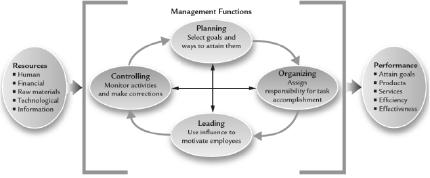
MANAGEMENT refers to the attainment of
organizational goals in an effective and efficient
manner through planning, organizing, leading, and
controlling organizational resources.
There are two important ideas in this definition: (1) the four
functions of planning, organizing, leading, and controlling,
and (2) the attainment of organizational goals in an
efficient and effective manner.
MANAGEMENT is the process of working with/through
others to achieve organizational objectives in a changing
environment. Central to this process is the effective and
efficient use of limited resources. To be effective is to
achieve organizational goals. To be efficient is to achieve
goals with minimal waste of resources, that is, to make the
best possible use of money, time, materials and people.
– It is the process of using organizational resources to
achieve organizational objectives through the functions of
planning, organizing and staffing, leading, and controlling.
Five components of this definition require closer examination:
1. Working with and through others –the manager and his
people should work together to attain the goals of the
company or organization.
2. Achieving organizational objectives – this is the main
reason for using management in any organization
3. Balancing effectiveness and efficiency – managers
should not only focus on effectiveness, he also needs to
be efficient to limit the waste of resources.
4. Making the most of limited resources – organization use
management for them to maximize the use of limited
resources.
5. Coping with a changing environment –organizations use
management to cope up with the changing environment
by utilizing the four functions of management.
What is the Difference between Efficiency and
Effectiveness?
Efficiency – the ability to maximize output with minimum
input. It is often referred to as “doing things right,” and
seeks to limit the wasted input which is costly for a
business. There is an element of speed in efficiency since it
requires things to be done quickly to avoid wasting time
and effort.
Effectivity – refers to the capacity to attain an intended
objective or result without wasting any of the resources or
by means of maximizing the use of limited resources. It is
often called “doing the right thing.” The intention is to
meet the desired goal regardless of the amount of input
required. Careful analysis and critical thinking are
present in effectiveness. If there is a goal that needs to be
achieved, the things that need to be done are prioritized
to achieve that goal.
Lesson 2: The Process of Management
THE PROCESS OF MANAGEMENT
• A process is a series of actions that achieves something
– making a profit or providing a service, for example.
• To achieve an objective the manager uses resources and
carries out four major managerial functions.
ORGANIZATIONAL RESOURCES
1. Human Resources – employees or people needed to get
the job done.
2. Financial Resources – any money used by the company to
accomplish the goals
3. Physical Resources – these are the firm’s tangible goods
and real estate, including raw materials, office space,
production facilities, office equipment, and vehicles.
4. Information Resources – the data needed and used to
accomplish the job
THE FOUR MANAGEMENT FUNCTIONS
The four basic management functions – activities that make up the
management process – are the following:
1. PLANNING (Delivering Strategic Value) – it involves
choosing tasks that must be performed to attain
organizational goals, outlining how the task must be
performed, and indicating when they should be performed.
Planning activity focuses on attaining goals. Planning is
essential to getting the “right” things done. Planning is
concerned with organizational success in the near future
(short term) as well as in the more distant future (long term).
2. ORGANIZING (Building a Dynamic Organization) –
assigning the tasks developed under the planning functions
to various individuals or groups within the organization. It
creates a mechanism to put plans into action. Organizing is
assembling and coordinating the human, financial,
informational and other resources needed to achieve goals.
3. LEADING (Mobilizing People) – stimulating people
to be high performers. It includes motivating and
communicating with employees, individually and in
groups. It involves close day-to-day contact with people,
helping to guide and inspire them toward achieving team
and organizational goals.
4. CONTROLLING (Learning and Changing) –
concerned with monitoring employees’ activities, keeping
the organization on track toward its goals, and making
corrections as needed. Trends toward employment and trust
of employees have led many companies to place less
emphasis on top-down control and more emphasis on
training employees to monitor and correct themselves.
However, the ultimate responsibility for control still rests
with managers.
ORGANIZATIONAL PERFORMANCE
An organization is a social entity that is goal directed and
deliberately structured. Based on the definition, let us
discuss further the meaning of social entity, goal directed
and deliberately structured. When we say Social entity it
means two or more people, there is no organization that is
compose of only one person. Goal directed means the
organization is designed to achieve some outcome or goal
such as make a profit, all organizations are focus in
accomplishing the goals that are set. Deliberately
structured means tasks are divided, and responsibility for
their performance is assigned to organization members,
people within the company have their own duties and
responsibilities based on their abilities.
The manager’s responsibility is to coordinate resources in an
effective and efficient manner to accomplish the organization’s
goals. Organizational effectiveness is the degree to which the
organization achieves a stated goal, or succeeds in accomplishing
what it tries to do. Organizational efficiency refers to the amount
of resources used to achieve an organizational goal. It is based on
the how much raw material, money, and people are necessary for
producing a given volume of output. All managers have to pay
attention to costs, but severe cost cutting to improve efficiency can
sometimes hurt organizational effectiveness.
The ultimate responsibility of managers is to achieve
high performance, which is the organization’s ability to
attain its goals by using resources in an
efficient and effective manner.
THE FIVE MANAGERIAL SKILLS
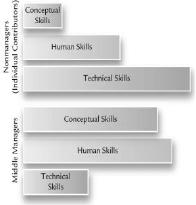
1. CONCEPTUAL SKILLS
a. Conceptual skill is the cognitive ability to see the
organization as a whole and the relationships among its
parts. It involves knowing where one’s team fits into the
total organization and how the organization fits into its
environment. It means the ability to think strategically—to
take the broad, long-term view— and to identify, evaluate,
and solve complex problems.
b. Especially important for top managers. Many of the
responsibilities of top managers; decision making, resource
allocation, and innovation, require a broad view.
2. HUMAN SKILLS (INTERPERSONAL SKILLS)
a. Human skill is the manager’s ability to work with
and through other people and to work effectively as a
group member. It is demonstrated in the way a manager
motivates, facilitates, coordinates, leads, communicates, and
resolves conflicts.
b. Important for managers at all levels, and particularly
those who work with employees directly on a daily basis.
c. Communication skills are an example of an important
interpersonal skill. An important subset of interpersonal
skills for managers is multiculturalism, or the ability to
work effectively and conduct business with people from
different cultures. Many managers at all levels ultimately
fail because their interpersonal skills are not good enough
for the demands of the job.
3. TECHNICAL SKILLS
a. Technical skill is the understanding of and
proficiency in the performance of specific tasks. This
includes mastery of the methods, techniques, and equipment
involved in specific functions such as engineering,
manufacturing, or finance. Also includes specialized
knowledge, analytical ability, and competent use of tools
and techniques to solve problems in that specific discipline.
b. Most important at lower organizational levels and
become less important than human and conceptual skills as
managers are promoted.
4. DIAGNOSTIC SKILL
Diagnostic skill involves investigating a problem and then
choosing a course of action to solve it.
5. POLITICAL SKILL
Political skill is the ability to acquire the power necessary to
reach objectives. Managers high in political skill possess a
keens sense of astuteness and understanding of people.
Negotiating and forming alliances are examples of political
skills. Political skill should be regarded as a supplement to
job competence and other basic skills.
Relationship of Skills to Type of Managers
When Skills Fail
1. During turbulent times, managers must use all their skills
and competencies to benefit the organization and its
stakeholders.
2. Many companies falter because managers fail to listen to
customers, misinterpret signals from the market, or can’t
build a cohesive team.
3. The number one reason for manager failure is ineffective
communication skills and practices. Especially in times
of uncertainty or crisis, if managers do not communicate
effectively, including listening to employees and
customers and showing genuine care and concern,
organizational performance and reputation suffer.
Lesson 3: Management Types
MANAGEMENT TYPES
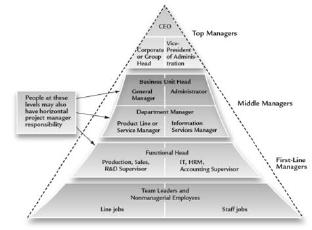
A. Vertical Differences
For first-level managers, the main concern is facilitating
employee performance. Middle managers, though, are
concerned less with individual performance and more with
linking groups of people, such as allocating resources,
coordinating teams, or putting top management plans into
action across the organization. For top-level managers, the
primary focus is monitoring the external environment and
determining the best strategy to be competitive.
1. Top managers are at the top of the organizational
hierarchy and are responsible for the entire organization,
with titles such as president, chairperson, executive director,
CEO, and executive vice president. They are concerned with
long-range planning.
Responsibilities of top managers include:
a. setting organizational goals;
b. defining strategies for achieving them;
c. monitoring and interpreting the external environment;
d. making decisions that affect the entire organization;
e. communicating a shared vision for the organization;
f. shaping corporate culture; and
g. Nurturing an entrepreneurial spirit.
2. Middle managers work at the middle levels of the
organization and are responsible for business units and
major departments, with titles such as department head,
division head, manager of quality control, and director of the
research lab. They are concerned with near-future planning.
a. The middle manager’s job has changed dramatically over
the past two decades. Many organizations improved
efficiency by laying off middle managers and slashing
middle management levels.
b. Traditional pyramidal organization charts were flattened
to allow information to flow quickly from top to bottom
and decisions to be made with greater speed. In addition,
technology has taken over many tasks once performed by
middle managers, such as monitoring performance and
creating reports.
c. Research shows that middle managers play a critical role
in facilitating change and enabling organizations to
respond in rapid shifts in the environment.
d. Middle managers’ status also has escalated because of
the growing use of teams and projects.
3. Project managers are responsible for temporary work
projects that involve the participation of people from
various functions and levels of the organization, and perhaps
from outside the company as well.
4. First-line managers are at the first or second
management level and are directly responsible for the
production of goods and services, with titles such as
supervisor, line manager, section chief, and office manager.
Their focus is on accomplishing day-to-day objectives.
This type of managerial job might also involve motivating
and guiding young, often inexperienced workers; providing
assistance as needed; and ensuring adherence to company
policies. Responsibilities of first-line managers include:
a. applying rules and procedures to achieve efficient
production;
b. providing technical assistance; and
c. motivating subordinates.
B. Horizontal Differences
Horizontal differences in management jobs occur across
the organization in the different functional areas such as
advertising, sales, finance, human resources, manufacturing,
and accounting.
1. Functional managers are responsible for departments
that perform a single functional task and have employees
with similar training and skills.
a. Line managers are responsible for the manufacturing
and marketing departments that make or sell the
product or service.
b. Staff managers are in charge of departments such as
finance and personnel that support line departments.
2. General Managers are responsible for several
departments that perform different functions.
Lesson 4: What is it Like to be a Manager?
A. Making the Leap: Becoming a New Manager
1. Becoming a manager involves a profound
transformation in the way people think of themselves, called
personal identity that includes letting go of deeply held
attitudes and learning new ways of thinking. Specific
aspects of this transformation include changing one’s
identity:
a. from a specialist who performs specific tasks to a
generalist who coordinates diverse tasks;
b. from things done through one’s own efforts to getting
things done through other people;
c. from an individual actor to a team and network builder
motivator and organizer; and
d. From working relatively independently to working in a
highly interdependent manner.
Most new managers are unprepared for the variety of
activities managers routinely perform.
1. Adventures in Multitasking
a. Managerial activity is characterized by variety,
fragmentation, and brevity. The average time spent on any
one activity is less than nine minutes, and managers must be
able to shift gears quickly.
2. Life on Speed Dial
a. Managers perform a great deal of work at an unrelenting
pace, requiring great energy. Most top executive
routinely work at least 12 hours a day and spend 50
percent or more of their time traveling.
b. Calendars are often booked months in advance, but
unexpected disturbances erupt every day.
c. Majority of executives’ meetings and other contacts are
ad hoc, and even scheduled meetings are typically
surrounded by other events such as quick phone calls,
scanning of e-mail, or spontaneous encounters.
d. Technology, such as e-mail, text messaging, cell phones,
and laptops, intensifies the pace.
3. Where Does a Manager Find the Time?
a. Time is a manager’s most valuable resource, and one
characteristic that identifies successful managers is that
they know how to use time effectively to accomplish the
important things first and the less important things later.
b. Time management refers to using techniques that
enable you to get more done in less time and with better
results, be more relaxed, and have more time to enjoy
your work and your life.
c. Learning to manage their time effectively is one of the
greatest challenges that new managers face.
Lesson 5: The 17 Managerial Roles
The 17 Managerial Roles are divided into the four functions of
management. The role/s of the manager of a certain organization
is/are based on the management type he/she possessed as well as
the job description given to him/her. It means that these 17 roles
are not being possessed of a certain manager alone, the role/s of the
manager again is based on the MANAGEMENT TYPE and JOB
DESCRIPTION.
PLANNING
1. Strategic Planner – set direction for others based on
external environment.
2. Operational Planner – plan for running the organization
or the unit.
ORGANIZING
3. Organizer – design jobs for group members and clarify
assignments.
4. Liaison – develop and maintain network of work-related
contacts.
5. Staffing coordinator – recruit, hire, train, evaluate, and
fire group members.
6. Resource allocator – divide resources to help get job
done.
7. Task delegator – assign tasks to group members.
LEADING
8. Figurehead – engage in ceremonial activities, and
represent the group to outsiders.
9. Spokesperson – answer inquiries and report information
about the group to outsiders.
10. Negotiator – make deals with others for needed
resources.
11. Motivator and coach – recognize achievements,
encourage, gives feedback and advice.
12. Team builder – contribute to group morale, hold
meetings to encourage members to talk about
accomplishments and concerns.
13. Team player – correct conduct, cooperate with others and
be loyal.
14. Technical problem solver – help group members solve
technical problems; perform individual contributor tasks.
15. Entrepreneur – suggest innovative ideas and further
business activity of the group; search for new
undertakings for the group.
CONTROLLING
16. Monitor – measure performance and productivity, and
review progress on tasks.
17. Disturbance handler – resolve problems and complaints.
Lesson 6: Factors Influencing Management
1. Globalization – refers to the phenomenon of growing
interconnectivity and interdependent relations between
nations. This has been greatly influenced by advancements
in technology, transportation, communication, and education
as well as the gradual deregulation of trade.
2. Technology – one of the main driving forces of
business. Outsourcing is a significant phenomenon brought
by technology, and it refers to the transfer of an
organizational function to a third party. When the third
party is located in another in another country, it is
called offshore outsourcing or simply offshoring.
3. Sustainability and Corporate Social Responsibility –
Sustainability in business means that companies should
plan and conduct long-term business operations to ensure
minimal negative impact on the social, cultural, and
economic aspects of their external environment or
community. Corporate Social Responsibility is defined as
the willingness of companies to run their business
operations in a sustainable and responsible manner. Ex: of
sustainability in business are cost-saving mechanism activities such
as recycling, reduction of energy consumption in the workplace,
and the use and production of environmental friendly products.
Some activities being done by most organization as part of their
Corporate Social Responsibility are outreach programs, support of
significant causes and other forms of philanthropic activities.
4. Psychology – important facet in management since it
focuses on developing people management skills and
analyzing customer satisfaction. It can help manager
foster closer relations and better communication with
employees.
5. Business Ecosystem – consist of a group of firms that
provide related products and services. A good example is
the collaboration between communication firms, media, and
technology to disseminate information to the public.
Lesson 7: How to Succeed in Management by Walking
Around
Here’s a checklist of walk-around tips a manager can start using
today, as provided by communication consultant Linda Duyle:
i. Get out of the office. Dedicate some time each week to get out
and talk with your workforce.
ii. Leave behind your cell phone and other gadgets. Minimize
distraction that can tug on your attention. You want to
demonstrate courtesy and respect during your time on the floor.
iii. Start slowly. Don’t feel the need to dive right into your
discussion even if you have prepared an agenda. Effective
listening requires you to focus on the person with whom you
are speaking. Clear your mind of distraction.
iv. Make eye contact. Look directly at the people with whom you
are speaking.
v. Make it two-way communication. When you’re asked a
question that you can’t answer, tell the employee that you don’t
have the answer but will get back to him or her.
vi. Be honest. If times are tough, don’t sugar-coat reality. For
example, if the company lost a big contract, bring it up in your
casual conversation.
vii. Process information. You may want to bring a small notepad
with you to write down questions or comments that you’d like
to remember or that require follow-up. You will learn some
great new things about your people and operations.
viii. Show appreciation. Thank the person for his or her time and
comments.
ix. Never quit. People may not be comfortable during the early
months of the walk-around process. But as they see you more
frequently and your willingness to be visible, comfort in the
process will improve.
Module # 2 –The Evolution of Management
Lesson 1: The Universal Process Approach
LESSON 1:
THE UNIVERSAL PROCESS APPROACH
(CLASSICAL APPROACH/ADMINISTRATIVE
MANAGEMENT THEORY)
• The oldest and one of the most popular approaches to
management thought.
• Also known as the universalist or functional approach
• According to this approach, the administration of all
organizations, public or private and large or small,
requires the same rational process.
• Early writers emphasized the specialization of labor, the
chain of command and authority.
There are two main assumptions:
• Although the purpose of organization may vary, a core
management process remains the same across all
organizations.
• This process can be reduced to a set of separate functions
and related principles.
ADVOCATE OR PERSON BEHIND THE
UNIVERSAL PROCESS APPROACH
HENRI FAYOL
• He published his classic book, Administration
Industrielle et Generale in 1916. It was not translated
into English until 1949.
• Fayol’s work had a permanent impact on 20th century
management thinking.
• He was a manager who attempted to translate his broad
administrative experience into practical guidelines for
the successful management of all types of organizations.
• He believed that the manager’s job could be divided into
five functions: planning, organizing, command,
coordination and control (POC3).
FAYOL’S 14 UNIVERSAL PRINCIPLES OF MANAGEMENT
1. Division of work – specialization of labor is necessary
for organizational success.
2. Authority – the right to give orders must accompany
responsibility
3. Discipline – obedience and respect help an organization
run smoothly
4. Unity of command – each employee should receive
orders from one superior.
5. Unity of direction – the efforts of everyone in the
organization should be coordinated and focused in the
same direction.
6. Subordination of individual interests to the general
interest – resolving the tug of war between personal and
organizational interests in favour of the organization is
one of management’s greatest difficulties.
7. Remuneration – employees should be paid fairly in
accordance with their contribution.
8. Centralization – the relationship between centralization
and decentralization is a matter of proportion; the
optimum balance must be found for each organization.
9. Scalar chain – subordinates should observe the formal
chain of command unless expressly authorized by their
respective superiors to communicate with each other.
10. Order – both material things and people should be in
their proper places.
11. Equity – fairness that results from a combination of
kindliness and justice will lead to devoted and loyal
service.
12. Stability and tenure of personnel – people need time to
learn their jobs.
13. Initiative – one of the greatest satisfactions is
formulating and carrying out a plan.
14. Esprit de corps – harmonious effort among individuals
is the key to organizational success.
These functions and principles have withstood the test of time
because of their widespread applicability.
LESSONS FROM UNIVERSAL PROCESS
APPROACH/ADMINISTRATIVE MANAGEMENT
THEORY
• The complex management process can be separated into
interdependent areas of responsibility or functions.
• Management is a continuous process beginning with
planning and ending with controlling.
• There is a concern that this rigid approach may make
management seem more rational and orderly than it really is.
• The functional approach is useful because it specifies what
managers should do, but the other approaches help explain
why and how.
Lesson 2: The Operational Approach
LESSON 2:
THE OPERATIONAL APPROACH (Scientific
Management Theory/Quantitative Management
Theory/Quality Management Theory)
• The term Operational Approach is a convenient
description of the production-oriented area of
management dedicated to improving efficiency, cutting
waste and improving quality.
• It has also been called Scientific Management,
Management Science, Operations Research, Production
Management, and Operations Management.
• Its underlying purpose is “to make person-machine
systems work as efficiently as possible.”
• Throughout its historical development, the operational
approach has been technically and quantitatively
oriented.
ADVOCATES OR PERSONS BEHIND THE
OPERATIONAL APPROACH
Frederick W. Taylor (Father of Scientific Management)
• Taylor was born in 1856 and was a self-made man.
• As a factory manager, Taylor was appalled at the
industry’s unsystematic practices
• In his pursuit to find a better way he sought what he
termed a “mental revolution” in the practice of
industrial management.
• Scientific Management is the development of
performance standards on the basis of systematic
observation and experimentation.
• Experiment was Taylor’s trademark.
Taylor started the scientific management movement in
industry by focusing in four areas:
1. Standardization – according to Taylor for the
organization to have efficient and effective way of
producing products, there should be standardize
procedure so that there will be same output in the
production process.
2. Time and Task Study – according to Taylor, the output of
the employees depends on the time and task given to
them, meaning to say if the task is hard and requires
specialization, you have to give it to employee/s that
possessed that specialization and should give more time
to finish the task.
3. Systematic Selection and Training – for the company to
be effective and efficient, it requires systematic
selection of employees and provide training that can
enhance the ability of the employees.
4. Pay Incentives – for the employees to be more effective
and productive, the company or organization should
provide incentives based on their contribution.
Taylor’s Followers
1. Frank and Lillian Gilbreth – inspired by Taylor to turn
motion study into an exact science. Using motion
pictures, they studied and streamlined work motions,
paving the way for work simplification by cataloguing
17 different hand motions (called therbligs)
2. Henry L. Gantt – refined production control and cost
control techniques. Variations of Gantt’s work-
scheduling charts are still used today. He also
emphasized the importance of the human factor and
urged management to concentrate on service rather than
profits.
The Quality Advocates
3. Walter A. Shewhart – introduced the concept of
statistical control in 1931.
4. Kaoru Ishikawa – he advocated quality before World
War II. He focused on prevention and introduced the
idea of both internal and external customers. He
introduced fishbone diagrams as a problem-solving tool.
5. W. Edwards Deming – introduced concepts such as
employee participation and continuous improvement
in Japan.
6. Joseph M. Juran – he introduced Pareto Analysis, a
technique for separating major problems from minor
ones.
7. Armand V. Feigenbaum – developed the concept of total
quality control. His 1951 book focused on quality
improvement throughout the organization. He felt that
the customer is the one who ultimately determines
quality.
8. Philip B. Crosby – wrote the 1979 best-seller Quality is
Free, which promoted the concept of zero defects or
doing it right the first time.
LESSONS FROM OPERATIONAL APPROACH
• Scientific management was a revolutionary approach,
producing dramatic results in the context of the
haphazard industrial practices at the time.
• It created a much-needed emphasis on promoting
production efficiency and combating waste.
• Even though Taylor’s work is often considered
“dehumanizing” today, Taylor actually improved
working conditions by reducing fatigue and
redesigning machines to fit people.
• Operations management tends to be broader in scope and
application than scientific management. Operations
management is defined as developing tools and
procedures to efficiently transform raw materials,
technology, and human talent into useful goods and
services.
Lesson 3: The Behavioral Approach
LESSON 3:
THE BEHAVIORAL APPROACH (Human Relations
Theory)
• This approach recognizes the importance of people in
management and reflects the belief that successful
management depends on the ability of the manager to
understand and work with people who have a variety of
backgrounds, needs, perceptions, and aspirations.
• The progress of this humanistic approach from the
human relations movement to modern organizational
behavior has greatly influenced management theory and
practice.
THE HUMAN RELATIONS MOVEMENT
It was a concerted effort among theorists and practitioners to
make managers more sensitive to employee needs. It was
supported by three very different historical influence:
1. Threat of Unionization – the movement was a union-
avoidance tactic, with the idea that satisfied employees
would be less likely to join unions.
2. The Hawthorne Studies – practical behavioral research
ORGANIZATIONAL BEHAVIOR
• It is a modern approach to management that attempts to
determine the causes of human work behaviour and
translates the results into effective management
technique.
• This is an interdisciplinary approach with psychology
and predominating.
LESSONS FROM BEHAVIORAL APPROACH
• Primarily, the behavioural approach makes it clear to
present and future managers that people are key to
productivity
• According to advocates of the behavioural approach,
technology, work rules and standards do not guarantee
good job performance because success depends on
motivated and skilled individuals who are committed
to organizational objectives.
• Only a manager’s sensitivity to individual concerns can
foster the cooperation necessary for high productivity.
• Organizational behaviour, as a science extension of
human relations, promises to fill in some of the gaps left
by human relationists, while at the same time retaining
an emphasis on people.
Lesson 4: The Systems Approach
• System – is a collection of parts operating
interdependently to achieve a common purpose.
• This approach requires a completely different style of