National Cranberry
Cooperative, 1996
Syndicate 4
Ian Qin
Cheer Lin
Rima Patel
Sophie Shao
Harry Kapahi
T1 2014 PT Operations Syndicate 4
Executive Summary
The National Cranberry Cooperative (NCC) in 1996 is facing operational
challenges at Receiving Plant #1 (RP1) that affects productivity and costs. The
purpose of this report is to investigate how NCC can progress towards resolving
some of the challenges before the commencement of the peak season.
The evaluation is based on the information provided and uses tools such as
process flow diagram, capacity and utilization analysis and inventory build-up
diagrams.
The primary operational challenges at RP1 are the long average truck waiting
time during unloading of wet berries, inventory build up and excessive over-time.
This report has identified the dryers’ capacity of 600 barrels per hour is the
slowest capacity in the system, hence it causes the bottleneck of processing wet
berries.
Short-term recommendations include adding an additional dryer to resolve
bottleneck issue, rescheduling of wet trucks to match the arrival rate and
standardising the weight of berries each truck delivers to meet the capacity
required.
Long-term Recommendations capital investment in additional separator to match
capacity to delivery, converting of dry bins to wet berry holding bins to cater for
future growth in water harvesting, exploring methods of lowering the rate of bad
fruit being supplied to the receiving plant and selling the recently purchased
dumper, which has very low utilization rate and has not improved the process
capacity, then fund other capital investment.
Page 2 of 13

T1 2014 PT Operations Syndicate 4
1. Draw a detailed process flow diagram of the current process at
Receiving Plant #1. Perform a detailed capacity analysis indicating
the capacity at each process step.
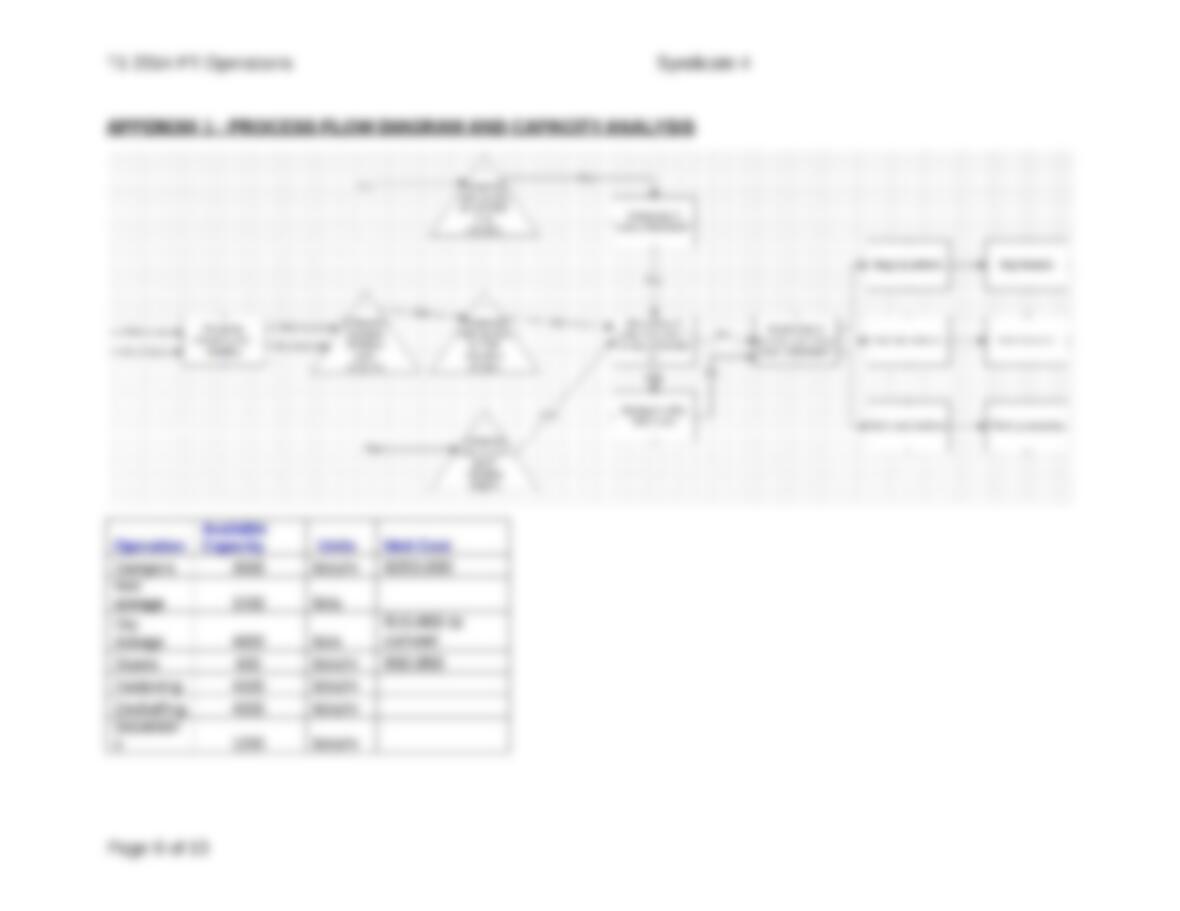
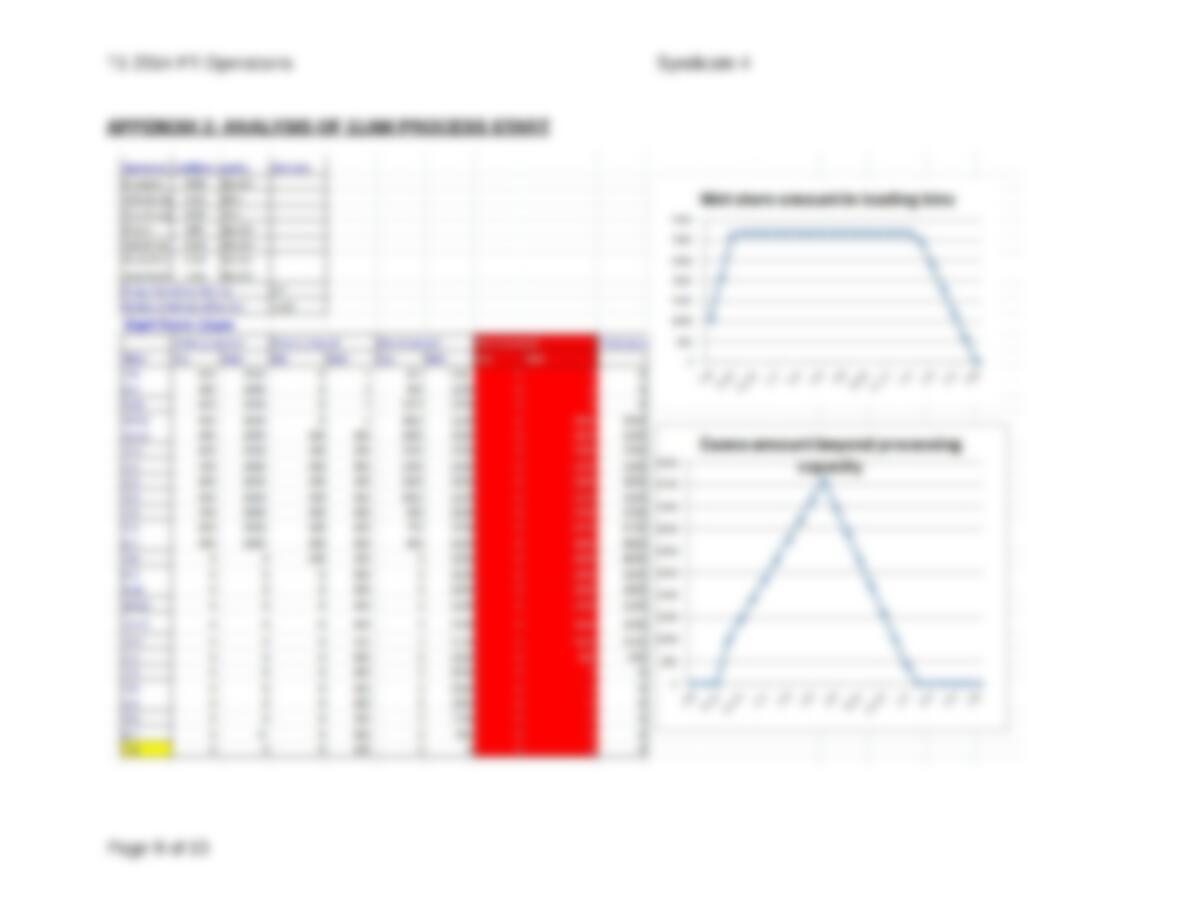
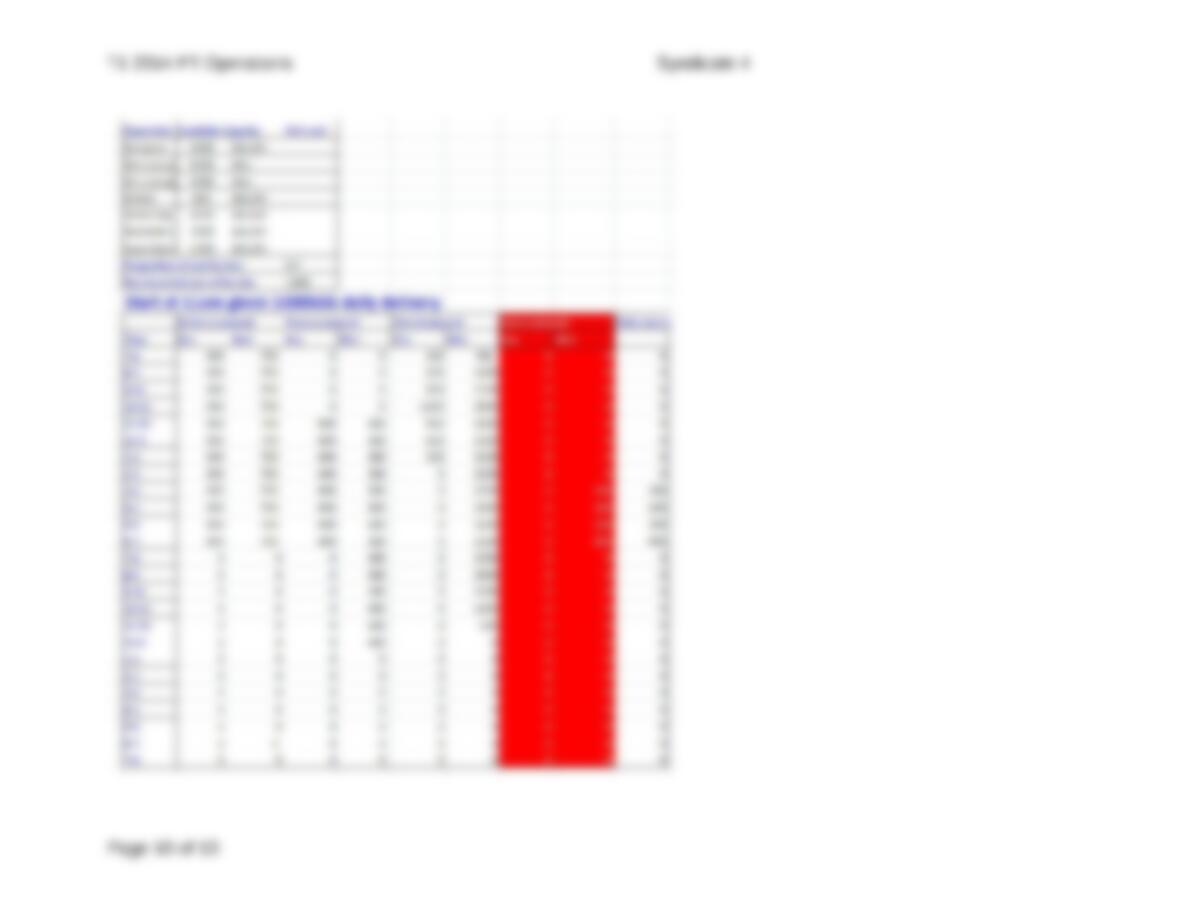
See Appendix 1
2. What is the maximum long-term achievable throughput rate of
Receiving Plant #1? What factors affect this throughput rate?
Maximum long-term achievable flow rate is 1200 bbls/hr, which is based on the
separator’s capacity. The separator is final process step that receives all berries.
Wet berries have to go through dryers, which only have 600bbls/hour capacity, so
when wet loading bins (3200bbls capacity) are filled up quickly and more trucks
come in, whole system reaches bottleneck because of dryers low process
capacity. However, wet and dry berries actually go through a paralleled process.
Even wet berries only has 57% (600/1050) processing rate, dry berries actually
got 100%. In the end, they do share 1200bbls/hr capacity of dryers.
Factors affecting long term throughput rate:
a) Separator (1200bbls/hour) – The input rate is 1500bbls/hr so current
processing capacity is only 80% (1200/1500).
b) Dryers (600bbls/hour) – Significantly reducing throughout rate of web
berries and causing trucks delay.
c) Wet holding bins (3200bbls) – Remain 100% utilization most of the time
comparing with less than 50% utilization of dry holding bins.
d) Rate arrival of trucks – Only if NCC has power to manage and negotiate
the frequency of trucks delivery.
Page 3 of 13
T1 2014 PT Operations Syndicate 4
3. Currently what is (are) the major reason(s) for trucks waiting and
excessive overtime?
Excessive delay only happens to trucks with wet berries but not with dry berries.
It’s because wet berries have to go through dryers which can only process
600bbls/hr and it creates the bottleneck when wet bins (3200bbls) are
continuously loaded up. This is the main reason causing excessive delay and
overtime. Wet trucks have to wait until backlog can be handled and there are
new wet trucks coming in every hour until 7pm.
Wet loading bins can only store 3200bbls comparing with 4000bbls of dry loading
bins. Because the percentage of water-harvested berries is increasing from 58%
to 70%, it’s expected to see more wet berries. So the second bottleneck is the