National Cranberry Cooperative
CASE STUDY ANALYSIS
Operations Management – OPMG – 601
PRESENTED BY:
MOHAMED MAHMOUD SALEH

NCC Case Study Analysis
Case Study Brief
NCC are facing several problems in the operation management of receiving plant no.1
(RP1), during the cranberry harvesting period. These problems can be concluded as
followed:
1- The water harvested berries shall increase this year to be 70% of the total
harvested quantity, instead of 58% last year. Accordingly, there is a need to convert
some of the storage bins from storing dry berries to wet berries.
2- The need of installing a light meter system for berries color grading to assure the
quality of separating and grading the berries according to their colors, as this
process causes overpaying from NCC to the farmers.
3- Reduce the idle time of the trucks and the overtime costs by rescheduling the
process shift time.
4- Analyzing the decision of adding two new dryers and its impact on the process.
The processes of the RP1 can be summarized as follows:
1- Receiving and testing.
2- Weighing, sampling and grading.
3- Dumping.
4- Temporary Holding.
5- De-stoning Capacity.
6- De-chaffing Capacity.
7- Drying.
8- Separation according to quality grading.
9- Bulking and Bagging.
Page 1of 9
NCC Case Study Analysis
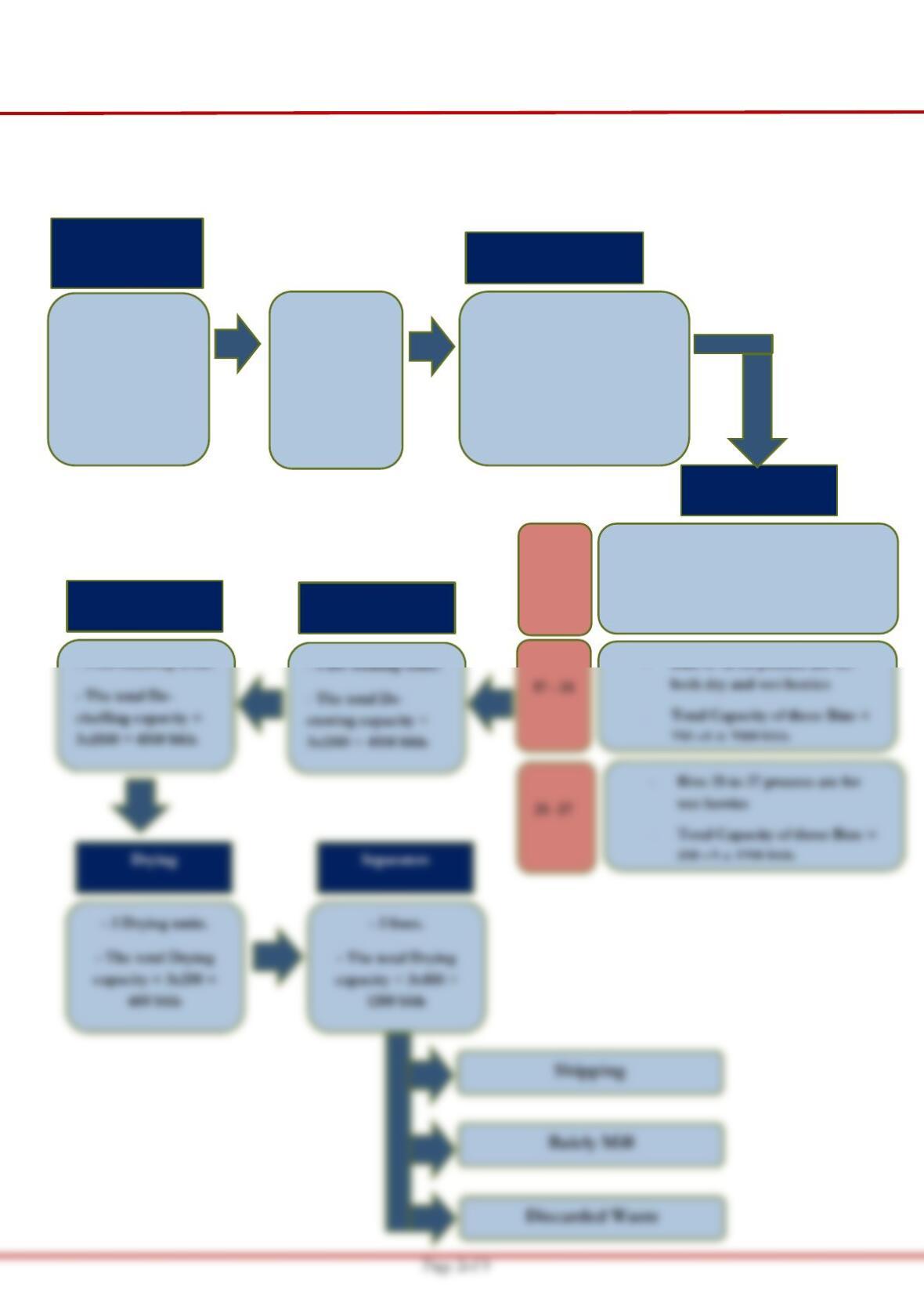
NCC Process Flow Diagram
Trucks arriving at
RP1. The average
weight of barriers
on truck is 75 bbls
per truck
The berries
weighed,
sampled and
color graded
Trucks arriving at
RP1
Dumping
– Average dumping time is
7.5 minute per truck.
– No. of Dumper are 5
– The total capacity of
dumpers = 5x75x60/7.5=3000
bbls/hr
Temporary
Holding
– Bins 1 to 16 process are for dry
berries
– Total Capacity of these Bins =
250 x16 = 4000 bbls
1 – 16
De-stoning
De-chaffing
– 3 De–chaffing units.
– Bins 17 to 24 process are for
250 x8 = 2000 bbls
– Bins 25 to 27 process are for
400 x3 = 1200 bbls
– 3 De–stoning units.