GENERAL ELECTRIC IN 2017:
NAMING AND CLAIMING THE INDUSTRIAL INTERNET
CASE: SM–288
DATE: 11/6/17
Beth Comstock, vice chair of General Electric, and her colleague, Bill Ruh, sat in a conference
room with their boss, GE Chairman and CEO Jeff Immelt. Immelt had called the meeting to
discuss the work he, Comstock, and Ruh had done over the past several years, and to lay out a
plan for that work to continue once GE’s new CEO, John Flannery, began his duties as chairman
in October 2017.
As Immelt reflected on his time as CEO—from 2001 to 2017—he knew he was leaving behind a
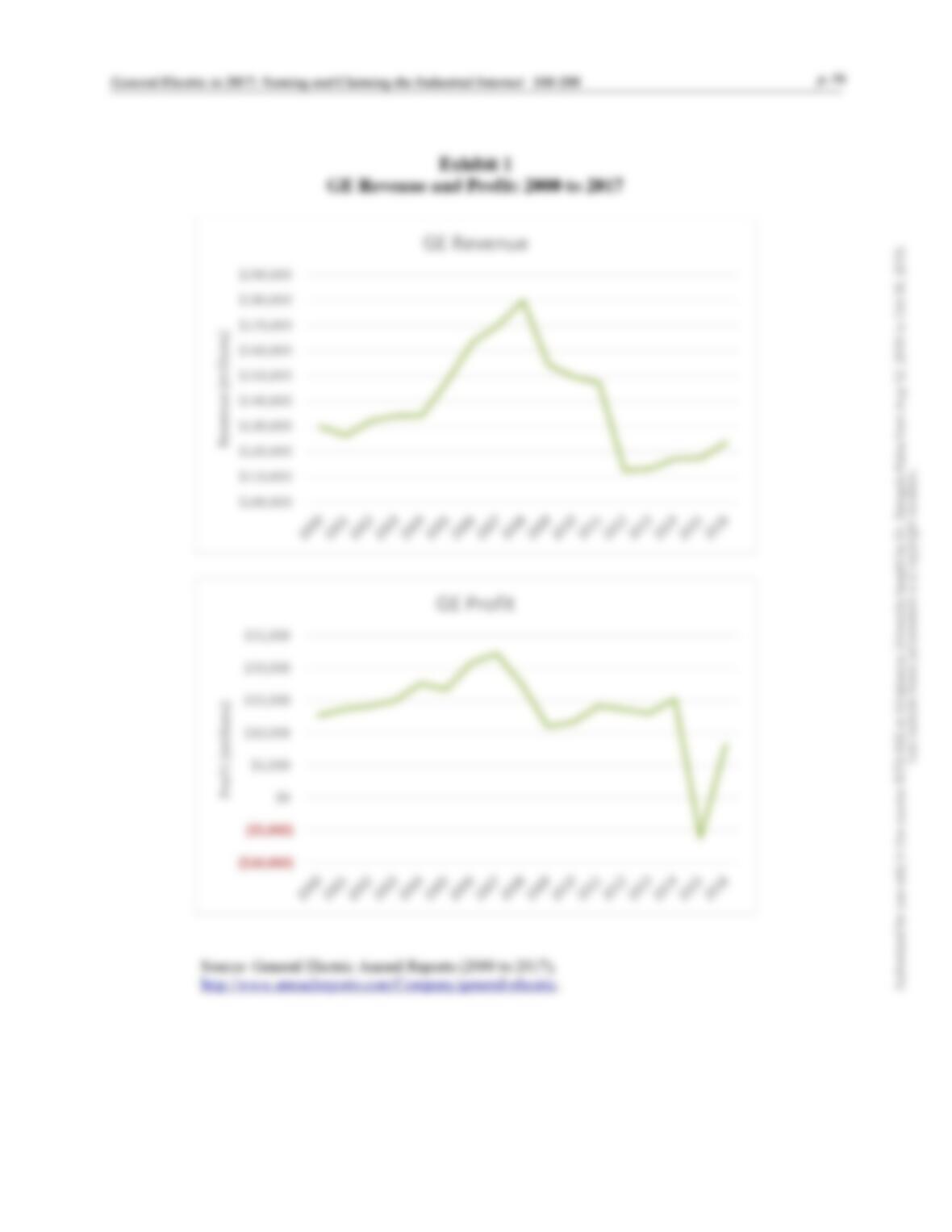
complicated legacy. On one hand, GE was less profitable in 2017 than it had been in 2001 (see
Exhibit 1 for GE’s revenue and profit over time). Its stock price had not recovered from the
2008 financial crisis, the company continued to underperform compared to analyst predictions,
and to top it all off, Immelt had dismantled GE Capital—selling $260 billion worth of its
assets—at a time when GE Capital represented 46 percent of the company’s profits.1,2 On the
other hand, Immelt had shifted GE back to its industrial manufacturing roots, started to
revolutionize its business model by selling both products like jet engines and outcomes like
increased energy efficiency, and created a subsidiary dedicated entirely to the harnessing of big
data—GE Digital—in order to make sure that GE was ready for an increasingly digitally
connected world.
Comstock also thought about her time at GE. As Immelt’s lieutenant, she had been one of the
key players in first conceiving of GE Digital and then bringing it to life. Once she and Immelt
had created the digitally focused, data-centric group, however, Comstock had stepped back from
1 Trefis Team, “Why GE’s Stock Has Underperformed in 2017,” Forbes, July 7, 2017,
https://www.forbes.com/sites/greatspeculations/2017/07/07/why-ges-stock-has-underperformed-in–
2017/#456c278c4536 (September 21, 2017).
2 “General Electric 2014 Annual Report,” General Electric, http://www.ge.com/ar2016/assets/pdf/GE_AR16.pdf
(September 18, 2017).
Cameron Lehman (MBA 2017) and Lecturer Robert Siegel prepared this case as the basis for class discussion rather
than to illustrate either effective or ineffective handling of an administrative situation.
Copyright © 2017 by the Board of Trustees of the Leland Stanford Junior University. Publicly available cases are
distributed through Harvard Business Publishing at hbsp.harvard.edu and The Case Centre at thecasecentre.org;
please contact them to order copies and request permission to reproduce materials. No part of this publication may
be reproduced, stored in a retrieval system, used in a spreadsheet, or transmitted in any form or by any means ––
electronic, mechanical, photocopying, recording, or otherwise –– without the permission of the Stanford Graduate
School of Business. Every effort has been made to respect copyright and to contact copyright holders as
appropriate. If you are a copyright holder and have concerns, please contact the Case Writing Office at
businesscases@stanford.edu or write to Case Writing Office, Stanford Graduate School of Business, Knight
Management Center, 655 Knight Way, Stanford University, Stanford, CA 94305-5015.
Authorized for use only in the course INTS-602 at Athabasca University taught by Dr. Bangaly Kaba from Aug 12, 2019 to Oct 06, 2019.
Use outside these parameters is a copyright violation.

p. 2
General Electric in 2017: Naming and Claiming the Industrial Internet SM-288
her day-to-day activities to focus on her broader purview—running both GE Ventures and GE’s
entire commercial organization, in addition to parts of the company. Thinking about the future,
she wondered what she would tackle next now that her long-time boss and commander–in-chief,
Immelt, was stepping down.
Finally, Ruh took a look back on his six years with GE. Hired by Immelt to take charge of GE’s
new digital initiative, he had been responsible for creating data- and analytics-based solutions for
all of GE’s different subsidiaries, such as GE Transportation and GE Power, which would
ultimately evolve the company’s business model. As he thought about the future, he wondered
how he could take what he, Immelt, and Comstock had started and make sure that it stayed alive
and healthy under the watch of the new CEO.
Though Immelt, Comstock, and Ruh were wrapped up in their own thoughts, they did have one
thought in common: each of them knew that come 2018, none of them would be working
together in the same way. The three of them had changed General Electric—and only time
would tell how that change would play out over the long term.
BACKGROUND: GENERAL ELECTRIC
General Electric began with the 1890 incorporation of the Thomas Edison General Electric
Company. In 1892, Edison’s company merged with the Thomson-Houston Electric Company
under the name General Electric, and GE was born.3 In 1896, GE became one of the 12 original
companies listed on the nascent Dow Jones Industrial Average.4
After its founding, GE began to grow in both size and scope, quickly moving beyond
manufacturing light bulbs and providing electricity. In 1902 GE invented the electric fan, in
1912 it began molding plastic parts, and in 1917, it entered—and won—the first U.S. military
aircraft competition, eventually producing engine parts for America’s planes during World War
I.5
Moving even further afield, in 1926, GE-owned subsidiary Radio Corporation of America (RCA)
founded the National Broadcasting Corporation (NBC), which began to cover landmark events
like the Rose Bowl in Pasadena, Calif., and Charles Lindbergh’s return to the United States after
the world’s first transatlantic flight.6 During World War II, American pilots flew in planes
running on GE engines; in 1969 Neil Armstrong took mankind’s first step on the moon in boots
made with GE’s silicone rubber, and in 1983, GE released the world’s first MRI machine, now a
staple of GE Healthcare.7
By 2017, GE had grown into a multinational conglomerate comprised of a suite of subsidiaries—
GE Additive (3D printing), GE Aviation, GE Capital, GE Digital, GE Healthcare, GE Lighting,
GE Power, GE Renewable Energy, GE Transportation, and Current powered by GE (a start-up
subsidiary founded in 2015 to sell energy management systems). With $124 billion in revenue,
3 “Thomas Edison & the History of Electricity,” General Electric, https://www.ge.com/about-us/history/thomas-
edison (September 21, 2017).
4 Steve Schaefer, “The First 12 Dow Components: Where Are They Now?” Forbes, July 15, 2011
https://www.forbes.com/sites/steveschaefer/2011/07/15/the-first-12-dow-components-where-are-they-
now/#29540425b032 (September 21, 2017).
Authorized for use only in the course INTS-602 at Athabasca University taught by Dr. Bangaly Kaba from Aug 12, 2019 to Oct 06, 2019.
Use outside these parameters is a copyright violation.

p. 3
General Electric in 2017: Naming and Claiming the Industrial Internet SM-288
nearly 300,000 employees, and a presence in more than 180 countries worldwide, GE was
nothing less than an industrial giant.8,9
CHANGING OF THE GUARD: FROM WELCH TO IMMELT
Jack Welch, GE’s legendary chairman and CEO from 1980 to 2001, transformed GE from a
broad manufacturer into an industrial powerhouse. Under his tenure, GE’s revenues more than
quadrupled, its profits increased more than tenfold, and its market capitalization increased by
nearly 3,000 percent.10 Welch imbued GE with a traditional organizational ethos—one based on
a commitment to excellence, a focus on quality, and extreme operational discipline, all enforced
through cost cutting and Six Sigma process improvement.
Having fine-tuned GE into a well-oiled machine, in 2001 Welch handed over the reins to newly
elected Chairman and CEO Jeff Immelt. Immelt, a Dartmouth graduate, began his career at GE
in 1982 after graduating from Harvard Business School. He started in Plastics, then worked his
way through Appliances and Healthcare before earning the top job in 2001 (see Exhibit 2 for
Immelt’s profile).11 Within a year of his taking the helm, however, GE encountered a massive
challenge.
Pivot #1: After the
Dot-com Bubble
From August 2000 to April 2002, with the bursting of the dotcom bubble, GE’s stock price
plummeted from $60 to $33 per share.12 In the midst of the nationwide economic slowdown,
which was exacerbated by the terrorist attacks on 9/11, Immelt had to figure out a way to help
GE recover—so he endeavored to take the company in a new direction.
One of Immelt’s first moves was to make GE leaner and faster, better able to compete in a post–
dotcom bubble economy. “Even before I was the CEO, I believed the company couldn’t
simultaneously be good at media, pet insurance, and making jet engines,” Immelt said. “Our
portfolio was too broad and too opaque. One group had no idea what another group did.”13
Almost immediately, Immelt began shifting GE’s portfolio, divesting from financial services like
insurance and acquiring companies he thought would grow in the future, such as Universal
Studios, which he combined with GE’s NBC to form NBCUniversal, and Amersham, a British
5 Ibid.
6 “Our History,” NBCUniversal, http://www.nbcuniversal.com/our-history (September 21, 2017).
7 Ibid.
8 “General Electric 2016 Annual Report,” General Electric,
http://www.ge.com/ar2016/assets/pdf/GE_AR16_AuditedFinancialStatement.pdf (September 21, 2017).
9 Ibid.
10 “Jack Welch,” CNBC First 25, https://www.cnbc.com/2014/04/29/25-jack-welch.html (September 21, 2017).
11 Ibid.
12 “The Jack and Jeff Show Loses Its Lustre,” The Economist, May 2, 2002,
http://www.economist.com/node/1111969 (September 21, 2017).
13 Jeff Immelt, “How I Remade GE,” Harvard Business Review, September 2017, https://hbr.org/2017/09/inside-
ges-transformation (September 25, 2017).
Authorized for use only in the course INTS-602 at Athabasca University taught by Dr. Bangaly Kaba from Aug 12, 2019 to Oct 06, 2019.
Use outside these parameters is a copyright violation.

p. 4
General Electric in 2017: Naming and Claiming the Industrial Internet SM-288
health care company specializing in CT scanners and MRI machines.14 Immelt then pumped
money into research—posting $3.1 billion dollars in R&D in 2004—to recast GE as a
15,16
technology company focused on innovation. Regarding the change, Immelt said:
We have to change the company—to become more innovation driven—in order to
deal with this new environment. It’s the right thing for investors. Productivity is
still very important, but if you look back at GE’s businesses over the past decade
or so, those that have been managed for both productivity and growth have done
the best.17
And Immelt didn’t just stop at GE’s portfolio—he also wanted to shift the company’s culture,
from Welch’s Six Sigma bottom-line efficiency to innovative, topline growth. As noted in
Bloomberg Businessweek, Immelt began:
… pushing for a cultural revolution … Under his former boss, the renowned Jack
Welch, the skills GE prized above all others were cost-cutting, efficiency, and
dealmaking. What mattered was the continual improvement of operations, and
that mindset helped make the $152 billion industrial and financial behemoth a
marvel of earnings consistency. Immelt hasn’t turned his back on the old ways.
But in his GE, the new imperatives are risk-taking, sophisticated marketing, and
above all, innovation.18
Pivot #2: After the
Financial Crisis
In 2008, Immelt had his second chance to take GE in a new direction. With the onset of the
subprime mortgage crisis in 2008, GE saw its stock price drop from a high of $42 per share in
October 2007 to a low of $7 per share in March 2009.19
To right the ship, Immelt continued to shift GE’s portfolio away from finance and toward its core
manufacturing products—engines, drilling equipment, and medical devices. He began by selling
off $26.5 billion of real estate assets, and amid increased regulatory scrutiny, continued to divest
from GE’s financial services, moving away from expansions that Welch had championed in the
1980s and 1990s.20
14 Geoff Colvin, “The Bionic Manager,” Fortune, September 19, 2005, http://fortune.com/2005/09/19/the-bionic-
manager-jeff-immelt-ge/ (September 25, 2017).
15 “General Electric 2004 10–K Report,” General Electric, http://getfilings.com/o0000040545-05-000020.html
(September 25, 2017).
16 Ibid.
17 Thomas Stewart, “Growth as a Process,” Harvard Business Review, June 2006, https://hbr.org/2006/06/growth-
as-a-process (September 25, 2017).
18 “The Immelt Revolution,” Bloomberg Businessweek, March 27, 2005,
https://www.bloomberg.com/news/articles/2005–03-27/the-immelt-revolution (September 25, 2017).
19 “General Electric Historical Stock Prices,” Nasdaq, http://www.nasdaq.com/symbol/ge/historical
(September 26, 2017).
20 Michael de la Merced and Andrew Sorkin, “G.E. to Retreat From Finance in Post-Crisis Reorganization,” The
New York Times, April 10, 2015, https://www.nytimes.com/2015/04/11/business/dealbook/general-electric–to-sell-
bulk-of-its-finance-unit.html?mcubz=1 (September 26, 2017).
Authorized for use only in the course INTS-602 at Athabasca University taught by Dr. Bangaly Kaba from Aug 12, 2019 to Oct 06, 2019.
Use outside these parameters is a copyright violation.
p. 5
General Electric in 2017: Naming and Claiming the Industrial Internet SM-288
After once again pivoting GE’s portfolio, Immelt had the task of figuring out how to position GE
for success in the next 20 years—and he knew he wasn’t going to be able do that alone.
Discussing the company’s new direction, Immelt said, “Frequently I’d say in a meeting, ‘Hey,
I’ve got half an idea. Can anybody grab it?’ More often than not, one of the people who did was
Beth Comstock.”21
THE FIRESTARTER: BETH COMSTOCK
Beth Comstock, a graduate of the College of William & Mary, worked at both CBS and Turner
Broadcasting before joining NBC in 1996 as a senior vice president in charge of
communications. From NBC, Comstock jumped to parent company GE, where she served as a
VP of corporate communications. She was subsequently promoted to chief marketing officer of
GE, then in 2005 was promoted again, this time to president of integrated media at
NBCUniversal (see Exhibit 3 for Comstock’s profile).22
At NBCUniversal, Comstock gained invaluable and experience about television and media—
both what worked as well as what didn’t. In 2006 she oversaw the purchase of iVillage, a media
company targeted toward women. The venture ceased operations in 2014. Comstock, however,
learned from the iVillage acquisition and, as a joint venture with The Walt Disney Corporation
and Fox Entertainment Group, launched Hulu, now a major player in the online entertainment
space.
23 She also led the creation of Peacock Equity, a media-focused venture capital group that