1
Group Report By:
Ana Chagelishvili
Thao Phan Ting Chih Wang (Tina)
Chi Ming Yip (Victor)
Jia Li, Zhao (Paris)
Course Name: Information System
Course lecturer: Rae Harbird
[November, 2011], London, UCL
2
Table of Contents
Part 1 Introduction…………………..
………………………………………………………….…….Page 3
Part 2 Scenario…………………………………………..……………………………………
…….…..Page 3
Part 3 Three Tier Architecture………………… ….……………………………………….
………..Page 4
Part 4 Description of MySQL…………………….
…………………………………………………..Page 7
Part 5 How MySQL can be used in
PU………………………………………………………………Page 10
Part 6 Advantages of MySQL
………………………………………………………………………..Page 12
Part 7 Disadvantages of MySQL…………………………………………………….
………………….Page 13
Part 8 Conclusion…………………………………….
………………………………………….…..Page 14
Bibliography……………………………………. ………………………………………….
………..Page 15
3
Part 1 Introduction
Databases constitute a linchpin of the current fast-changing information age, where
efficient sorting, categorization, and retrieval of data are vital. Database software is a type
of computer program that is designed to handle large volumes of data and to store them in
such a way that finding and retrieving any snippet of data is very efficient. For an
institution like Passmores with presumably over 10,000 students and staff, good database
software is critical for storing the huge amounts of information generated with efficiency,
accuracy, and reliability. This report discusses how MySQL, a powerful relational database
management system, could be used for recording and maintaining student profiles. In what
follows, this report provides a general overview of MySQL, its salient features with regard
to student data management, its role in a three-tier information system, and its advantages
and disadvantage Part 2 Scenario
For a university to manage the large amount of people such as staff and students, they need
a system to help them store and use the information. The system has to prevent for any
information leakages or losses. A system with fully rounded features will benefit the
universities in many different angles.
Passmores University (PU) is now considering switching to a new system that that will
allow them to record and maintain student profiles. The student profile will be built up
year-by-year without renewing.
The records includes two areas:
Academic:
Record the courses taken by each student
Student achievement results
Study transcript
Registration information
Fee status
Administrative:
Access to information of examinations including both the departments and students
Allow departments to know what courses each student is taking
Allow departments to get in touch with the students
4
The system also needs to allow students to:
Check the courses that they are registered to
Where and when examinations will be held
Check exam results
Then, eventually the new system will permit the present piecemeal provision to be
dispensed with. This new system will be involved with extensive network of PCs that
allows the support of administration activities and deliver information to user
communities.
Part 3 Three Tier Architecture
In order to be able to understand three tier architecture it is a good idea to define what the
tier architecture is at first. It is defined as “a server architecture in which the presentation,
the application processing, and the data management are logically separated entities.”1
There are two types of tier architecture- two tier architecture and three tier architecture.
The most widely used is three tier architecture. Which is defined as following: “It is a
client-server architecture in which the user interface, functional process logic, computer
data storage and data access are developed and maintained as independent modules, most
often on the separate platforms.”2 To have a clearer idea why three tier architecture is so
popular amongst application developers it is useful to look back at the development of tier
architecture. In 1980s two tier architecture was introduced for the first time. In following
architecture the application was running in the client machine which directly interacted
with the server most commonly with a database management system. This meant that
client application contained business logic in itself. So, when business logic was modified
it was automatically affecting client application. Developers had to change client service
every time they were changing something in business logic and afterwards, they had to test
it each time. Because of this reason it became essential to separate business logic from
other layers in order to minimize the impact on the client application.3 1 Multitier
Architecture.Wikipedia, the Free Encyclopedia [internet]. 2009 [Access: 02 Nov. 2011];
Available from: http://en.wikipedia.org/w iki/Multitier_architecture. 2 Multitier
Architecture. Wikipedia, the Free Encyclopedia [internet]. [Access: 02 Nov. 2011];
Available from: http://en.wikipedia.or g/wiki/Multitier_architecture. 3 Three-Tier
Architecture | Linux Journal. Linux Journal | The Original Magazine of the Linux
Community [internet]. 2010. [Access: 02 Nov. 2011]; Available from
http://www.linuxjournal.com/article/3508?page=0,0.
5
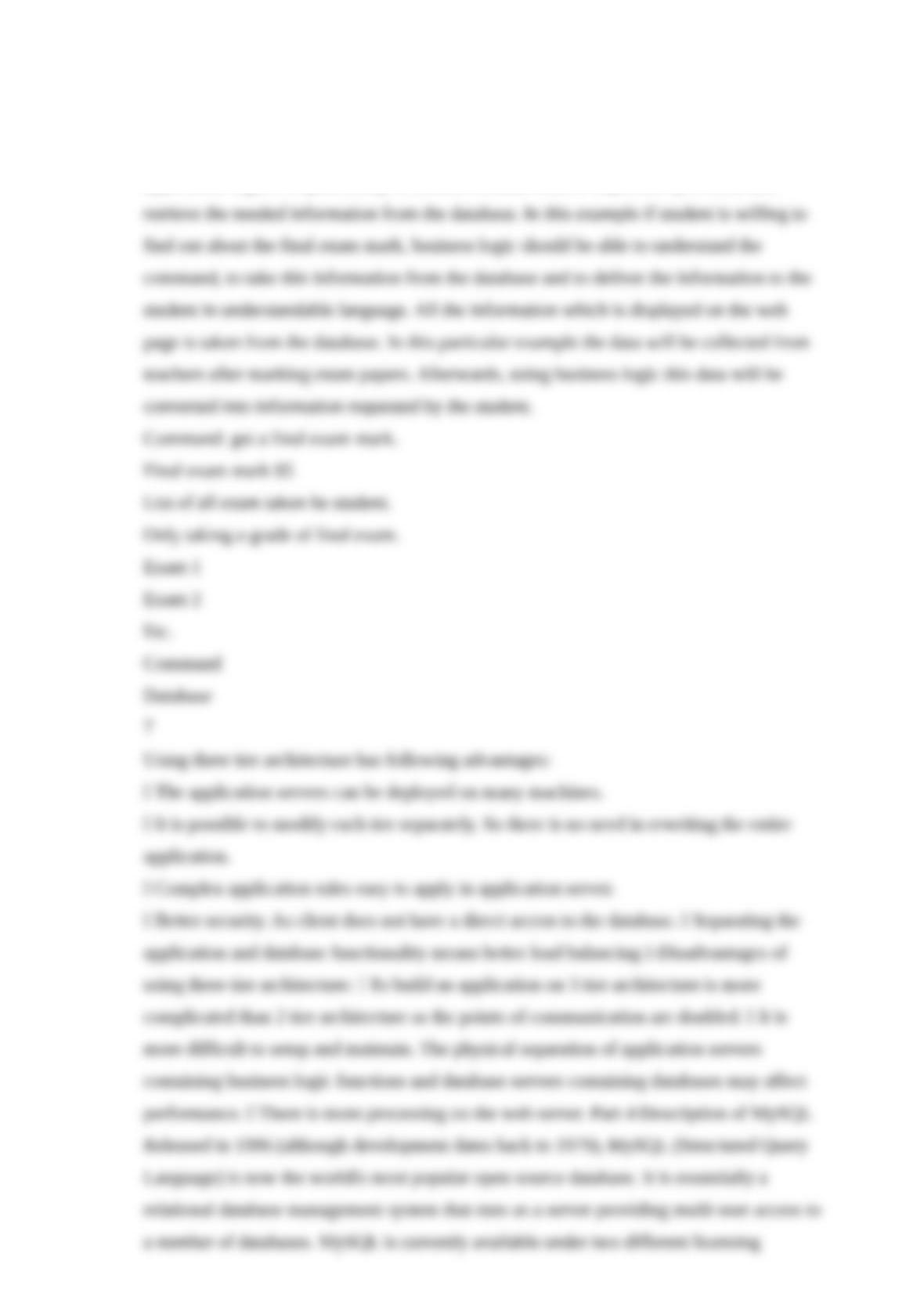
Three tier architecture is also known as multi tier architecture and contains three layers:
Presentation Layer
Application Logic
Database Layer
The top layer is also known as a user interface and its main function is to translate tasks
into something which will be easy to understand for clients.
The function of an application logic is to process commands, make decisions, evaluations
and calculations. Moreover, it moves data between the two adjacent layers.
The last layer is a database where the information is stored and retrieved. The information
will go at first to business logic where it will be evaluated and in the end it will be deliver
to the clients.4
How it works in practice?
An example can be UCL portico web site which gives information to students about their
grades, financial transactions, timetable and many others.
4 “File:Overview of a Three-tier Application VectorVersion.svg.” Wikipedia, the Free
Encyclopedia[internet]. 2009 [Access on 02 Nov. 2011]; Available from:
http://en.wikipedia.org/wiki/File:Overview_of_a_three-tier_application_vectorVersion.svg.
6
In three tier architecture the web page which is seen by a client is apresentation layer. At
this point the client only takes care of the presentation logic: getting the users input,
performing some simple checking and drawing the resulting output. The next step is
application logics responsibility. It should evaluate what is requested by a client and