Chapter 1
Multinational Financial
Management – Opportunities and
Challenges

MNEs
The Multinational Enterprise
(MNE)
•A multinational enterprise (MNE) is defined as one
that has operating subsidiaries, branches or affiliates
located in foreign countries.
•The ownership of some MNEs is so dispersed
internationally that they are known as transnational
corporations.
•The transnationals are usually managed from a global
perspective rather than from the perspective of any
single country.
•Today’s MNEs are dependent on emerging markets.

Financial Globalization and
Risk
•The global financial market place is a combination of complex
risks:
–The international monetary system is a mix of floating and
managed fixed exchange rates. China’s status is rising.
–Monetary and fiscal policies are affected by large fiscal
deficits.
–Large and continuing imbalances of balance of payments
changing the exchange rate landscape.
–Form of business shifting from the publicly-traded firm to
the privately owned model.
–Global capital markets are shrinking and changing.
–Large inflows and outflows of capital travel through
industrial and emerging markets.

The Global Financial
Marketplace
•Assets, institutions, and linkages comprise one
method to map global capital markets (see Exhibit
1.1).
–Assets are debt securities issued by governments,
forming the basis of other forms of financing.
–Institutions are the central banks, commercial, and
investment banks. The global financial system’s
stability depends on how well they do.
–Linkages are the interbank networks using
currency. Without ready exchange of currencies
the market is hard-pressed to operate efficiently.
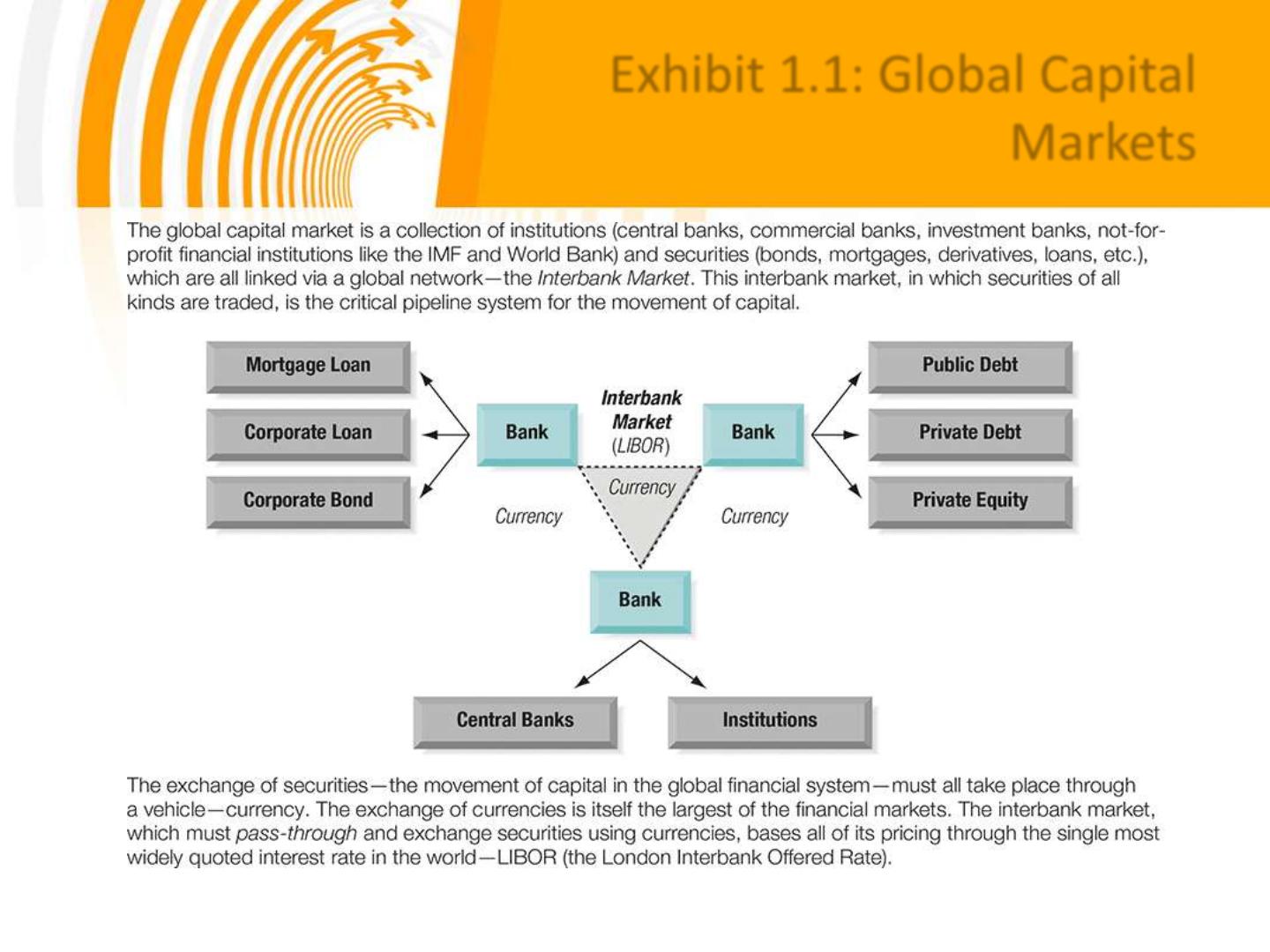
Exhibit 1.1: Global Capital
Markets
The Market for Currencies
•Most currencies are quoted against the dollar as in
“units per dollar”