Table of Contents
1.0 EXECUTIVE SUMMARY 2
2.0 INDUSTRY FORECAST: OUTLOOK AND TRENDS IN DATA 2
3.0 PORTERS FIVE FORCES ANALYSIS 3
COMPETITION IN THE MP3 PLAYER INDUSTRY 3
3.1. Rivalry Among Competing Sellers of MP3 Players 4
3.2 Threat of Potential New Entrants into the Manufacturer of MP3 Players 5
3.3 Firms in Other Industries Offering Substitute Products for MP3 Players 6
3.4 Suppliers of Materials, Parts, Components, or Other Resource Inputs for MP3 Players
7
3.5 Buyers of MP3 Players 7
4.0 DOMINANT ECONOMIC FEATURES 8
5.0 COMPETITOR ANALYSIS 9
Differentiation, price and innovation 9
Profitability 10
Other competitors 10
Conclusion 10
6.0 FORCES DRIVING INDUSTRY CHANGE 10
APPENDIX A 12
Figure 5.0 THE FIVE-FORCE MODEL OF COMPETITION 12
APPENDIX B 13
Hard drive based players 14
Table 5.1a 14
Table 5.1b 15
Flash based players 16
Table 5.2a 16
Table 5.2b 17
Table 5.3 18
Strategic Group Map 19
Ranking of MP3 players for 2005 19
APPENDIX C 20
SWOT Analysis – Apple versus the competition 20
Apples competitors 20
BIBLIOGRAPHY 21
1.0 EXECUTIVE SUMMARY
2.0 INDUSTRY FORECAST: OUTLOOK AND TRENDS IN DATA
The macro environment in which the MP3 player industry operated during 2005 was by
large shaped by the individual MP3 companies recognizing and responding to unmet needs
of a trend that was largely boosted by Apple: Their innovative response to creating a
solution for music lovers and their busy lives. This sequence of events within the MP3
industry was the formation of a trend that had gained momentum in 2005 and was showing
clear signs of a durable future ahead. There appeared to be great opportunities for a whole
cross section of this industry and it would depend on which companies crafted and
executed strategy that would best strengthen their sustainable competitive advantages
within this rapidly evolving industry. MP3 companies needed to understand the
environmental background that influenced their strategic thinking. It would have been
imperative for them to get an understanding of what the outlook and trends in data were
indicating.
It was not until the last quarter of 2001, when Apple first released its iPod that the industry
was revolutionized. This spurred their competitors into developing their own versions of
iPods. Sales in 2004 reached 28 million. By 2005 there were over a 100 manufacturers in
the digital music player industry. The pace of technological innovation within the industry
was driven hard by competitors trying to get a competitive advantage by developing units
that were smaller, had larger memory capacity, longer battery life and easier user interface.
Strategic partnerships were formed between MP3 player manufacturers and computer
hardware vendors, with their products being integrated into the design of the MP3 players.
The market emphasis on small and lightweight product encouraged hardware suppliers to
develop smaller hardware components that allowed superior memory and design that often
exceeded markets expectations.
Memory was an integral marketing tool, this spurred manufactures of hard drives and flash
memory to align themselves with specific MP3 player manufacturers and offer their
newest and most innovative memories to best capitalize on this fast emerging market.
Convergence between consumer electronic devices was an increasing trend. It became a
growing market requirement to reduce the need to carry multiple devices if it could be
integrated into one. Mobile phones that had digital cameras, MP3 players, all integrated
into a PDA system were also increasing in popularity. There was a different level of
convergence, particularly in the mobile phone industry. The need to listen to music on the
go was fast becoming a way of life. This was reinforced with the development of MP3
players that were small enough to fit in a shirt pocket and had memory capacity to hold an
average persons entire record collection. In tandem with the markets need for product
divergence, MP3 manufacturers focused on multifunctional usage capabilities. This was
seen in products that allowed music to be stored and listened to as well as being able to
become your electronic calendar/personal organizer with alarm clock, plus recording
potential. This was also expanded on to include photo storage capabilities, built in radios
with some including the ability to store and view videos.
With the increasing availability of the Internet and the revolution of broadband, download
speeds. MP3 players were being offered as direct purchases over the internet which made
the purchase of MP3 players very accessible and easy to buy, from anywhere in the world.
The Internet not only boosted sales, but also was fast becoming the preferred choice of
where you bought your music. 184 million tracks of music were sold on line in the first
seven months of 2005, more than twice the tracks sold in the same period compared to the
previous year. This symbiotic relationship was beneficial for both the MP3 players sales as
well as the online music industry. Only Apple chose a propriety audio format in
programming its MP3 players so that only music purchased from its online store will work
on an Apple player. Other industries players also provided online music, which included
Sony, Wal-Mart, Real Networks and Virgin. MP3 players became a fashion statement and
status symbol. They evolved into much more than music players. The size, functions and
colours became an important feature; the elegance of design was beginning to be displayed
prominently in movie clips and being talked about by the trendy media and their
celebrities. An emerging trend was also the ability to wear it as an accessory or in some
case it was incorporated as an accessory. The look was as important as the functionality.
One of the significant developments in 2005 was the decision taken by some of players to
withdraw from the MP3 market. Rio was one of these prominent players that found the
increasing competitive forces had eroded their prospects for a long-term return on their
investments.
3.0 PORTERS FIVE FORCES ANALYSIS
The ongoing challenge of companies in the MP3 player industry is maintaining sustainable
profits whilst weighing consequences of decisions made and the impact on outcomes of
these interrelated forces on its market growth. Managers of this industry must recognize
that the markets high profitability invites both existing and potential competitors to try
gaining a portion of the earnings experienced. Thus, the importance of managements role
is to identify business strategies that could enhance the sustainability of the companys
profits and ensure stability and increase of future earnings. To survive and be successful in
the long term, each company must learn to cope with the fast paced movement of changing
technology, current consumer needs and life-styles, and maintain a competitive edge or
differentiate itself from its competitors through innovative product lines, and services and
features offered. Porters Five-Forces Model of Competition [refer to Appendix A, Fig. 5.0]
is a relevant tool that assists companies and diagnoses competitive pressures existing in
this market. Hence, the purpose of this analysis provides a broader understanding of the
stronger and weaker competitive forces in the MP3 player industry.

3.1. Rivalry Among Competing Sellers of MP3 Players
It is evident that rivalry among competing companies in the market is generally strong.
Apple currently dominates the industry, and the success of increasing their bottom-line
continually intensifies competition from companies who desire taking a portion of this
profitable market. Apples competitive advantage in comparison to its competitors is based
on focusing and understanding the buyer costs to switching brands, this includes the
amounts of downloads done regularly on iTunes. Such factors and the markets rapid
growth triggers industry rivalry. The following factors identified that influence rivalry
among competing sellers are: Costs to Switch Brands, Consumer Demand, Product
Differentiation, and Apples Strategic Success.
Costs to Switch Brands: The factors affecting rivalry on the market has a mixed impact.
There is stronger rivalry on the industry with lower buyer switching costs amongst MP3
player manufacturers that support Microsoft Media format. However, rivalry is weaker for
users of Apple and Sony digital music players because of higher switching costs to buyers
once numerous music downloads have been purchased [both companies have their own
audio format] from the online music stores of iTunes [Apple] or Online Connect [Sony].
Consumer Demand for MP3 Players: The rapid growth of this market permits many
competing companies to produce the required quantity demanded by consumers. Elasticity
of demand is inelastic due to minimal changes in customer demand and price (Baye,
2006). This in effect reduces the risk of losing customers to other firms in the industry and
lessens rivalry among competing sellers. However, Apple is struggling to maintain control
of its market share and finds it difficult to produce the necessary units of digital music
players to meet consumer demands.
Product Differentiation: In 2005, there are over 100 companies manufacturing MP3
players, but only 7 companies claimed majority of the market. Based on the data analyzed
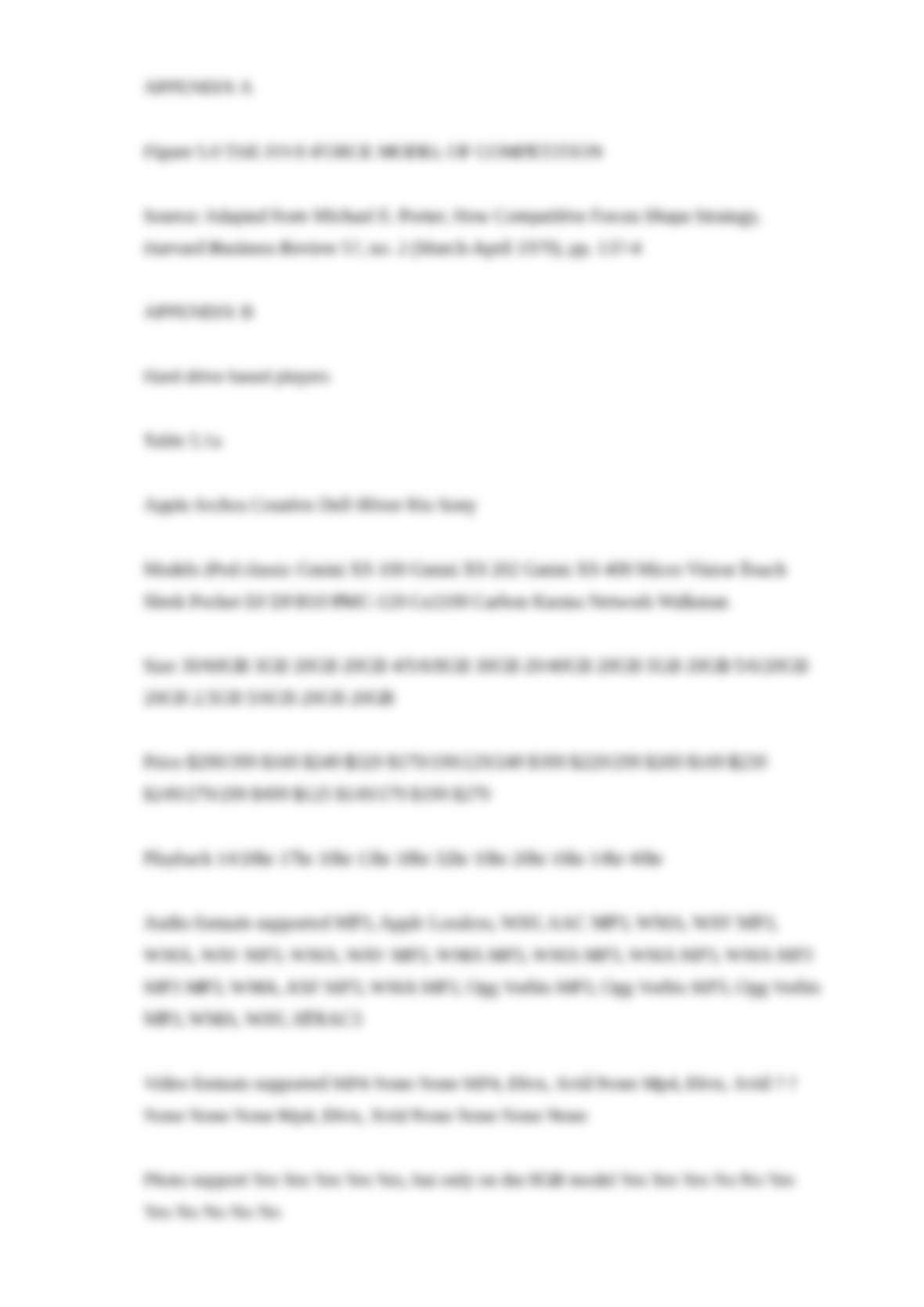
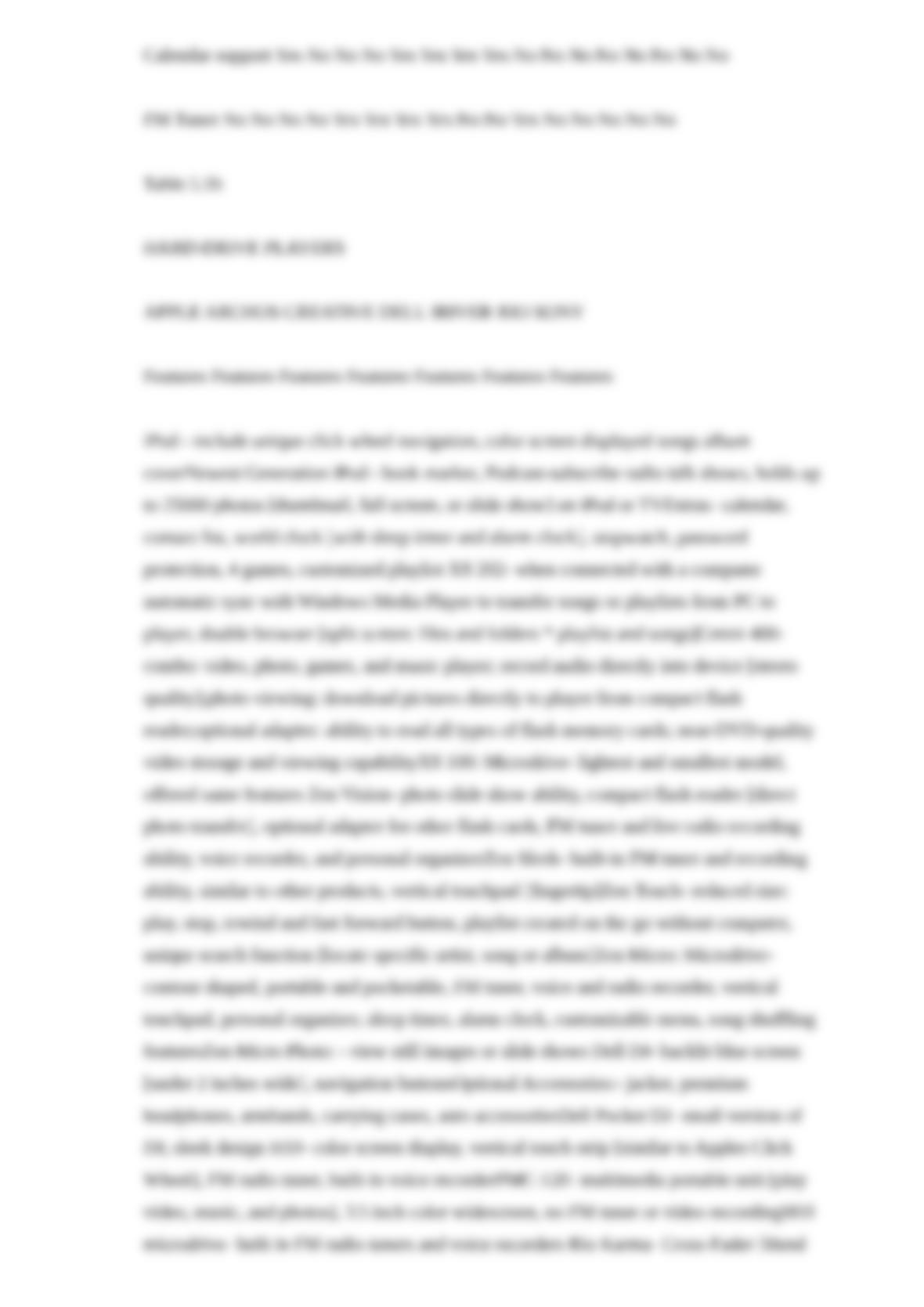
[refer to Appendix B, Tables 5.1-5.4], there are two types of MP3 players [hard-drive and
flash-based players] offered by 6 of the dominating firms in the industry. The common
similarity amongst the competing firms is the form of digital music players produced [i.e.
the size, shape, colour, etc.], but overall each model can be differentiated by its distinct
features [such as click wheel navigation, FM radio tuner, battery capacity, etc], brand
identity [logos or trademarks], design style [i.e. aesthetics, physical appearance, fashion
statement], and performance quality [i.e. improving ease of use, quality at a lower cost].