Motivation Behaviour Report
Introducon
The following report analyzes the motivational process of individuals working in existent
organizations. We interviewed four people from di erent industries and organizational levels to
have a be”er outlook on the ma”er. Our four interviewees are the following:
A&ab Rhana, Cashier at McDonald’s.
Abdelmalek Ke“as, Sports center supervisor at Holiday Inn.
Cassandra Ricafort, O/ce clerk and receptionist at La Capitale Insurance.
Eyad Shiekh, Finance, accounting and administration manager at IC Company’s.
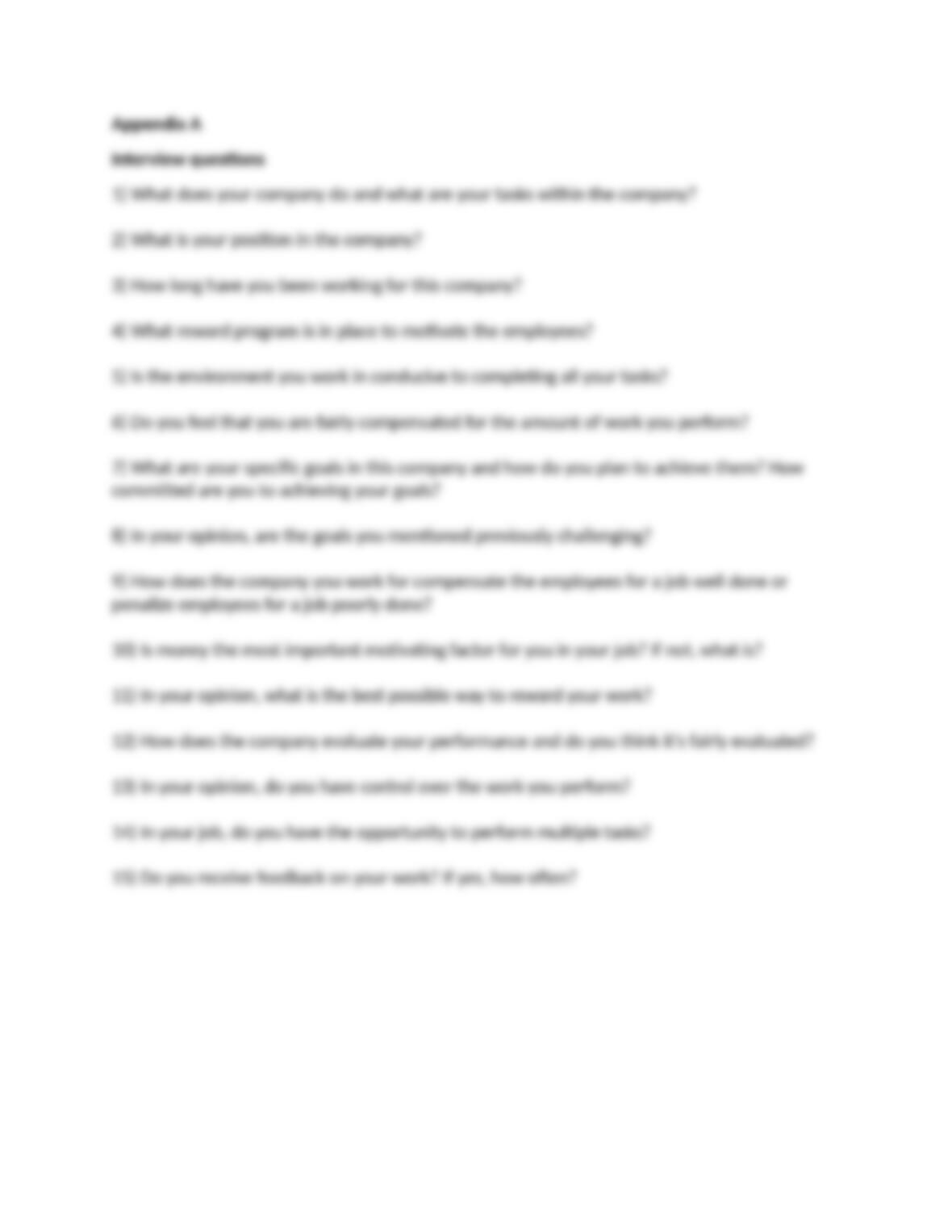
Each one of them has been asked about their experiences with motivation at work. This report
summarizes the interviews results, compares the experiences of the interviewees, identi3es the
motivational process in their organization, and o ers recommendations to increase motivation
at their workplace based on organization behaviour theories.
Interview Analysis and Findings
During the interviews that were performed, each person was asked about how
motivated they are at work. The answers that were given were not all the same. A&ab Rhana, a
cashier at McDonald’s responded by saying that he was not very motivated by his work. While
the other three interviewees responded by saying that they were motivated by their work. In
order to 3nd out the reason behind the di erence in answers, the interviewees were asked
questions pertaining to job design, which refers to the “structure, content and con3guration of a
person’s work tasks and roles”. (PAGE 200) More specifically, interviewees were asked
questions about job scope, which is the breadth and depth of a job. (PAGE 201) The breadth of
a job corresponds to the number of di erent tasks that are performed, while the depth
corresponds to the degree of control a worker has in his job. (PAGE 201) A job that has high
breadth and depth is said to be a high scope job, while a job with low depth and breadth is said
to be a low scope job. In the case of A&ab Rhana, he said that he did not have many activities to
perform and that he had li”le control over his work. One could therefore suggest that his job is
a low scope job. While the other three intervieews all claimed that they had many di erent
activities to perform as well as having control over their work, which makes their jobs high
scope. A high scope job is said to provide more intrinsic motivation, which is self-applied
motivation that comes from the relationship between the worker and the task, than a low scope
job. (PAGE 155) This could help explain why a McDonald’s cashier with low job depth and
breadth is not very motivated by his work.
By identifying the di erences in the jobs performed, one could begin to understand why
some jobs are more motivating than others. One way to di erentiate between the di erent
characteristics of jobs is to use the Job Characteristic Model. According to the Job
Characteristics Model, ’’ there are 3ve core job characteristics that have particularly strong
potential to a ect worker motivation: skill variety, task identity, task signi3cance, autonomy and
job feedback”. (PAGE 203)
Each interviewee was asked questions about their skill variety, autonomy and feedback
from their job. In the case of A&ab Rhana, a McDonald’s cashier, he does not have the
opportunity to perform a variety of tasks. He was only in charge of the cash register and had to
take customer orders during his entire shi&. On the other hand, Cassandra Ricafort, an o/ce
clerk and receptionist at La Capitale Insurance, has the opportunity to perform multiple tasks
such as ordering supplies, helping paralegals prepare proceedings and prepare evidence
booklets. According to the job characteristic model theory, an employee will be more
motivated if given the opportunity to perform a variety of tasks that require various skills. (PAGE
203)
Another core job characteristic that has an impact on motivation is task autonomy. In
the case of both Eyad Shiekh, the finance, accounting and administration manager at IC
Company’s, and Abdelmalek Ke”as, the supervisor at the Holiday Inn, they both stated that they
thought they had control over their work. In the case of Abdelmalek Ke”as, he stated that “I
have full control over the work I do and this is what I like the most”. Also, Eyad Shiekh said that
having control and being responsible for the job at hand gives him the desire to want to
accomplish his job even more. On the other hand, A&ab Rhana claimed that she had li”le
control over her work. He is simply told what his task is and he has to do it. The answers given
by the interviewees reinforce the idea that having control over ones work, increases ones
motivation. (PAGE 203)
The final core job characteristic the intervieews were asked about was feedback.
According to the Job Characteristics Model, feedback from ones job is the “knowledge of the
actual results of the work activities”. (PAGE 203) In the case of feedback, all four interviewees
said that they received feedback on the jobs they do. In the case of A&ab Rhana, he received
feedback regularly during his shi&s from his manager and that it gave him a “boost of energy to
continue to work harder”. In this case as well, the answers given by the intervieews reinforce
the notion that receiving feedback from ones job is an essential part of having high intrinsic
motivation. (PAGE 204)
Another way to try to understand why some workers are motivated while others are not
is to try and understand how motivation occurs. According to expectancy theory,” motivation is
determined by the outcomes that people expect to occur as a result of their actions on the job”.
(PAGE 164) In the interviews, the four participants were asked what motivates them at their
jobs. In the case of A&ab Rhana and Cassandra Ricafort, money was said to be a very motivating
part of their jobs. Both said that money was important because they are both students and
needed the money to pay for tuition and other school expenses. Eyad Shiekh also said that
money was a motivating part of his job because it allowed him to provide for his family. On the
other hand, Abdelmalek Ke“as said that he felt that he was underpaid and therefore felt that
money was not a motivating factor in his job. In the case of three of the interviewees, the
money provided by their jobs satis3ed the many needs they had. According to expectancy
theory, this makes money highly valent. Valence is defined as the extent to which an outcome is
a”ractive or una“ractive to a person. (PAGE 164)