
ECO 303 AS 1 (Ch.1) Due via BB by 2:00pm CST Feb.12th (F)
Multiple choice @ 1 point each. Select the best answer available.
1. The ultimate role of the financial system of a country is to:
A) Provide a means for households to save B) Facilitate production, employment, and consumption
C) Be a low-cost source of funds for government D) Provide jobs in the financial sector
2. All of the following economic variables are flow variables except?
A) Income B) Money C) GDP D) None of the previous. They are all stock variables
3. Which of the following statements best describes financial instruments?
A) All financial instruments are a means of payment.
B) Financial instruments can transfer resources between people but not risk.
C) Financial instruments can transfer risk but not resources between people.
D) Financial instruments can transfer resources and risk between people.
4. Which of the following is NOT a key financial service provided by the financial system?
A) Providing information B) Creating liquidity C) Creating profit D) Sharing risk
5. In the United States, fiscal policy is determined by
A) Congress, the President, and the Federal Reserve acting together.
B) The Federal Reserve and the U.S. Treasury acting together,
C) The President and Congress acting together.
D) The Federal Reserve acting independently.
E) The U. S. Treasury acting independently.
6. The Federal Reserve System:
A) is responsible for making loans in the Fed Funds market
B) is responsible for creating the money necessary for the U.S. Government to pay its bills.
C) is responsible for maintaining price stability.
D) is responsible for long-term economic growth.
7. The relationship between money growth and inflation across countries is:
A) positive and fairly strong B) positive and fairly weak
C) negative and fairly weak D) negative and fairly strong
Use the following table to answer questions 8 & 9.
Time period 1995 1996 1997 1998 1999
Price index 100 120 142 146 148
8. During the time from period 1997 through period 1999,
A) the annual rate of inflation rises.
B) the annual rate of deflation decreases slowly.
C) the annual rate of deflation increases slowly.
D) prices are relatively stable when compared to the other periods.
9. During the time from period 1995 through period 1997,
A) the annual rate of inflation rises.
B) the annual rate of inflation falls.
C) prices are relatively stable when compared to the other periods.
D) deflation is rapid.
10. Financial intermediaries promote economic efficiency and thereby increase people’s wealth
A) by reducing the transactions cost of linking together borrowers and lenders.
B) to the extent that they help reduce the problems due to asymmetric information.
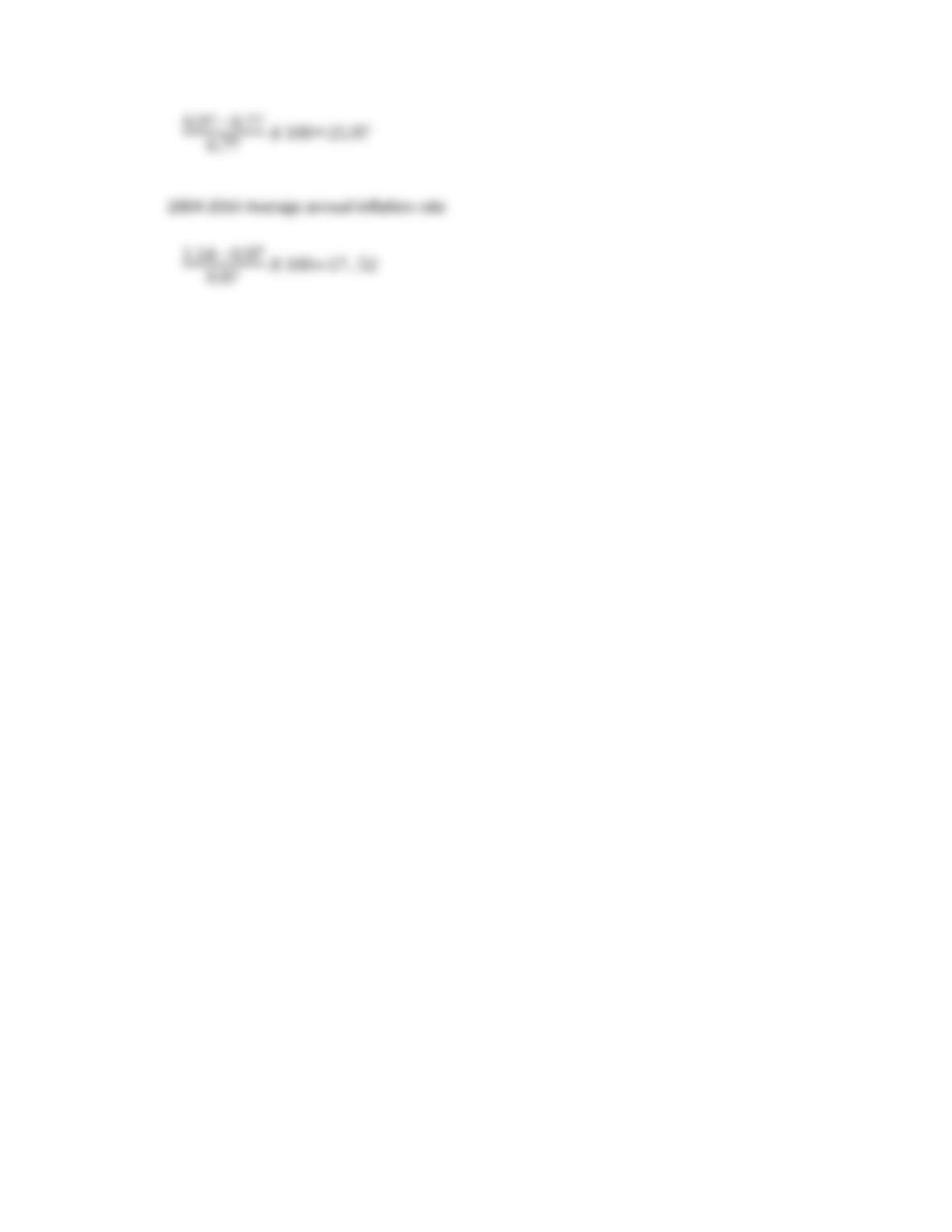
0.97−0.77
0.77 X100=25.97
2004-2014 Average annual inaon rate
1.14−0.97
0.97 X100=17. .52