Module 2: Importance and Misconceptions in
Entrepreneurship
Lesson 1: ENTREPRENEURSHIP AND
ORDINARY SMALL BUSINESS ACTIVITY
• Differences of the activities between ordinary
and small businesses:
a. Motive in opening a business
b. Perception of risk in the business
c. Reactions to changes in the environment
d. View on competition
e. Vision for development and growth
f. Horizon of business operation
g. Sources of business funds
1. MOTIVE IN OPENING A BUSINESS
– An entrepreneur should think deeply what his
/her intention in opening a business is. Opening a
business requires being creative, involves innovation,
and also keeping in mind that it constantly changes
and continues.
– An entrepreneur should not be stuck with a certain
idea, but rather always comes up with new and fresh
ideas.
– The owner of the business also opens a business with
the primary goal of making it as his/her source
of livelihood. However, sometimes the level of
profitability is neglected. The profitability aspect and
the level of profitability are two distinct important
issues.
2. PERCEPTION OF RISK IN THE BUSINESS
– An entrepreneur always allows challenges and risks
on his/her business. An entrepreneur faces it squarely
and finds a way to minimize the effects on the business
itself. Acknowledges, accept, prepare and solves the
challenges that he/she may face along the business
venture.
3. REACTIONS TO CHANGES IN THE
ENVIRONMENT
– We can differentiate an entrepreneur to an ordinary
business owner. An entrepreneur reacts positively to
changes in the business environment. A change in the
business environment allows new ideas to enter the
game. He/she develops a creative mechanism for
development and growth.
– Entrepreneurs never stops planning for alternative
actions and not just wait for everything to fall on its
place.
– On the other hand, an ordinary business owner
remains passive and static to changes in the
environment where he/she operates. He/she usually
believes that a change in the environment delivers
negative impact on the business and will bring
negative consequences.
4. VIEW ON COMPETITION
– An entrepreneur sees the presence of competition as
a sign of a healthy economic environment. This
competition will allow a certain entrepreneur to
continuously improve the products and think of ways
and strategies to maintain the good standing of his/her
business.
– An ordinary business owner views competition as an
unhealthy element in the business and tries to avoid it.
He/she sees it as a major risk for the business so he/she
stops to think of way to eliminate the competition and
worse, gives up on his business.
5. VISION FOR DEVELOPMENT AND GROWTH
– An entrepreneur usually outlines his/her
entrepreneurial venture in terms of short-term,
medium-term and long term plans of actions.
He/she makes sure that the vision and mission of
his/her business is clear. An entrepreneur properly
manages the venture in such a way that the operations
will provide development and growth to the
business.
– An ordinary business owner, relies upon chance or
luck in maintaining the status quo of his/her
business. This is where the famous “Bahala na.” line
enters the business. He/she is not much concerned
about its development and growth as long as he/she
satisfied with its earnings.
6. HORIZON OF BUSINESS OPERATION
– An entrepreneur thinks globally but acts
locally. He/she is primarily focused and concerned
with the major economic events. He/she believes that
the business will soon face a healthy competition in the
international market. The entrepreneur has both local
and global perspectives.
– An ordinary business owner focuses only on the local
environment. He/she does not want to get involved in
a much bigger environment. He/she has no plans of
expanding the business.
7. SOURCES OF BUSINESS FUNDS
– He/she strongly believes that the wealth the venture
may create is more than enough to compensate for the
sourced funds. He/she also explores opportunities to
generate funds from both internal and external
resources.
– On the contrary, the owner of an ordinary business
tends to limit the funding of his/her business enterprise
to personal resources. He/she fears that financial
institutions will not be willing to extend financial
assistance to the business. That certain individual is
fully convinced that he/she is pursuing the
unprogressive type of business endeavor.
❖ Knowing the differences between an ordinary
business owner and an entrepreneur can help you to
assess yourself further. Such knowledge will
enable you to avoid completely the perceptions or
behavior similar to the latter and focus more on
the perceptions or behavior of the former.
Lesson 2: MISCONCEPTIONS ON
ENTREPRENEURSHIP
• Misconceptions – a view or opinion that is
incorrect because based on faulty thinking or
understanding. (Oxford languages)
Listed below are some misconceptions on
entrepreneurship:
a. Entrepreneurship applies only to manufacturing
businesses.
b. Entrepreneurship applies only to small businesses.
c. Entrepreneurship applies mostly to persons with
good educational background in business courses.
d. Entrepreneurship applies only to a good economy.
e. Entrepreneurship is simply opening a small
business.
1. ENTREPRENEURSHIP APPLIES ONLY TO
MANUFACTURING BUSINESSES
– It is a misconception that entrepreneurship is only
applicable to manufacturing but not to
merchandising and service. It should be remembered
that merchandising and providing services are also
business ventures.
– Creativity and innovation appear limited in
merchandising because there is no transformation in
the appearance and content of the product. The
appearance of the product in merchandising does not
change from the time it is bought from the
manufacturer until it is finally sold to the consumer.
– The major merchandising activities involved are
buying and selling only. Creativity and innovation is
not merely a thing in merchandising and service. In
case there will be creativity it is easily imitated by the
competitors.
2. ENTREPRENEURSHIP APPLIES ONLY TO
SMALL BUSINESSES.
– The amount of the business capital does not serve as
a reckoning ground for classifying whether the
venture is operating within the concept of
entrepreneurship or ordinary small businesses.
– The programs of the NGOs (Non-governmental
organization) are noticed to focuses on giving
programs for the development of small businesses,
which led to the belief that entrepreneurship is for
small businesses only. This perception is definitely
wrong because the concepts and principles of
entrepreneurship are applicable to all types of
businesses regardless of their sizes.
– When the business venture expands its operations, or
opens other branches locally or abroad, the owner
usually employs a qualified manager to run the day-
to-day operations of the business branches. The
owner may relinquish to the manager the certain
functions such as decision-making and marketing.
As a result, entrepreneurship then becomes corporate
entrepreneurship.
• CORPORATE ENTREPRENEURSHIP –
process that goes on inside an existing
business venture and may lead to new ones
and the development of new products and
services. (ex. franchising)
3. ENTREPRENEURSHIP APPLIES MOSTLY TO
PERSONS WITH A GOOD EDUCATIONAL
BACKGROUND IN BUSINESS COURSE.
– One of the most believed misconceptions is that you
have to be a degree holder in business courses to be
an entrepreneur, not knowing that with or without a
business background knowledge you can be one.
– An entrepreneur should keep in mind the concepts
and principles of entrepreneurship and apply it to their
chosen business.
– The practice of entrepreneurship does not even
require an entrance examination in business
courses. Successful entrepreneurs come from all types
of life status and educational background, and yet
some of these individual manages to reach the top.
This just proves that, it is your inner driving force that
carries you towards becoming a dynamic
entrepreneur.

4. ENTREPRENEURSHIP APPLIES ONLY TO A
GOOD ECONOMY.
– An entrepreneur finds a way for his/her business to
take flight in the midst of distressed economies. It is
also an example of coping up with a business
environment. In this way, creativity and innovation
will be useful. Even during a financial crackdown,
new ideas can be created and new business
opportunities can be identified.
5. ENTREPRENEURSHIP IS SIMPLY OPENING A
SMALL BUSINESS.
– Entrepreneurship does not simply mean opening a
small business. This is to simply the first step in
actualizing the entrepreneurial venture. Before that,
the business must have already passed through the
preliminary stages of scanning the environment and
preparation of the feasibility study and business
plan. Entrepreneurship does not start and end with
opening a small business. It is a long continuing
process.
❖ Knowing and clarifying these misconceptions will
help certain entrepreneurs to have a clear
perspective of entrepreneurship to provide you
with good foundation in the study of this field.
Lesson 3: IMPORTANCE OF
ENTREPRENEURSHIP
Entrepreneurship is not only important to the business
itself. In this lesson, we will take a look on how
Entrepreneurship affects the entrepreneurs and the
businesses itself. Let us take this Covid–19 pandemic
as an example. It has been months since our country
has been placed in an enhanced community quarantine
and we have witnessed how this deadly–virus affected
the lifestyle and the livelihood here in the Philippines.
Now the Philippines is facing a lot of struggles
because a lot establishment and businesses was closed
in fear that their employees or even the entrepreneur
that owns it will be infected. The government already
sees the need to gradually open the economy so the
livelihood will be back and adjust to the new normal.
Let us study the importance of entrepreneurship to the
entrepreneur, the community and the Philippine
economy.
• IMPORTANCE TO THE FILIPINO PEOPLE
1. It provides guidelines in their wealth-creating
ventures.
2. It helps improve a certain individual’s finances
and way of life.
3. It helps bringing out creativity to a certain
entrepreneur.
4. It helps improving the lifestyle, and makes it a
happy and fruitful one.
• IMPORTANCE TO THE LOCAL
COMMUNITY
1. It provides additional job opportunities to the
local community.
2. It creates a new demand in the market.
3. It makes substantial contribution to the raising
and collection of taxes.
4. It facilitates the movement of the factors of
production.
5. It opens new business opportunities.
6. It promotes a peaceful and loving community.
7. It increases constructive competition.
• IMPORTANCE TO THE PHILIPPINE
ECONOMY
1. It adds a little challenge to the entrepreneurs to
level up their creativity and innovation for the
products and services.
2. It helps find an entrepreneurial niche in the
world market.
3. It expedites the process of recovery of the
Philippines during financial crackdown.
4. It facilitates the smooth flow of finances in the
local market.
5. It assists the national government to have
favorable economic ratings in the local and
international market.
❖ Entrepreneurship is essential in the
development of the economy. It also gives
additional job opportunities for the Filipino
people.
❖ Entrepreneurship plays a major role in the
economy of a certain country. It also
expedites the process of the development
and even the recovery of the Philippine
economy in the midst of a crackdown.
RECAPITULATION OF MODULE 2
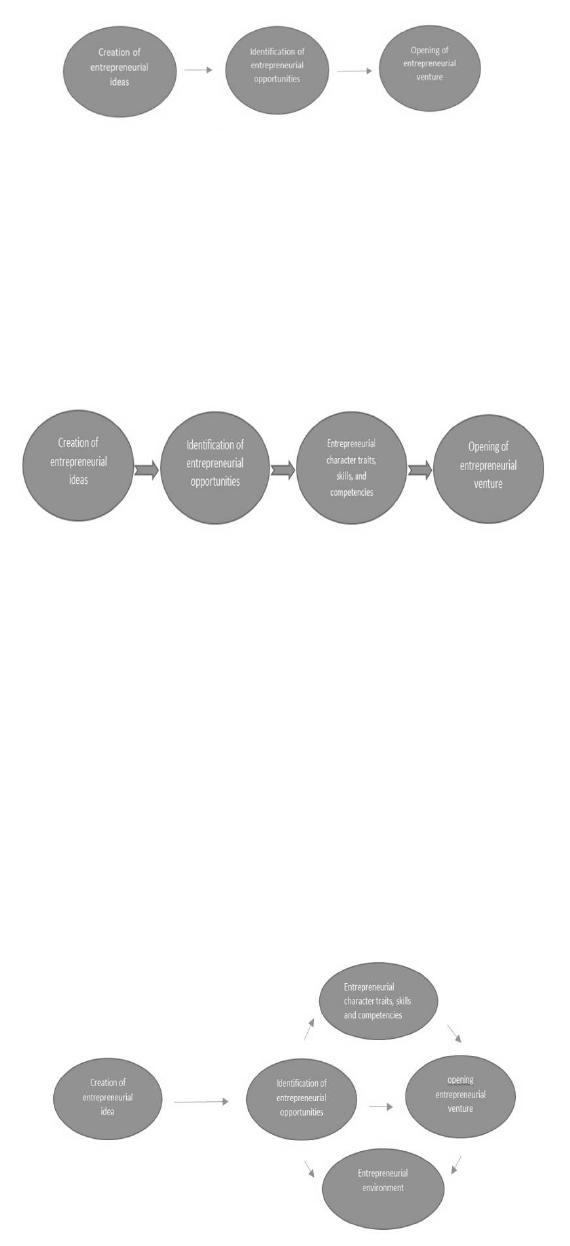
The Entrepreneurial process of creating a new venture is
shown in the diagram below.
1. Creation of Entrepreneurial idea
2. Identification of Entrepreneurial opportunities
3. Opening of Entrepreneurial venture
I. Following the Entrepreneurial process, a business
venture is opened or created based on existing business
opportunities, which arise from business ideas.
II. Good sources of Entrepreneurial Ideas:
a. Changes in the environment
Entrepreneurial ideas arise from the changes that happen in
the external environment with entrepreneurial implications.
External Environment refers to the following.
• Physical environment (climate, natural resources, wildlife)
• Societal Environment – includes various forces (economic
forces, sociocultural forces, political forces, technological
environment.
• Industry Environment (government, competitors,
suppliers, customers, creditors, employees).
b. Technological discovery and advancement
Discovery and advancement in the use of technology are
other good sources of entrepreneurial ideas and
opportunities. A person with entrepreneurial interest looks at
the possibility of business opportunities in any new
discovery or advancement in technology.
c. Government’s thrust, programs, and policies
Priorities, Projects, Programs and Policies of the
Government are also good sources of entrepreneurial ideas.
We refer to the Local Government (municipal, city and
provincial or national and its branches). Whenever there are
changes in the policies and programs of the government,
new entrepreneurial ideas are likely born, an entrepreneur
however will take it as a business opportunity to come up
with a new product.
d. People’s interest
The interests, hobbies, and preferences of the people are rich
sources of entrepreneurial ideas. An Entrepreneur must be
keen in identifying the cycle of interest and trends of
his/her target market since these tend to continuously
change. She/he must be ready to address the change
properly and immediately to avoid possible negative effects
on the operations of the business venture.
e. Past experiences
Past Experiences and Exposure are also good source of
entrepreneurial ideas. Expertise and skills developed by a
person who has worked in a particular field may lead to the
opening of a related business enterprise.
Module 3: Entrepreneurial Character Traits, Skills, and
Competencies
Lesson 1: Character Traits Common to Successful
Entrepreneurs
Character Trait – refers to mark or attribute that
distinguishes an entrepreneur from the owner of an
ordinary small business.
❖ Based on the studies conducted by the Small Enterprise
Research and Development Foundation SERDF of the
Department of Trade and Industry DTI , the characteristics of
an entrepreneur are grouped into three clusters;
a. Achievement Cluster
b. Planning Cluster
c. Power Cluster
1. ACHIEVEMENT CLUSTER
– Consists of entrepreneurial character traits that are
directly related to the entrepreneur’s desire to be an
achiever in the field of entrepreneurship. The
entrepreneur ordinarily does not settle for mediocrity
but instead aspires for quality.
Entrepreneur who belongs to achievement cluster is an;
A. Opportunity-Seeker
A Business opportunity-seeker is an entrepreneur who;
▪ sees and acts on new business opportunities; and
▪ Seizes unusual opportunities to obtain financing,
equipment, land, work, space, or assistance.
Business Opportunities – source of entrepreneurial ideas
may arise from changes in the environment
B. Committed
A highly committed entrepreneur display full commitment
to the work or endeavor that he/she is undertaking. She/he
does not entertain negativism and skepticism. Highly
committed entrepreneur:
▪ accepts full responsibility for what has been promised
to the customers,
▪ establishes proper coordination with among workers, so
that goods and services are delivered as promised, and
▪ Seeks to prioritize the satisfaction and interest of
customers.
Commitment is directly related to interest.
C. Persistent
Trials, sacrifices, and failures challenge the entrepreneur
to be persistent. He/She learns to;
▪ take repeated or different actions in order to
overcome the obstacles,
▪ make personal sacrifices or exerts extraordinary
effort to complete the required task, and;
▪ Stick to his/her own judgment in times of
opposition and failure.
Persistence is the foundation of commitment
D. Risk-taker
Successful entrepreneurs are business risk-takers. There is
risk in entrepreneurship because of uncertainty. No one can
predict exactly what will happen tomorrow. Risk is
inseparable from entrepreneurship. It is inherent in all
entrepreneurial ventures.
▪ Aggressive risk-taker is not to take any risk in business.
▪ A moderate risk-taker is more calculative in taking
risks. He/She analyzes the situation before taking the leap.
▪ A conservative risk-taker is not very eager to make any
kind of risk. He/She is satisfied with managing a small
business and a regular clientele.
However, a risk-taking entrepreneur cannot be equated with the
owner of an ordinary small business. Their respective concepts of
risk-taking are different from one another.
E. Efficient and Quality oriented
A successful entrepreneur highly values efficiency and the
concept of quality in all business undertakings. He/She
▪ always performs the required tasks in accordance with
existing standards of excellence or continuously
improves on his/her past performance and;
▪ Strives to do things better and faster with minimal cost.
The concept of efficiency in an entrepreneurial endeavor is related
to the cost involved in the production of goods and services. The
basic rule is that you should incur the lowest minimal cost in the
production of goods and services without sacrificing quality to
make them competitive in the market.
2. PLANNING CLUSTER
– A set of characteristics of successful entrepreneurs that
basically supports the character traits in the achievement
cluster.
a. Goal Setter – guided by SMART Principles in setting
objectives (Specific, Measurable, Achievable, Realistic,
Time-bound)
b. Information Seeker – seeks relevant information and
verifies them, seeks opinion and advice of experts in the
business fields.
c. Systematic in Planning and monitoring – gathers all
information before formulating plans, develops step-
by-step approach in planning, monitors the work
progress, and take corrective measures if
necessary, evaluates the alternatives in achieving goals.
3. POWER CLUSTER
a. Persuasive and positive worker – can influence and
convince others while maintaining the highest degree
of respect, makes use of positive contacts in the
business community to meet goals and objectives.
b. Self-confident – manifests a strong trust or belief in
himself. It is a gradual process where past correct
experiences have significant effect to the present.
Lesson 2: Skills and Core Competencies in
Entrepreneurship
Skills and Core Competencies in Entrepreneurship
Skills – are the personal abilities to do
something well. They come from the knowledge, practice
or experience, and aptitude of a person.
Skills required in the practice of entrepreneurship:
1. Cognitive
2. Interpersonal
3. Technical
ENTREPRENEURIAL SKILLS
❖ Without the required skills, a person can hardly
succeed in a particular business endeavor, perform
the assigned specialized tasks, or even truly
become a successful entrepreneur.
❖ Hence, skills play a significant role in the
practice of entrepreneurship.
1. Cognitive skills
Refer to the mental ability of the entrepreneur to learn new
things, generate new ideas, and express knowledge in
both oral and written forms. The human brain is
responsible for the development of cognitive skills, which
are essential in making systematic and effective plans and
monitoring them.
The Brain as the Center of Cognitive Skills
The cognitive skills of an entrepreneur include the following
abilities;
a. Ability to understand written materials
b. Ability to learn and apply new information
c. Ability to solve problems systematically
d. Ability to creates new ideas
e. Ability to innovate new products and procedures or
methods
Problem-solving Skill
– Problems are common in the life of an entrepreneur as
he/she manages the day-day-day operations of the
business venture. These problems can be big or small,
ordinary or unusual, and repetitive or non-repetitive.
2. Technical Skills
Relate to the knowledge and proficiency in a specialized
field like computer technology, accounting, marketing,
operation research, engineering, medical fields, or other
related technical fields.
a. Information technology
b. Feasibility study and business plan preparation
c. Technical writing skills
d. Marketing
e. Management and finance
3. Interpersonal skills
The relationship and interaction of the entrepreneur with the
workers, suppliers, creditors, prospective customers, and
other members of the business community.
The interpersonal skills of an entrepreneur may include,
among others;
a. Skills in verbal communication
b. Skills in non-verbal communication
c. Skills in listening
d. Skills in leading, and
e. Skills in negotiating.
THE ENTREPRENEURIAL CORE COMPETENCY
A combination of entrepreneurial character skills that
provide and become the ultimate source of competitive
advantage of the entrepreneur.
The competitive advantage refers to the strategic position
and condition of the entrepreneurial venture that;
a. Provides the necessary attributes to outperform
competitors,
b. Distinguishes the venture from competitors
c. Achieves superior performance in the industry, and ;
d. Produces a product or develops production methods that
can hardly be copied by competitors.
Module 4: The Environment of the Entrepreneurial
Venture
LESSON 1: The Physical Environment
An entrepreneurial venture is created out of the
business opportunities which the entrepreneur should
seek to exploit. These business opportunities emerge
from the entrepreneurial ideas that arise from the
changes in the environment, government policy, or
technological advancements.
Figure 3.1.11 the Entrepreneurial Process of
Creating a New Venture
The entrepreneur needs to possess the necessary
entrepreneurial character traits, skills, and
competencies before exploiting the business
opportunities.
Figure 3.1.2 Entrepreneurial Character Traits,
Skills, and Competencies influencing the opening of
Business
If a prospective entrepreneur possesses the necessary
character traits, skills, and competencies, should he/she
immediately open a new business in order to exploit the
business opportunity?
The answer is a big “NO.” He/she must first evaluate
and analyze first the business environment. The
environment where the business venture will operate is
an important factor to considering in opening a new
business.

Figure 3.1.3 Entrepreneurial Environment as
Another factor influencing the Opening of Business
Remember that the business does not operate in a test
tube or a cylinder but in an environment that consists
of three layers:
1. Physical environment
2. Societal environment
3. Industry environment
PHYSICAL ENVIRONMENT
The first layer of the environment is the physical or
natural environment. It is composed of the natural
elements that are inherent in the Earth. It is divided
into climate, physical resources, and wildlife. These
three natural elements of the physical environment
have significant contributions and effects to the
business venture. Prospective entrepreneurs should
critically evaluate them before opening their
businesses.
The entrepreneur must critically assess the
availability of raw materials in the locality before opening a
new business. He/She must evaluate if the available raw
materials to be used for the proposed business are sufficient
for a long-term operation.
Wildlife
The wild plants and animals in the Philippines
forests are continuously abused. The trees cut for timber are
not properly replaced. Wild animals are hunted and killed.
These abuses lead towards imbalance in the Philippines
ecological system where wild plants and animals are
supposed to be interrelated.
In view of this entrepreneur must ensure that
his/her business contributes to the preservation and
not the destruction of the ecological system of the
local community and our country in general. He/She
must not open a business venture that will destroy the
wildlife reserve. After all, it is also an entrepreneur’s
task to become a model of social responsibility and
environmental awareness.
Lesson 2: Societal Environment
Changes in the physical environment have a direct