1
Federal Democratic Republic of Ethiopia
Ministry of Science and Higher Education
Module for Communicative English Language Skills I (FLEn 1011)
Members of the Module Writing Team
1. Dr. Tekle Ferede (Jimma University)
2. Dr.Yinager Teklesellassie (Bahir Dar University)
3. Dr. Geremew Lemu (Addis Ababa University)
September 2019
2
Introduction to the Module
The module for the course Communicative English Skills I (EnLa101) is intended to be given in
the first semester for all first-year students joining Ethiopian universities. The module focuses on
listening and reading skills and integrates these two skills with speaking and writing activities.
The module is prepared to enable you, the student, to communicate in English with acceptable
accuracy and fluency by using English appropriately in different contexts. The module aims to
develop your English language proficiency through language learning activities designed to help
you use English for your academic and social needs. The language learning activities encourage
you to learn by doing things in English and by reflecting on the activities you do in each unit.
Grammar and vocabulary learning activities are also included in the module.
There are five units in this module. Unit 1 is on study skills, and the activities in this unit will
encourage you to make notes from lectures and use them for revising your courses. Unit 2 is
about health and fitness in which you will listen to a story about a sports star and discuss the
benefits of health and fitness. Unit 3 is on cultural values and in this unit you will read about the
culture of one cultural community in Ethiopia and listen to a lecture on cultural tourism. In
addition, in Unit 3 you will talk about cultural values and write about cultural values that you are
proud of. In Unit 4 you will listen to, read and talk about wildlife. Unit 5 deals with population
and you will listen to a talk on population density, and you will read about the population of one
country. In Unit 5 you will also study the collocations of ‗population‘ and the form and uses of
the active and passive voices. At the end of each unit there are sections which require you to
reflect on the activities you have performed and to self-assess your level of achievement of unit
objectives.
It is believed that you will successfully complete this module, which is followed by another
module in the second semester for the course Communicative English Skills II (EnLa102).
Communicative English Skills II will focus on speaking and writing skills and will, of course,
integrate these skills with listening and reading activities. The writers of the modules believe that
both courses will help you improve your English language proficiency and be successful in your
academic career and social life.
3
Module objectives
Upon completing this module, you will be able to:
express yourself in social and academic events in English;
use English with reasonable level of fluency and accuracy;
listen to talks related to social and academic events given in English;
read academic and other texts written in English;
write in English as academically and socially appropriate; and
develop your English on your own.
4
Table of Contents
Contents Page
UNIT 1: Study Skills 6
1.1 Listening: What is a lecture? 6
1.2 Grammar focus: Modals and infinitives for giving advice 10
1.3 Reading: Reading for study 12
1.4 Grammar focus: Present perfect tense 17
1.5 Reflections 19
1.6 Self-assessment 19
1.7 Summary 20
Unit 2: Health and Fitness 21
2.1 Listening: Zinedine Zidane 21
2.2 Grammar focus: Conditionals 24
2.3 Reading: Health and fitness 26
2.4 Vocabulary: Guessing meaning from context 29
2.5 Reflections 29
2.6 Self-assessment 30
2.7 Summary 30
Unit 3: Cultural Values 31
3.1 Listening: Cultural tourism 31
3.2 Grammar focus: The present simple, past simple, present perfect
and past perfect in contrast 36
3.3 Strategies for improving English grammar knowledge 40
3.4 Reading: The Awramba community 41
3.5 Reflections 46
3.6 Self-assessment 46
5
3.7 Summary 48
Unit 4: Wildlife 49
4.1 Listening: Human-wildlife interaction 49
4.2 Reading: Africa‘s wild animals 52
4.3 Vocabulary: Denotative and connotative meanings 57
4.4 Grammar focus: Conditionals revised 59
4.5 Reflections 60
4.6 Self-assessment 60
4.7 Summary 61
Unit 5: Population 62
5.1 Listening: Population density 62
5.2 Reading: Population pyramid 66
5.3 Vocabulary: Collocation 71
5.4 Grammar focus: Voice 73
5.5 Reflections 76
5.6 Self-assessment 76
5.7 Summary 77
6
UNIT 1: Study Skills
Unit introduction
The purpose of this unit is to familiarize you with the skills and academic practices that you need
to develop as university students. The unit revolves around two important aspects of academic
study, namely, taking notes while listening to lectures and reading for academic study. The
various activities in the unit thus are geared towards helping you to take effective notes during
lectures and to practice reading for different purposes.
Objectives
By the end of this unit, you will be able to:
find out what is involved in a lecture;
take lecture notes by listening to a talk;
give advice using appropriate language;
identify the various purposes for reading;
read and make notes;
use the present perfect tense appropriately and correctly;
write a paragraph reflecting on your reading experience;
expand your vocabulary knowledge; and
reflect on your learning and self-assess your progress.
1.1 Listening: What is a lecture?
While studying at university, you will be exposed to a lot of information in relation to your field
of study. This information will reach you mainly through reading and listening to lectures.
However, it will not be possible for you to remember all the information that you have read or
heard later when you want to use it for different purposes, for example, to answer questions
during examinations. This means that you need to take notes when reading and listening to
lectures. Thus, taking notes is an important skill that you need to develop in order to be
successful in your university studies. In this unit, you will listen to a talk on how to take lecture
notes and practice the skill of taking notes.
7
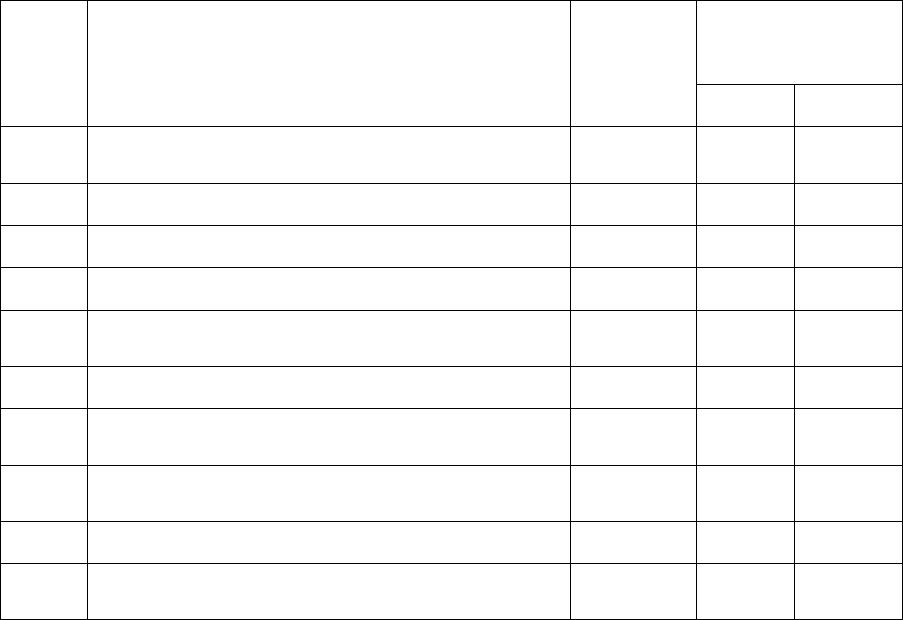
Activity 1.1.1: A short survey
1. As mentioned earlier, note taking is one important study skill you need to develop, but it is not
the only type of study skill you need to develop as a student. There are other study skills
such as time management and organizing information. Read the list of studying habits or skills
of highly effective students in the table below, and put a tick mark against the habits that you
have already developed.
2. If there are any habits you haven‘t already developed, decide whether you want to develop
them or not and explain the reasons to your neighbor. Put a tick mark under the ‗Yes‘ or
‗No‘ columns in the table to show your decisions.
No.
Habits
Already
developed
Want to develop
in future
Yes
No
1.
They do not attempt to cram all their study into
one session.
2.
They plan when they are going to study.
3.
They study at the same time.
4.
They have study time that has a specific goal.
5.
They never procrastinate their planned study
session.
6.
They start with the most difficult subject first.
7.
They always review notes before starting an
assignment.
8.
They make sure they are not distracted while
they are studying.
9.
They use study groups effectively.
10.
They review their notes, schoolwork and other
class materials over the weekend.
Activity 1.1.2: Pre-listening
Before you listen to the talk, look at the following questions and discuss your answers in groups
of three or four. One student will report the results of your discussion to the whole class.
1. What is a lecture?
2. Who gives a lecture?

8
3. Have you listened to lectures before? When? Where?
4. If you have, what did you do during the lecture apart from listening?
5. What do the following words mean? (Your teacher will help you if you do not know their
meanings.)
transient distractions verbatim cues discriminating
Activity 1.1.3: While-listening
1. Now listen to the talk once and, as you listen, match the things that you have to do in column
A with the purposes for doing them in column B.
A (What you do)
B (Purpose for doing)
1. If possible, read on the subject before
attending the lecture. ________
a. to get an indication of the structure of the
lecture and to be able to organize your
notes
2. Sit near the front of the room as much as
possible. ________
b. to refresh your memory and make your
notes more complete with points that you
did not have time to write down during the
lecture
3. Listen carefully to the introduction to the
lecture. _______
c. to focus on what is important and most
relevant
4. Look and listen for cues from the lecturer.
_______
d. to understand the subject and make it
easier for you to take notes
5. As soon as possible, review your notes
after the lecture. ______
e. to concentrate and make it easier for you to
see and hear
Check your answers with those of another student.
2. Listen to the talk again, take notes and answer the questions below individually. Then, discuss
your answers in groups of three.

9
When taking notes, remember the following points:
Do not try to write down everything that the lecturer says. Focus only on the main
points and important details
Do not try to take notes in complete sentences. Use words and phrases.
As much as possible, use abbreviations (shortened forms of words) and symbols
instead of writing words in full.
Look at the questions for one minute before you listen.
1. What areas does the speaker say the talk will focus on?
2. What is the difference between the spoken language and reading?
3. In what ways may lecturers be different?
4. Why should you make a note of the topic, the lecturer and the date during note taking?
5. What are some of the ways in which lecturers can assist you in taking notes?
6. What will happen if you try to write down everything?
Activity 1.1.4: Post-listening
1. Write a paragraph of about 100 words explaining some of the problems you face when you
listen to a lecture. Before you start writing the paragraph, plan the content of your paragraph in
an outline form, write your paragraph based on your plan, and revise and edit it before you
read it to a neighbor or to the whole class. You can also give your paragraph to a classmate
who can give you feedback on the language of your paragraph.
______________________________________________________________________________
______________________________________________________________________________
______________________________________________________________________________
______________________________________________________________________________
______________________________________________________________________________
_____________________________________________________________________________
10
1.2 Grammar focus: Modals and infinitives for giving advice
Look at the following sentences taken from the listening talk, and in pairs, tell each other the
purpose of the sentences.
a. Try to prepare yourself in advance.
b. Sit near the front of the room.
c. You should be able to work out the important themes of the lecture.
d. You should not try to write down every word that the lecturer says.
Note that each of the sentences advises you on how best you can take lecture notes. They do this
with the use of infinitives (Try, Sit) and should (should not). Two other ways of giving advice
include the use of ought to and had better.
Example: You ought to work very hard.
You had better work very hard.
Note: Should and ought to express similar meaning. Had better is sometimes used when we
want to make the advice stronger to indicate that the advice we give is really important.
Activity 1.2.1: Sentence completion
Complete the following sentences by choosing the correct word or phrase from the alternatives
given.
1. I need a quiet place to study. Where______ (I should/ ought to I/ should I) go?
2. The airline allows only two pieces of luggage. You _____ (had better not/ better not/had
not better) pack too much or you will have to take some of it out at the airport.
3. A: I think that the grade my teacher gave me on my test is wrong.
B: Really? You _____ (ought talk/should to talk/ought to talk) to her after class today.
4. It is raining and I don‘t want to get my dress wet. I (had better not bring/had better to
bring/had better bring) an umbrella.
5. A: I‘m very hot.
B: You _____ (should take off/ought take off/better had) your coat.
11
6. I did not understand much in the last lecture. I ____ (ought read/had better read/had read
better) more on the topic.
Activity 1.2.2: Completing short dialogues
In pairs, take turns and give advice to each other using the cues given below. Use the three ways
of giving advice you practiced above. The first one has been done for you as an example.
1. Aman: I want to speak English more fluently.
Muna: You should practice speaking every day.
2. Aman: I‘m adding weight recently.
Muna: ___________________________________________________________.
3. Aman: My parents send me money but I‘m always broke.
Muna: __________________________________________________________.
4. Aman: I‘m not feeling well.
Muna: ___________________________________________________________.
5. Aman: I can‘t study in the dorm. The other students talk too much.
Muna: ___________________________________________________________.
6. Aman: I want to join a good department next year.
Muna: ____________________________________________________________.
7. Aman: I find it difficult to get up early in the morning.
Muna: ____________________________________________________________.
8. Aman: I spend a lot of time watching television every day.
Muna: _____________________________________________________________.
9. Aman: I‘m feeling bored this afternoon.
Muna: _____________________________________________________________.
10. Aman: I keep losing my mobile phones. I lost two mobile phones last month alone.
Muna: ____________________________________________________________.
1.3 Reading: Reading for study
Activity 1.3.1: Preparing for reading
Look at the first three questions below and answer them individually. Then discuss your answers
in groups of three. Report your answers to the class.
1. What is reading?
2. Is reading an article in a newspaper the same as reading a book in your field of study?
Explain.
3. Do you think reading for your study at university will be different from reading at high
school? How is it the same or different?
4. Find out the meanings of the following words with the help of your teacher.
invaluable scan skim
assimilate repertoire
Activity 1.3.2: Reading for understanding
1. Read the following text and answer the questions below it.