Week 4: Lecture Notes
1. Deciding to Globalize
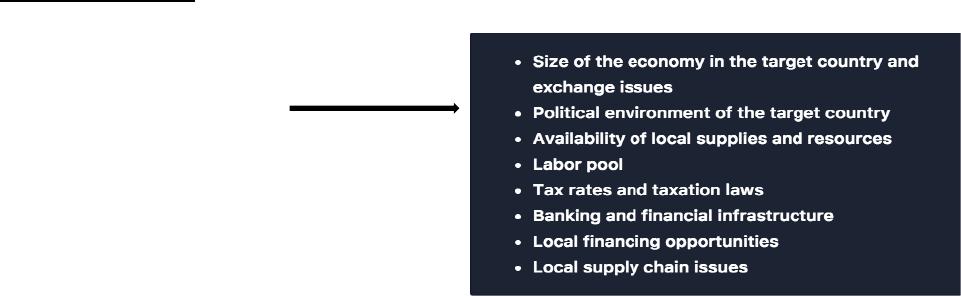
Factors strategists should consider when deciding
whether or not to go global include:
The two key issues for firms attempting to move toward
globalization are:
1. The degree of complexity of the external
environment in the foreign market
2. The diversity of the company’s product line.
2. The Global Business Environment
Worldwide strategy requires centralized planning so that tradeoffs can be made on a global basis. One strategic
decision might be where to locate the functional activities. Should the functional area be centralized? If the
functional area is centralized, which country will run the functional operations of the company? If not, then in which
countries should the functional area be decentralized? Each company’s issues surrounding this strategic decision
would be analyzed differently, depending on each country’s specific circumstances.
3. Competitive Strategies
The four strategic orientations of global firms are:
1. Ethnocentric (-oriented global companies) – believe that the values and priorities of the parent organization
should guide all strategic decision making. They employ a top–down governance with a strong hierarchy in
functional areas. If they are a manufacturing company, the factory is based in the home country.
2. Polycentric (-oriented global companies) – differ from ethnocentric ones in that they focus on public
acceptance in host countries while striving to respect the host countries’ cultures by delegating local
strategy objectives to the subsidiaries.
3. Regiocentric (-oriented global companies) – are a combination of ethnocentric and polycentric in terms of
the focus on profitability and public acceptance. Products are developed with regional standards, and
strategy is based on integrating regional responsiveness.
4. Geocentric (–oriented global companies) – are similar to regiocentric in terms of their mission. Companies
that take a geocentric approach view the entire world as a market. The difference is that the product is not
regionally based but may contain variations.
!
!
!
!
!
!
!
!
Chapter 7 Notes
WHY COMPANIES DECIDE TO ENTER FOREGIN MARKTES
LO 1: The primary reasons companies choose to compete in international markets.
A company may opt to expand outside its domestic market for any of five major reason:
1. To gain access to new customers. Expanding into foreign markets offers potential for increased revenues,
profits, and long–term growth; it becomes an especially attractive option when a company encounters
dwindling growth opportunities in its home market.
2. To achieve lower cost through economies of scale, experience, and increased purchasing power.
3. To gain access to low–cost inputs of production.
4. To further exploit its core competencies. A company may be able to extend a market–leading position in its
domestic market into a position of regional or global market leadership by leveraging its core competencies
further.
5. To gain access to resources and capabilities located in foreign markets.
Companies that are the suppliers of other companies often expand internationally when their major customers do so,
to meet their customers’ needs abroad and retain their position as a key supply chain partner.
WHY COMPETING ACROSS NATIONAL BORDERS MAKES STRATEGY MAKING MORE COMPLEX
LO 2: How and why differing market conditions across countries influence a company’s strategy choices in
international markets.
Crafting a strategy to compete in one or more countries of the world is inherently more complex for five reasons:
1. Different countries have different home–country advantages in different industries; competing effectively
requires an understanding of these differences.
2. There are location–based advantages to conducting particular value chain activities in different parts of the
world.
3. Different political and economic conditions make the general business climate more favorable in some
countries than in other.
4. Companies face risk due to adverse shifts in currency exchange rate when operating in foreign markets.
5. Differences in buyer taste and preferences present a challenge for companies concerning customizing
versus standardizing their products and services.
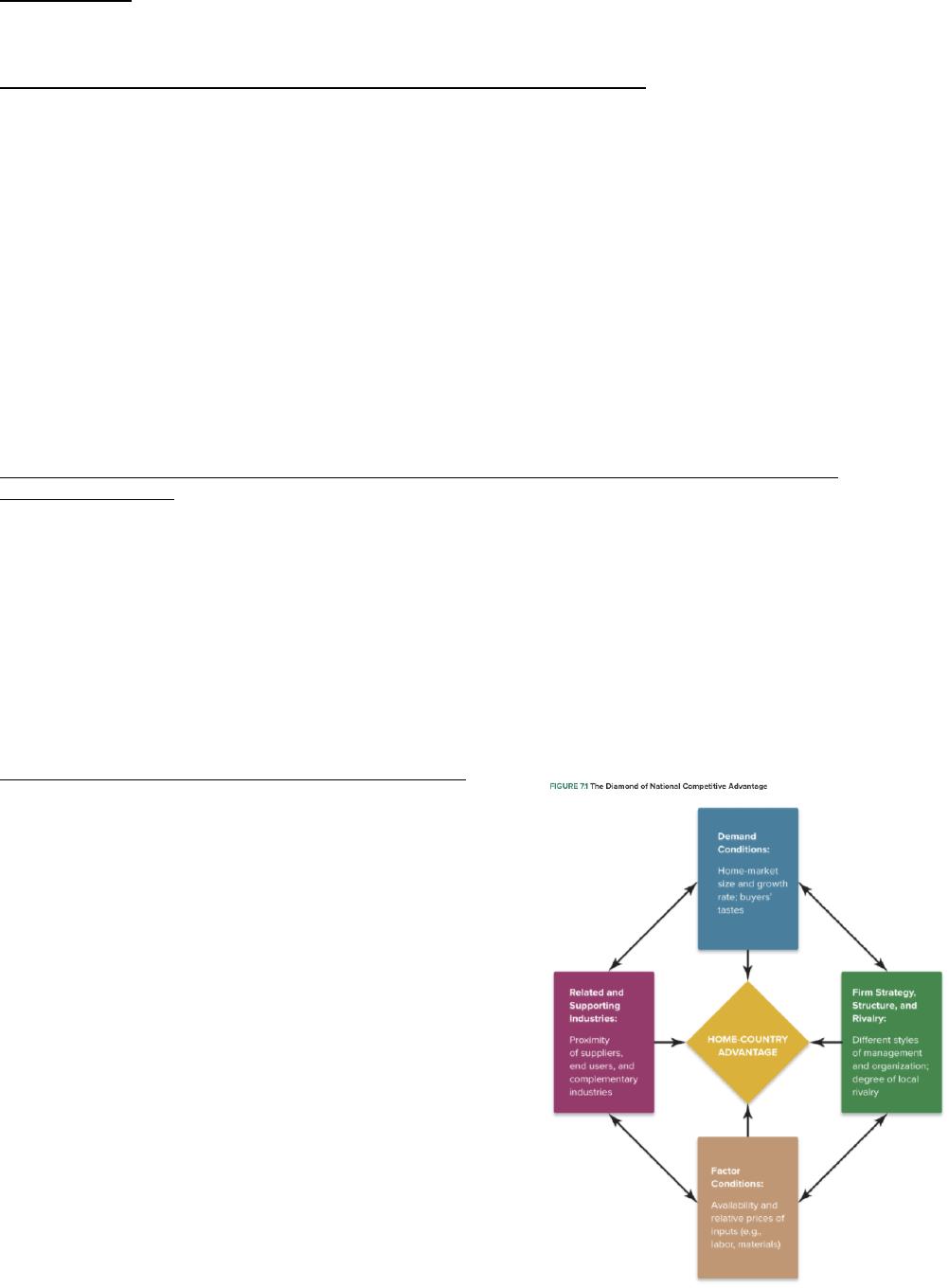
Home–Country Industry Advantages and the Diamond Model
Where industries are more likely to develop, competitive strength
depends on a set of factors that describe the nature of each country’s
environment and vary from country to country. The four major
factors are summarized in a framework developed by Michael Porter
and known as the Diamond of National Competitive Advantage.
Demand Conditions: The demand conditions in an industry’s home
market include the relative size of the market, it’s growth potential,
and the nature of domestic buyer’s needs and wants. Differing
population sizes, income levels, and other demographics factors give
rise to considerable differences in market size and growth rates from
country to country. Industry sectors that are larger and more
important in their home market tend to attract more resources and
grow faster than other.
Factor Conditions: Factor conditions describe the availability,
quality, and cost of raw materials, and other inputs (called factor of
production) that firms in an industry requires for producing their
products and services. The relevant factors of production vary from
industry to industry but can include different types of labor, technical
or managerial knowledge, land, financial capital, and natural

resources. Elements of a country’s infrastructure may be included as well, such as its transportation, communication,
and banking system.
Related and Supporting Industries: Robust industries often develop in locales where there is a cluster of related
industries, including others within the same chain system (e.g., suppliers of components and equipment, distributors)
and the makers of complementary products or those that are technologically related. The advantage to firms that
develop as part of a related–industry cluster come s from the close collaboration with key suppliers and the greater
knowledge sharing throughout the cluster, resulting in greater efficiency and innovativeness.
Firm Strategy, Structure, and Rivalry: Different country environment foster the development of different styles of
management, organization, and strategy. Countries vary in terms of the competitive rivalry of their industries.
The diamond framework can be used to reveal the answers to several questions that are important for competing on
an international basis.
1. It can help predict where where foreign entrants into an industry are most likely to come from.
2. It can reveal the countries in which foreign rivals are likely to be weakest and thus can help managers
decide which foreign markets to enter first.
3. It focuses on the attributes of a country’s business environment that allow firms to flourish, it reveals
something about the advantages of conducting particular business activities in the country
The diamond framework is an aid to deciding where to locate different value chain activities most beneficially.
Opportunities for Location–Based Advantages
Companies are locating different value chain activities in different parts of the world to exploit location–based
advantages that vary from country to country. Differences in wage rate, worker productivity, energy cost, and the
like create sizable variations in manufacturing cost from country to country. For other types of value chain activities,
input quality or availability are more important considerations.
The Impact of Government Policies and Economic Conditions in Host Countries