sustainability
Article
Moderating the Role of Firm Size in Sustainable
Performance Improvement through Sustainable
Supply Chain Management
Jing Wang 1,*ID , Yuchen Zhang 1and Mark Goh 2
1School of Business, Beijing Technology and Business University, Beijing 100048, China;
zhangyuchen995@gmail.com
2The Logistics Institute Asia-Pacific (TLIAP) and NUS Business School, National University of Singapore,
Singapore 119077, Singapore; tligohkh@nus.edu.sg
*Correspondence: wj@th.btbu.edu.cn
Received: 8 May 2018; Accepted: 18 May 2018; Published: 21 May 2018
Abstract:
In the context of the Chinese government’s strategy for sustainable development, the study
of sustainable supply chain management (SSCM) for enterprises has important practical significance.
Drawing data from 172 Chinese firms, the model studied the moderating role of firm size on the
SSCM practices and the sustainable performance of the firms (economic, environmental, and social),
using hierarchical regression analysis on SPSS 22.0. The results suggest that SSCM practices and firm
size are positively related to the firm’s environmental and social performance. Firm size moderates
the effect of SSCM practices on economic performance. Additionally, SSCM internal practices have
a significant positive impact on the economic performance of large enterprises, but not so much
on the economic performance of the Small and medium enterprises(SMEs). This paper proposes
a comprehensive SSCM practice performance model that identifies firm size as a moderating role.
Through research on the moderating effect of firm size, the implementation and recommendation of
SSCM for different firm size are given.
Keywords:
sustainable supply chain management; firm size; sustainable performance; hierarchical
regression analysis
1. Introduction
Sustainable supply chain management (SSCM) is the embodiment of sustainable concepts in
supply chain management, which is driven by the demands of stakeholders to manage the material
flow, information flow, and capital flow in supply chain. It also enables managers to strategically and
transparently integrate and realize the social, environmental, and economic goals of an organization [
1
].
SSCM, which integrates environmental and social concerns into the supply chain, has been widely
implemented by firms to face challenges in global sustainability. Elkington [
2
] first put forward
the triple bottom line for enterprises to encourage the firms to increase their economic leverage
through protecting the environment and improving social performance. Environmental challenges
place competing demands on enterprises who extend their green effort across their supply chains [
3
].
Companies and their extended supply chains are a holistic system, and their management method
at the supply chain level is important [
4
]. Recent studies have shown that some companies and their
suppliers develop sustainable strategies in order to reduce energy consumption and improve materials
reuse [5].
Most of the literature on firm size shows that large enterprises are more conducive to
the company’s economic performance and productivity [
6
]. While, in fact, as a firm expands,
Sustainability 2018,10, 1654; doi:10.3390/su10051654 www.mdpi.com/journal/sustainability
Sustainability 2018,10, 1654 2 of 14
the firm consciously fulfills its corporate and social responsibilities. Such firms have a richer
understanding of the corporate environment and social responsibility, and thus use better resources
to fulfill their corporate social responsibility. Similarly, without a regulatory framework of green
supervision, most SMEs have no incentive to pay heed to sustainability in the supply chain. However,
SMEs represent an important sector of many countries, both economically and socially. For instance,
in China, SMEs provide more than 80% of employment in cities and towns, and have become the
main channel of employment. Indeed, more than 20 million SMEs registered with China’s Business
Administration Council in 2015, which realized an increase in contribution of profits and taxes.
In the industrial sector, more than 365,000 SMEs account for 97.4% of the total number of enterprises;
these SMEs contributed taxes of 2.5 trillion RMB, accounting for 49.2% of the total tax revenue; their
profits of 4.1 trillion RMB accounted for 64.5% of the total industrial profit. The development of China’s
SMEs also creates many jobs and supports the community.
As the largest developing country, China’s sustainable development strategy and countermeasures
are of great significance to the choice of sustainable development path in developing countries.
The Chinese government has announced that the CO2 emission per unit of GDP will declines by
10–20%, compared with 2005 in the Doha Amendment. Moreover, the Paris Agreement also provides
external institutional framework for sustainable development in China, which adds external pressures
and impetus, and brings new opportunities for the transformation of economic structure and green
development in China.
Previous studies on SSCM mainly focused on enterprise economic and environmental
performance and very rarely embraced social dimension [
7
,
8
]. Further, empirical studies on SSCM on
developing economy enterprises and SMEs are scant. Enterprises need a framework to help them to
identify and implement their sustainability development schemes [
9
]. The purpose of this paper is to
verify the moderating role of firm size on sustainable supply chain management (SSCM) practices and
performance, and, furthermore, to reveal the different impacts of SSCM practices on the performance
of different firm size categories in China.
2. Theoretical Background
2.1. SSCM Development
Over the coming decades, uncertainty in the supply chains of manufacturing firms is going to be
more important for the companies that are called to compete in a new globalized economy [
10
], thus the
traditional supply chain management (SCM) way of paying heed to cost and competitive relationships
has been proven inefficient [
11
]. With greater emphasis on sustainable development and firms gain
sustainable competitive advantage, the long-term choice of these firms is to take an active role in
environmental responsibility, and to take active measures to invest in the green movement to maintain
competitiveness whilst under pressure from government regulations. International green barriers
and consumer awareness of green environmental protection have been gradually enhanced [
12
].
Implementing the sustainability concept in a firm’s supply chain has emerged since the end of the
1980s [13].
SSCM is a critical and timely topic that captures the increasing concerns of government and the
public over sustainability, be it through legislation, public interest, or competitive opportunity [
14
].
Under environmental and economic performance, SSCM focuses on employees and communities to
ensure sustainable performance [
15
]. Mefford [
16
] detailed the economic value of SSCM, and dispelled
the narrow view of the sustainable supply chain. Done correctly, SSCM will also increase sales,
reduce costs, reduce financial risk, increase profits, and eventually increase shareholder returns.
New technology is introduced into the enterprise so that energy consumption, land use rate, and labor
costs can be reduced [
10
]. Lu [
17
] focused on the future development of SSCM by studying how
environmental and social performance affect the entire supply chain, and proposed some research
directions for the next 20 years. There are many specific ways to establish a SSC framework;
Sustainability 2018,10, 1654 3 of 14
simulation-optimization frameworks are either an alternative approach or an effective solution method
for the integrated problems [
18
]. Centobelli et al. [
19
] organized the SSC framework and proposed six
main literature gaps. From these six sustainability gaps, eight research issues have been identified.
2.2. SSCM Practice and Sustainable Performance
Previous studies have shown that internal management of enterprises is an important factor for
enterprises to gain competitive advantages [
20
]. Company salary structure is an important component
of company motivation mechanism [
21
]. Forming an incentive system for employees can help to
improve employee environmental initiatives, and help enterprises to establish an environment suitable
to their needs [
22
]. The second aspect of the internal SSCM practices is the implementation of enterprise
information technology [
23
]. A study of 120 manufacturing firms in the United States pointed out
that the ability of e-commerce technology utilization in the process of enterprise procurement and
cooperation has a significant positive impact on the integration of suppliers and customer production
information. Third, employee participation also contributes to the management of the sustainable
supply chain [
24
]. It is necessary to train and publicize employees in all aspects of environmental
performance and social sustainable development, improve employee awareness of environmental
protection, and enhance their enthusiasm, so as to build a sustainable supply chain [
25
]. Fourth,
quality is still an important factor in ensuring value-addedness in the production and delivery of
products in the supply chain [20]. Therefore, enterprises should ensure the future competitiveness of
enterprises by enhancing their strategic status and operational efficiency [
26
]. Fifth, innovation ability
has a positive impact on the SSCM of enterprises. The level of innovation of an enterprise directly
affects the sustainable of the whole supply chain [
27
]. Sixth, ecological design is the key dimension in
the management of green supply chains, which has a significant impact on the sustainable development
of the enterprise [
28
]. The development strategy of enterprises is also a factor that affects internal
SSCM practices, and enterprise strategy is a factor in the implementation of high-level supply chain
management [29].
In reality, many enterprises have benefited from the establishment and practice of green supply
chain operations, and they have been recognized by social performance [
30
]. Managers agree that
internal control of the enterprise is conducive to ensuring the continued operation of enterprises;
for listed companies, internal control and the company’s share price are positively correlated [
31
].
Therefore, we posit the following hypotheses:
Hypothesis 1a(H1a). Internal SSCM practices are positively related to economic performance.
Hypothesis 1b(H1b). Internal SSCM practices are positively related to environmental performance.
Hypothesis 1c(H1c). Internal SSCM practices are positively related to social performance.
As competition shifts from a single enterprise to the whole supply chain, the focus of market
competition has not only remained in the internal management practice, but also has begun to focus
on the external management practice [
20
]. Against this backdrop, firms should not only focus on their
own quality assurance work, but also strive to extend the management to suppliers and customers so
that they manage the whole supply chain network [26].
Following the literature, this paper divides the external practices of SSCM into the following
seven points: First, to ensure effective product, information, and capital flows in the supply chain,
firms need to establish an appropriate information sharing level and business coordination capability
withcross-functional cooperation [
32
]. Second, compliance with laws and regulations on environmental
and social problems is another necessary factor for sustainable supply chain enterprises to improve
their environmental and social performance [
25
]. Third, enterprise external SSCM practice also includes
supplier environmental assessment. When the supplier’s environmental management ability is high,
product regulation and process supervision can reduce pollution, but it has significant negative and
Sustainability 2018,10, 1654 4 of 14
positive impacts on economic performance [
33
]. Fourth, product recovery can reduce the consumption
of toxic and harmful materials, as well as the negative impact of products on the environment.
Fifth, green procurement also has a positive impact on the sustainable supply chain of the enterprise.
Through empirical research on manufacturing enterprises in Malaysia, Zailani et al. [
34
] reported that
green procurement has a positive impact on the economy, society, and environment, and is conducive
to the successful implementation of SSCM. Finally, we consider the impact of product traceability on
SSCM. The enhanced traceability of upstream and downstream producers can improve the production
behavior of upstream and downstream producers [
35
]. Firms implement effective SCM to obtain high
quality, low-cost competitive advantage, thus making it profitable for enterprises to enhance their
sustainable performance [36]. Thus, we posit the following hypotheses:
Hypothesis 2a(H2a). External SSCM practices are positively related to economic performance.
Hypothesis 2b(H2b). External SSCM practices are positively related to environmental performance.
Hypothesis 2c(H2c). External SSCM practices are positively related to social performance.
2.3. Firm Size and Sustainable Performance
Although Chinese SMEs tend to imitate product design in order to overcome the constraints
of resources and capabilities and to reduce the cost of product development, large enterprises
are more capable than SMEs in obtaining abundant innovative resources [
37
]. At the same time,
the marketing, production, and R&D activities can easily be promoted in the large enterprise to benefit
the enterprise [
38
]. A recent report by the European Commission clearly underscores the difference
between SMEs and large firms. The report shows that in Europe, large enterprises are more likely to
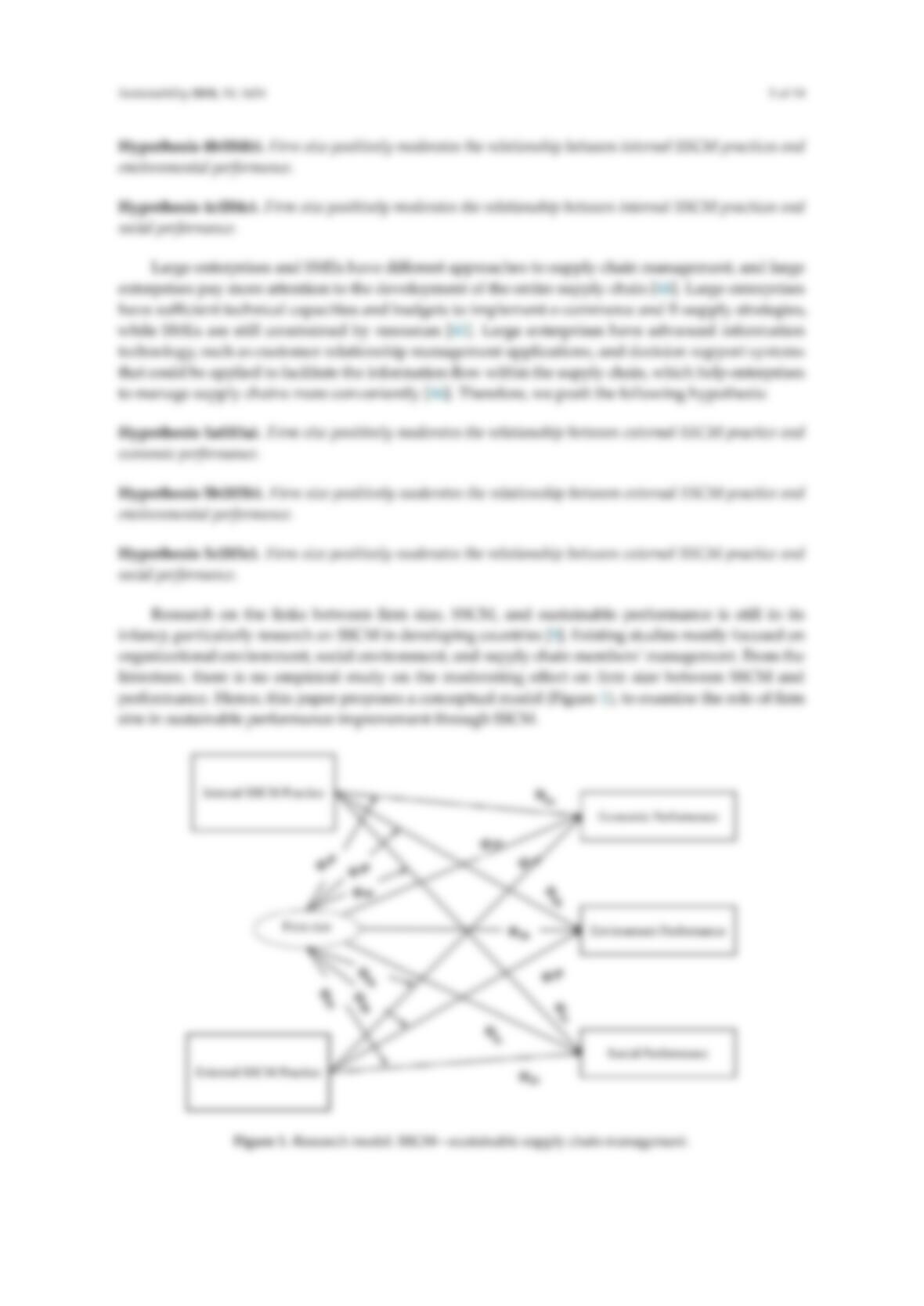
role of firm size, the classification and recommendations of SSCM for different firm sizes are given.
The internal and external SSCM practices are two second-order variables. Internal practices
measurement has been measured by a seven-item scale, following Pagell et al. [21], Zhu et al. [27],
and Sila et al. [20]. External practices measurement has been measured by a six-item scale measure.