The Chartered Institute of Management Accountants 2011
P3 – Performance Strategy
Performance Pillar
P3 – Performance Strategy
23 November 2011 – Wednesday Morning Session
Instructions to candidates
You are allowed three hours to answer this question paper.
You are allowed 20 minutes reading time before the examination begins
during which you should read the question paper and, if you wish, highlight
and/or make notes on the question paper. However, you will not be allowed,
under any circumstances, to open the answer book and start writing or use
your calculator during this reading time.
You are strongly advised to carefully read ALL the question requirements
before attempting the question concerned (that is all parts and/or sub–
questions).
ALL answers must be written in the answer book. Answers written on the
question paper will not be submitted for marking.
You should show all workings as marks are available for the method you use.
The pre–seen case study material is included in this question paper on pages
2 to 7. The unseen case study material, specific to this examination, is
provided on pages 8 and 9.
Answer the compulsory question in Section A on page 11. This page is
detachable for ease of reference
Answer TWO of the three questions in Section B on pages 14 to 19.
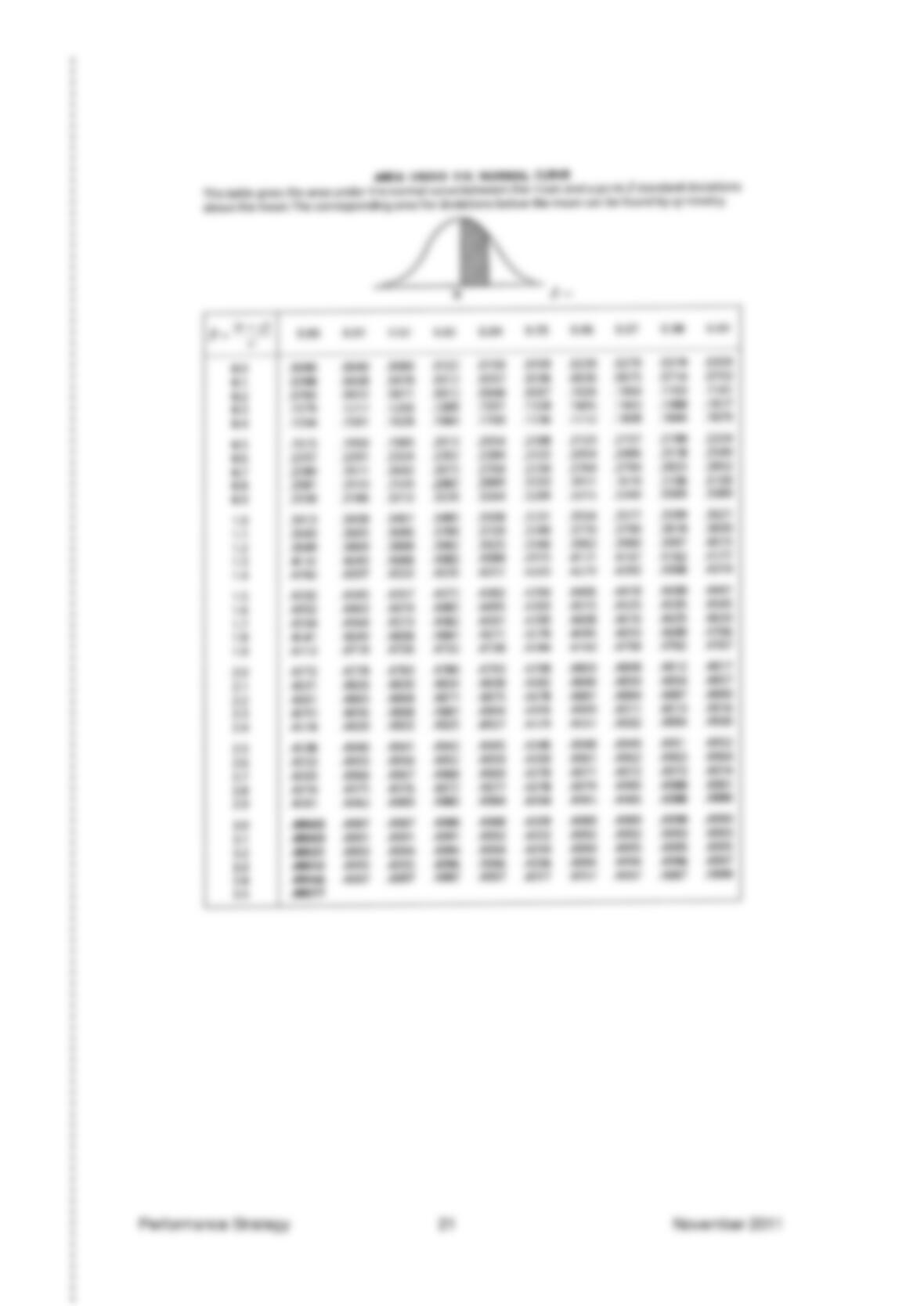
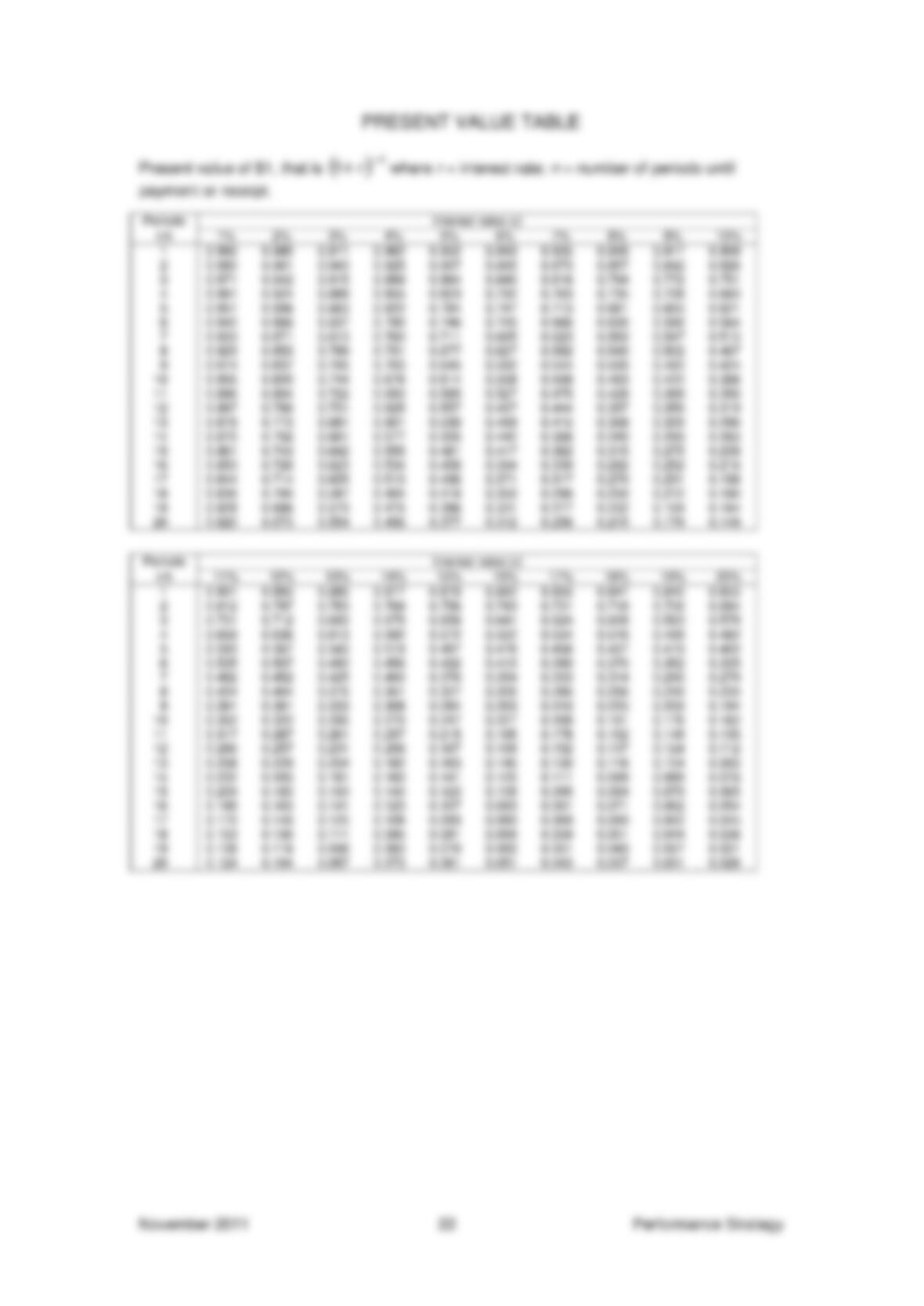
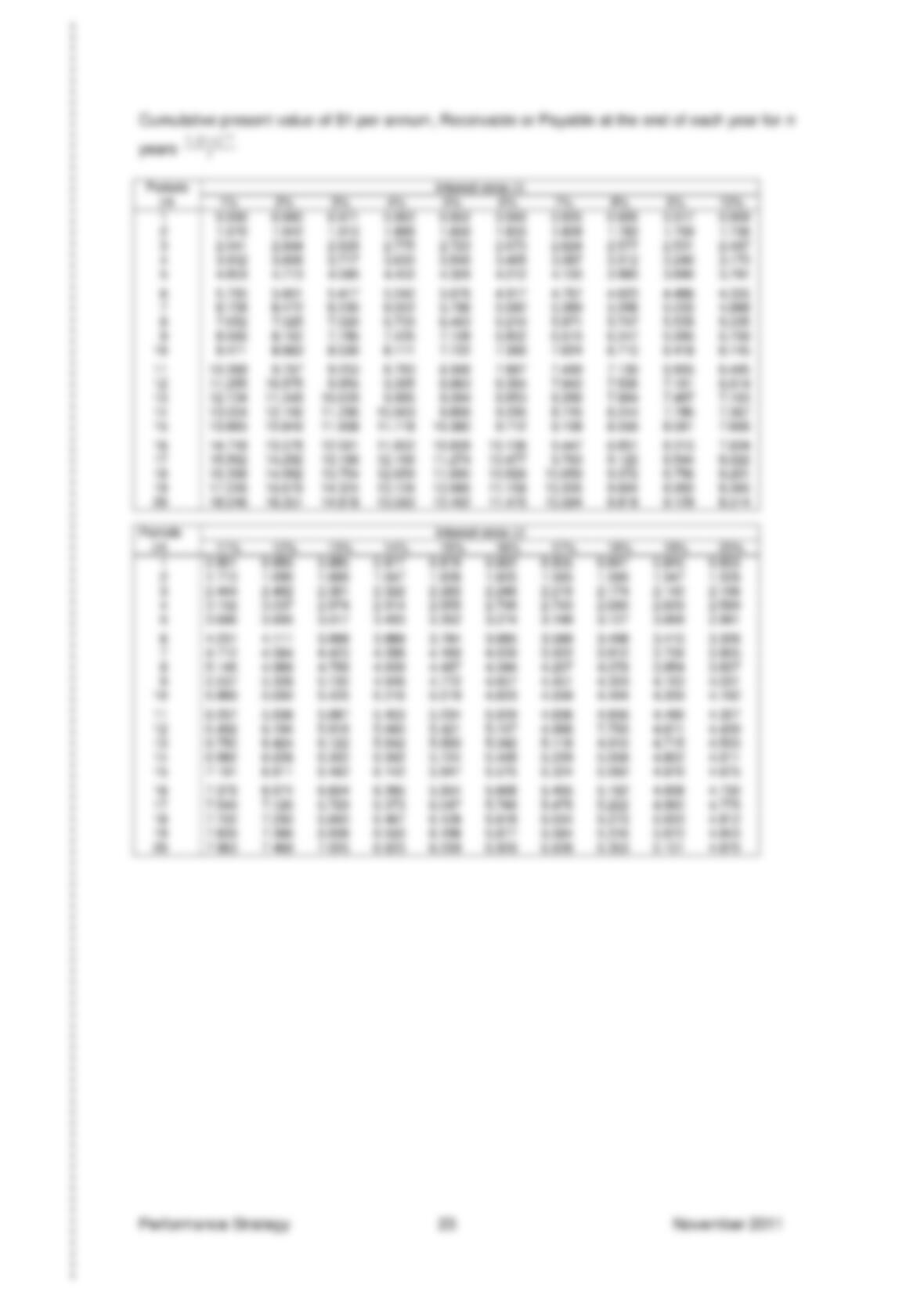
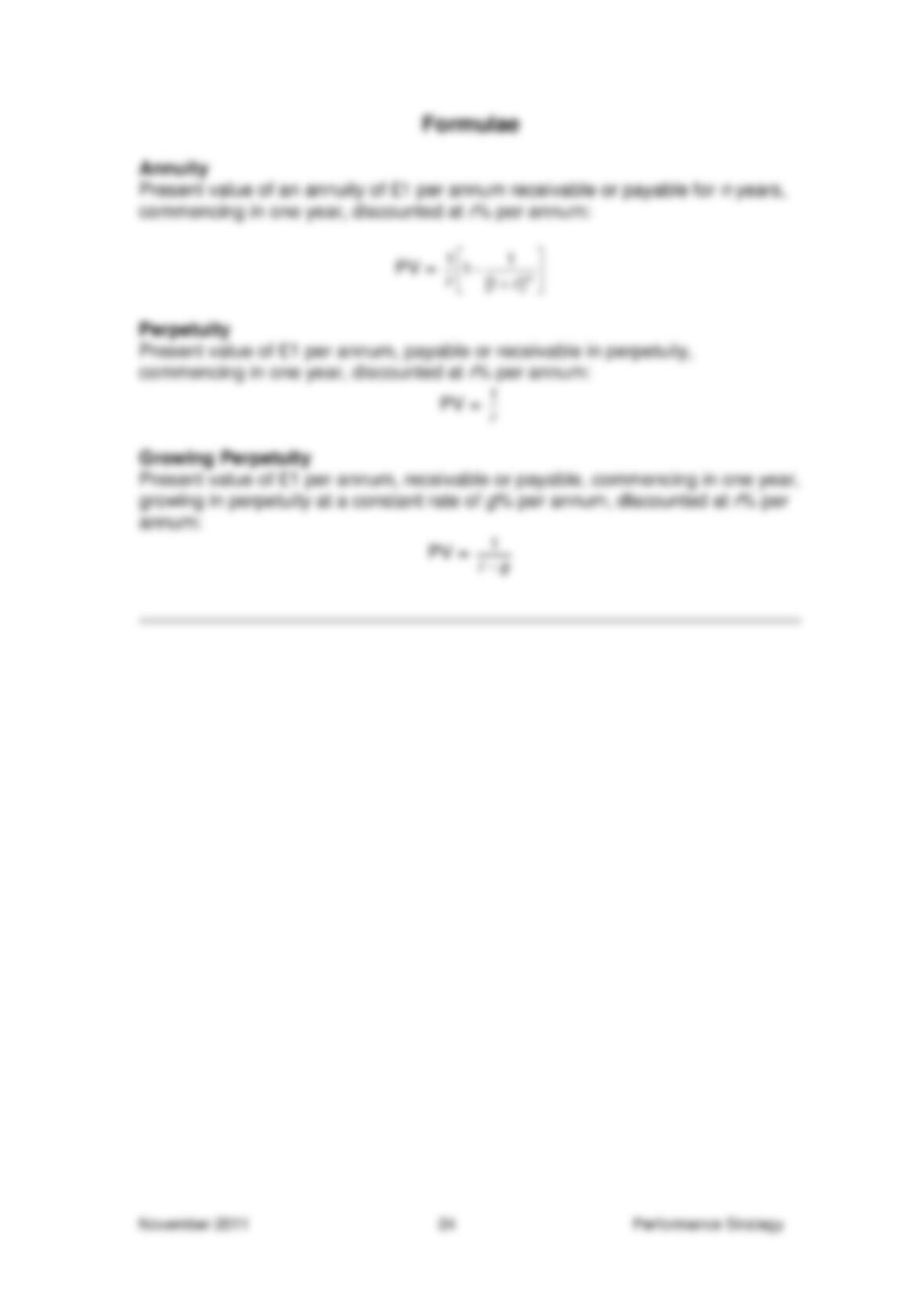
Maths tables and formulae are provided on pages 21 to 24.
The list of verbs as published in the syllabus is given for reference on page
27.
Write your candidate number, the paper number and examination subject title
in the spaces provided on the front of the answer book. Also write your
contact ID and name in the space provided in the right hand margin and seal
to close.
Tick the appropriate boxes on the front of the answer book to indicate which
questions you have answered.
TURN OVER
November 2011
2
Performance Strategy
Pre–seen case study
Introduction
M plc is a long established publisher of newspapers and provider of web media. It is based in
London and has had a full listing on the London Stock Exchange since 1983. The company has
three operating divisions which are managed from the United Kingdom (UK). These are the
Newspapers Division, the Web Division and the Advertising Division.
Newspapers Division
The Newspapers Division publishes three daily newspapers and one Sunday newspaper in the
UK. The Division has three offices and two printing sites. Between them the three offices edit the
three daily newspapers and the Sunday newspaper. The Newspaper Division has two subsidiary
publishing companies, FR and N. FR is based in France within the Eurozone and N in an
Eastern European country which is outside the Eurozone. Printing for all the Division’s
publications, except those produced by FR and N, is undertaken at the two printing sites. FR and
N have their own printing sites.
Web Division
The Web Division maintains and develops 200 websites which it owns. Some of these websites
are much more popular in terms of the number of “hits” they receive than others. Web material is
an increasing part of M plc’s business. In the last ten years, the Web Division has developed an
online version of all the newspapers produced by the Newspapers Division.
Advertising Division
The sale of advertising space is undertaken for the whole of M plc by the Advertising Division.
Therefore, advertisements which appear in the print media and on the web pages produced by
the Newspapers Division (including that produced by FR and N) and the Web Division
respectively are all handled by the Advertising Division.
Group Headquarters
In addition to the three operating divisions, M plc also has a head office, based in the UK, which
is the group’s corporate headquarters where the Board of Directors is located. The main role of
M plc’s headquarters is to develop and administer its policies and procedures as well as to deal
with its group corporate affairs.
Mission statement
M plc established a simple mission statement in 2005. This drove the initiative to acquire FR in
2008 and remains a driving force for the company. M plc’s mission is “to be the best news media
organisation in Europe, providing quality reporting and information on European and world–wide
events”.
Strategic objectives
Four main strategic objectives were established in 2005 by M plc’s Board of Directors. These are
to:
1. Meet the needs of readers for reliable and well informed news.
2. Expand the geographical spread of M plc’s output to reach as many potential newspaper
and website readers as possible.
3. Publish some newspapers which help meet the needs of native English speakers who
live in countries which do not have English as their first language.
4. Increase advertising income so that the group moves towards offering as many news
titles as possible free of charge to the public.
Performance Strategy
3
November 2011
Financial objectives
In meeting these strategic objectives, M plc has developed the following financial objectives:
i. To ensure that revenue and operating profit grow by an average of 4% per year.
ii. To achieve steady growth in dividend per share.
iii. To maintain gearing below 40%, where gearing is calculated as debt/(debt plus
equity) based on the market value of equity and the book value of debt.
Forecast revenue and operating profit
M plc’s forecast revenue and net operating profit for the year ending 31 March 2012 are
£280 million and £73 million respectively.
Extracts from M plc’s forecast income statement for the year ending 31 March 2012 and forecast
statement of financial position as at 31 March 2012 are shown in the appendix.
Comparative divisional performance and headquarters financial information
The following information is provided showing the revenue generated, the operating profit
achieved and the capital employed for each division and the operating costs incurred and capital
employed in M plc’s headquarters. This information covers the last two years and also gives a
forecast for the year ending 31 March 2012. All M plc’s revenue is earned by the three divisions.
Newspapers Division
Year ended
31.3.2010
Year ended
31.3.2011
Forecast for year
ending 31.3.2012
£million
£million
£million
Revenue external
Revenue internal transfers
Net operating profit
91
90
45
94
91
46
94
96
48
Non–current assets
420
490
548
Net current assets
4
8
(10)
Web Division
Year ended
31.3.2010
Year ended
31.3.2011
Forecast for year
ending 31.3.2012
£million
£million
£million
Revenue internal transfers
55
60
66
Net operating profit
10
13
16
Non–current assets
37
40
43
Net current assets
1
1
(2)
Advertising Division
Year ended
31.3.2010
Year ended
31.3.2011
Forecast for year
ending 31.3.2012
£million
£million
£million
Revenue external
162
180
186
Internal transfers
(145)
(151)
(162)
Net operating profit
10
18
19
Non–current assets
3
6
7
Net current assets
1
1
(2)
Headquarters
Year ended
31.3.2010
Year ended
31.3.2011
Forecast for year
ending 31.3.2012
£million
£million
£million
Operating costs
8
9
10
Non–current assets
37
39
43
Net current assets
1
1
(1)
November 2011
4
Performance Strategy
Notes:
1. The Advertising Division remits advertising revenue to both the Newspapers and Web
Divisions after deducting its own commission.
2. The Web Division’s entire revenue is generated from advertising.
3. The revenues and operating profits shown for the Newspapers Division include those
earned by FR and N. The converted revenue and operating profit from N are forecast to
be £20 million and £4 million respectively for the year ending 31 March 2012. FR is
forecast to make a small operating profit in the year ending 31 March 2012. The Board
of M plc is disappointed with the profit FR has achieved.
Additional information on each of M plc’s divisions
Newspapers Division
FR is wholly owned and was acquired in 2008. Its financial statements are translated into British
pounds and consolidated into M plc’s group accounts and included within the Newspaper
Division’s results for internal reporting purposes.
Shortly after it was acquired by M plc, FR launched a pan–European weekly newspaper. This
newspaper, which is written in English, is produced in France and then distributed throughout
Europe. M plc’s board thought that this newspaper would become very popular because it
provides a snapshot of the week’s news, focused particularly on European issues but viewed
from a British perspective. Sales have, however, been disappointing.
N, which publishes local newspapers in its home Eastern European country, is also treated as
part of the Newspapers Division. M plc acquired 80% of its equity in 2010. At that time, M plc’s
board thought that Eastern Europe was a growing market for newspapers. The subsidiary has
proved to be profitable mainly because local production costs are lower than those in the UK
relative to the selling prices.
The Newspapers Division’s journalists incur a high level of expenses in order to carry out their
duties. The overall level of expenses claimed by the journalists has been ignored by M plc in
previous years because it has been viewed as a necessary cost of running the business.
However, these expenses have risen significantly in recent years and have attracted the
attention of M plc’s internal audit department.
There has been significant capital investment in the Newspapers Division since 2009/10. The
printing press facilities at each of the two printing sites have been modernised. These
modernisations have improved the quality of output and have enabled improved levels of
efficiency to be achieved in order to meet the increasing workloads demanded in the last two
years. Surveys carried out before and after the modernisation have indicated higher levels of
customer satisfaction with the improved quality of printing.
The increased mechanisation and efficiency has reduced costs and led to a reduction in the
number of employees required to operate the printing presses. This has led to some dis–
satisfaction among the divisional staff. Staff in the other divisions have been unaffected by the
discontent in the Newspapers Division. Staff turnover has been relatively static across the three
divisions, with the exception of the department which operates the printing presses in the
Newspapers Division where some redundancies have occurred due to fewer staff being required
since the modernisation.
Web Division
The web versions of the newspapers are shorter versions of the printed ones. There is currently
no charge for access to the web versions of the newspapers. Revenues are generated from
sales by the Advertising Division of advertising space on the web pages. Some of the websites
permit unsolicited comments from the public to be posted on them and they have proved to be
very popular. The Web Division is undertaking a review of all its costs, particularly those relating
to energy, employees and website development.
Performance Strategy
5
November 2011
The Web Division’s management accounting is not sophisticated: for example, although it
reports monthly on the Division’s revenue and profitability, it cannot disaggregate costs so as to
produce monthly results for each of the 200 websites. The Division is at a similar disadvantage
as regards strategic management accounting as it lacks information about the websites’ market
share and growth rates. This has not mattered in the past as M plc was content that the Web
Division has always been profitable. However, one of M plc’s directors, the Business
Development Director (see below under The Board of Directors and group shareholding) thinks
that the Web Division could increase its profitability considerably and wants to undertake a
review of its 200 websites.
Advertising Division
The Advertising Division remits advertising revenue to both the Newspapers and Web Divisions
after deducting its own commission. In addition, the Advertising Division offers an advertising
service to corporate clients. Such services include television and radio advertising and poster
campaigns on bill boards. Advertisements are also placed in newspapers and magazines which
are not produced by M plc, if the client so wishes. An increasing element of the work undertaken
by the Advertising Division is in providing pop–up advertisements on websites.
Planning process
Each division carries out its own planning process. The Newspapers Division operates a rational
model and prepares annual plans which it presents to M plc’s board for approval. The Web
Division takes advantage of opportunities as they arise and is operating in a growth market,
unlike the other two divisions. Its planning approach might best be described as one of logical
incrementalism. Increased capital expenditure in 2010/11 helped the Advertising Division to
achieve an 11% increase in revenue in that year. The Divisional Managers of both the Web
Division and the Advertising Division are keen to develop their businesses and are considering
growth options including converting their businesses into outsource service providers to M plc.
The Board of Directors and group shareholding
M plc’s Board of Directors comprises six executive directors and six non–executive directors, one
of whom is the Non–executive Chairman. The executive directors are the Chief Executive, and the
Directors of Strategy, Corporate Affairs, Finance, Human Resources and Business Development.
The Business Development Director did not work for M plc in 2005 and so had no part in drafting
the strategic objectives. She thinks that objective number four has become out–dated as it does not
reflect current day practice. The Business Development Director has a great deal of experience
working with subscription–based websites and this was one of the main reasons M plc recruited her
in March 2011. Her previous experience also incorporated the management of product portfolios
including product development and portfolio rationalisation.
There are divisional managing directors for each of the three divisions who are not board
members but report directly to the Chief Executive.
One of M plc’s non–executive directors was appointed at the insistence of the bank which holds
10% of M plc’s shares. Another was appointed by a private charity which owns a further 10% of
the shares in M plc. The charity represents the interests of print workers and provides long–term
care to retired print workers and their dependents. Two other non–executive directors were
appointed by a financial institution which owns 20% of the shares in M plc. The remaining 60%
of shares are held by private investors. The board members between them hold 5% of the
shares in issue. None of the other private investors holds more than 70,000 of the total 140
million shares in issue.
It has become clear that there is some tension between the board members. Four of the non–
executive directors, those appointed by the bank, the charity and the financial institution, have
had disagreements with the other board members. They are dissatisfied with the rate of growth
and profitability of the company and wish to see more positive action to secure M plc’s financial
objectives.
Some board members feel that the newspapers market is declining because fewer people can
make time to read printed publications. Some of the non–executive directors think that many
people are more likely to watch a television news channel than read a newspaper.
November 2011
6
Performance Strategy
Editorial policy
M plc’s board applies a policy of editorial freedom provided that the published material is within
the law and is accurate. The editors of each of the publications printed in the UK and France and
of the websites have complete autonomy over what is published. They are also responsible for
adhering to regulatory constraints and voluntary industry codes of practice relating to articles
and photographs which might be considered offensive by some readers.
There is less scrutiny of the accuracy of the reporting in N’s home country than in other
countries. The Eastern European country in which N is situated has become politically unstable
in the last two years. Much of this unrest is fuelled by the public distaste for the perceived blatant
corruption and bribery which is endemic within the country’s Government and business
community. It is well known that journalists have accepted bribes to present only the
Government’s version of events, rather than a balanced view. There is also widespread
plagiarism of published material by the country’s newspapers and copyright laws are simply
ignored.
Corporate Social Responsibility
A policy is in place throughout M plc in order to eliminate bribery and corruption among staff
especially those who have front line responsibility for obtaining business. This policy was
established 15 years ago. All new employees are made aware of the policy and other staff
policies and procedures during their induction. The Director of Human Resources has
confidence in the procedures applied by his staff at induction and is proud that no action has
ever been brought against an employee of M plc for breach of the bribery and corruption policy.
M plc is trying to reduce its carbon footprint and is in the process of developing policies to limit
its energy consumption, reduce the mileage travelled by its staff and source environmentally
friendly supplies of paper for its printing presses. The Newspapers Division purchases the paper
it uses for printing newspapers from a supplier in a Scandinavian country. This paper is
purchased because it provides a satisfactory level of quality at a relatively cheap price. The
Scandinavian country from which the paper is sourced is not the same country in which N is
situated.
Strategic Development
The Board of Directors is now reviewing M plc’s competitive position. The Board of Directors is
under pressure from the non–executive directors appointed by the bank, the charity and the
financial institution (which between them own 40% of the shares in M plc), to devise a strategic
plan before June 2012 which is aimed at achieving M plc’s stated financial objectives.

APPENDIX 1
Extracts from M plc’s forecast group income statement and forecast statement of
financial position
Forecast income statement for the group for the year ending 31 March 2012
Notes
£ million (GBP million)
Revenue
280
Operating costs
Net operating profit
(207)
73
Interest income
1
Finance costs
(11)
Corporate income tax
1
FORECAST PROFIT FOR THE YEAR
(19)
44
Forecast statement of the group financial position as at 31 March 2012
£ million (GBP million)
ASSETS
Non–current assets
641
Current assets
Inventories
2
Trade and other receivables
27
Cash and cash equivalents
Total current assets
2
Total assets
31
672
Performance Strategy
Share capital
Non–current liabilities
Long term borrowings
250
Total equity and liabilities
296
672