DO NOT OPEN THIS QUESTION PAPER UNTIL YOU ARE TOLD TO DO SO
The Chartered Institute of Management Accountants 2012
P3 – Performance Strategy
Performance Pillar
P3 – Performance Strategy
Friday 31 August 2012
Instructions to candidates
You are allowed three hours to answer this question paper.
You are allowed 20 minutes reading time before the examination begins
during which you should read the question paper and, if you wish, highlight
and/or make notes on the question paper. However, you will not be allowed,
under any circumstances, to begin using your computer to produce your
answer or to use your calculator during the reading time.
You are strongly advised to carefully read ALL the question requirements
before attempting the question concerned (that is all parts and/or sub–
questions).
ALL answers must be submitted electronically, using the single Word and
Excel files provided. Answers written on the question paper and note paper
will not be submitted for marking.
You should show all workings as marks are available for the method you use.
The pre–seen case study material is included in this question paper on pages
2 to 8. The unseen case study material, specific to this examination, is
provided on pages 10 and 11.
Answer the compulsory question in Section A on page 13. This page is
detachable for ease of reference
Answer TWO of the three questions in Section B on pages 16 to 21.
Maths tables and formulae are provided on pages 23 to 26.
The list of verbs as published in the syllabus is given for reference on page
27.
Your computer will contain two blank files – a Word and an Excel file.
Please ensure that you check that the file names for these two documents
correspond with your candidate number.
TURN OVER
September 2012
2
Performance Strategy
Pre–seen case study
Introduction
B Supermarkets (B) was founded as a grocery retailer in a European country in 1963. Its sales
consist mainly of food and household items including clothing. B now owns or franchises over
15,000 stores world–wide in 36 countries. The company has stores in Europe (in both eurozone
and non–eurozone countries), Asia and North America. B’s head office is located in a eurozone
country. B has become one of the world’s largest chains of stores.
B’s Board thinks that there are opportunities to take advantage of the rapid economic growth of
some Asian countries and the associated increases in demand for food and consumer goods.
Structure
The B Group is structured into a holding company, B, and three subsidiary companies which are
located in each of the regions of the world in which it operates (Europe, Asia and North
America). The subsidiary companies, referred to as “Regions” within B, are respectively B–
Europe, B–Asia and B–North America.
Store operations, sales mix and staffing
B operates four types of store: supermarkets, hypermarkets, discount stores and convenience
stores. For the purpose of this case study, the definition of each of these types of store is as
follows:
A supermarket is a self–service store which sells a wide variety of food and household goods
such as washing and cleaning materials, cooking utensils and other items which are easily
carried by customers out of the store.
A hypermarket is a superstore or very large store which sells the same type of products as a
supermarket but in addition it sells a wide range of other items such as consumer durable white
goods, for example refrigerators, freezers, washing machines and furniture. Hypermarkets are
often located on out–of–town sites.
A discount store is a retail store that sells a variety of goods such as electrical appliances and
electronic equipment. Discount stores in general usually sell branded products and pursue a
high–volume, low priced strategy and aim their marketing at customers who seek goods at prices
which are usually less than can be found in a hypermarket.
A convenience store is a small shop or store in an urban area that sells goods which are
purchased regularly by customers. These would typically include groceries, toiletries, alcoholic
beverages, soft drinks and confectionery. They are convenient for shoppers as they are located
in or near residential areas and are often open for long hours. Customers are willing to pay
premium prices for the convenience of having the store close by.
B sells food products and clothing in its supermarkets and hypermarkets at a higher price than
many of its competitors because the Board thinks that its customers are prepared to pay higher
prices for better quality food products. B also sells good quality consumer durable products in its
supermarkets and hypermarkets but it is forced to sell these at competitive prices as there is
strong competition for the sale of such goods. B’s discount stores sell good quality electrical
products usually at lower prices than those charged in its supermarkets and hypermarkets, B
only sells electronic equipment in its discount stores. Customers have a greater range from
which to choose in the discount stores as compared with supermarkets and hypermarkets
because the discount stores specialise in the goods which they sell. B’s convenience stores do
not have the availability of space to carry a wide range of products and they charge a higher
price for the same brand and type of goods which it sells in its supermarkets.
Although B owns most of its stores, it has granted franchises for the operation of some stores
which carry its name.
Nearly 0.5 million full–time equivalent staff are employed world–wide in the Group. B tries when
possible to recruit local staff to fill job vacancies within its stores.
Performance Strategy
3
September 2012
Value statement and mission
In recognition of the strong competitive and dynamic markets in which it operates, B’s Board has
established an overall value statement as follows: “We aim to satisfy our customers wherever we
trade. We intend to employ different generic competitive strategies depending on the market
segment in which our stores trade.”
The Board has also produced the following mission statement:
“B practises sustainable investment within a healthy ethical and thoughtful culture and strives to
achieve customer satisfaction by giving a courteous and efficient service, selling high quality
goods at a reasonable price, sourcing goods from local suppliers where possible and causing
the least damage possible to the natural environment. By this, we aim to satisfy the expectations
of our shareholders by achieving consistent growth in our share price and also to enhance our
reputation for being an environmentally responsible company.”
Strategic objectives
The following objectives have been derived from the mission statement:
1. Build shareholder value through consistent growth in the company’s share price.
2. Increase customer satisfaction ratings to 95% as measured by customer feedback
surveys.
3. Increase commitment to local suppliers by working towards achieving 40% of our
supplies from sources which are local to where B stores trade.
4. Reduce carbon emissions calculated by internationally agreed measures by at least 1%
per year until B becomes totally carbon neutral.
5. Maximise returns to shareholders by employing different generic competitive strategies
depending on the market segment in which B stores trade.
Financial objectives
The Board has set the following financial objectives:
1. Achieve consistent growth in earnings per share of 7% each year.
2. Maintain a dividend pay–out ratio of 50% each year.
3. Gearing levels as measured by long–term debt divided by long–term debt plus equity
should not exceed 40% based on book value.
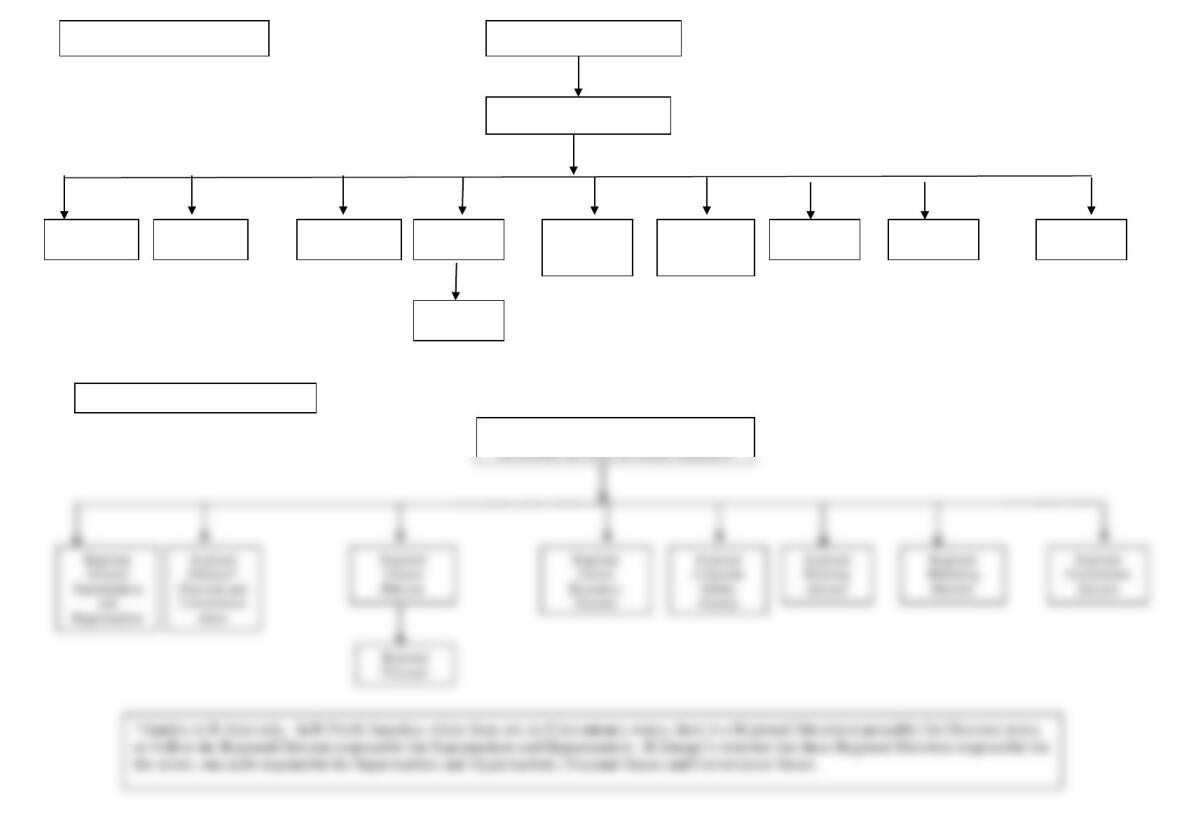
Governance
The main board comprises the Non–executive Chairman, the Chief Executive and nine Executive
directors. These cover the functions of finance, human resources, corporate affairs (including
legal and public relations), marketing, planning and procurement. There is also one executive
director for each of the three regions, being the Regional Managing Directors of B–Europe, B–
Asia and B–North America. There are also nine non–executive main board members in addition
to the Chairman.
The main Board of Directors has separate committees responsible for audit, remuneration,
appointments, corporate governance and risk assessment and control. The Risk Assessment
and Control Committee’s tasks were formerly included within the Audit Committee’s role. It was
agreed by the Board in 2009 that these tasks should be separated out in order not to overload
the Audit Committee which has responsibilities to review the probity of the company. B’s
expansion has been very rapid in some countries. The expansion has been so rapid that B has
not been able to carry out any internal audit activities in some of these countries to date. The
regional boards do not have a committee structure.
Each of the Regional Managing Directors chairs his or her own Regional Board. All of the
Regional Boards have their own directors for finance, human resources, corporate affairs,
marketing, planning and procurement but their structure is different for the directors who have
responsibility for the stores. In B–Asia, one regional director is responsible for the hypermarkets
and supermarkets and another is responsible for discount stores and convenience stores. In B–
North America, one regional director is responsible for the hypermarkets and supermarkets and
another is responsible for discount stores (B does not have any convenience stores in North
September 2012
4
Performance Strategy
America). In B–Europe there is one regional director responsible for supermarkets and
hypermarkets, one for discount stores and one for convenience stores. In all regions the regional
directors have line accountability to their respective regional managing director and professional
accountability to the relevant main board director. There are no non–executive directors on the
regional boards. Appendix 1 shows the main board and regional board structures.
Treasury
Each of B’s three regions has a regional treasury department managed by a regional treasurer
who has direct accountability to the respective Regional Director of Finance and professional
accountability to the Group Treasurer. The Group Treasurer manages the central corporate
treasury department which is located in B’s head office. The Group Treasurer, who is not a main
board member, reports to the Director of Finance on the main board.
Shareholding, year–end share prices and dividends paid for the last five years
B is listed on a major European stock exchange within the eurozone and it wholly owns its
subsidiaries. There are five major shareholders of B, including employees taken as a group,
which between them hold 25% of the 1,350 million total shares in issue. The major shareholders
comprise two long term investment trusts which each owns 4%, a hedge fund owns 5%,
employees own 5% and the founding family trust owns 7% of the shares. The remaining 75% of
shares are owned by the general public.
The year–end share prices and the dividends paid for the last five years were as follows:
2007
€
2008
€
2009
€
2010
€
2011
€
Share price at 31 December
47.38
25.45
28.68
29.44
31.37
Net Dividend per share
1.54
1.54
1.54
1.62
1.65
Planning and management control
B has a very structured planning process. Each regional board produces a five year strategic
plan for its region relating to specific objectives set for it by the main board and submits this to
the main board for approval. The main board then produces a consolidated strategic plan for the
whole company. This is reviewed on a three yearly cycle and results in a revised and updated
group five year plan being produced every three years.
B’s management control system, which operates throughout its regions and at head office, is
well known in the industry to be bureaucratic and authoritarian. Strict financial authority levels for
development purposes are imposed from the main Board. There is tension between the main
Board and the regional boards. The regional board members feel that they are not able to
manage effectively despite being located much closer to their own regional markets than the
members of the main Board. The main Board members, on the other hand, think that they need
to exercise tight control because they are remote from the markets. This often stifles planning
initiatives within each region. This tension is also felt lower down the organisation as the regional
board members exercise strict financial and management control over operational managers in
their regions in order to ensure that the main Board directives are carried out.
Competitive overview
B operates in highly competitive markets for all the products it sells. The characteristics of each
of the markets in which it operates are different. For example, there are different planning
restrictions applying within each region. In some countries, B is required to operate each of its
stores in a partnership arrangement with local enterprises, whereas no such restriction exists
within other countries in which it trades. B needs to be aware of different customer tastes and
preferences which differ from country to country. The following table provides a break–down of
B’s stores in each region.
B Europe
B Asia
B North America
Supermarkets and hypermarkets
3,456
619
512
Discount stores
5,168
380
780
Convenience stores
4,586
35
Performance Strategy
5
September 2012
B is one of the largest retailing companies in the world and faces different levels of competition
in each region. B’s overall market share in terms of retail sales for all supermarkets,
hypermarkets, discount stores and convenience stores in each of its regions is as follows:
Market share
Europe
20%
Asia
1%
North America
1.5%
The following table shows the sales revenue and net operating profit earned by B in each of its
regions for the year ended 31 December 2011:
B Europe
€ million
B Asia
€ million
B North America
€ million
Revenue
89,899
10,105
9,708
Net Operating Profit
4,795
743
673
B is constantly seeking other areas of the world into which it can expand, especially within Asia
where it perceives many countries have an increasing population and strengthening economies.
Corporate Social Responsibility (CSR)
B is meeting its CSR obligations by establishing environmental targets for carbon emissions
(greenhouse gas emissions), careful monitoring of its supply chain, undertaking sustainable
investments and investing in its human capital.
Environmental targets for carbon emissions:
B’s main board is keen to demonstrate the company’s concern for the environment by pursuing
continuous improvement in the reduction of its carbon emissions and by developing ways of
increasing sustainability in its trading practices. A number of environmental indicators have been
established to provide transparency in B’s overall performance in respect of sustainability. These
published measures were verified by B’s statutory auditor and are calculated on a like–for–like
basis for the stores in operation over the period measured.
In the year ended 31 December 2011, B reduced its consumption of kilowatt hours (kWh) per
square metre of sales area as compared with the year ended 31 December 2008 by 9%. The
target reduction for that period was 5%. In the same period it reduced the number of free
disposable plastic bags provided to customers per square metre of sales area, by 51% against a
target of 60%. Its overall greenhouse gas emissions (measured by kilogrammes of carbon
dioxide per square metre of sales area) reduced by 1% in 2011 which was exactly on target.
B provides funding for the development of local amenity projects in all of the countries where B
stores operate. (An amenity project is one which provides benefit to the local population, such as
providing a park, community gardens or a swimming pool.)
Distribution and sourcing:
Distribution from suppliers across such a wide geographical area is an issue for B. While
supplies are sourced from the country in which a store is located as much as possible, there is
nevertheless still a requirement for transportation across long distances either by road or air.
Approximately 20% of the physical quantity of goods sold across the group as a whole are
sourced locally, that is within the country in which the goods are sold. These tend to be
perishable items such as fruit and vegetables. The remaining 80% of goods are sourced from
large international manufacturers and distributors. These tend to be large items such as
electrical or electronic equipment which are bought under contracts which are set up by the
regional procurement departments. B, due to its size and scope of operations, is able to place
orders for goods made to its own specification and packaged as under its own brand label.
Some contracts are agreed between manufacturers and the Group Procurement Director for the
supply of goods to the whole of the B group world–wide.
B’s inventory is rarely transported by rail except within Europe. This has resulted in lower
average reductions in carbon emissions per square metre of sales area by stores operated by B–
September 2012
6
Performance Strategy
Asia and B–North America than for those stores operated by B–Europe. This is because the
carbon emission statistics take into account the transportation of goods into B’s stores.
Sustainable investments:
B aspires to become carbon neutral over the long term. The Board aims to reduce its carbon
emissions by investing in state of the art technology in its new store developments and by
carrying out modifications to existing stores.
Human Resources:
B prides itself on the training it provides to its staff. The training of store staff is carried out in
store by specialist teams which operate in each country where B trades. In this way, B believes
that training is consistent across all of its stores. In some countries, the training is considered to
be at a sufficiently high level to be recognised by national training bodies. The average number
of training hours per employee in the year ended 31 December 2011 was 17 compared with 13
hours in the year ended 31 December 2010. In 2011, B employed 45% more staff with declared
disabilities compared with 2010.
Information systems and inventory management
In order to operate efficiently, B’s Board has recognised that it must have up–to–date information
systems including electronic point of sale (EPOS) systems. An EPOS system uses computers or
specialised terminals that can be combined with other hardware such as bar–code readers to
accurately capture the sale and adjust the inventory levels within the store. EPOS systems
installation is on–going. B has installed EPOS systems in its stores in some countries but not in
all its stores world–wide.
B’s information systems are not perfect as stock–outs do occur from time–to–time, especially in
the European stores. This can be damaging to sales revenue when stock–outs occur during peak
sales periods such as the days leading up to a public holiday. In Asia and North America in
particular, B’s information technology systems sometimes provide misleading information. This
has led to doubts in the minds of some head office staff about just how robust are B’s inventory
control systems.
As is normal in chain store groups, there is a certain degree of loss through theft by staff and
customers. Another way that loss is suffered is through goods which have gone past their “sell–
by” date and mainly relates to perishable food items which are wasted as they cannot be sold to
the public. In most countries, such food items which cannot be sold to the public may be sold to
local farmers for animal feed.
Regulatory issues
B’s subsidiaries in Asia and North America have sometimes experienced governmental
regulatory difficulties in some countries which have hindered the installation of improved
information systems. To overcome some of these regulatory restrictions, B–Asia and B–North
America have, on occasions, resorted to paying inducements to government officials in order for
the regulations to be relaxed.
Appendix 1
Chief Executive Officer
Chairman (Non- Executive)
Regional MD
B-Europe
Regional MD
B-Asia
Regional MD
B- N America
Finance
Director
Human
Resources
Director
Corporate
Affairs
Director
Planning
Director
Marketing
Director
Procurement
Director
Group
Treasurer
Regional MD
B Regional Board Structure
B Main Board Structure