DO NOT OPEN THIS QUESTION PAPER UNTIL YOU ARE TOLD TO DO SO
© The Chartered Institute of Management Accountants 2013
CIMA Gateway Assessment
CIMA Gateway Assessment
19 November 2013 – Tuesday Afternoon Session
Instructions to candidates
You are allowed three hours to answer this question paper.
You are allowed 20 minutes reading time before the examination begins
during which you should read the question paper and, if you wish, highlight
and/or make notes on the question paper. However, you are not allowed,
under any circumstances, to open the answer book and start writing or use
your calculator during this reading time.
You are strongly advised to carefully read ALL the question requirements
before attempting the question concerned (that is, all parts and/or sub–
questions). The question requirements for Section A are highlighted in a
dotted box.
ALL answers must be written in the answer book. Answers or notes written
on the question paper will not be submitted for marking.
You should show all workings as marks are available for the method you use.
ALL QUESTIONS ARE COMPULSORY.
Section A comprises three questions on pages 2 to 7.
Section B comprises one question containing 12 objective test sub–questions
on pages 8 to 12.
Maths tables and formulae are provided on pages 13 to 16. These are
detachable for ease of reference.
The list of verbs as published in the syllabus is given for reference on page
19.
Write your candidate number, the paper number and the examination subject
title in the spaces provided on the front of the examination answer book. Also
write your contact ID and name in the space provided in the right hand
margin and seal to close.
Tick the appropriate boxes on the front of the answer book to indicate which
questions you have answered.
TURN OVER
Gateway Assessment
2
November 2013
SECTION A – 75 MARKS
[You are advised to spend no longer than 45 minutes on each question in this section]
ANSWER ALL THREE QUESTIONS
Question One
P Company produces a small range of products that, due to the nature of the industry in which it
operates, have limited life cycles. The company currently produces four products A, B, C and D.
The company uses a market forecast of sales for three years into the future. The sales revenue
figures, both actual and forecast, for the four products are as follows (where (F) denotes forecast
sales for the year):
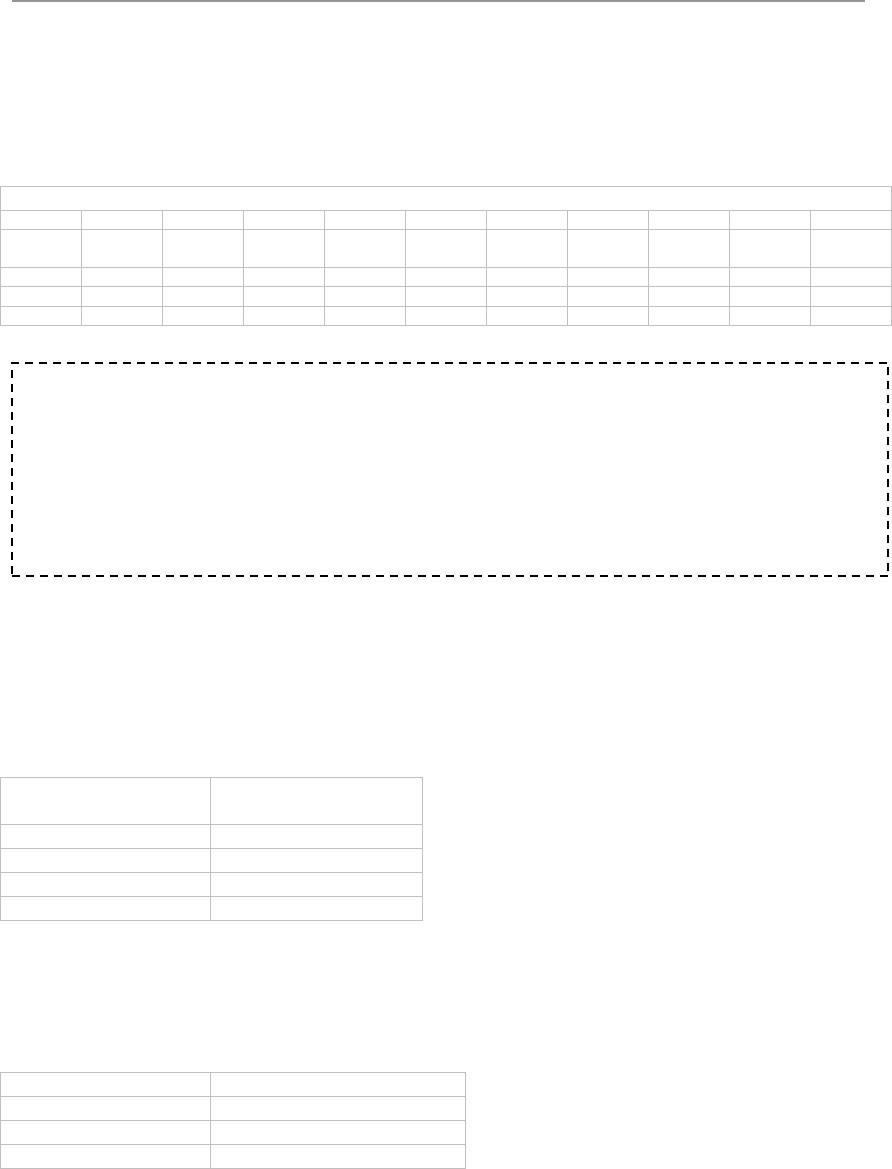
Sales ($000)
Product
2007
2008
2009
2010
2011
2012
2013
2014(F)
2015(F)
2016(F)
A
2,000
4,000
6,000
7,000
4,500
3,000
2,000
1,500
B 4,000 5,000 6,500 7,500 8,000 4,000 2,500 500
C
3,000
6,000
8,000
9,000
5,000
4,000
D
5,000
7,000
8,500
10,000
3,500
1,000
Since product A is nearing the end of its life cycle, P Company is working on a replacement
product, product E. As the market in which P Company operates is competitive, it uses a target
costing approach in all new product development. In order for product E to be viable, the
overhead cost element of the target cost per unit should not exceed $87.
The costs of P Company’s activities have been identified and the budget drawn up for the quarter
ended 31 December 2013 as follows:
Activities
Budgeted costs
$000
Product research
3,000
Purchasing
450
Production
4,500*
Distribution
2,800
* This includes a depreciation provision of $1,200,000 of which $60,000 relates to one quarter‘s
depreciation for the new product. P Company uses a straight line basis for depreciation.
Other information for each of the activities above for the quarter ended 31 December 2013 is as
follows:
Product research
10,000 research hours
Purchasing
7,500 purchase orders
Production
20,000 machine hours
Distribution
200,000 kgs
Required
(a) On the graph paper provided, construct a graph that shows the forecast and actual
sales for each product for each year of sales. (5 marks)
(b) Discuss the shape of the life cycle curves of the four products in your graph in part (a)
and their importance, if any, to P Company.
(6 marks)

November 2013
3
Gateway Assessment
The new product E is included in the above budget and the following additional information is
available for the product:
(i) Estimated total output over the product life cycle is 50,000 units (five year life cycle)
(ii) Product research requirement: 1,000 research hours
(iii) Output in quarter ended 31 December 2013: 1,500 units
(iv) Equivalent order size per purchase order: 50 units
(v) Other information available; machine time per unit is 15 minutes; weight per unit is
0.8 kgs
The cost driver rates identified for the quarter ended 31 December 2013 are expected to continue
for the whole of product E’s life cycle.
.
Section A continues on page 4
TURN OVER
Required
(c) Discuss the reasons why a company like P Company would use a target costing
approach in new product development. (5 marks)
(d) Calculate the overhead cost per unit for product E over its life cycle using an activity
based costing approach. Based on your calculations of the overhead element of cost,
recommend if production for product E should go ahead. (9 marks)
(Total for Question One = 25 marks)

Gateway Assessment
4
November 2013
Question Two
G4S Company is a major retailer in N country, selling mobile phones. Over the last four years the
Company has opened a number of new retail outlets and taken on more support staff at its head
office. As a result, the Company has now outgrown its existing headquarters and so the decision
has been taken by the Board to relocate to a larger purpose built building.
The Company has seen the relocation project as an opportunity to implement a number of
initiatives including setting up a customer service contact team to support the retail outlets in
dealing with customer enquiries and complaints. In addition, an up–graded office IT support
system is to be designed and must be ready for installation in the new premises
TD, the head of facilities management, has decided to establish a project team to ensure that all
of the activities associated with the move to the new premises are co–ordinated to meet the
project objectives. She has taken on the formal role of project sponsor, working on behalf of G4S
Company’s Board, and has appointed SF to manage the relocation project. The time scale for the
project is ambitious; the Board has proposed that all work should be completed and re–location
taken place by the end of six months.
Section A continues on page 6
Required:
(a) Identify and explain the activities that SF would need to undertake in the planning
phase of the project for G4S Company’s relocation. (15 marks)
(b) Compare and contrast the roles of TD, as the project sponsor, and SF, as the project
manager.
(10 marks)
(Total for Question Two = 25 marks)

This page is blank