Macro economics 3
1. Using the global capital diagram presented in class (and in handout), in which the
rate of return (or marginal product of the capital) is shown for both the home
country and rest of the world, explain effects of free trade in factor incomes when
there is zero mobility of both labor and capital, and compare this to the effects of
having perfectly free mobility of capital. What are the implications of this, if any, to
be drawn from the expanding trend toward multi nationalization?
Answer: in the heterogeneous economies the globalization is effected by integration of goods
and financial markets. The Free trade is the policy of trade followed in international trade
government does not restrict imports or exports of the country. Sometimes government
imposes policies to support local employment and protection of natural resources. Free trade
generally promotes the trade for goods without taxes, tariff and quotas. It promotes the
unregulated access to market and the avoid market distortions and also encourage trade
agreements among countries. Free trade could be better understood by the Ricardian theory
of comparative advantage. According to some economist the selective application of the free
trade is economically inefficient causing trade diversion between one country which is
having a free trade and the country facing trade barriers. Free trade would cost one producer
the lesser cost and the other a higher cost which will raise disparity. Commodity and factor
mobility are both substitutes for each other. The classical economist generally chooses factor
immobility. In a 2*2*2 model the factors mobility is discussed where two factors labor and
capital, two commodities are discussed between two countries. The model assumes there is
homogeneous production function in the economy of first degree. The marginal productivity
of labor complete depends on the mobility of factors of production. Factor endowments are
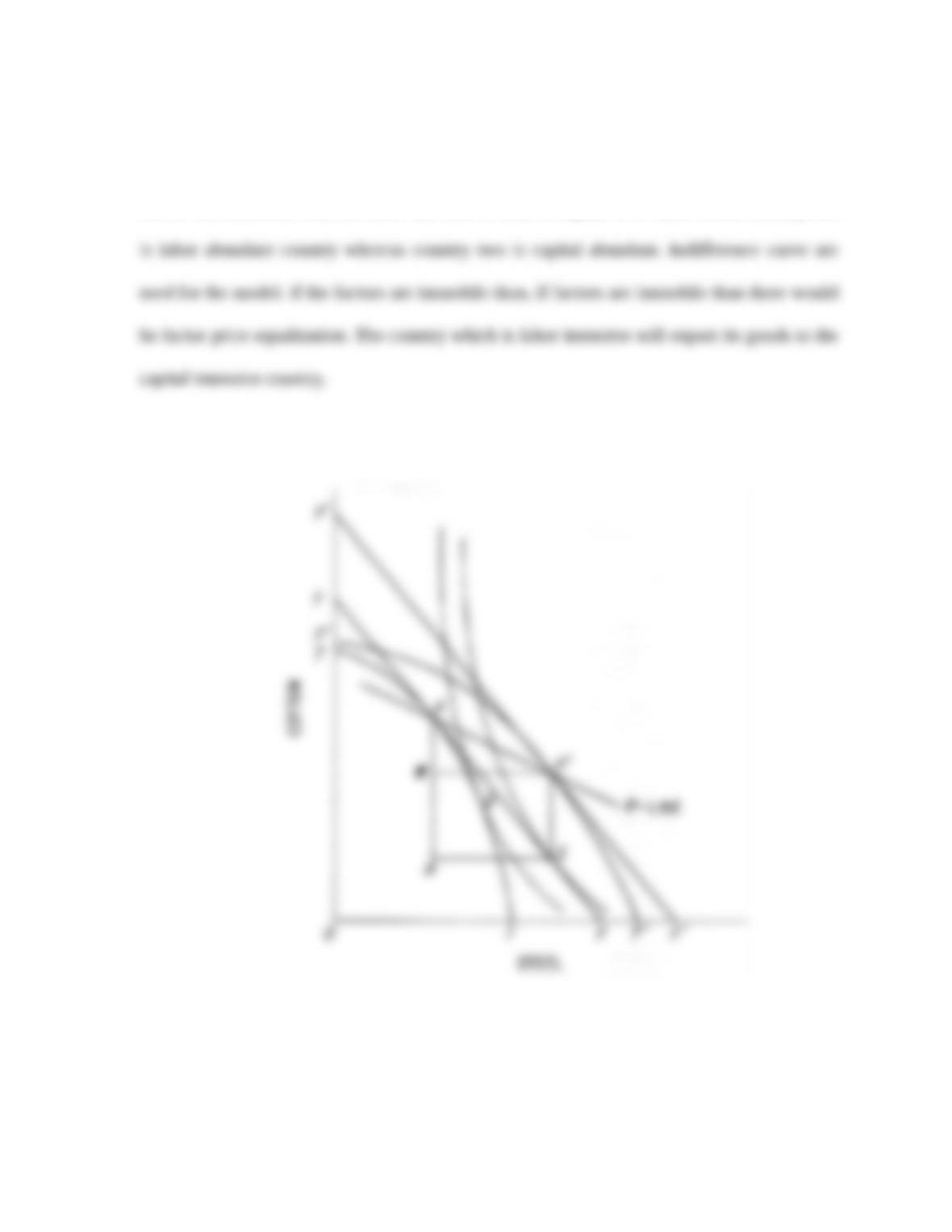
excludable from specialization. Assume that two countries are producing two final
commodities cotton and steel. With two factor of production that is labor and capital. Country
one is well endowed with the labor but there is lack of capital or in other words country one