Miller Indices
Miller indices form a notation system in crystallography for planes in crystal (Bravais) lattices. A crystal
lattice may be considered as an assembly of a number of equidistant parallel planes passing through the
lattice points and are called lattice planes. For a given lattice, these sets of planes can be selected in a
number of ways. The interplanar spacing for a given set of parallel planes is fixed but for different sets of
planes the interplanar spacing vary as also the density of lattice points.
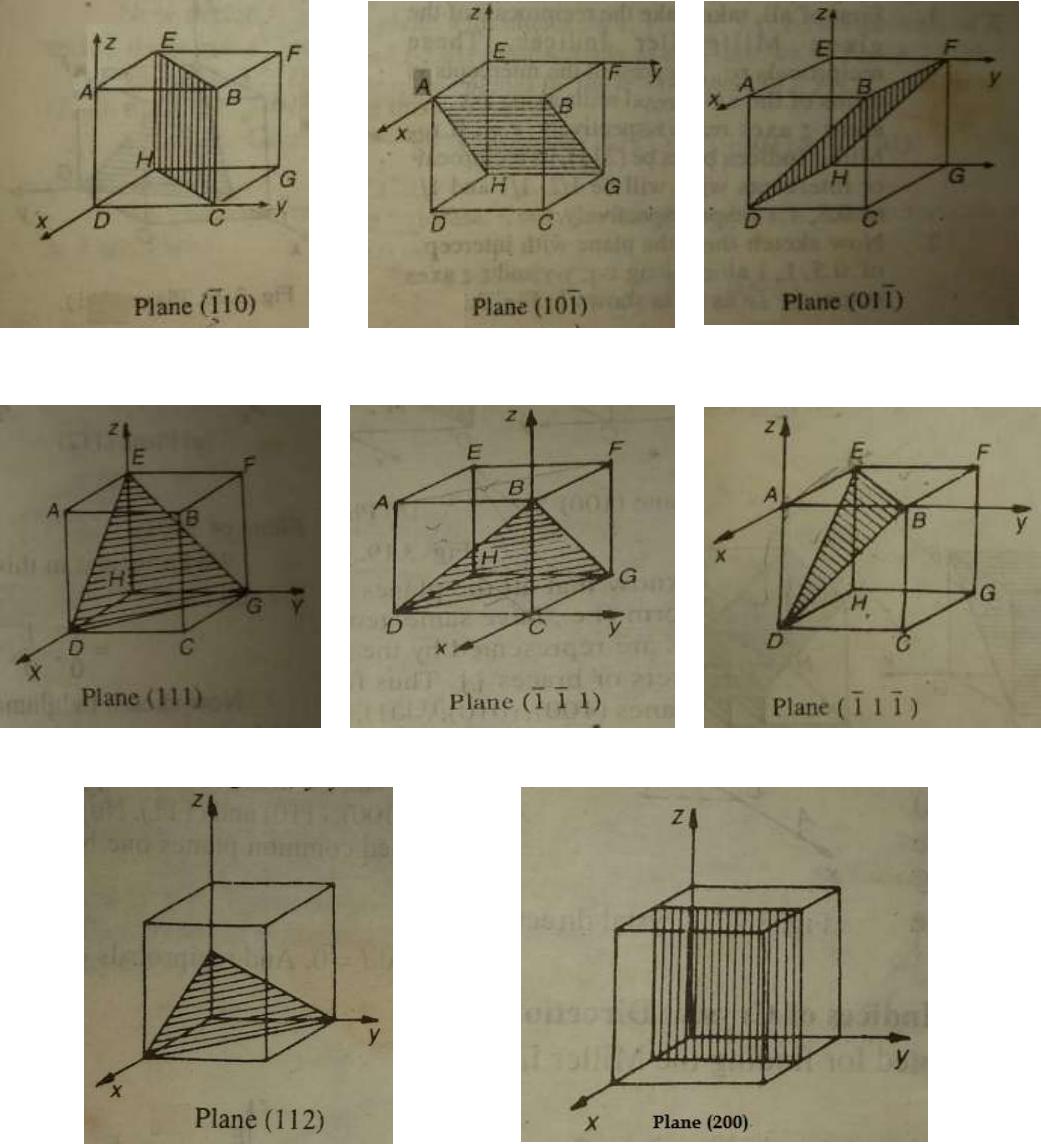
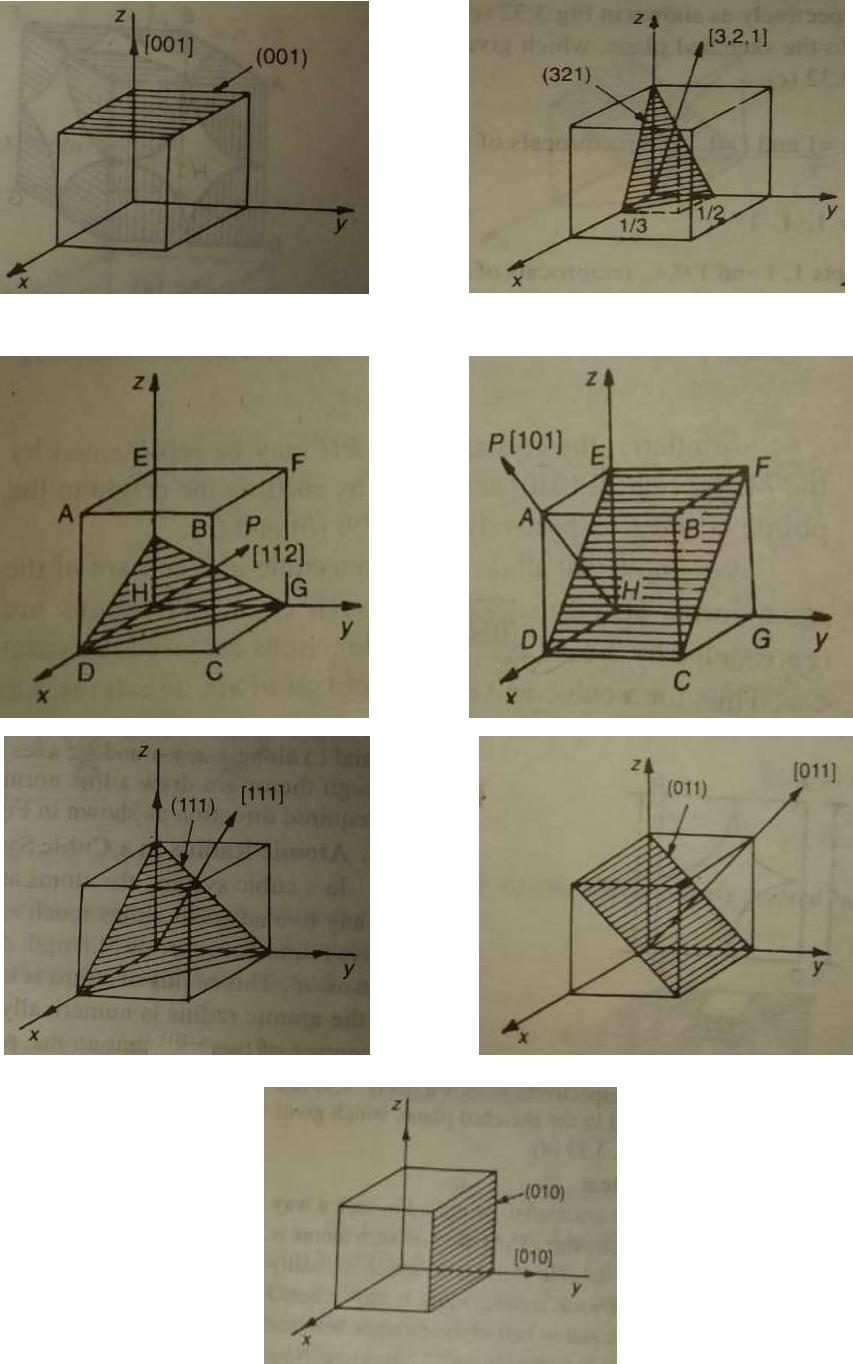
In describing crystallographic planes, the axes are taken along three non parallel edges of the unit cell,
and the intercepts are measured in term of respective unit length, which is assigned to each of the cell
regardless of its actual dimension. The use of the intercepts a, b and c to represent a crystallographic
plane has the disadvantage that the intercepts are often fractions (less than 1) and may be infinite (for a
plane parallel to an axis). For this reason, it is now common practice to use the reciprocal of the
intercepts to designate a crystallographic plane.
To obtain the Miller indices of a plane, we adopt the following procedure:
1. Determine the intercepts of the plane along x, y and z axes in terms of lattice parameters (unit
cell parameters).
2. Divide these intercepts by the appropriate unit translations.
3. Note their reciprocals.