UV2541
Rev. Jul. 30, 2014
This case was prepared by Associate Professor Marc Lipson. It was written as a basis for class discussion rather than
to illustrate effective or ineffective handling of an administrative situation. Copyright 2009 by the University of
Virginia Darden School Foundation, Charlottesville, VA. All rights reserved. To order copies, send an e-mail to
sales@dardenbusinesspublishing.com. No part of this publication may be reproduced, stored in a retrieval system,
used in a spreadsheet, or transmitted in any form or by any means—electronic, mechanical, photocopying,
recording, or otherwise—without the permission of the Darden School Foundation.
MILAGROL LTDA.
In June 2010, Peterson Valve Company was in the final stages of making an offer to
purchase Milagrol Ltda., a Brazilian manufacturer of faucets, showers, and other bathroom
fittings, including a line of high-quality automated fixtures designed to conserve water.
Discussions of a merger had proceeded smoothly. Both companies believed there were
advantages to combining efforts. Milagrol needed capital to support research and development
efforts. Peterson was interested in diversifying its operations globally and in gaining access to
manufacturing processes that would be costly to develop.
The remaining substantive challenge that Peterson faced was determining a reasonable
initial offer. Peterson’s management was not looking for a bargain price and would be satisfied
with capturing only the value created from the synergies arising from information transfer.
Peterson therefore wished to offer Milagrol a price consistent with the expected value of the
company given its operations in Brazil and exports to neighboring countries. At the time,
Milagrol had a 20% share of the Brazilian market. Both companies were privately held.
Milagrol History and Strategy
Milagrol was founded in 1962 in the Brazilian state of Santa Catarina. It began as a
manufacturer of well points for collecting water from wells. To assist with the introduction of
polyvinyl chloride (PVC) pipes into Brazil, the company developed shutoff valves that would not
generate the sudden water shocks that damaged PVC pipes. This innovation was essential to the
newly developing market and launched Milagrol as a pioneering company that would eventually
accomplish a string of firsts in Brazil, including the first foot-operated flow control system, first
vandal-proof faucets, and first ceramic-cartridge valve systems. Engineering innovations were
soon matched by design capabilities, and Milagrol expanded into high-quality bathroom fittings
featuring world-class designs. The company also developed a line of water-conserving valves
that became well known in Brazil.
This document is authorized for use only by Adriana Gutiérrez Barrios in Corporate Finance at INCAE Business School, 2021.

-2- UV2541
By the end of 2009, Milagrol was the leading manufacturer of the automatic faucets used
in airports, shopping centers, and other public locations in South America. In fact, two out of
every five major public projects in Brazil used Milagrol products, and the company also exported
to Colombia, Ecuador, Mexico, Paraguay, and some Central American countries. Milagrol had
been one of the featured firms in a recent Brazilian manufacturing exposition and had won
numerous awards. There were few competitors offering the same capabilities. Although the
Milagrol product lines were relatively expensive, the focus on technological innovations that
benefited both society and customers was key to its success. All told, Milagrol had lived up to
the company’s mission statement: “We generate value for our investors and opportunities for our
employees by developing technical and design solutions in water products that improve the lives
of our customers and the quality of our environment.”
Sales growth in the years leading up to 2009 had averaged 15% a year. More growth was
anticipated in the near term as interest in water-saving faucets increased and as a result of
favorable publicity regarding the firm’s product lines. Research and development costs were
expected to be high in the near term as the firm took advantage of this opportunity.
The water-saving technology Milagrol used was not predominantly proprietary, and
much of the technology was well understood. The challenge an entrant faced was developing
efficient manufacturing systems that would enable the valves to be profitably manufactured and
sold. Furthermore, given their complex design, these valves were highly susceptible to quality
problems, and the Milagrol manufacturing processes ensured a consistently high manufacturing
quality. Essentially, Peterson was interested in obtaining the manufacturing technology for use in
its own U.S. operations and also in the ongoing refining of these processes for Peterson’s water–
saving devices, which was Milagrol’s research focus.
Valuation Challenges
Complicating any analysis was the uncertain economic situation in Brazil. On the one
hand, the economy had continued to sizzle despite the global recession—retail sales had
continued the steady growth seen over the previous five years, and industrial production had
added momentum in the past year. The favorable retail environment was one of the things that
was attractive to Peterson. On the other hand, as the economy continued to pick up steam,
concerns about inflation began to rise. The central bank had responded with an increase in a key
interest rate to 10.25% from 9.50% just one week previously to “assure the convergence of
inflation with the trajectory of targets.”1 This was the first increase since September 2008.
Expectations varied, but many predicted continued interest rate increases, with rates likely to
reach as high as 11.75%.2 Although the widely anticipated interest rate increase was expected to
attenuate inflationary pressures, few believed at the time that the government would be able to
1 The central bank increased its overnight interest rate, known as the SELIC (Sistema Especial de Liquidação e
de Custódia) rate.
2 “Brazil Lifts Interest Rates by 75 Basis Points to Slow Roaring Economy,” Dow Jones Newswires, April 29,
2010.
This document is authorized for use only by Adriana Gutiérrez Barrios in Corporate Finance at INCAE Business School, 2021.
-3- UV2541
keep inflation at its 4.5% target. At the time of the interest rate action, inflation was running at
about 5.22%. Many observers anticipated inflation could run a few percent higher than the target
over the next two years, despite the government’s aggressive stance.3
Uncertainty surrounding the Brazilian real was, under these conditions, quite pronounced.
Given the relative health of the economy, there had been a surge of capital flowing into the
country, and the government had put in place additional controls on those capital flows to
mitigate upward pressure on the real. Furthermore, increasing interest rates could generate
substantial demand for the real once global financial markets stabilized.4 But any rise in inflation
would put significant downward pressure on the currency over the long run.
Forecasting the operating cash flows of Milagrol was a relatively easy task. The cost
structure was predictable, and investments in working capital and manufacturing capacity (plant
and equipment) were easily determined. Forecasts accounting for unit sales increases and price
increases not related to inflation could be developed from demographic data in combination with
assumptions about the growing demand for sustainable technologies. Given the uncertainty
regarding inflation, Peterson had obtained a forecast of inflation for the coming five years from
Econo-Metrics, a reputable international economic forecasting group. That group expected
Brazilian inflation of 6% and then 7% over the next two years, and then a gradual fall toward the
government target rate. In contrast, they expected U.S. inflation to be essentially zero for 2011
and then to rise by half a percent each year back to a typical 2% level. The resulting forecast is
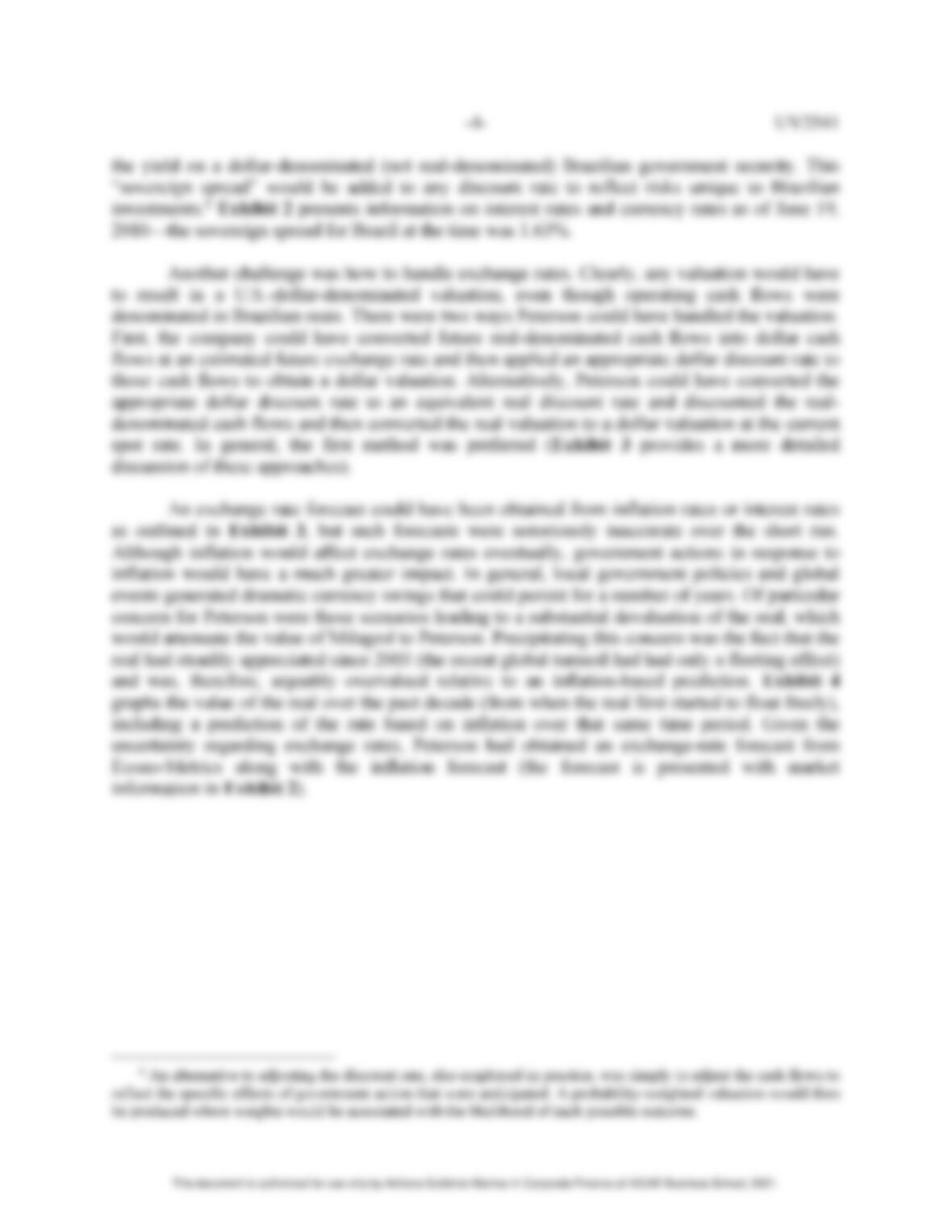
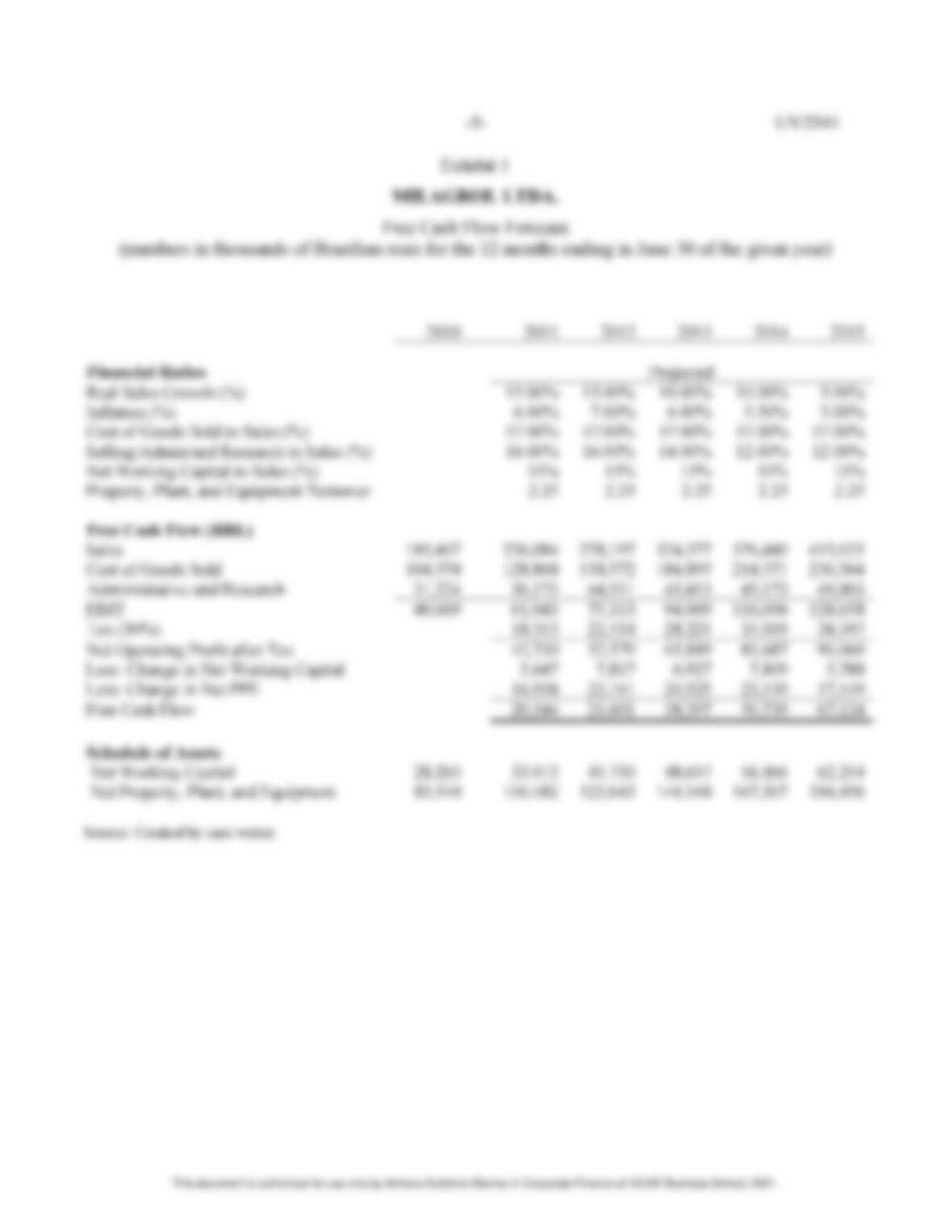
presented in Exhibit 1; all cash flows are denominated in Brazilian reais.5