Migrants and refugees: Let them in or kick them out?
Migrants are defined as a person who moves from one place to another, especially in
order to find work or better living conditions. It can also be defined as a person who moves
from one place to another, especially in order to find work or better living conditions. It is
difficult to differentiate between forced (fleeing civil turmoil or natural disaster) and voluntary
migration (economic or labour migration) and partly contextual, since the motivators for
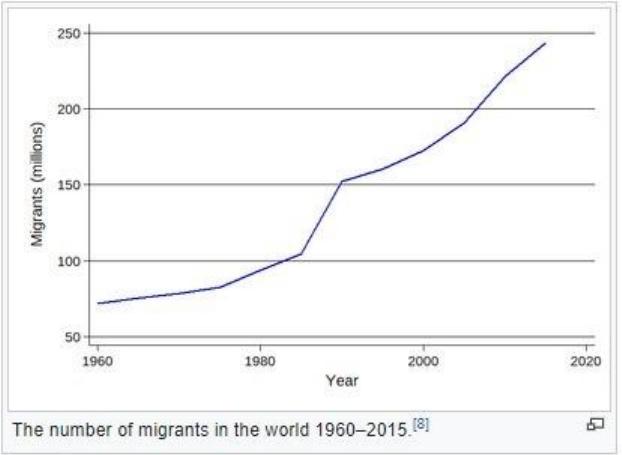
migration are sometimes associated. The World Bank estimated 16.3 million or 7.6 per cent of
migrants qualified as refugees as of 2010. By 2014 this number grew to 19.5 million (including
roughly 7.9 percent of the total number of migrants, based on the figure recorded in 2013). The
proportion of migrants among the world population has stayed relatively stable throughout the
past 5 decades at rates of approximately 3 per cent. Nomadic movements are usually not
regarded because migrations, as the transition is typically transient, there is no aim of staying
in the new area, although in modern times only a few citizens have maintained this type of
lifestyle. In the absence of an intention to live and settle in the places visited, temporary
movement for the purpose of travel, tourism, pilgrimages or the commute is also not considered
as migration. Structurally, migration to the South-South and North-North is significant. 38
percent of all migrants had migrated from developing countries to other developing countries
in 2013, while 23 percent had migrated to other high-income OECD countries. The United
Nations Population Fund says that “while the North has experienced a higher absolute increase
in the migrant stock since 2000 (32 million) compared to the South (25 million), the South
recorded a higher growth rate. Between 2000 and 2013 the average annual rate of change of
the migrant population in developing regions (2.3%) slightly exceeded that of the developed
regions (2.1%).”
The general definition of a refugee is a person who has been forced to leave their
country in order to escape war, persecution, or natural disaster. The first formal concept of
international refugee status emerged from the Commission for Refugees under the League of
Nations in 1921. Following the Second World War, and in response to the large number of
people fleeing Eastern Europe, the 1951 UN Convention on Refugees defined a “refugee” as
any person who “owing to well-founded fear of being persecuted for reasons of race, religion,
nationality, membership of a particular social group or political opinion, is outside the country
of his nationality and is unable or, owing to such fear, is unwilling to avail himself of the
protection of that country; or who, not having a nationality and being outside the country of his
former habitual residence as a result of such events, is unable or, owing to such fear, is
unwilling to return to it.” In 1967, the definition was basically confirmed by the UN Protocol
Relating to the Status of Refugees. The Convention Governing the Specific Aspects of Refugee
Problems in Africa expanded the 1951 definition, which the Organization of African Unity
adopted in 1969 “Every person who, owing to external aggression, occupation, foreign
domination or events seriously disturbing public order in either part or the whole of his country
of origin or nationality, is compelled to leave his place of habitual residence in order to seek
refuge in another place outside his country of origin or nationality.” The 1984 regional, non-
binding Latin-American Cartagena Declaration on Refugees includes “persons who have fled
their country because their lives, safety or freedom have been threatened by generalized
violence, foreign aggression, internal conflicts, massive violation of human rights or other
circumstances which have seriously disturbed public order.” As of 2011, the UNHCR itself, in
addition to the 1951 definition, recognizes persons as refugees “who are outside their country
of nationality or habitual residence and unable to return there owing to serious and
indiscriminate threats to life, physical integrity or freedom resulting from generalized violence
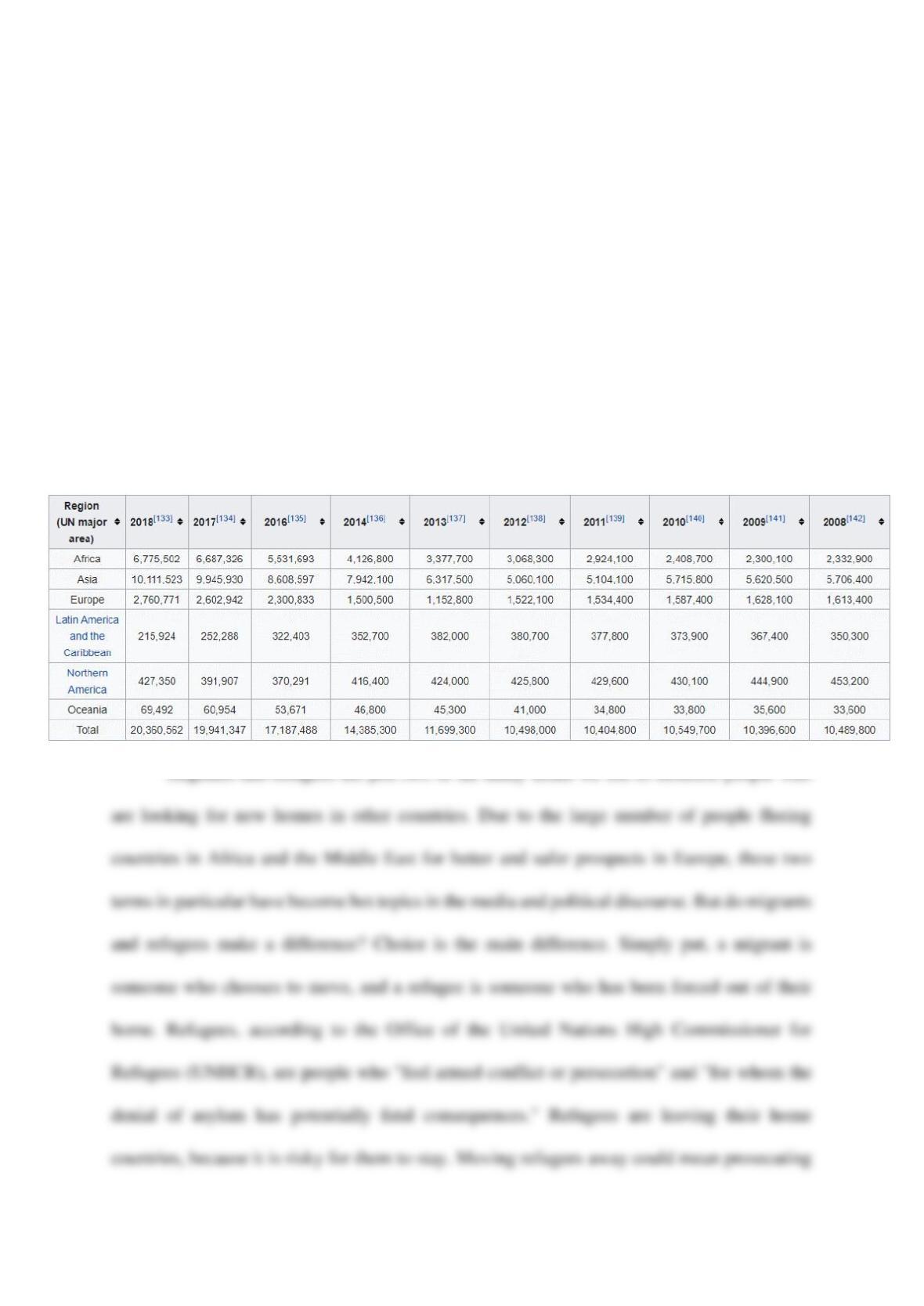
or events seriously disturbing public order.” The table below extracted from Wikipedia shows
the number of refugees and people in refugee-like situations by region between 2008 and 2018.