ECON 200. Introduction to Microeconomics Homework 5 Part I
Name:________________________________________
[Multiple Choice]
1. Diminishing marginal product explains why, as a firm’s output increases, (d)
a. the production function and total-cost curve both get steeper.
b. the production function and total-cost curve both get flatter
c. the production function gets steeper, while the total-cost curve gets flatter.
d. the production function gets flatter, while the total-cost curve gets steeper.
2. A firm is producing 1,000 units at a total cost of $5,000. If it were to increase production to 1,001
units, its total cost would rise to $5,008. What does this information tell you about the firm? (d)
a. Marginal cost is $5, and average variable cost is $8.
b. Marginal cost is $8, and average variable cost is $5.
c. Marginal cost is $5, and average total cost is $8.
d. Marginal cost is $8, and average total cost is $5.
3. A firm is producing 20 units with an average total cost of $25 and marginal cost of $15. If it were to
increase production to 21 units, which of the following must occur? (c)
a. Marginal cost would decrease.
b. Marginal cost would increase.
c. Average total cost would decrease.
d. Average total cost would increase
4. The government imposes a $1,000 per year license fee on all pizza restaurants. Which cost curves
shift as a result? (b)
a. average total cost and marginal cost
b. average total cost and average fixed cost
c. average variable cost and marginal cost
d. average variable cost and average fixed cost
5. If a higher level of production allows workers to specialize in particular tasks, a firm will likely exhibit
________ of scale and ________ average total cost. (a)
a. economies, falling
b. economies, rising
c. diseconomies, falling
d. diseconomies, rising
6. A perfectly competitive firm (c)
a. chooses its price to maximize profits.
b. sets its price to undercut other firms selling similar products.
c. takes its price as given by market conditions.
d. picks the price that yields the largest market share.
7. A competitive firm maximizes profit by choosing the quantity at which (b)
a. average total cost is at its minimum.
b. marginal cost equals the price.
c. average total cost equals the price.
d. marginal cost equals average total cost.
8. If profit-maximizing, competitive firm is producing a quantity at which marginal cost is between
average variable cost and average total cost, it will (a)
a. keep producing in the short run but exit the market in the long run.
b. shut down in the short run but return to production in the long run.
c. shut down in the short run and exit the market in the long run.
d. keep producing both in the short run and in the long run.
9. In the long-run equilibrium of a competitive market with identical firms, what is the relationship
between price P, marginal cost MC, and average total cost ATC? (d)
a. P > MC and P > ATC.
b. P > MC and P = ATC.
c. P = MC and P > ATC.
d. P = MC and P = ATC.
[Short Answer]
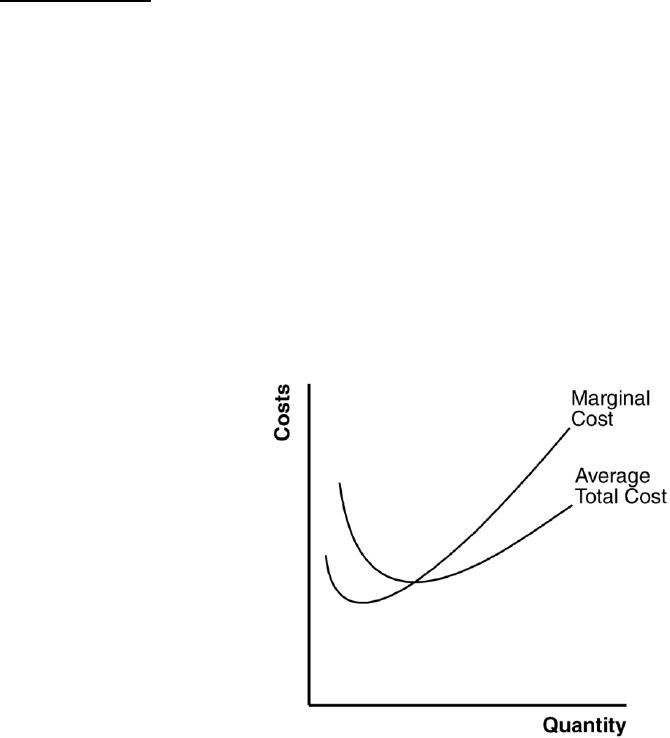
1. Draw the marginal-cost and average-total-cost curves for a typical firm. Explain why the curves have
the shapes that they do and why they cross where they do.
The figure shows the marginal-cost curve and the average-total-cost curve for a typical firm.
There are three main features of these curves: (1) marginal cost is U-shaped but rises sharply as output
increases; (2) average total cost is U-shaped; and (3) whenever marginal cost is less than average total
cost, average total cost is declining; whenever marginal cost is greater than average total cost, average
total cost is rising. Marginal cost is increasing for output greater than a certain quantity because of
diminishing returns. The average-total-cost curve is downward-sloping initially because the firm is able
to spread out fixed costs over additional units. The average-total-cost curve is increasing beyond some
output level because as quantity increases, the demand for important variable inputs increases;
therefore, the cost of these inputs increases. The marginal-cost and average-total-cost curves intersect
at the minimum of average total cost; that quantity is the efficient scale.
2. Define economies of scale and explain why they might arise. Define diseconomies of scale and explain
why they might arise.
Economies of scale exist when long-run average total cost decreases as the quantity of output
increases, which occurs because of specialization among workers. Diseconomies of scale exist when
long-run average total cost rises as the quantity of output increases, which occurs because of the
coordination problems inherent in a large organization
3. There are many types of costs: opportunity cost, total cost, fixed cost, variable cost, average total cost,
and marginal cost. Fill in the type of cost that best completes each sentence:
a. What you give up for taking some action is called the ______. opportunity cost
b. _____ is falling when marginal cost is below it and rising when marginal cost is above it.
average total cost
c. A cost that does not depend on the quantity produced is a(n) ______. fixed cost
d. In the ice-cream industry in the short run, ______ includes the cost of cream and sugar but not the
cost of the factory. variable cost
e. Profits equal total revenue minus ______. total cost
f. The cost of producing an extra unit of output is the ______. marginal cost
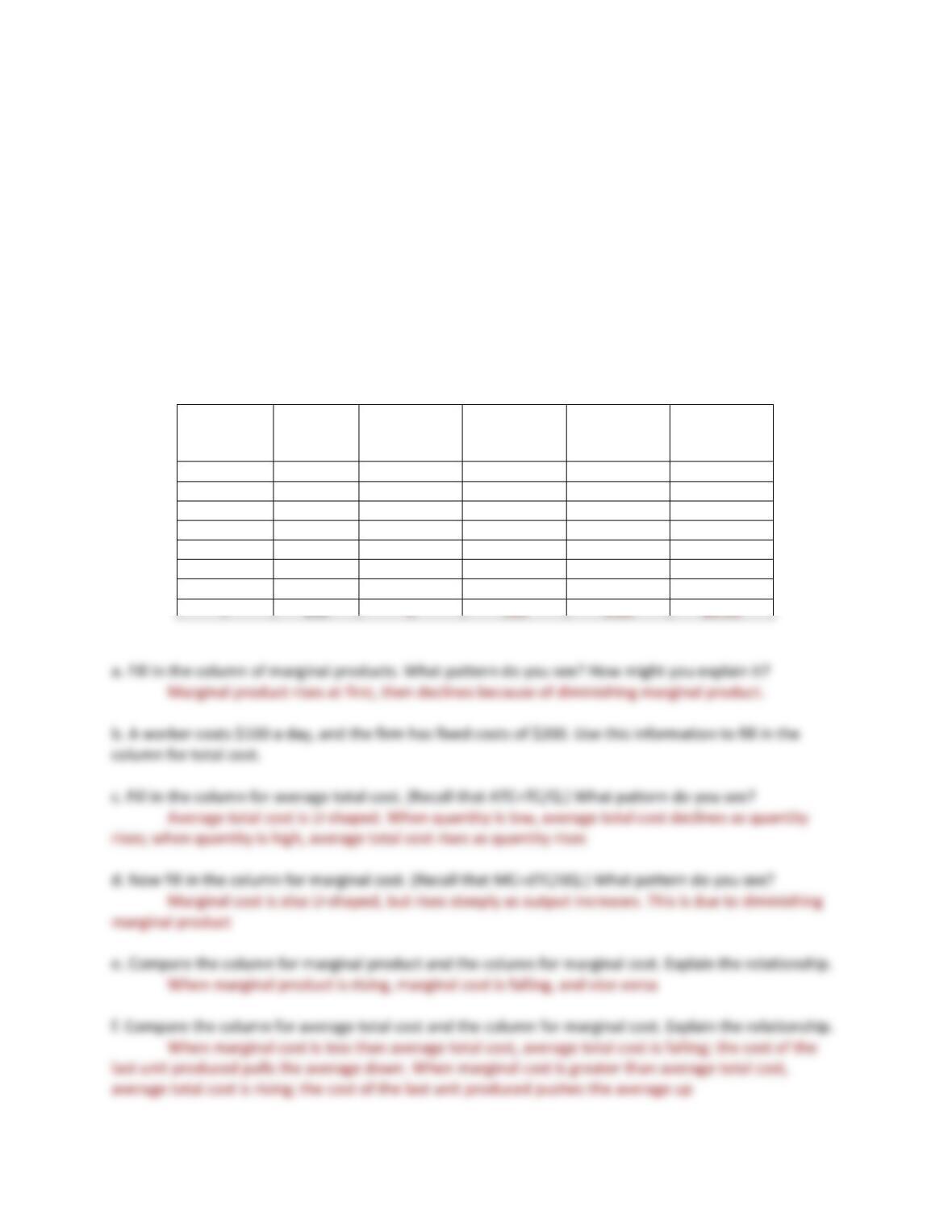
4. Nimbus, Inc., makes brooms and then sells them door-to-door. Here is the relationship between the
number of workers and Nimbus’s output in a given day:
Workers
Output
Marginal
Product
Total
cost
Average
Total
cost
Marginal
cost
0
0
$200
1
20
20
300
$15.00
$5.00
2
50
30
400
8.00
3.33
3
90
40
500
5.56
2.50
4
120
30
600
5.00
3.33
5
140
20
700
5.00
5.00
6
150
10
800
5.33
10.00
7
155
900
5.81
20.00