Page ! of !1 13
MGSC 346: Productions and Operations Management
Professor Shukla
Monday Lecture, 1/6
Course Objectives:
1. Firms
2. Managers
3. Individually
Production, why it is important is study:
1. Geo-location (2nd largest manufacturing region in the US)
LB, LA, SA, IE
2. Service – CPA, Finance loan officer
3. Headquarters -> site visits (renew or cancel contracts with suppliers)
Marketing:
– easy job when defined as “simply getting a one time sale”
– harder job is to:
– get repeated sales
– customer satisfaction
– create long term partnership and find lifetime value of a customer
What do companies need to do to make customer happy to get repeat sales and customer satisfaction:
– quality
– customer service experience
– R&D Projects (Profit=TR-TC)
– Good value (Quality/Price)
– Speed (good forecasting), Inventory management, Logistics and transportation
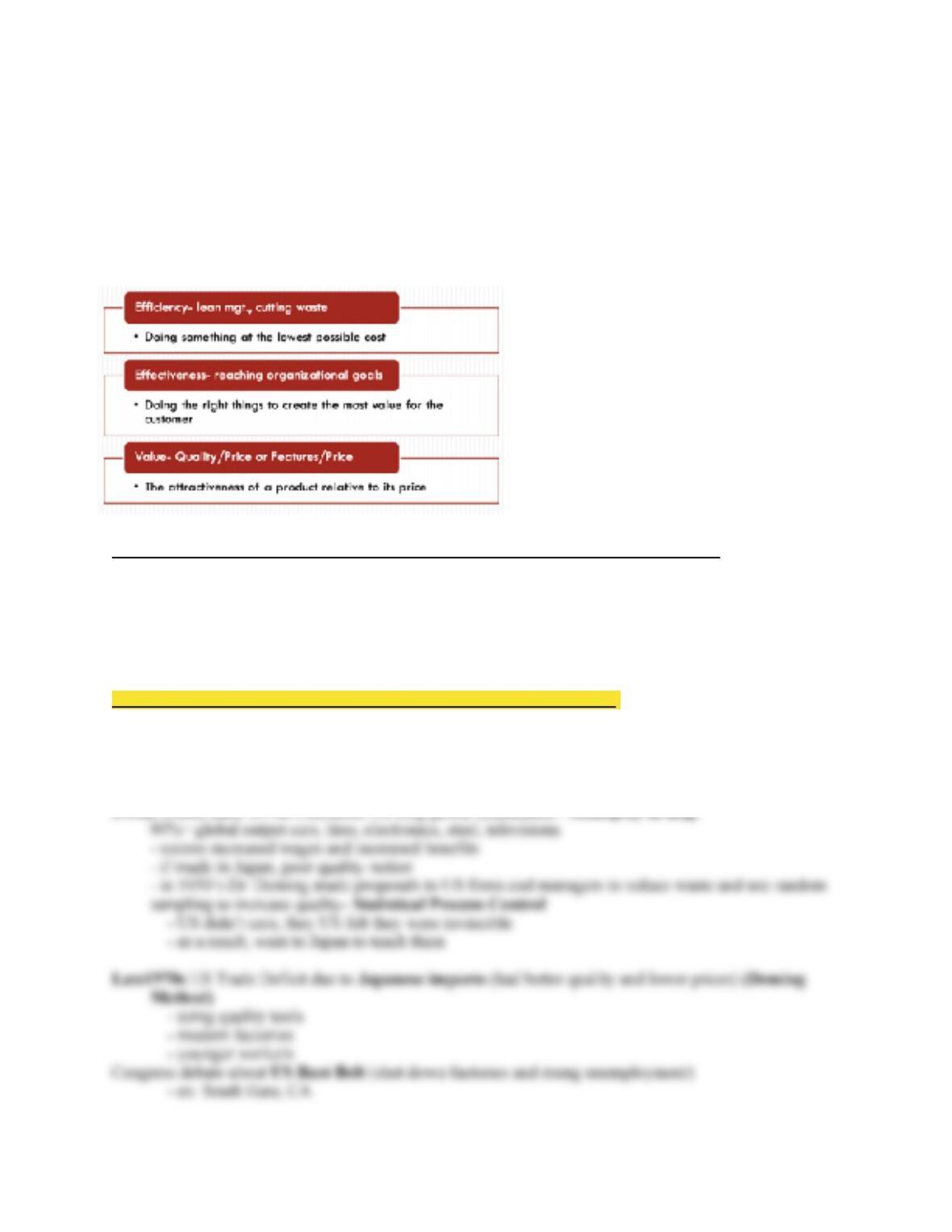
Core concept of course: Efficiency
– reduce wasted time and energy
– reduces cost -> lower cost
Syllabus:
– 1000 total points
– 3 tests (each have 3 chapters)
Chapter Topic Group presentation:
slide 1: citation, main points of article (could be two slides)
slide 2: critique about article (agree vs disagree)
slides 3, 4, 5: research prompts
slide 6: video about topic (interesting and informative)
Research prompts: do research on internet based on topic
Finding an article:
– Avoid articles by Ph.D research papers
– WSJ, HBJ, Fortune, etc
– send professor 3 links of options for approval and video option

Page ! of !2 13
Operations Audit Presentation:
1. Background
2. Description in Operations 10 Key Areas
3. Assessment
4. Recommendations
Overview Lecture: Efficiency and Effectiveness – Chapter 1
Business/Managers:
– Every business must be effective
– Definition is GOAL ATTAINMENT
– goals of a business are profit maximization, shareholder wealth
– short run, lose money to get profiles, members, subscribers
– increases in market share, total revenues, customer retention, stock price
– Efficient
– Definition is OUTPUTS/INPUTS =
# of units produced/(labor+equip costs+material costs+utility costs)
Service: # of transactions
– Another term is productivity
Tuesday Lecture, 1/7
Lecture 1, Chapter 1 – Operations and Supply Chain Management
Main slides: 3,4, 14
Define: What is Operations Management?
•Look at
•manufacturing firms (production)
•service firms (operations
•How to take inputs and transform them to get outputs
•Inputs (just a few examples: labor, capital, IT infrastructure etc.)
Analytics: who is buying from us and who is not, why are they buying and caused by
what factors, who are the competitors and their strengths/weaknesses
Page ! of !3 13
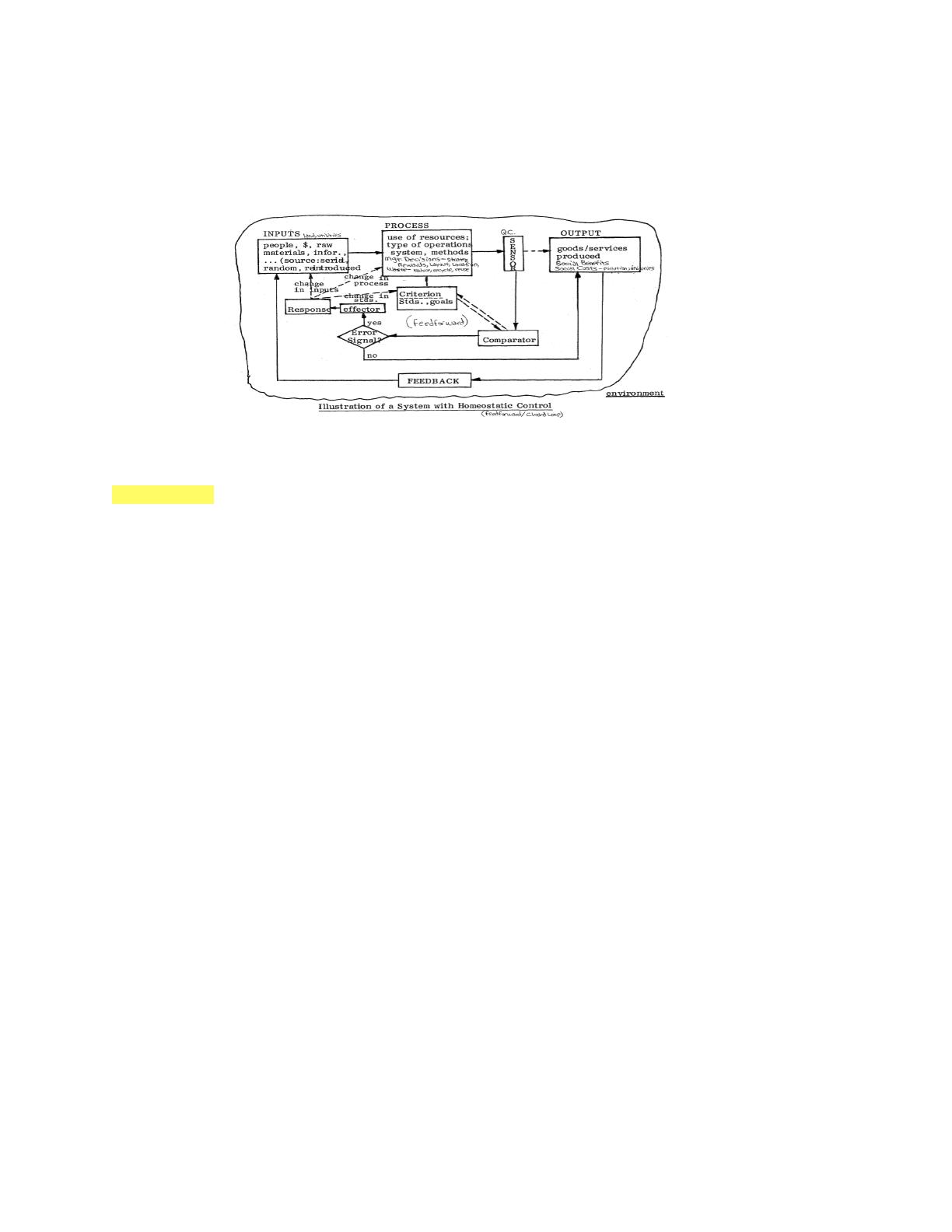
Systems Illustration
•Previously, illustration was an org chart, focus on individual job (no one else)
Test question: If there is an error and major gap, what are your choices and what are sequences
If there is a gap, two choices:
1. Change the process (change the rewards and punishments -> change behavior of
employees and customers
2. Change the inputs (expensive and timely)
3. Lower expectations, change standards (last resort)
What is Supply Chain Management?
•In the 1960’s-70’s, manufacturers had internal company focus
example: Chrysler. People buying more Japanese cars because they have higher quality, lower
prices, more innovative, more fuel efficient
•Made changes in management, training, and equipment
•As a result, increased quality, decreased prices.
•But still didn’t match Japanese cars
•Suppliers were providing poor quality inputs which lead to lower quality.
•They developed “partnerships” with suppliers
•TGM, ISO Cert. 100% quality goals
•Japan had Just In Time Inventory (lowers inventory)
•After changes and being on par with Japanese, no sales changes!
•After more research, the dealerships were the problem as they felt a high pressure environment
(hard sell)
•Vs Toyota they were just there, didn’t push the sale
•Chrysler changed to fixed price
Page ! of !4 13
BIG IDEA – WORK AS A CHAIN
Chain ()()() – Supply,Manufacturing, Distribution
•Only as strong as weakest link
Consumers today are part of the chain
– if you want something, have to express preferences
Supply chain management is ensuring the ENTIRE chain works together
Another term is productivity (efficiency?)
FOR COMPANY RESEARCH, where is co. in matrix on efficiency vs effectiveness.
Evaluating efficiency:
Benchmarking – a process in which one company studies the processes of another company to identify
best practices
ON TEST: Evolution of Manufacturing and Outsourcing (not in text)
1940s Post WWII- United States domination of manufacturing globally due to war impacts upon
factories, infrastructure, and economies in Europe and Japan