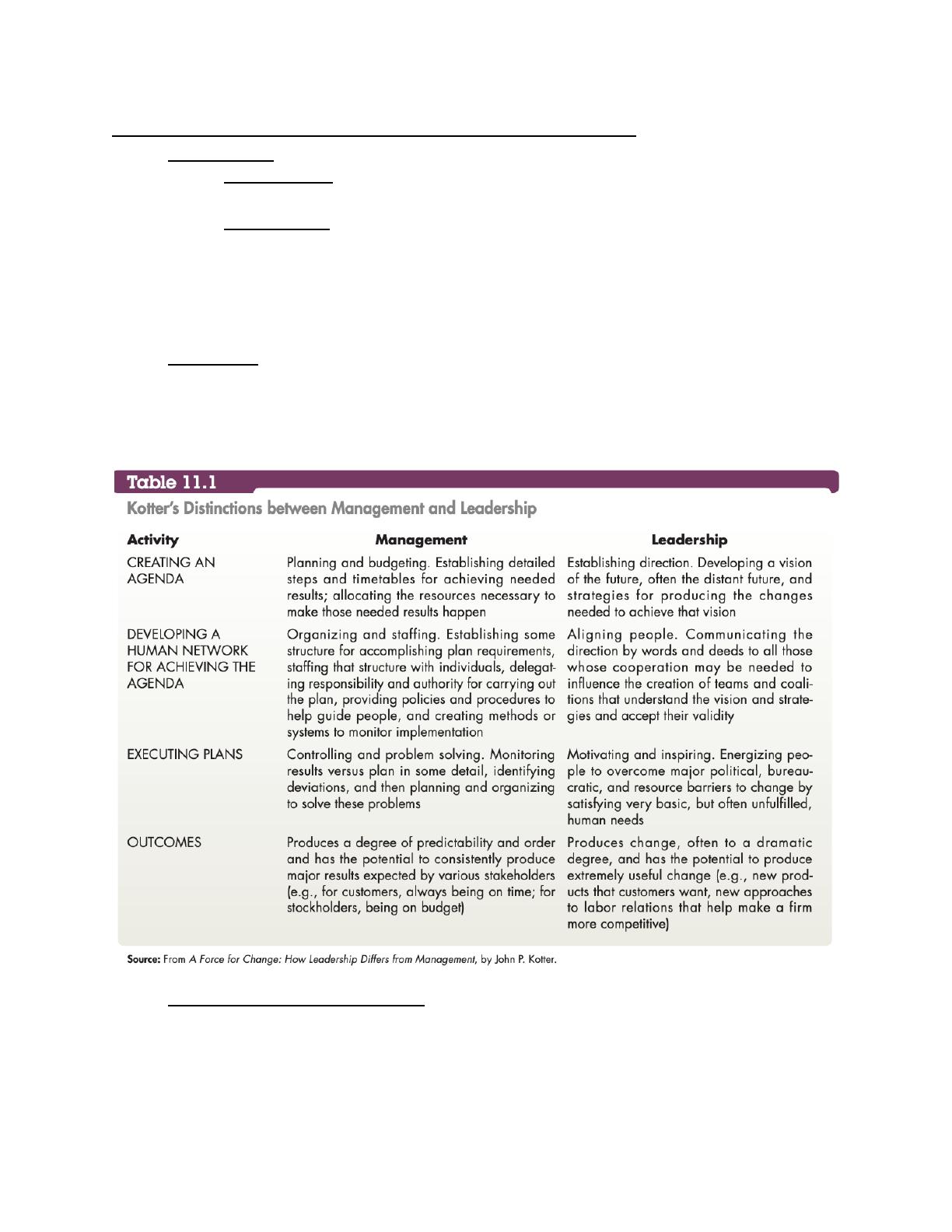
Chapter 11: Traditional Leadership Approaches
● Leadership – in terms of both process and property
○ As a process, leadership is the use of noncoercive influence to direct and
coordinate the activities of group members to meet a goal.
○ As a property, leadership is the set of characteristics attributed to those who are
perceived to use such influence successfully
■ Leadership involves neither force nor coercion. A manager who relies
solely on force and formal authority to direct the behavior of subordinates
is not exercising leadership. Thus, as discussed more fully in the next
section, a manager or supervisor may or may not also be a leader.
● Influence – The ability to affect the perceptions, beliefs, attitudes, motivation, and/or
behaviors of others
● A person can be a manager, a leader, both, or neither.
Management and leadership
●Trait Approaches to Leadership
○ Lincoln, Napoleon, Joan of Arc, Hitler, and Gandhi are names that most of us
know quite well. Early researchers believed that leaders such as these had some
unique set of qualities or traits that distinguished them from their peers.

○ Moreover, these traits were presumed to be relatively stable and enduring.
Following this trait approach, these researchers focused on identifying
leadership traits, developing methods for measuring them, and using the
methods to select leaders
○ The earliest writers believed that important leadership traits included intelligence,
dominance, self-confidence, energy, activity, and task-relevant knowledge
○ The traits approach also had a significant theoretical problem in that it could
neither specify nor prove how presumed leadership traits are connected to
leadership per se
○ For example, some researchers have sought to reintroduce a limited set of
traits into the leadership literature. These traits include emotional intelligence,
drive, motivation, honesty and integrity, self-confidence, cognitive ability,
knowledge of the business, and charisma (which is discussed in Chapter 12
●The behavioral approach to the study of leadership included the Michigan studies, the
Ohio State studies, and the Leadership Grid.
○ Tried to identify behaviors that differentiated effective leaders from nonleaders
●The Michigan leadership studies were a program of research conducted at the
University of Michigan.12 The goal of this work was to determine the pattern of
leadership behaviors that results in effective group performance. Two basic forms of
leader behavior were identified—job-centered and employee-centered
○ The leader who exhibits job-centered leader behavior pays close attention to
the work of subordinates, explains work procedures, and is mainly interested in
performance. The leader’s primary concern is efficient completion of the task.
○ The leader who engages in employee-centered leader behavior attempts to
build effective work groups with high-performance goals. The leader’s main
concern is with high performance, but that is to be achieved by paying attention
to the human aspects of the group.
■ These two styles of leader behavior were presumed to be at opposite
ends of a single dimension.
■ Thus, the Michigan researchers suggested that any given leader could
exhibit either job-centered or employee-centered leader behavior, but not
both at the same time.
■ Moreover, they suggested that employee-centered leader behavior was
more likely to result in effective group performance than was job-centered
leader behavior
● The Ohio State leadership studies were conducted at about the same time as the
Michigan studies, in the late 1940s and early 1950s. The Ohio State studies identified
several forms of leader behavior but tended to focus on the two most common ones:
consideration and initiating structure.
○ When engaging in consideration behavior, the leader is concerned with the
subordinates’ feelings and respects subordinates’ ideas. The leader–subordinate
relationship is characterized by mutual trust, respect, and two-way
communication.

○ When using initiating-structure behavior, on the other hand, the leader clearly
defines the leader–subordinate roles so that subordinates know what is expected
of them. The leader also establishes channels of communication and determines
the methods for accomplishing the group’s tasks.
■ Unlike the employee-centered and job-centered leader behaviors,
consideration and initiating structure were not thought to be on the same
continuum. Instead, as shown in the bottom portion of Figure 11.1, they
were seen as independent dimensions of the leader’s behavioral
repertoire. As a result, a leader could exhibit high initiating-structure
behavior and low consideration or low initiating-structure behavior and
high consideration.
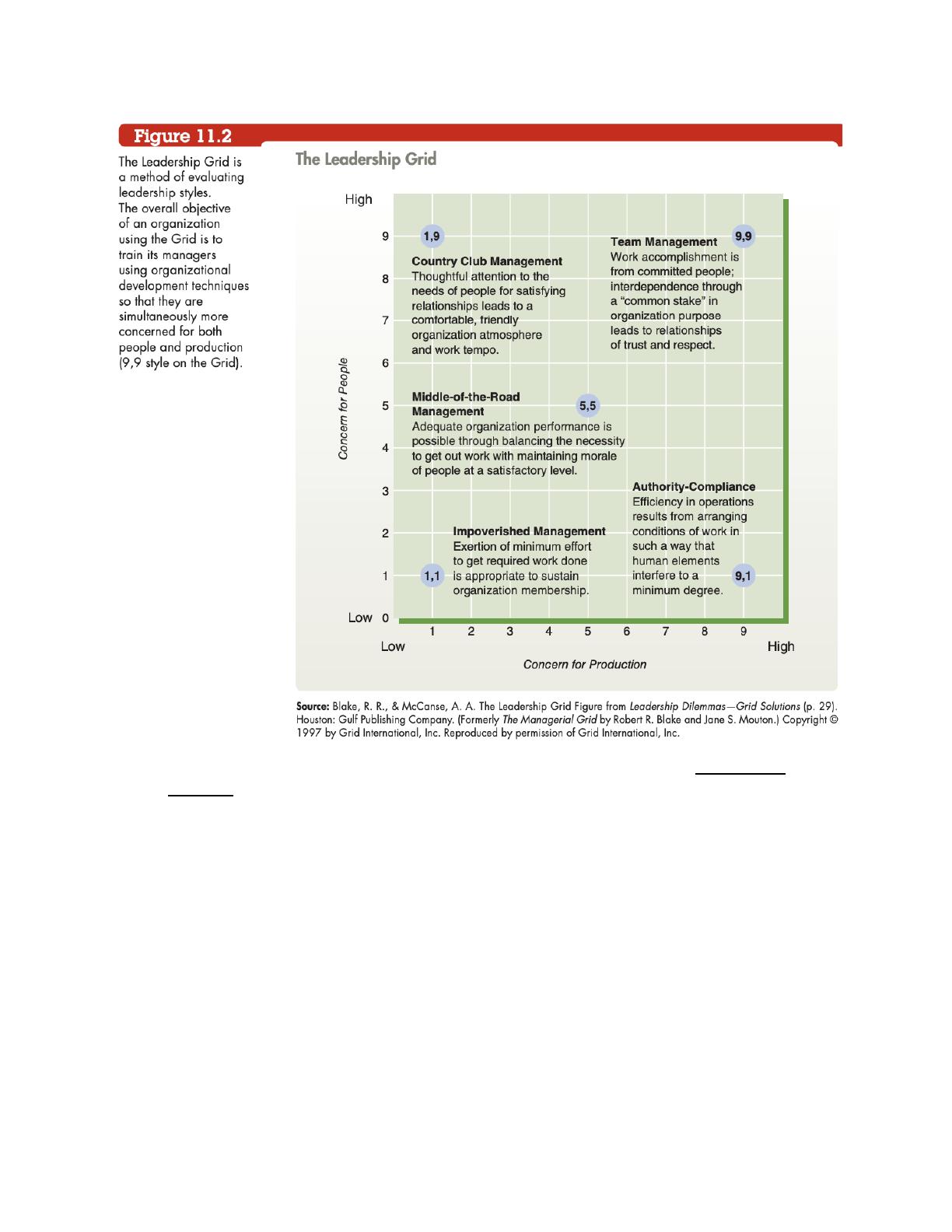
●Leadership grid is a means for evaluating leadership styles and then training managers
to move toward an ideal style of behavior. The most current version of the Leadership
Grid is shown in Figure 11.2.
○ The horizontal axis represents concern for production (similar to job-centered and
initiating-structure behaviors), and the vertical axis represents concern for people
(similar to employee-centered and consideration behavior).
○Note the five extremes of leadership behavior:
■ the 1,1 manager (impoverished management), who exhibits minimal
concern for both production and people;
■ the 9,1 manager (authority-compliance), who is highly concerned about
production but exhibits little concern for people;
■ the 1,9 manager (country club management), who has the exact opposite
concerns from the 9,1 manager;
■ the 5,5 manager (middle of the road management), who maintains
adequate concern for both people and production;
■ the 9,9 manager (team management), who exhibits maximum concern for
both people and production. According to this approach, the ideal style of
leadership is 9,9.
● The next step in the evolution of leadership theory was the creation of situational
models. Situational models assume that appropriate leader behavior varies from one
situation to another. The goal of a situational theory, then, is to identify key situational
factors and to specify how they interact to determine appropriate leader behavior.
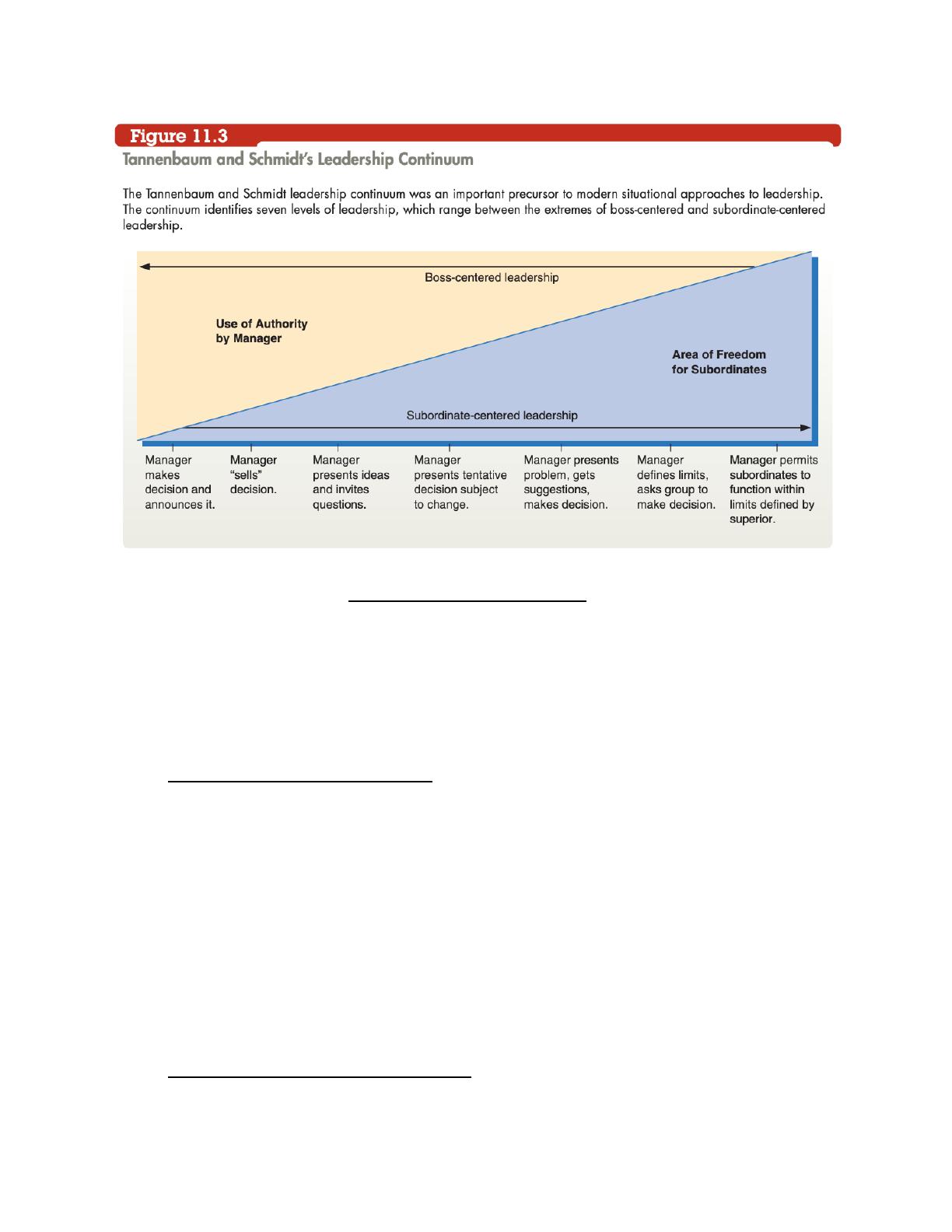
○ In a seminal article about the decision-making process, Robert Tannenbaum and
Warren H. Schmidt proposed a continuum of leadership behavior. Their model is
much like the original Michigan framework. Besides purely job-centered behavior
(or “boss-centered” behavior, as they termed it) and employee-centered
(“subordinate-centered”) behavior, however, they identified several intermediate
behaviors that a manager might consider. These are shown on the leadership
continuum in Figure 11.3.
■ This continuum of behavior ranges from the one extreme of having the
manager make the decision alone to the other extreme of having the
employees make the decision with minimal guidance from the leader.
Each point on the continuum is influenced by characteristics of the
manager, subordinates, and the situation
Leadership continuum
● Fred Fiedler developed the LPC theory of leadership. The LPC theory attempts to
explain and reconcile both the leader’s personality and the complexities of the situation.
(This theory was originally called the “contingency theory of leadership.”
○ However, because this label has come to have generic connotations, new labels
are being used to avoid confusion. “LPC” stands for “least-preferred coworker,” a
concept we explain later in this section.) The LPC theory contends that a leader’s
effectiveness depends on the situation and, as a result, some leaders may be
effective in one situation or organization but not in another
● Task vs. Relationship Motivation
○ Fiedler devised special terms to describe a leader’s basic personality traits in
relation to leadership: “task motivation” versus “relationship motivation. He also
conceptualized the situational context in terms of its favorableness for the leader,
ranging from highly favorable to highly unfavorable.
○ In some respects, the ideas of task and relationship motivation resemble the
basic concepts identified in the behavioral approaches. Task motivation closely
parallels job-centered and initiating-structure leader behavior, and relationship
motivation is similar to employee-centered and consideration leader behaviors. A
major difference, however, is that Fielder viewed task versus relationship
motivation as being grounded in personality in a way that is basically constant for
any given leader.
● The degree of task or relationship motivation in a given leader is measured by the
least-preferred coworker (LPC) scale. The LPC instructions ask respondents (i.e.,
leaders) to think of all the persons with whom they have worked and to then select their
least-preferred coworker. Respondents then describe this coworker by marking a series
of sixteen scales anchored at each end by a positive or negative quality or attribute
○ Fiedler assumed that the descriptions in the LPC scale actually say more about
the leader than about the least-preferred coworker. He believed, for example, that
everyone’s least-preferred coworker is likely to be equally “unpleasant” and that
differences in descriptions actually reflect differences in personality traits among
the leaders responding to the LPC scale. Fiedler contended that high-LPC
leaders are basically more concerned with interpersonal relations, whereas
low-LPC leaders are more concerned with task-relevant problems
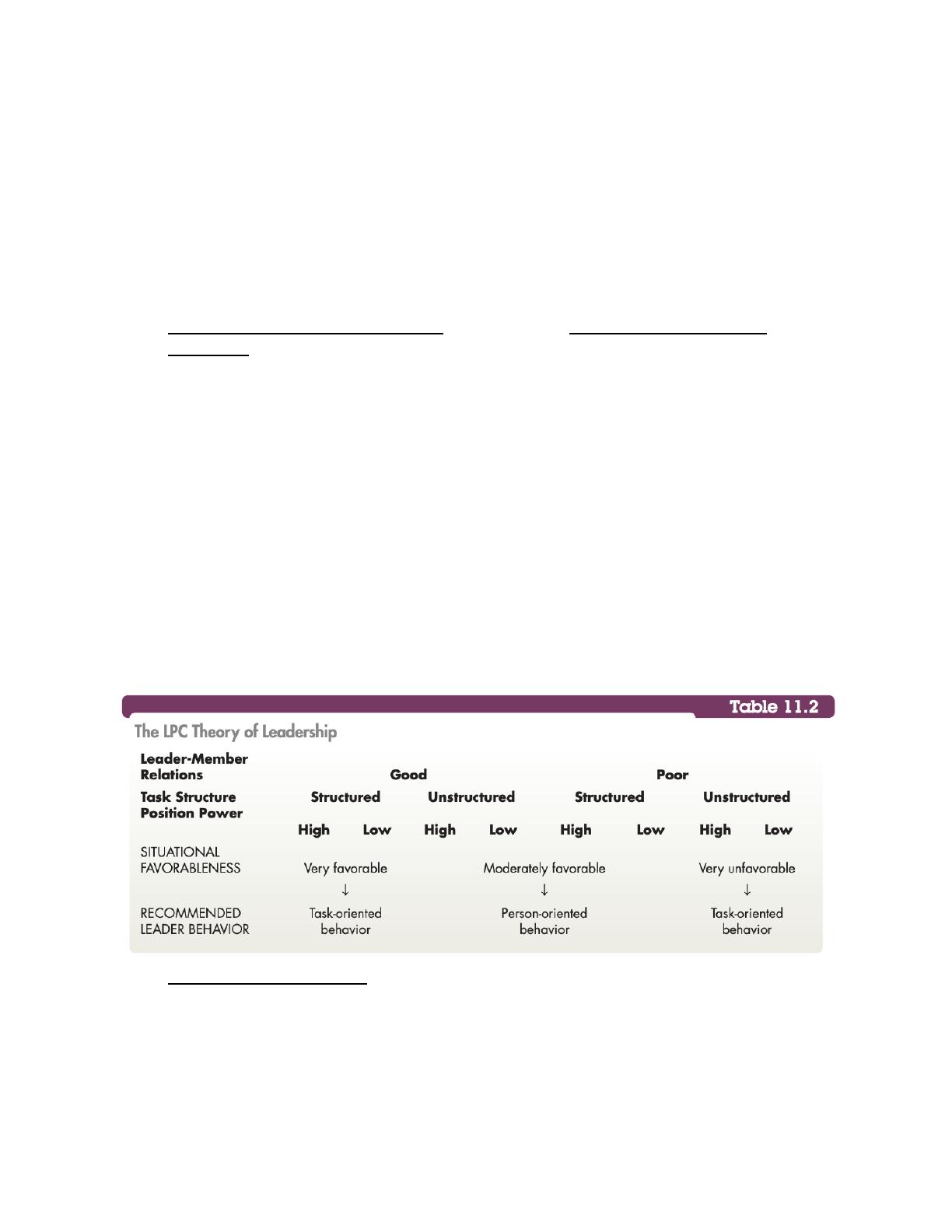
●Fiedler also identified three factors that determine the favorableness of the
situation. In order of importance (from most to least important), these factors are
leader–member relations, task structure, and leader position power.
○Leader–member relations refer to the personal relationship that exists between
subordinates and their leader. It is based on the extent to which subordinates
trust, respect, and have confidence in their leader, and vice versa
○Task structure is the second most important determinant of situational
favorableness. A structured task is routine, simple, easily understood, and
unambiguous. The LPC theory presumes that structured tasks are more
favorable because the leader need not be closely involved in defining activities
and can devote time to other matters. On the other hand, an unstructured task is
one that is nonroutine, ambiguous, and complex
○ Finally, leader position power is the power inherent in the leader’s role itself. If
the leader has considerable power to assign work, reward and punish
employees, and recommend them for promotion, position power is high and
favorable.
● Leader-Situation Match –
○What happens if a person-oriented leader faces a very favorable or very
unfavorable situation, or if a task-oriented leader faces a situation of intermediate
favorableness? Fiedler considers these leader–situation combinations to be
“mismatches.” Recall that a basic premise of his theory is that leadership
behavior is a personality trait. Thus, the mismatched leader cannot readily adapt
to the situation and achieve effectiveness. Fiedler contends that when a leader’s
style and the situation do not match, the only available course of action is to
change the situation through “job engineering.”
○ For example, Fiedler suggests that if a person-oriented leader ends up in a
situation that is very unfavorable, the manager should attempt to improve matters
by spending more time with subordinates to improve leader–member relations
and by laying down rules and procedures to provide more task structure.
● The Path-Goal Theory of Leadership –
○ The path–goal theory of leadership has its roots in the expectancy theory of
motivation discussed in Chapter 5. Suggests that effective leaders clarify the
paths (behaviors) that will lead to desired rewards (goals).
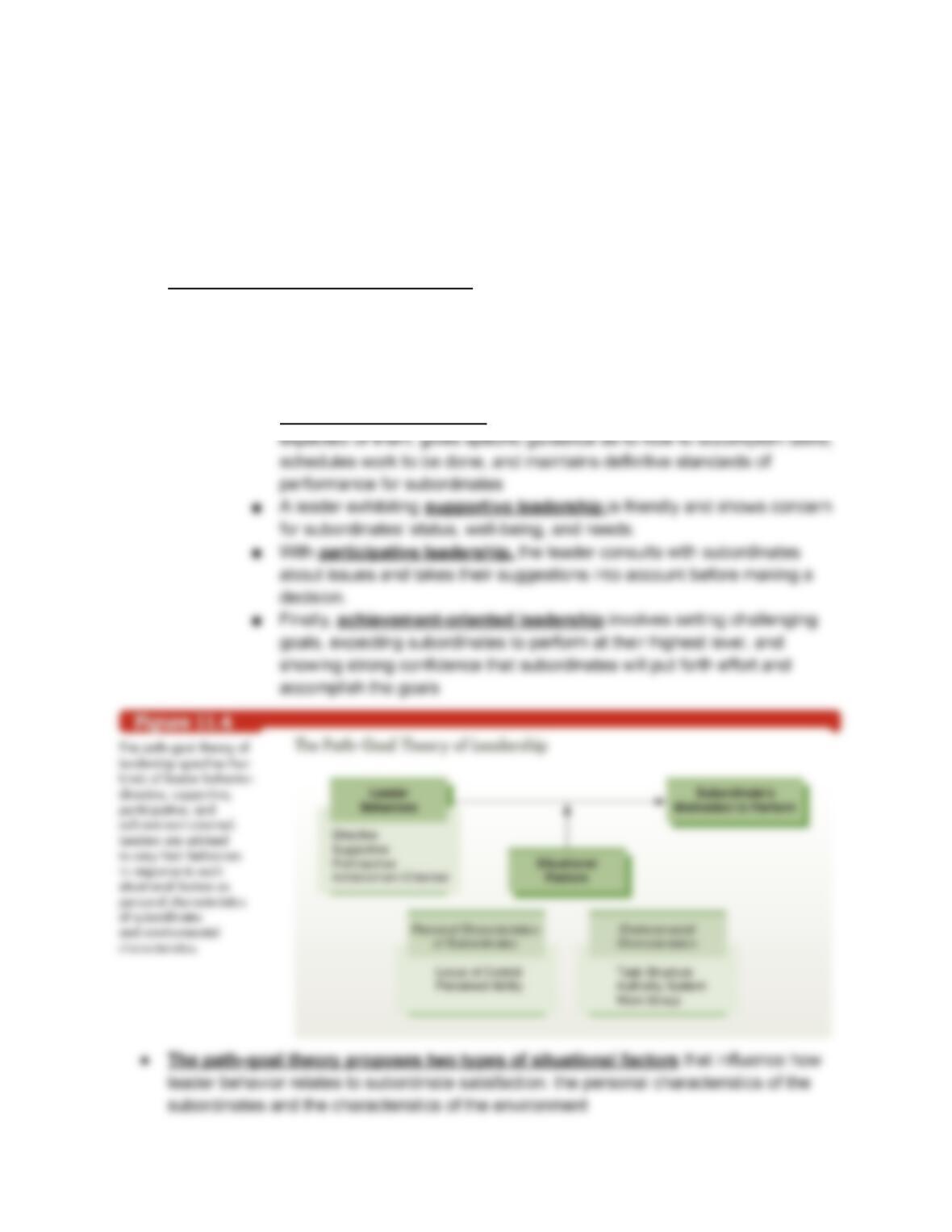
○ As Figure 11.4 shows, path–goal theory identifies four kinds of leader behavior:
directive, supportive, participative, and achievement-oriented.
■With directive leadership, the leader lets subordinates know what is