Zaneta Rupang
Merchandise Strategies
Macy’s Case Study
Wednesday, June 11
In today’s ever-emerging world of fashion, numerous new retailers are perpetually
introduced to customers. What di”erentiate these retailers and make them stand out
from the others would be when they have a distinctive strategy or points that they
excel in, where their competitors don’t do as well as they do. The purpose of this paper
is to suggest ways in which Macy’s would succeed in, by adding a make-up line
extension to one of their private labels.
Company History
Macy’s (Macy’s, Inc.) was first founded in 1858 on the corner of 14th Street and 6th
Avenue in New York City. What first started as a small fancy dry goods store has now
expanded into one of the largest retailer in the United States with more than 425
stores located across the States. Back on the very first day, Macy’s obtained $11.06 in
sales, however, by the end of the first full year, Macy’s managed to obtain
approximately $85,000 in gross sale. Furthermore, as a milestone of their
achievement, according to a study that was done in 2011, Macy’s was voted to have to
most brand awareness among other department store retailers in the US, and even
when compared to di”erent businesses, Macy’s only placed second to McDonalds
(Business Wire, “The Star Attraction), and in the following year, Macy’s was ranked as
‘most-valuable’ brand in 2011 according to the Interbrand Design Forums, the reason
behind the success says, “it does a great job branding every customer touchpoint; its
mobile presence aligns with the full website. the retailer continues to drive its initiative
to tailor local assortments and shopping experiences,” (Cincinatti Business Courier,
“‘Most-Valuable Brand’”).
The story behind Macy’s red logo is one to be told. Owner Rowland Hussey Macy’s
adapted the red star to be the logo of the retailer to symbolize success. The star was
actually a tattoo that he had since he was a teenager, to reminisce the old days when
he was working as a seaman. Another interesting story
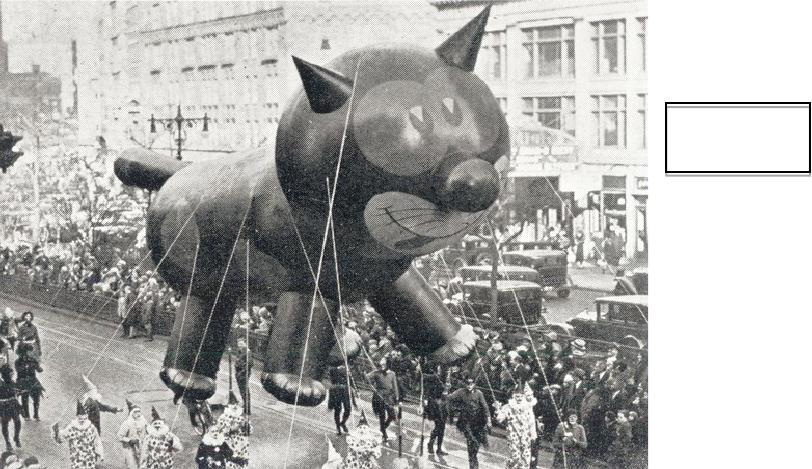
about Macy’s is their Thanksgiving Day Parade. It started in 1924 and is still ongoing
until today. The very first giant balloon that they had was Felix the cat (Figure 1).
Because of these humongous ballons,
Figure 1: Felix
the Cat in 1927
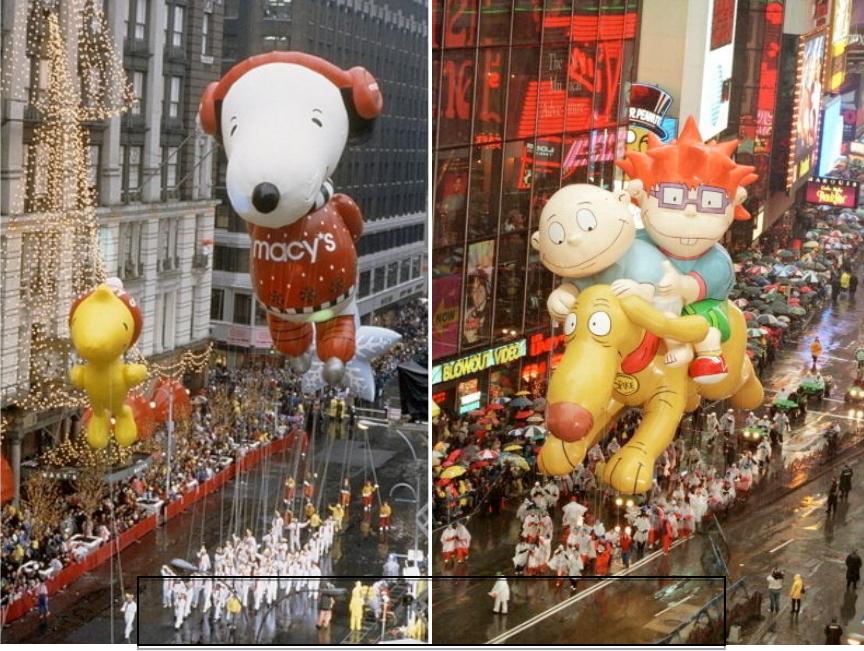
Macy’s is the second largest consumer of helium after the U.S. government (Figure 2).
The parade got so popular that it was televised for the first time locally in 1946 and
nationally in 1947. Today, approximately 3.5 million New Yorkers watch the parade live
from the streets and as much as 50 million Americans tune in for the live broadcast.
As a retailer, Macy’s have a few private brands that they have established over the
years. These private brands range from Alfani, Charter Club, INC, Hotel Collecrion,
Figure 2: Snoopy & Woodstock helium balloons in 2001 & Rugrats helium
ballons in 2011

American Rag, Green Dog, Style & Co., and Tools of the Trade, First Impressions, the
newly launched Bar III, and many others. Aside from the private brands, they have had
collaborations with famous figure. In the past, Macy’s has had several collaborations
in which they launched capsule collections with designers as well as celebrities. They
had the famous Italian designer Giambattista Valli for a special collection that was
launched in 2011, as well as Nicole Richie’s limited edition collection and Italian
designer Alberta Ferretti’s collection that was both launched in 2012. Other than these,
the popular collaborations that they had also included heavyweights designers such as
Michael Kors, Rachel Roy and Ralph Lauren. Chief Marketing OFcer of Macy’s Martine
Reardon says “the goal is to continue bringing amazing design talent, great quality and
construction, and a”ordable prices to shoppers who may not otherwise be able to
experiment with fashion rom these covetable brands,” (WWD, “The High and Low Of It:
Designer Collaborations”).
Macy’s current performance as of 2014 according to a market report by Market Watch
has shown an increase. Ranging from in all Sales/Revenue which increased from 23.4
Billion in 2010 to 27.93 Billion in 2014, Cost of Goods Sold (COGS) incl. D&A from
15.18 Billion in 2010 to 17.75 Billion in 2014, as well as Gross Income that increased
from 8.31 Billion in 2010 to 10.19 Billion in 2014. Furthermore, in a report released by
Forbes, Macy’s shared soared to a 7% increase, beating competitors Dillard’s, Sears
and Target in the stock market.
Action Point 1
Customers
The private label that is aimed for a make-up line extension is Charter Club. Overall,
Charter Club’s merchandise is similar to Ralph Lauren’s merchandise. Moreover, inside
the store, they are usually placed near the Ralph Lauren merchandise so that
customers who don’t want to spend as much money to buy Ralph Lauren’s products
would purchase Charter Club’s merchandise. On their website, Macy’s states that it is
their modern line created for the modern women with a take on classic American style.
The products are designed with fresh colors, re*ned details and traditional yet updated
silhouettes. The customers are women between the ages of 30-60, most of them are
Caucasian and married with a family. These are the customers who are more
conservative in the way they dress. The target customers are more towards the older
group because the merchandise that they o”er are more suitable for older group of
customers.
Based on my store visit, I could see that the actual customers vary than their desired
target, most of the customers that I saw inside the store ranged from the younger
customers at their early 20s up to their 60s. However, what I believe should be their
actual target customers are a wider group of customers, ranging from the early
twenties up to their *fties for the makeup extension. A wider range of target customer
could be achieved by making a make-up line extension because make-up is more
universal compared to clothing. In addition to this group of customers, the younger
ones are students, college students and university students. They follow fashion
trends by keeping up with the latest news from their personal gadgets such as
smartphones, tablets and laptops, they are the tech-savvy younger customer group.
Through their social media accounts, they follow news and updates from their favorite
celebrities and to also see what kind of fashion is in style. Other than shopping for
make-up at Macy’s, they also shop for drugstore make-up at Walgreens and Target,
with the occasional visit to Sephora for their favorite products. The older groups of
customers have their own income because they work. They read magazines such as
Cosmopolitan and Elle. Although they are not as tech-savvy as the younger group,
they do know the latest trends and styles by reading out celebrity news once in a
while in their leisure time. However, they do keep their gadgets with them such as
their smartphones, laptops and tablets. For this group, they shop for their make-up at
the make-up department at Bloomingdale’s and Nordstrom as well as Sephora.
Competitors
As for competitors, the competitors would be Topshop’s make-up line, Forever 21’s
make-up line as well as benefit. Topshop and Forever 21 are two examples of retailers
that launched their make-up line extension from their private brands. Topshop
launched their make-up line in 2009 and because Topshop is one of the leaders for the
fast-fashion retailers, Topshop has a divine knowledge of trends, colors and textures
that are in fashion, thus, they managed to gain great market recognition for their
make-up line. Topshop’s make–up line now holds stand-alone position inside their
stores and now they also place their merchandise at big department stores in Europe
such as Selfridges and John Lewis. Back in 2009, customers were hungry for
inspiration, and Topshop did exactly what customers wanted, a new innovation
delivered with current trends. Simultaneously with their make-up launch, they
launched video tutorials for their make-up on YouTube, YouTube make-up tutorials were
considered new back then so it was a smart strategy. As years passed, make-up line
extension is getting more familiar in the retailer business. An article by GCI magazine
says, “Diversifying into color cosmetics is no novel strategy for apparel brands the
category is considered a natural extension to clothing due to its evident association
with
Figure 3:
Topshop’s
Cosmetics
fashion,” (GCI, “Apparel Brands Looking to Branch Into Beauty for Growth”). In
launching their make-up line, Topshop didn’t go into it directly, they looked for a sector
that they knew had the potential to be expanded. In addition, Topshop dedicates a a
signiticant amount of space in their retail stores for their make-up items to showcase
their wide range of cosmetics. The packaging for their cosmetics is interesting, simple
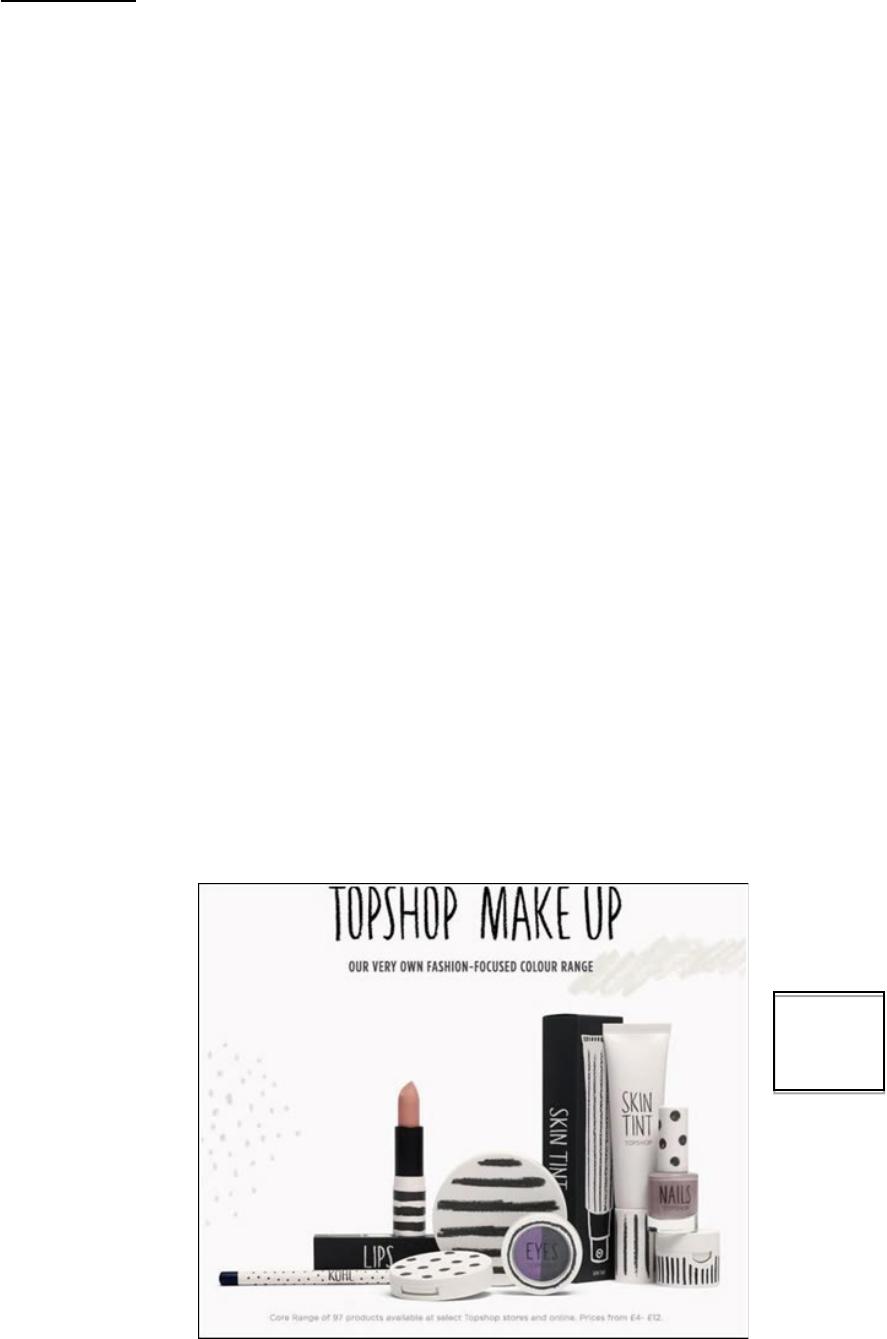
design that catches the eyes (Figure 3). The price of their cosmetic products range
from $4.00 which is the face wipes and up to $52.00 which is the exclusive brush set.
Forever 21 has had their cosmetic line for quite a while, however, earlier this year in
2014 they launched a more exclusive cosmetic line that has a slightly more expensive
price point compared to the one they had before. The previous cosmetics line was
called Love & Beauty, however, now on their store they only o”er the Premium
Collection line. The cosmetics that they have vary from cosmetic products for nails,
eyes, lips, face, skincare, fragrance and bath and accessories and tools. The price of
the cosmetics range the lowest from $6.80 which is their lip gloss, and up to $14.80