MEASURING EMPLOYEE DELIGHT AT VARIOUS MANAGERIAL
LEVELS
by
IRUJ KHALID (13949)
MASHAL IFTIKHAR (14037)
KHAWAJA MUHAMMAD TALHA (13178)
UROOJ IKRAM (13937)
A thesis
submitted in partial fulfillment of the requirements
for the degree of Bachelors of Business Administration
to Iqra University Research Centre (IURC)
at the Iqra University,
main campus, Karachi
Karachi, Pakistan
APRIL, 2013
ABSTRACT
Employee delight at various managerial levels is considered to be important factor for the
success of an organization. This research aim to provide an outline for employee delight
and it clarify the important factors of employee delight and to which extent it will
influence on the whole assessment of employee delight at various managerial levels in an
organization. Our hypothesis showing eight variables i.e. work relationship, recreational
events, technological support, appreciation and acknowledgement, merit-based growth
opportunities, workplace ambiance and their relationship, late-sitting; with employees at
different managerial levels i.e. senior manager, manager, supervisor and staff. The
Method used for compilation data is personal survey and questionnaire. The findings
disclosed that there is no relationship of work relationship, recreational events,
technological support, appreciation and acknowledgement, merit-based growth
opportunities, workplace ambiance and late-sitting with employee delight at various
managerial levels. By analyzing the data it uncovered that there is close correlation
between the job security and employee delight at various managerial levels.
2

TABLE OF CONTENTS
S.NO DESCRIPTON PAGE
NO.
1. ABSTRACT…………………………………………………………… ii
2. LIST OF TABLES…………………………………………………….. iv
3. LIST OF FIGURES……………………………………………………. vi
4. CHAPTER 1: INTRODUCTION………………………………………
1.1Overview……………………………………………………………………………….
1.2 Problem statement…………………………………………………………………..
1.3 Hypotheses…………………………………………………………………………….
1.4 Outline of the Study………………………………………………………………..
1
5. CHAPTER 2: LITERATURE REVIEW……………………………… 5
6. CHAPTER 3: RESEARCH METHODS…………………………………………
3.1 Method of Data Collection………………………………………………………
3.2 Sampling Technique……………………………………….…………………
3.3 Sample size……………………………………………………………………………
3.4 Instrument of Data Collection……………………………………..
3.4.1 Validity and Reliability test……………………………………………
3.5 Research Model developed……………………………………………………..
3.6 Statistical Technique……………………………………………………..
14
7. CHAPTER 4: RESULTS ……………………………………………………
4.1 Findings and Interpretation of the results………………………………….
4.2 Hypotheses Assessment Summary…………………………………………..
17
8. CHAPTER 5: CONCLUSION, DISCUSSIONS,
IMPLICATIONS AND FUTURE RESEARCH………….
5.1 Conclusion……………………………………………………………………………
5.2 Discussions…………………………………………………………………………..
5.3 Implications………………………………………………………………………….
5.4 Future Research…………………………………………………………………….
21
9. References……………………………………………………………. 23
10. Appendix……………………………………………………………… 26
3
LIST OF TABLES
S.NO TABLES Page
Number
1. 2.1 Basic Citation Styles ……………………………………… 13
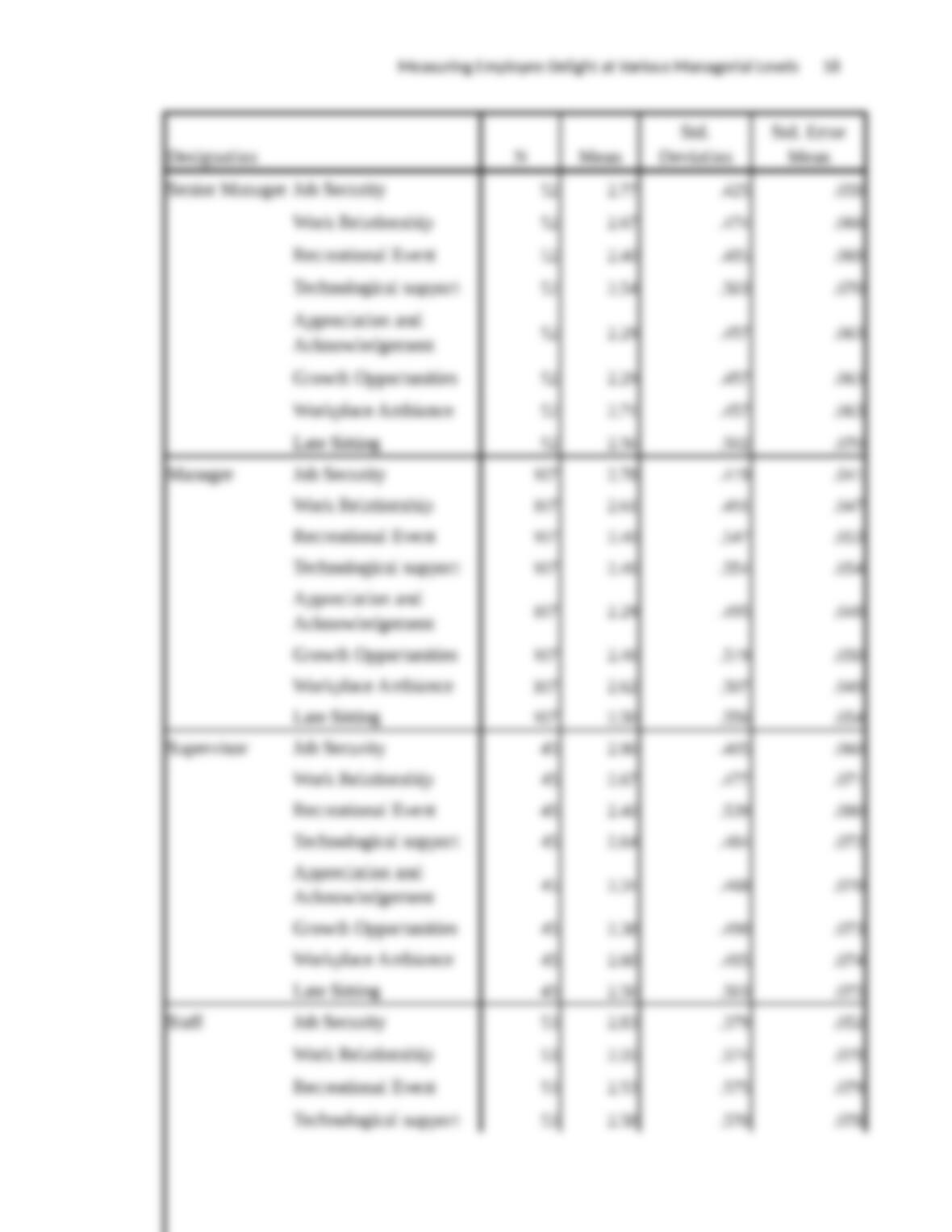
2. 4.1 One Sample Statistics …………………………………….. 17
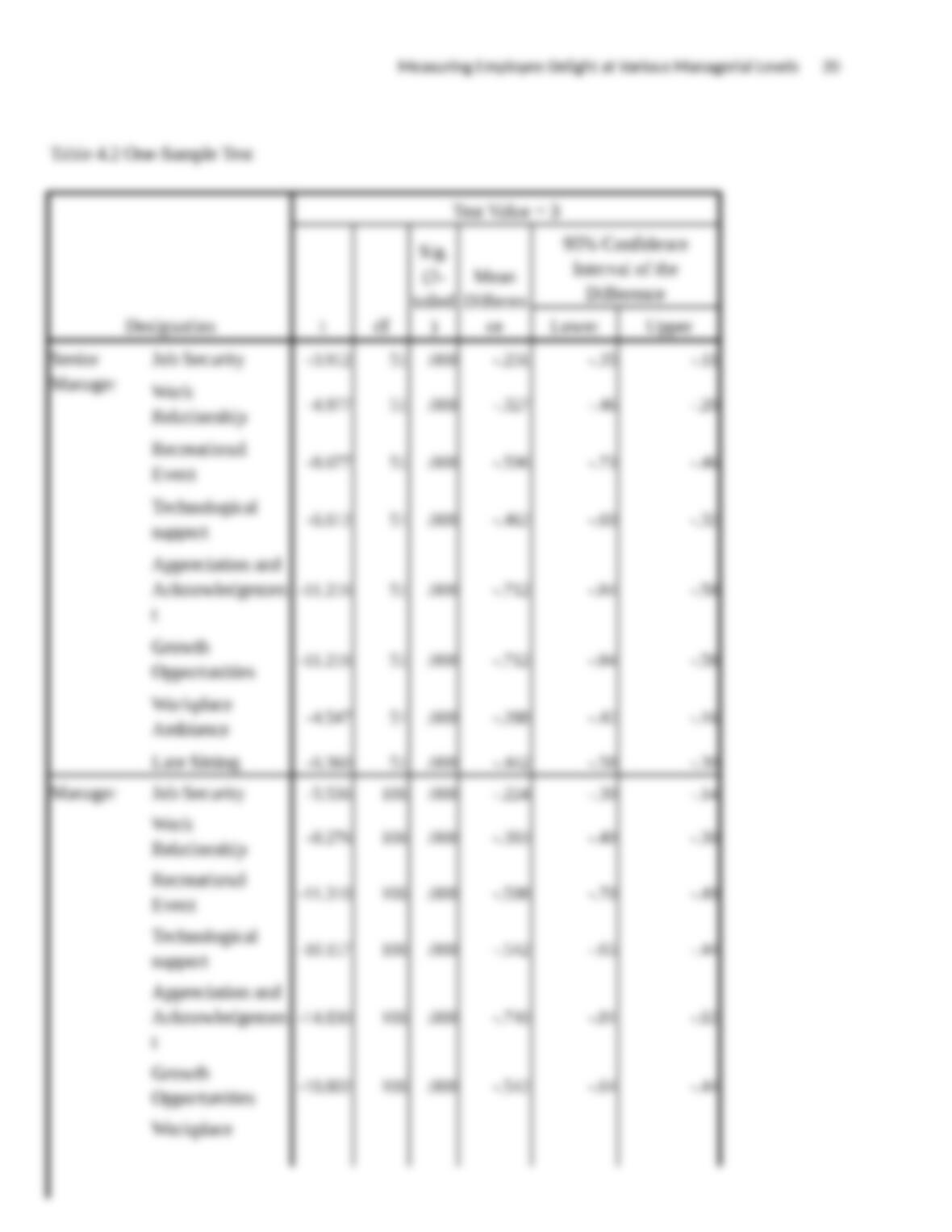
3. 4.2 One Sample Test ………………………………………….. 18
LIST OF FIGURES
S.NO. FIGURES Page
4

Number
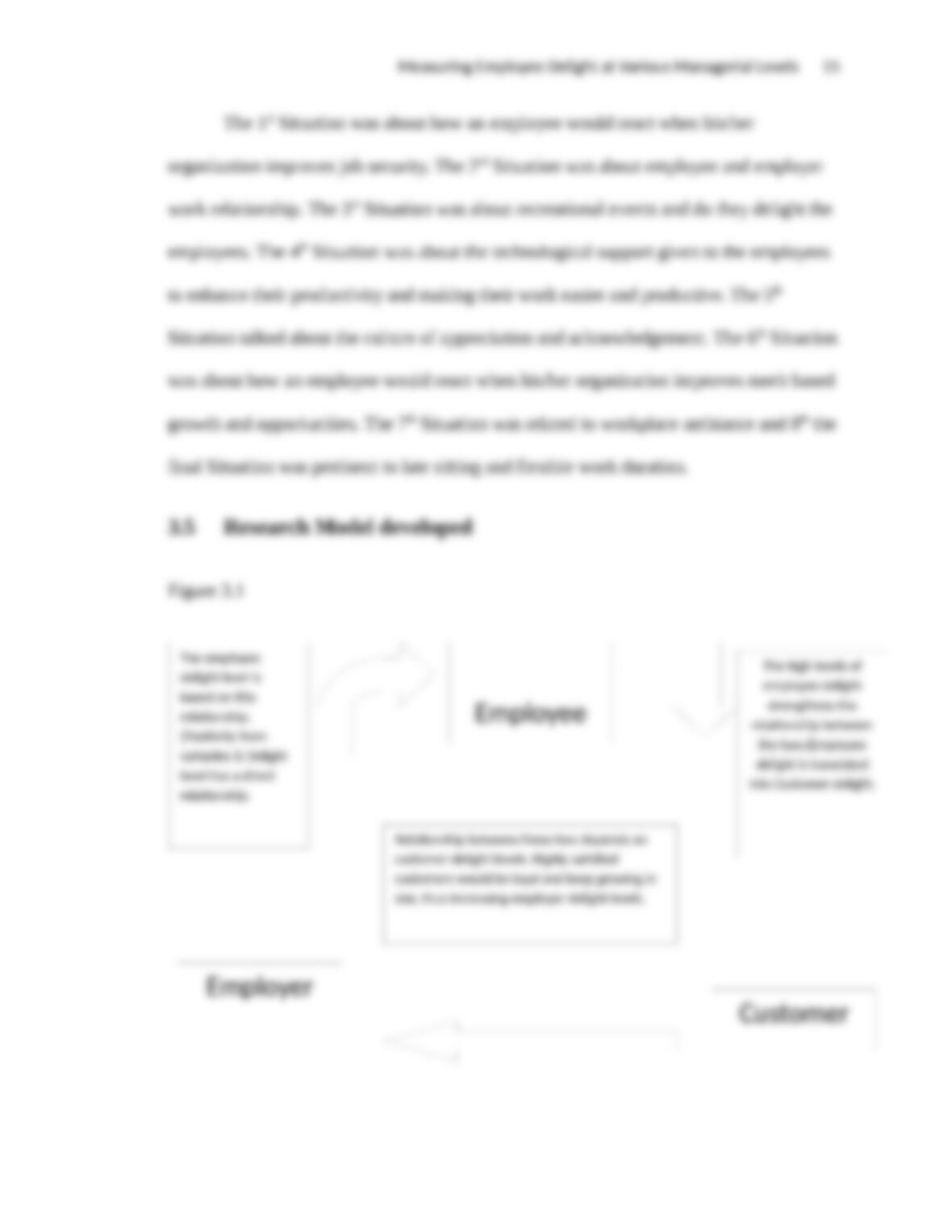
1. 3.1 Research Model Developed……………………………………. 15
5
Measuring Employee Delight at Various Managerial Levels 1
CHAPTER 1: INTRODUCTION
1.1 Overview
As a precedent to Employee Delight, Employee Satisfaction and motivation
towards the employees’ roles in an organization are pivotal to look upon. There have been
innumerable studies done in the past on employees’ satisfaction compared to the quality
of output they deliver and so forth, Scarpello, and Campbell (1983). “Employee Delight”
refers to delivering the WOW factor to the employees, which is then passed on to the
customers as “Customer Delight” translating into profits for the organization, Roger,
Clow, and Kash (1994).
This research shall try to highlight the ways and practices, which HR adopts or should
adopt in order to give their employees the feeling beyond satisfaction merely. It also tries
to identify the best techniques and/or methods by which we can measure whether or not
the employees are delighted; rather, how the management can, engage their employees
with their organization in such a manner that the employees feel delighted working with
that particular organization, Kaye, and Adams (2002). “The way management
appreciates and give recognition to employees portray a powerful image to staff at all
levels about what carries more value for the organization”, Cotton (2008). Defining
‘Employee Delight’ is not an easy task as the word “delight” itself can have varied
implications for different people.
Measuring Employee Delight at Various Managerial Levels 2
1.2 Problem statement
To study the employee delight at various managerial levels.
1.3 Hypotheses
H1: There is a relationship between job security and senior manager delight.
H2: There is a relationship between job security and manger delight.
H3: There is a relationship between job security and supervisor delight.
H4: There is a relationship between job security and staff delight.
H5: There is a relationship between work relationship and senior manager delight.




Late Sitting -6.111 52 .000 -.453 -.60 -.30