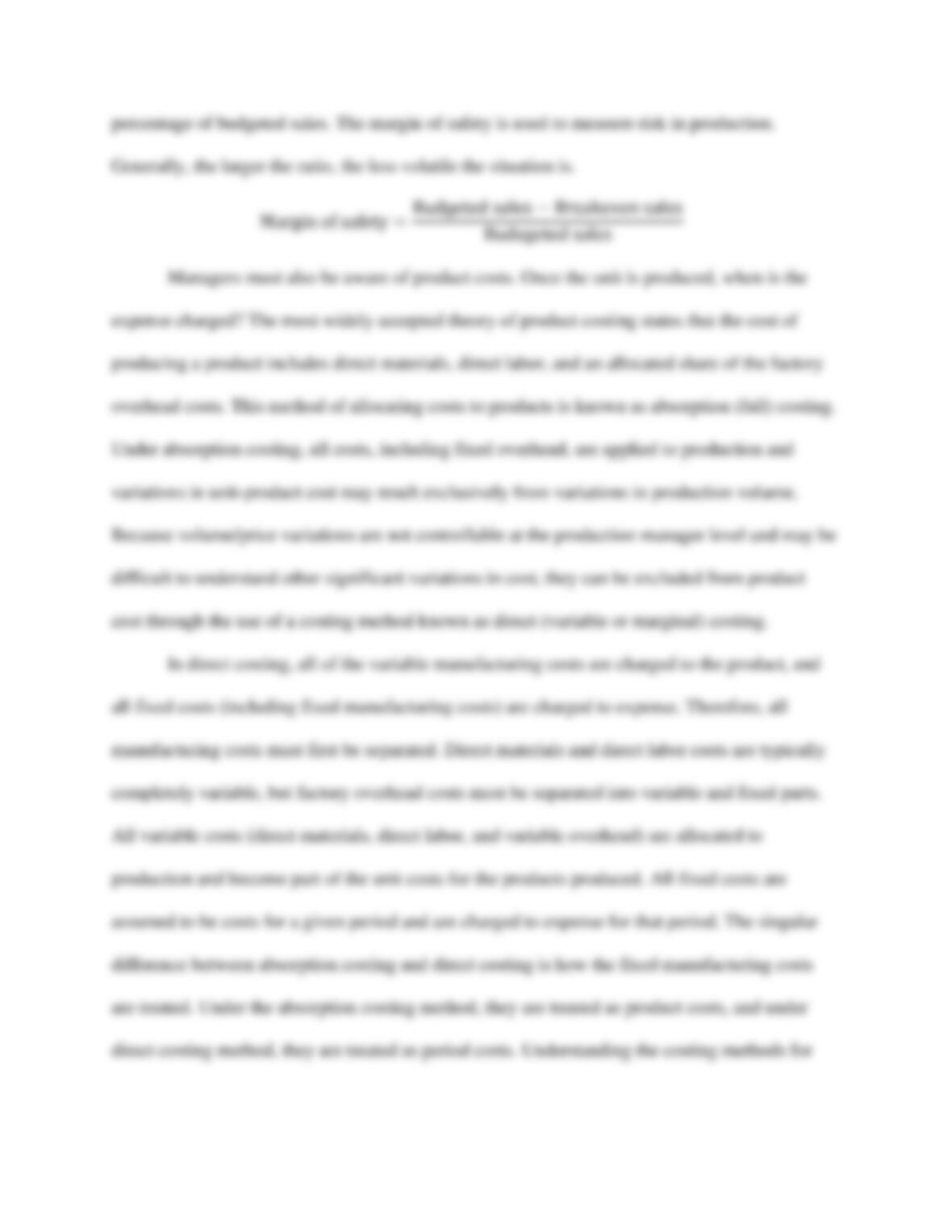
It is important to understand that not all costs behave in the same manner, especially with
changes in productivity. Managers need to understand the types of cost and how their behavior
can affect revenue and budgets. Accuracy and efficiency in budgets and planning are more
effective if the cost behaviors are considered. Cost behavior is not needed for any external
reporting, according to U.S. GAAP, but managers should use the data gathered from costing
methods to plan and control the costs in an organization. The comprehension of cost behavior
patterns are also vital for calculating the break-even point and for cost-volume profit analysis.
Cost-volume-profit (CVP) analysis, collectively with cost behavior data, allows
management to execute other internal analyses . CVP details the relationship between profit and
costs and how they change with volume changes. It displays the effects it has on profits of
changes in such aspects, like variable costs, fixed costs, sell prices, volume, and variety of
products sold. By studying the relationships among costs, sales, and net income, management is
more prepared to make and adapt planning decisions. Break-even analysis, a segment of CVP
analysis, computes the break-even sales amount or point, which is the level of sales at which
there is no profit or loss.
Cost data analysis is an extremely vital part of a manager’s role and function within the
organization. There are constant decisions to be made when it comes to manufacturing and
selling functions. Some of these decisions may be the norm or can be non-routine. There may be
times when management sees it fit to take an alternative course of action based on the cost data
that has been gathered. Ultimately, the success of the organization rests on the ability of
management to gather, interpret and take constructive action on cost analysis data.
Why is cost behavior analysis important to managers? It allows managers to compute
break-even analysis and cost-volume-profit analysis. They are able to make decisions about
short-term orders, special orders, make-or-buy dilemmas, and whether to accept or reject an
order. It also provides insight on managerial performance through the contribution margin
approach and effective budgeting decisions.
There are three basic cost behavior patterns. They are variable, fixed and mixed. Variable
costs are all the costs that vary in total with volume or activity changes. Variable costs include all
the costs of direct materials, direct labor and sales commissions. Some variable overhead items,
such as supplies, fuel and power, receiving costs, overtime premiums, and spoilage and defective
work costs are also considered variable costs.
Fixed costs are all the cost that do not change in total when the volume or activity
changes. Rent, property taxes, insurance, license fees and annual insurances fees are considered
to be fixed costs. The cost stays the same regardless if more or less units are produced or more or
less machine hours are used. They can be further broken down into discretionary and committed
costs. In theory, no cost can be fixed because they can be changed at the discretion of manager’s
decisions or changes in volume. Some types of discretionary fixed costs are advertising, training
and research and development costs. Committed costs are the costs are bound by previous
commitments, such as rent, depreciation, executive salaries and insurance. The commitment to
these cost was already established for a specified length of time for the organization’s production
and labor needs.
Semi-variable (mixed) costs are costs that composed of both variable and fixed elements.
Management needs to be aware of this relationships to accurately assess all costs. For example,
salary costs and commissions are considered to be mixed costs. Supervision, inspection, utilities,
and maintenance and repair costs fall into the semi-variable costs category. To analyze these
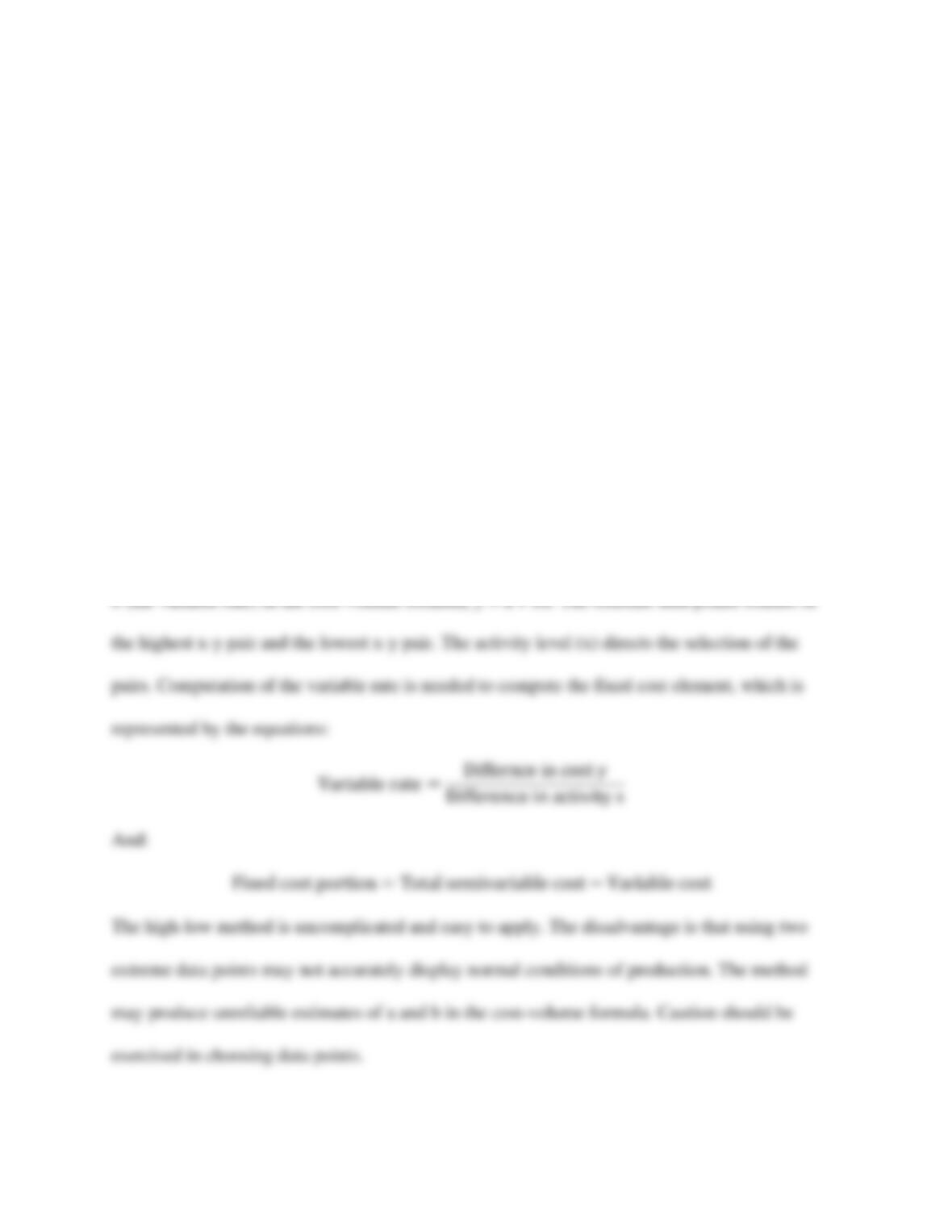
costs, semi-variable costs must be separated into its fixed and variable costs elements, so that
mathematical computation can take place. This computation is the cost-volume formula:
y = a + bx
Where:
y = semi-variable cost element
x = level of activity
a = fixed cost element
b = variable rate per unit of x
There are three methods to calculate the expense of semi-variable and fixed components.
They are the high-low method, scatter graph method and regression analysis. The high -low
method involves two extreme data points to determine the values of a (the fixed cost portion) and