3/10/21
1
Project Management
Class – 8
Resource
Allocation
1
Learning Outcomes
ØWhat is the fundamental trade–off between project cost
and project time?
ØExpediting a project
ØResource leveling
ØHow to allocate limited resources to specific
activities/projects when there are competing demands for
the same limited resources?
ØCase study review
2
3/10/21
2
Purchase and deliver equipment
Construct hospital
Develop information system
Install medical equipment
Train nurses and support staff
Select administration staff
Site selection and survey
Select medical equipment
Prepare final construction plans
Bring utilities to site
Interview applicants for
nursing and support staff
Organizing and Site Preparation Physical Facilities and Infrastructure Level 1
Level 0
Level 2
Relocation of a Hospital
Expediting a Project: Example
3
Relocation of Hospital
Activity List, Duration, and Precedence Relationship
Activity Immediate
Predecessors
Activity times
(wks)
START 0
Organizing and Site Preparation
A. Selecting administrative staff start 12
B. Site selection and survey start 9
C. Select medical equipment A10
D. Prepare final construction plans B10
E. Bring utilities to site B24
F. Inter v i e w a p plica n t s f or nu r s i n g and s u p port s t a f f A10
Physical Facilities and Infrastructure
G. Purchase and deliver equipment C35
H. Construct hospital D40
I. Develop information system A15
J. Install medical equipment E, G, H 4
K. Train nurses and support staff F, I, J 6
FINISH K0
4
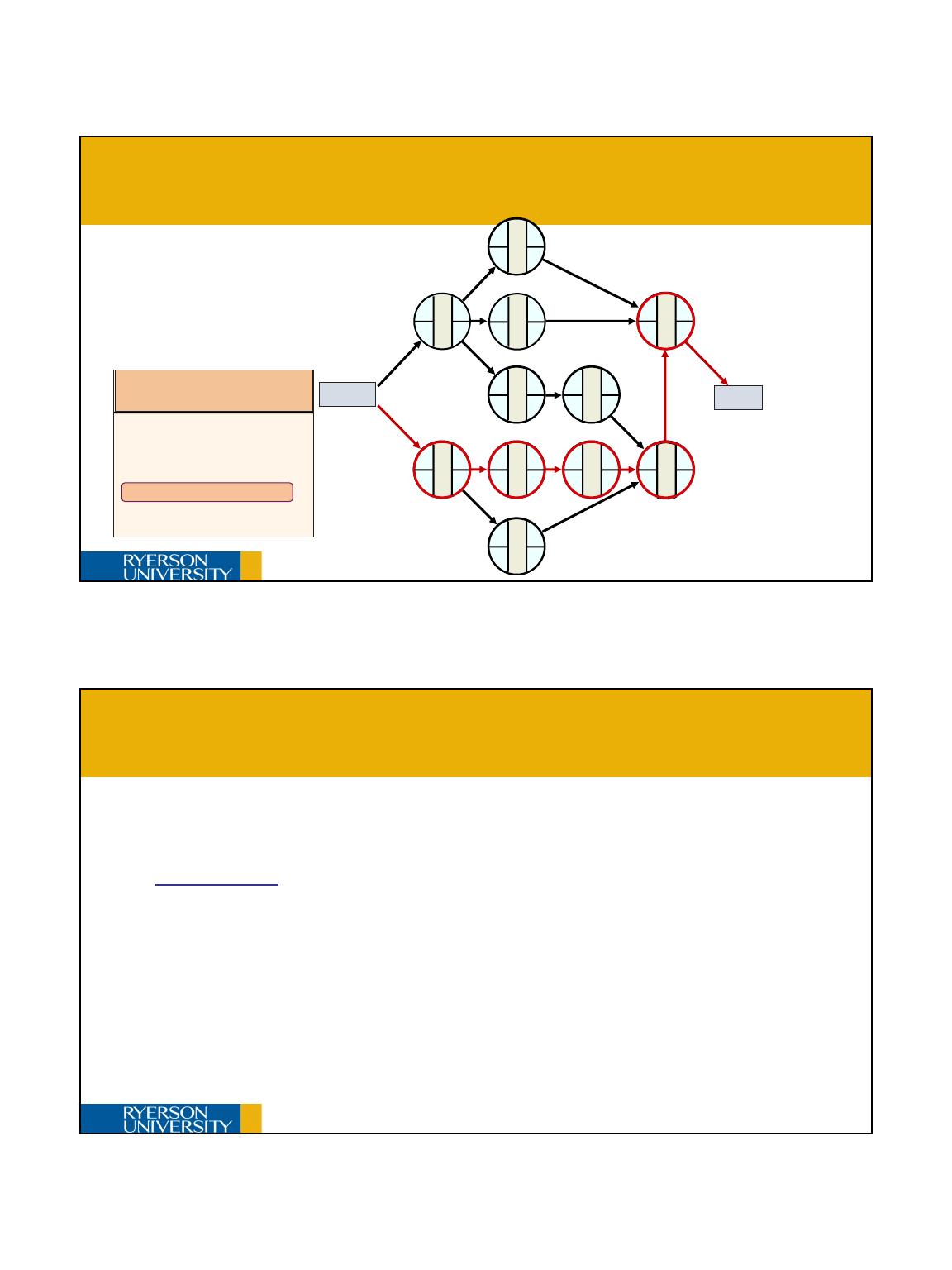
3/10/21
3
K
6
C
10
G
35
J
4
H
40
B
9
D
10
E
24
I
15
Finish
Start
A
12
F
10
0 9
9 33
9 19 19 59
22 57
12 22
59 63
12 27
12 22 63 690 12
The Critical Path takes
69 weeks
Path Time (wks)
A-I-K 33
A-F-K 28
A-C-G-J-K 67
B-D-H-J-K 69
B-E-J-K 43
Developing the Schedule and Finding Critical Path
5
Project Crashing
Project Crashing: Shortening (or expediting) some activities within a
project to reduce overall project completion time.
ØProject Costs
üDirect Costs: Labor, materials, and any other costs directly related to
activities
üIndirect Costs: Administration, depreciation, financial, and other
overhead costs that can be avoided by reducing total project time
üPenalty Costs: If project extends beyond some specific date.
6
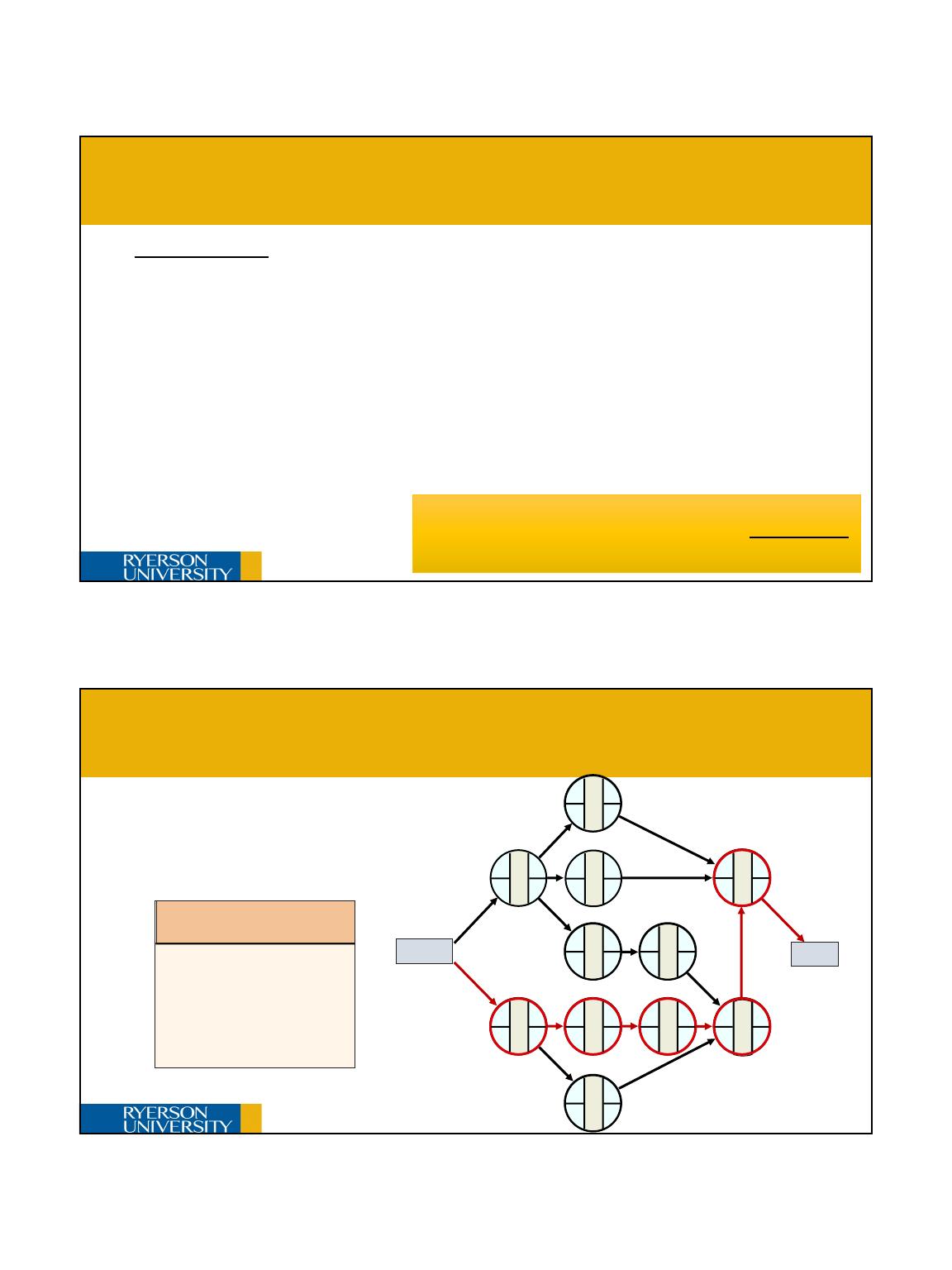
3/10/21
4
Cost to Crash
Cost to Crash
ØNormal time (NT) is the time necessary to complete an activity
under normal conditions.
ØNormal cost (NC) is the activity cost associated with the normal
time.
ØCrash time (CT) is the shortest possible time to complete an
activity.
ØCrash cost (CC) is the activity cost associated with the crash
time.
𝐂𝐨𝐬𝐭 𝐭𝐨 𝐜𝐫𝐚𝐬𝐡 𝐩𝐞𝐫 𝐩𝐞𝐫𝐢𝐨𝐝 =𝐂𝐂 −𝐍𝐂
𝐍𝐓 −𝐂𝐓
7
Which Activities to Crash?
ØWhich activities and for how long should
be crashed?
K
6
C
10
G
35
J
4
H
40
B
9
D
10
E
24
I
15
Finish
Start
A
12
F
10
0 9
9 33
9 19 19 59
22 5712 22
59 63
12 27
12 22 63 690 12
Path Time (wks)
A-I-K 33
A-F-K 28
A-C-G-J-K 67
B-D-H-J-K 69
B-E-J-K 43
8
3/10/21
5
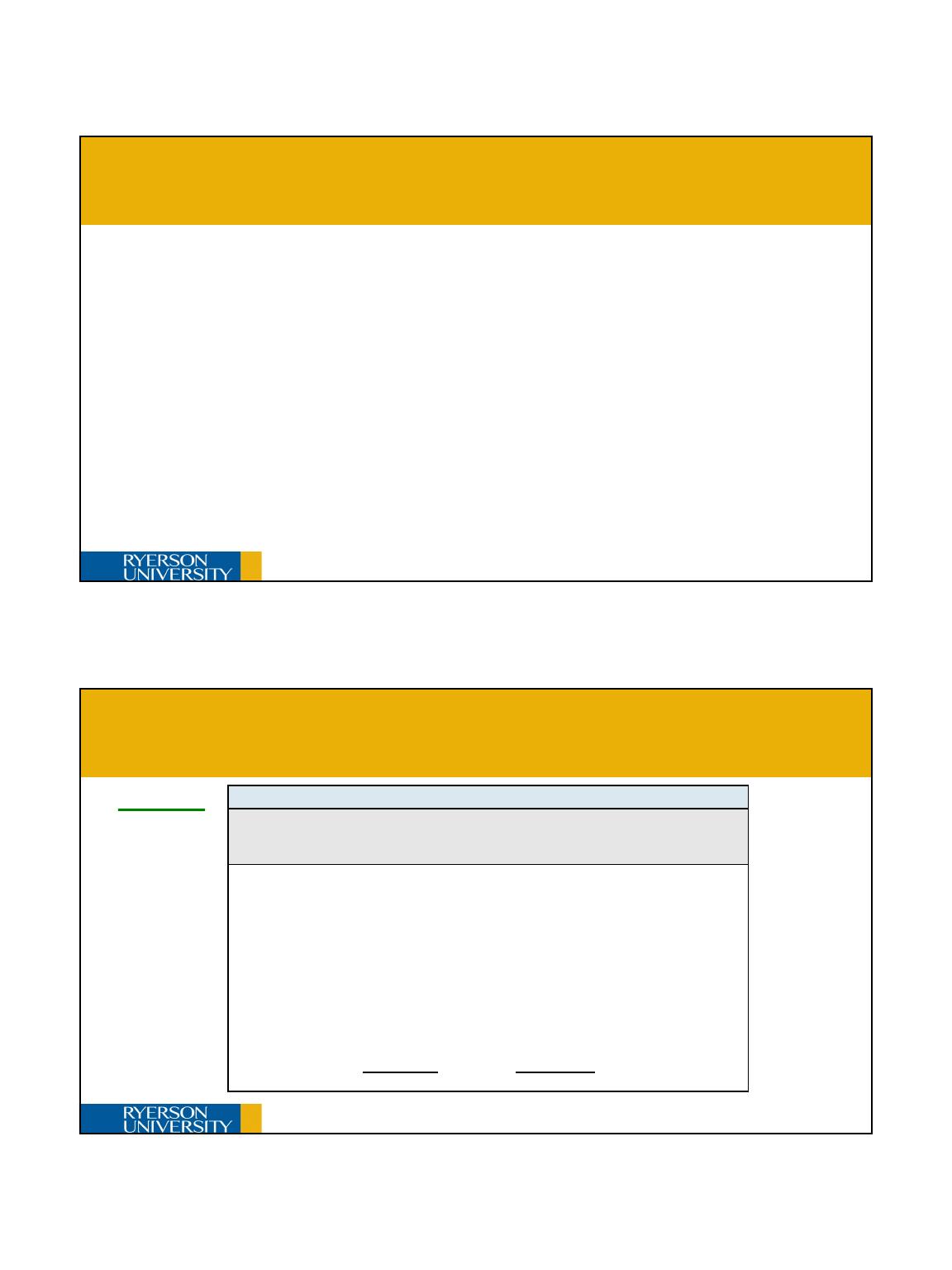
Which Activities to Crash?
Algorithm
ØWhich activities and for how long should be crashed?
ØDetermining the Minimum Cost Schedule:
1. Determine the project’s critical path(s).
2. Find the activity or activities on the critical path(s) with the lowest cost of
crashing per unit of time.
3. Reduce the time for this activity until…
a. It cannot be further reduced or
b. Until another path becomes critical, or
c. The increase in direct costs exceeds the savings that result from shortening
the project.
4. Repeat this procedure until the increase in direct costs is larger than the savings
generated by shortening the project.
9
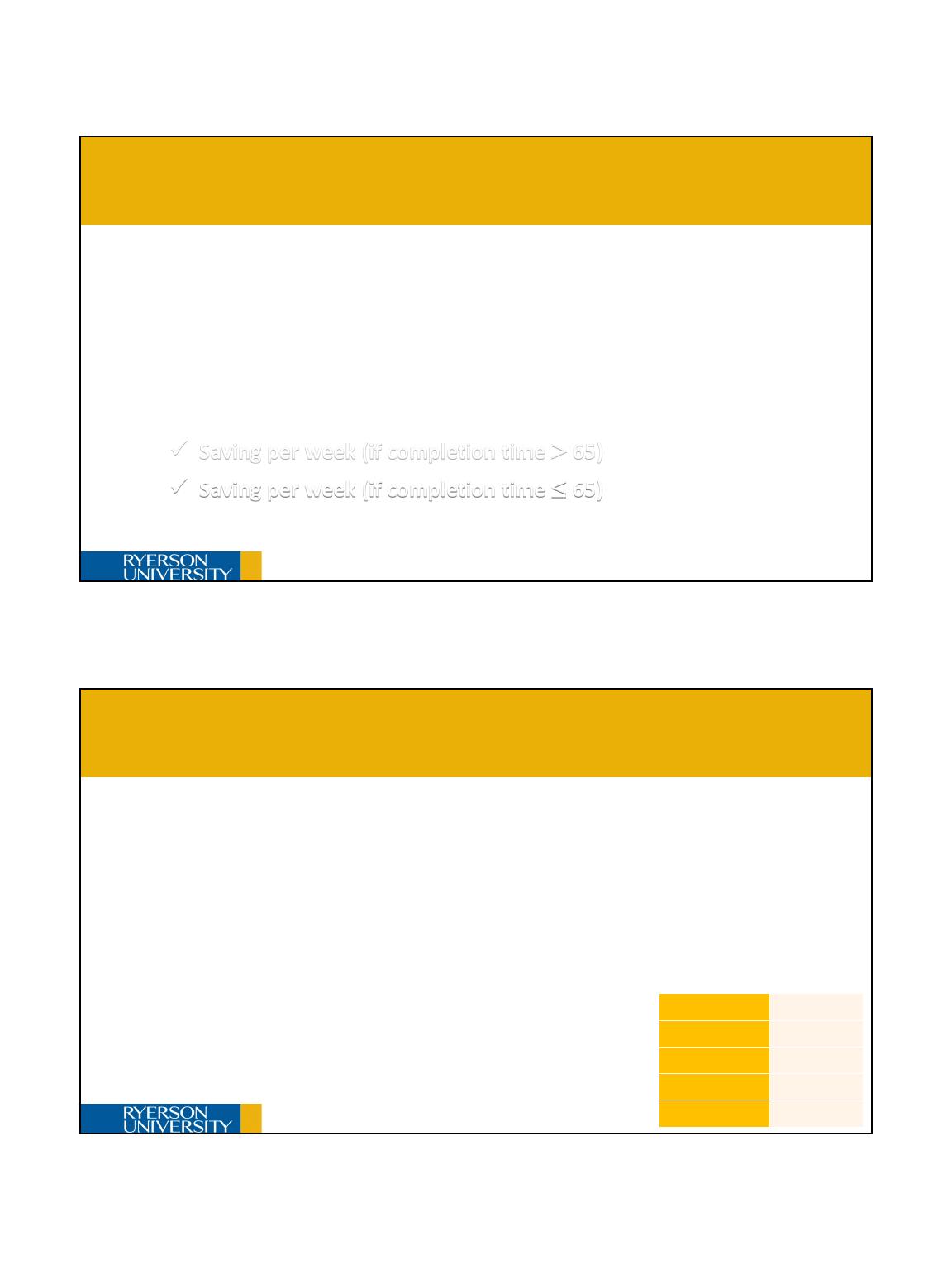
Hospital Example: Finding Cost to Crash
DIRECT COST AND TIME DATA FOR THE HOSPITAL PROJECT
Activity Normal
Time (NT)
(weeks)
Normal
Cost
(NC)($)
Crash Time
(CT)(weeks)
Crash Cost
(CC)($)
Maximum
Time
Reduction
(week)
Cost of
Crashing per
Week ($)
A12 $12,000 11 $13,000 11,000
B 9 50,000 764,000 27,000
C10 4,000 57,000 5600
D10 16,000 820,000 22,000
E24 120,000 14 200,000 10 8,000
F10 10,000 616,000 41,500
G35 500,000 25 530,000 10 3,000
H40 1,200,000 35 1,260,000 512,000
I15 40,000 10 52,500 52,500
J 4 10,000 113,000 31,000
K 6 30,000 534,000 14,000
Totals $1,992,000 $2,209,500
CC –NC
NT –CT
10
3/10/21
6
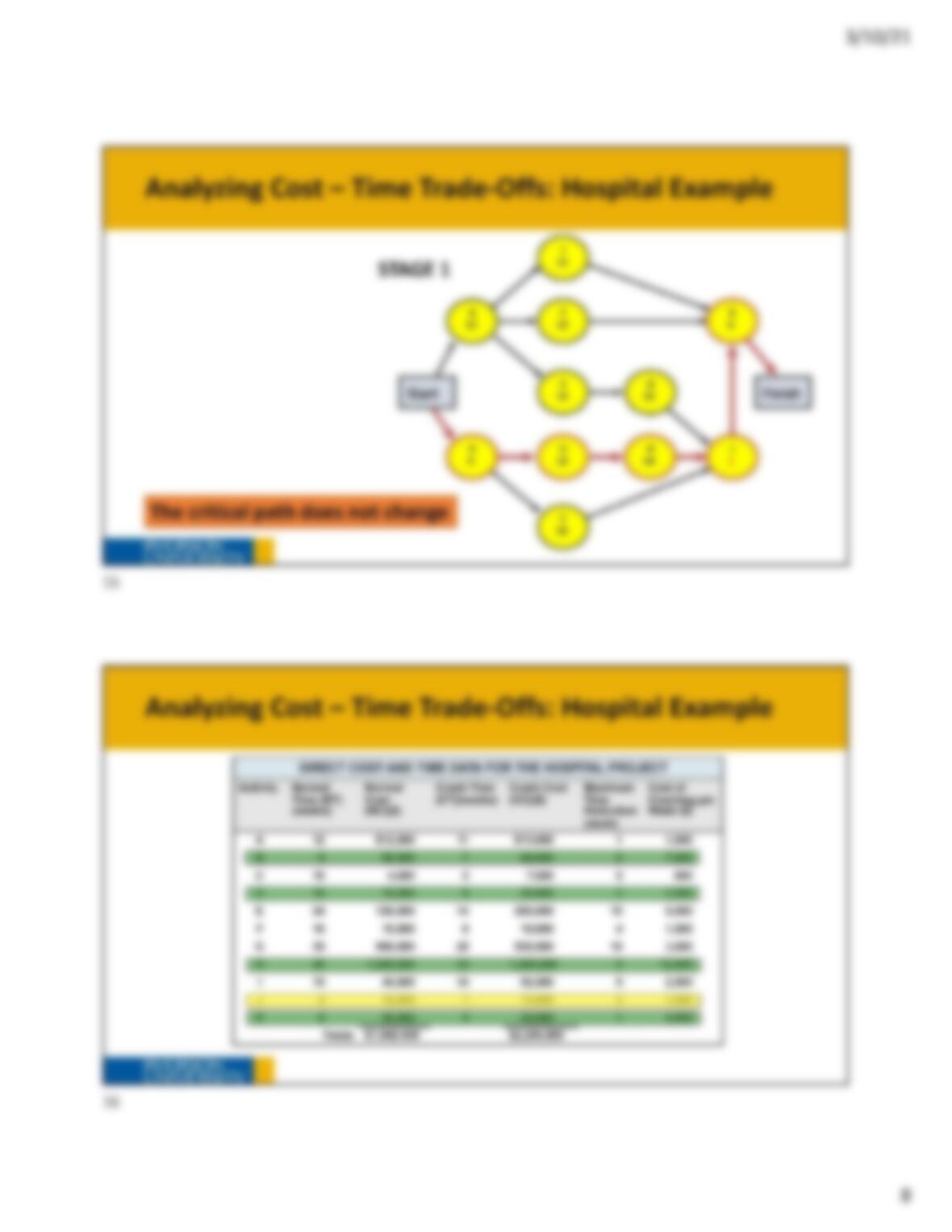
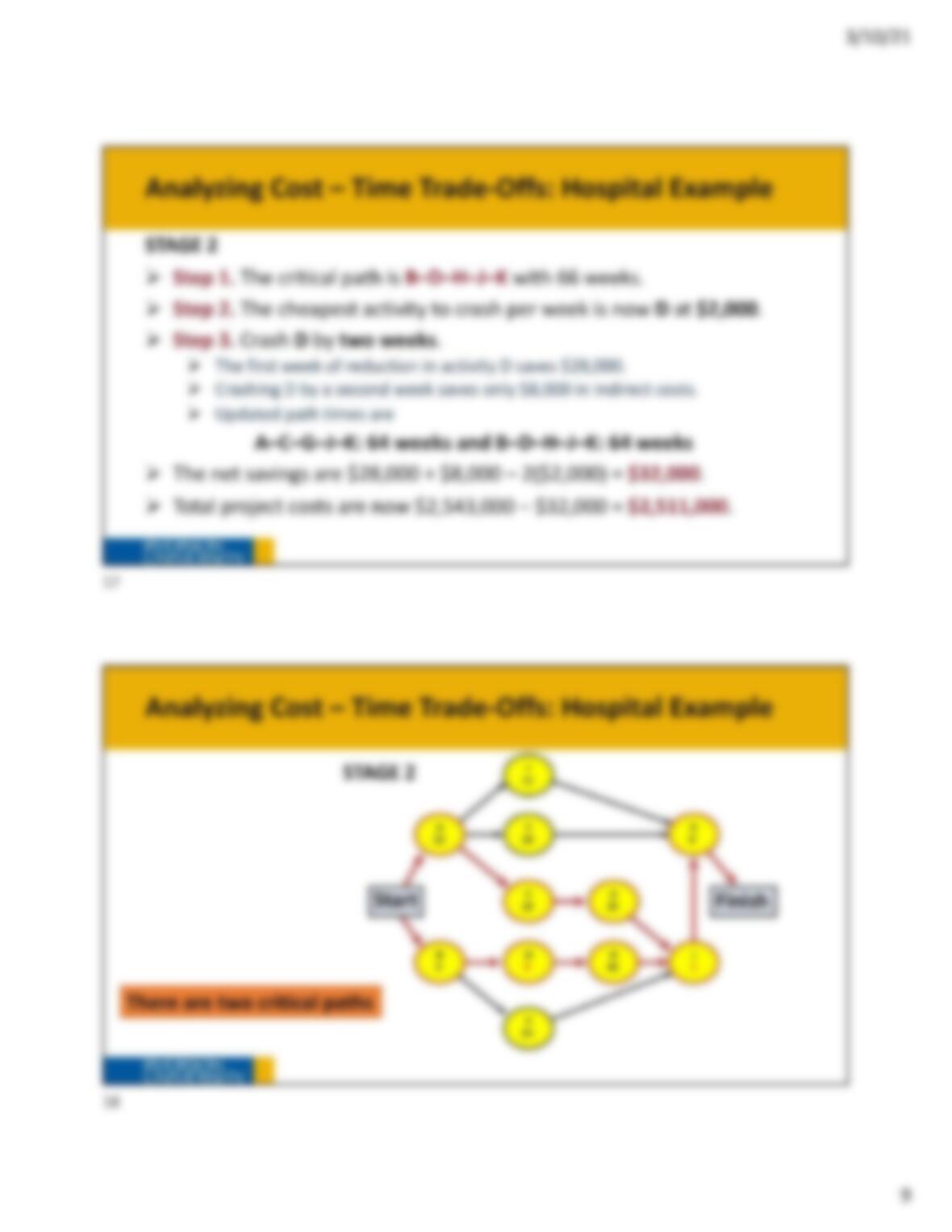
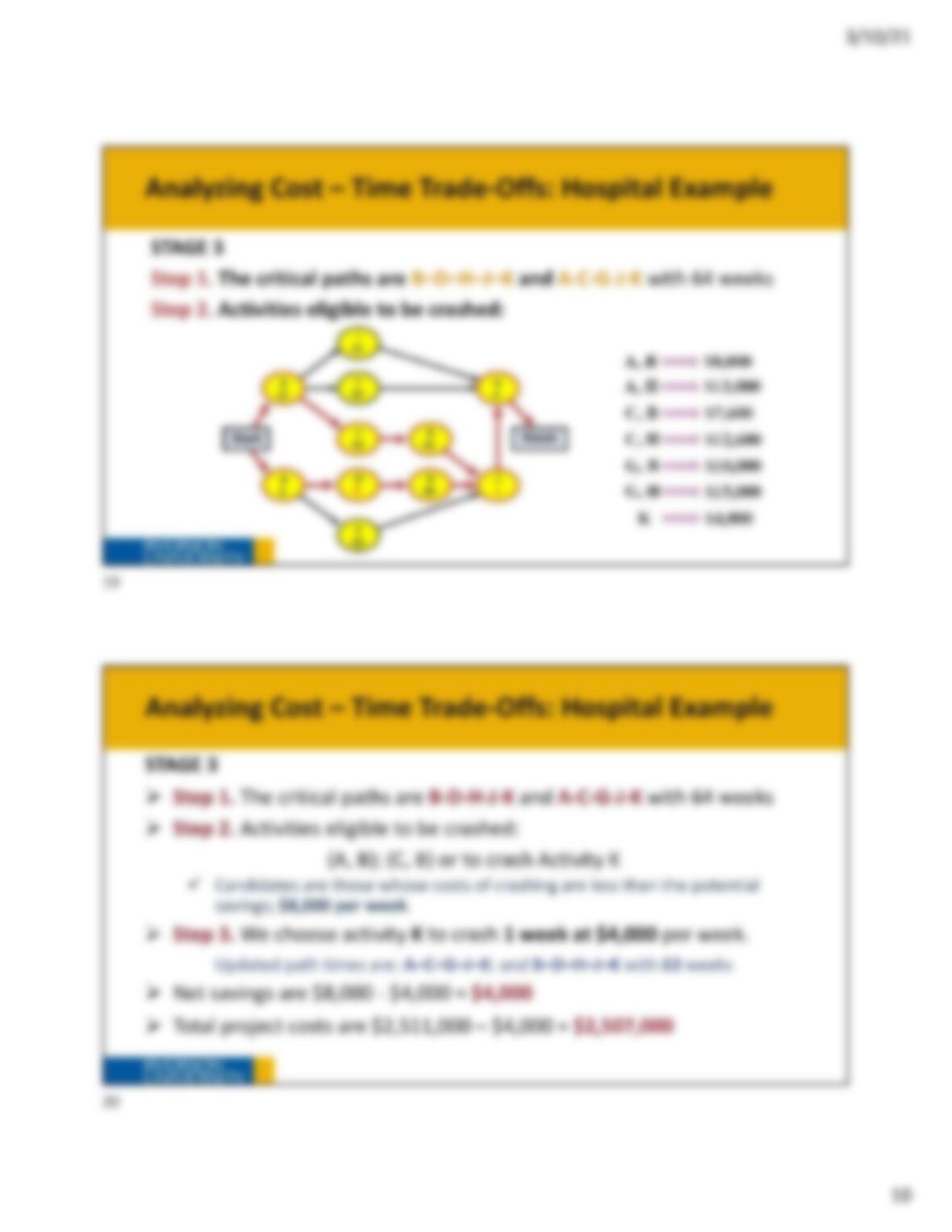
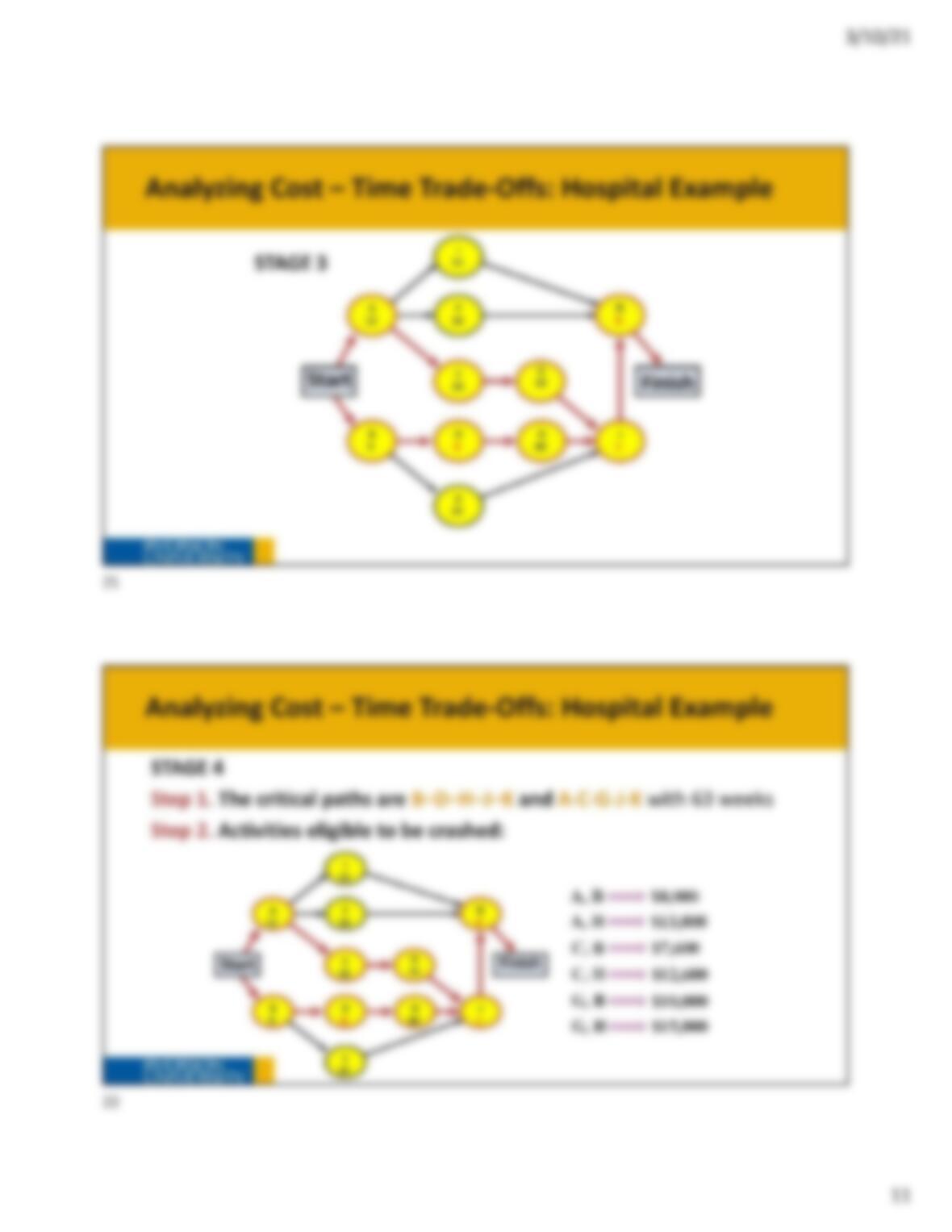
Analyzing Cost –Time Trade–Offs
Hospital Example
ØProject completion time was 69 weeks (Critical Path Analysis)
ØSuppose that project indirect costs are $8,000 per week
ØAfter 65 weeks, the Regional Hospital Board imposes cost of $20,000
per week if the hospital is not fully operational.
ØQuestion: What is the saving per week shortening the project?
üSaving per week (if completion time >65)
üSaving per week (if completion time ≤65)
11
Analyzing Cost –Time Trade–Offs
Hospital Example
ØDetermine the minimum–cost schedule for the Hospital project.
ØProject completion time = 69 weeks
ØProject cost = $2,624,000
Direct = $1,992,000
Indirect = 69($8,000) = $552,000
Penalty = (69 –65)($20,000) = $80,000
A–I–K 33 weeks
A–F–K 28 weeks
A–C–G–J–K 67 weeks
B–D–H–J–K 69 weeks
B–E–J–K 43 weeks
12
3/10/21
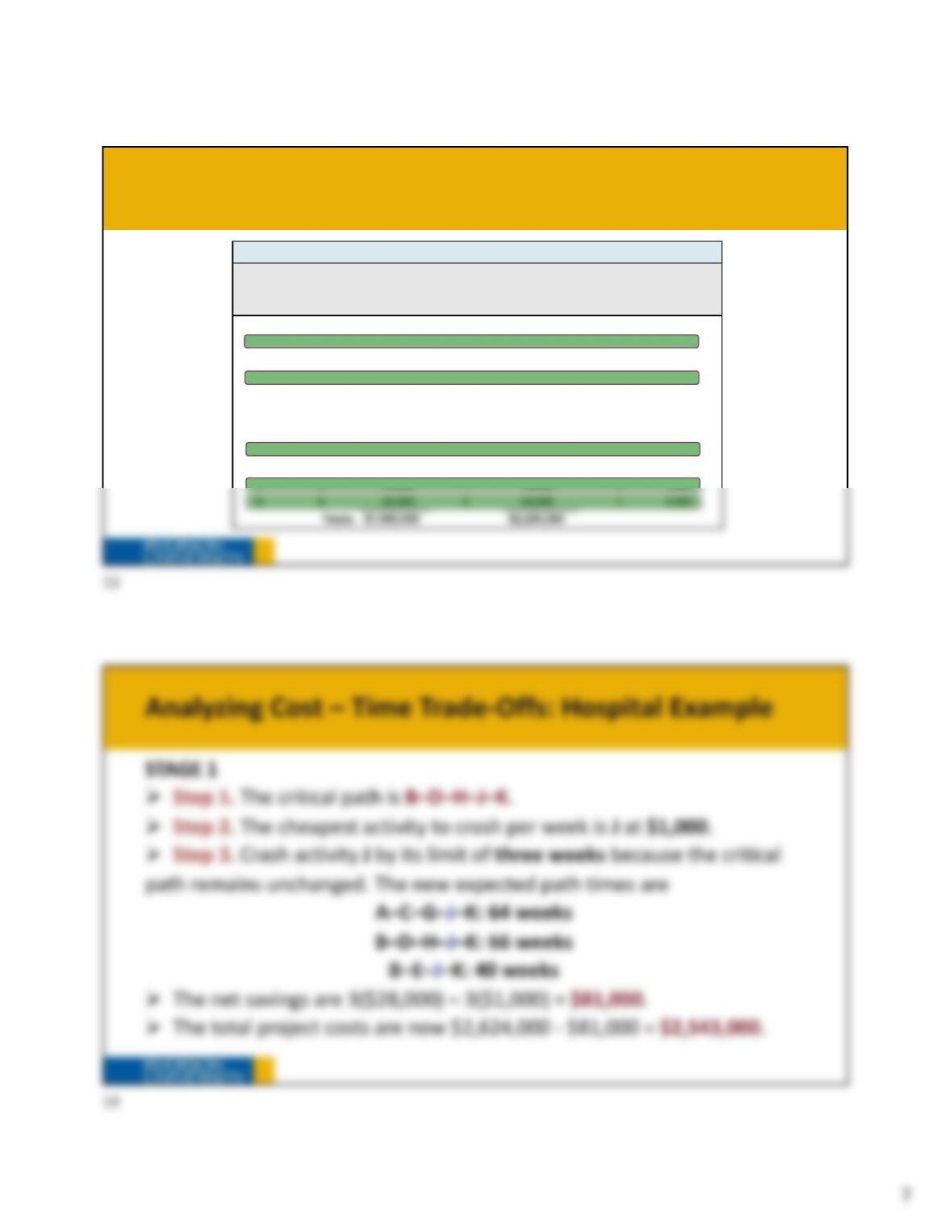
DIRECT COST AND TIME DATA FOR THE HOSPITAL PROJECT
Activity Normal
Time (NT)
(weeks)
Normal
Cost
(NC)($)
Crash Time
(CT)(weeks)
Crash Cost
(CC)($)
Maximum
Time
Reduction
(week)
Cost of
Crashing per
Week ($)
A12 $12,000 11 $13,000 11,000
B 9 50,000 764,000 27,000
C10 4,000 57,000 5600
D10 16,000 820,000 22,000
E24 120,000 14 200,000 10 8,000
F10 10,000 616,000 41,500
G35 500,000 25 530,000 10 3,000
H40 1,200,000 35 1,260,000 512,000
I15 40,000 10 52,500 52,500
Hospital Example
Which Activity To Crash?