Markov Analysis

15-2
Learning Objectives
1. Determine future states or conditions by
using Markov analysis.
2. Compute long-term or steady-state
conditions by using only the matrix of
transition probabilities.
3. Understand the use of absorbing state
analysis in predicting future conditions.
After completing this chapter, students will be able to:
15-3
Chapter Outline
15.1 Introduction
15.2 States and State Probabilities
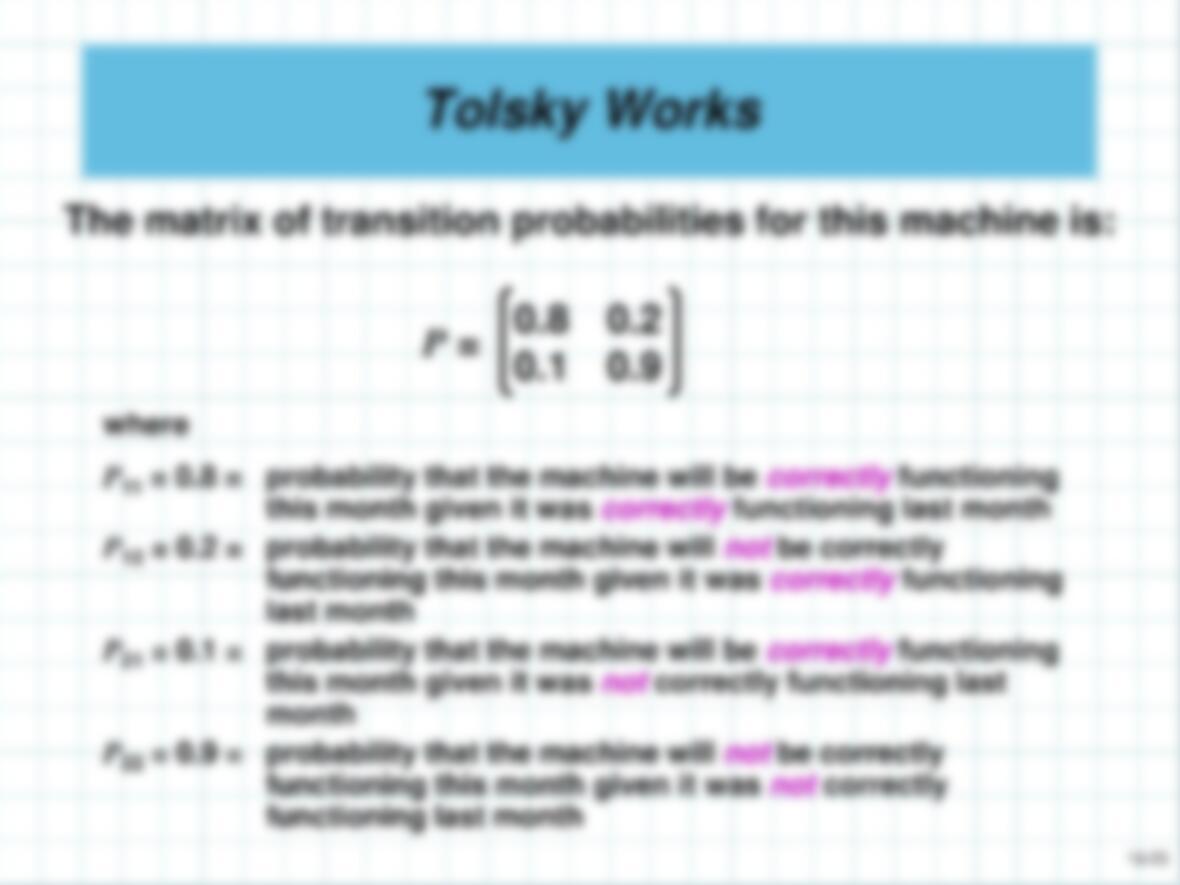
15.3 Matrix of Transition Probabilities
15.4 Predicting Future Market Shares
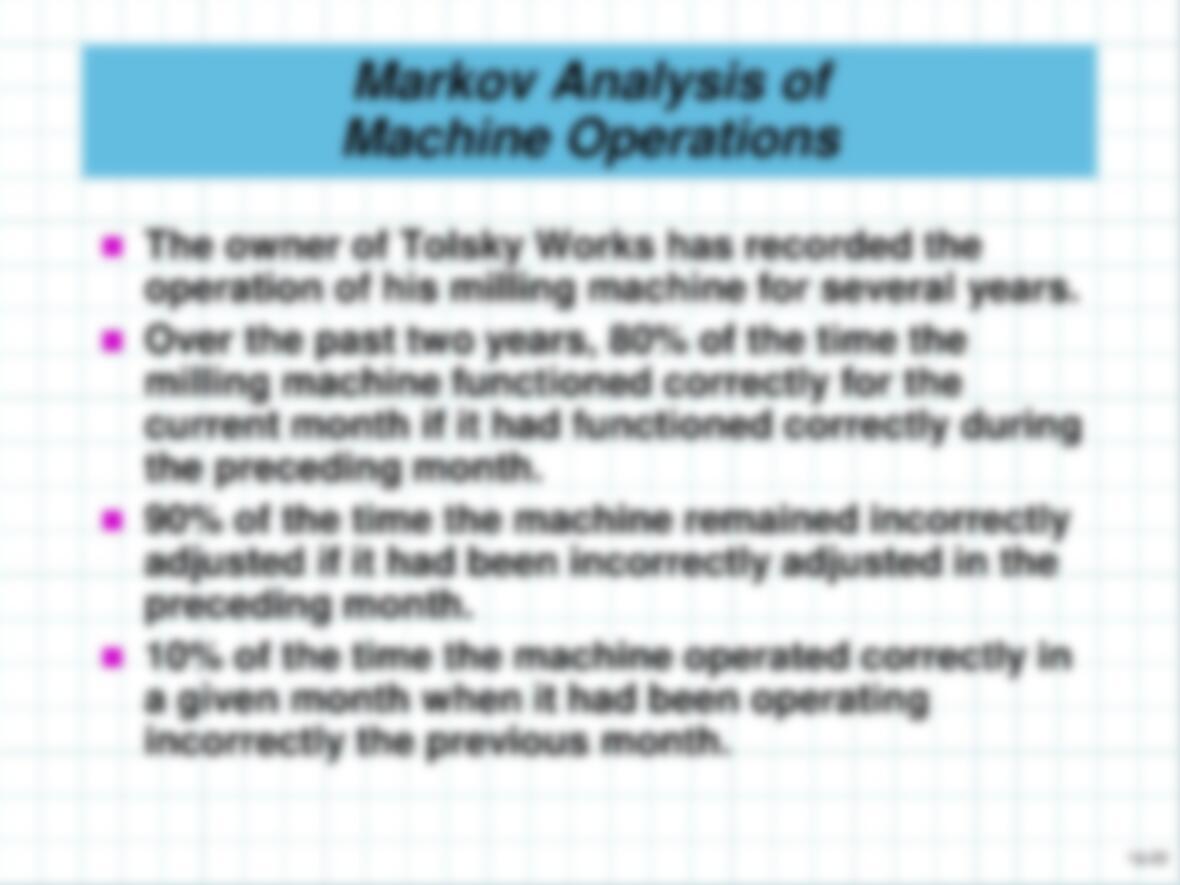
15.5 Markov Analysis of Machine Operations
15.6 Equilibrium Conditions
15.7 Absorbing States and the Fundamental
Matrix: Accounts Receivable Application
15-4
Introduction
◼Markov analysis is a technique that deals with
the probabilities of future occurrences by
analyzing presently known probabilities.
◼It has numerous applications in business.
◼Markov analysis makes the assumption that
the system starts in an initial state or
condition.
◼The probabilities of changing from one state
to another are called a matrix of transition
probabilities.
◼Solving Markov problems requires basic
matrix manipulation.

15-5
Introduction
◼This discussion will be limited to Markov
problems that follow four assumptions:
1. There are a limited or finite number of
possible states.
2. The probability of changing states
remains the same over time.
3. We can predict any future state from the
previous state and the matrix of transition
probabilities.
4. The size and makeup of the system do
not change during the analysis.
15-6
States and State Probabilities
◼States are used to identify all possible conditions
of a process or system.
◼It is possible to identify specific states for many
processes or systems.
◼In Markov analysis we assume that the states are
both collectively exhaustive and mutually
exclusive.
◼After the states have been identified, the next
step is to determine the probability that the
system is in this state.
States and State Probabilities
The information is placed into a vector of state
probabilities:
(i) = vector of state probabilities
for period i
= (