In Partial Fulfillment of the Requirements of the Degree of
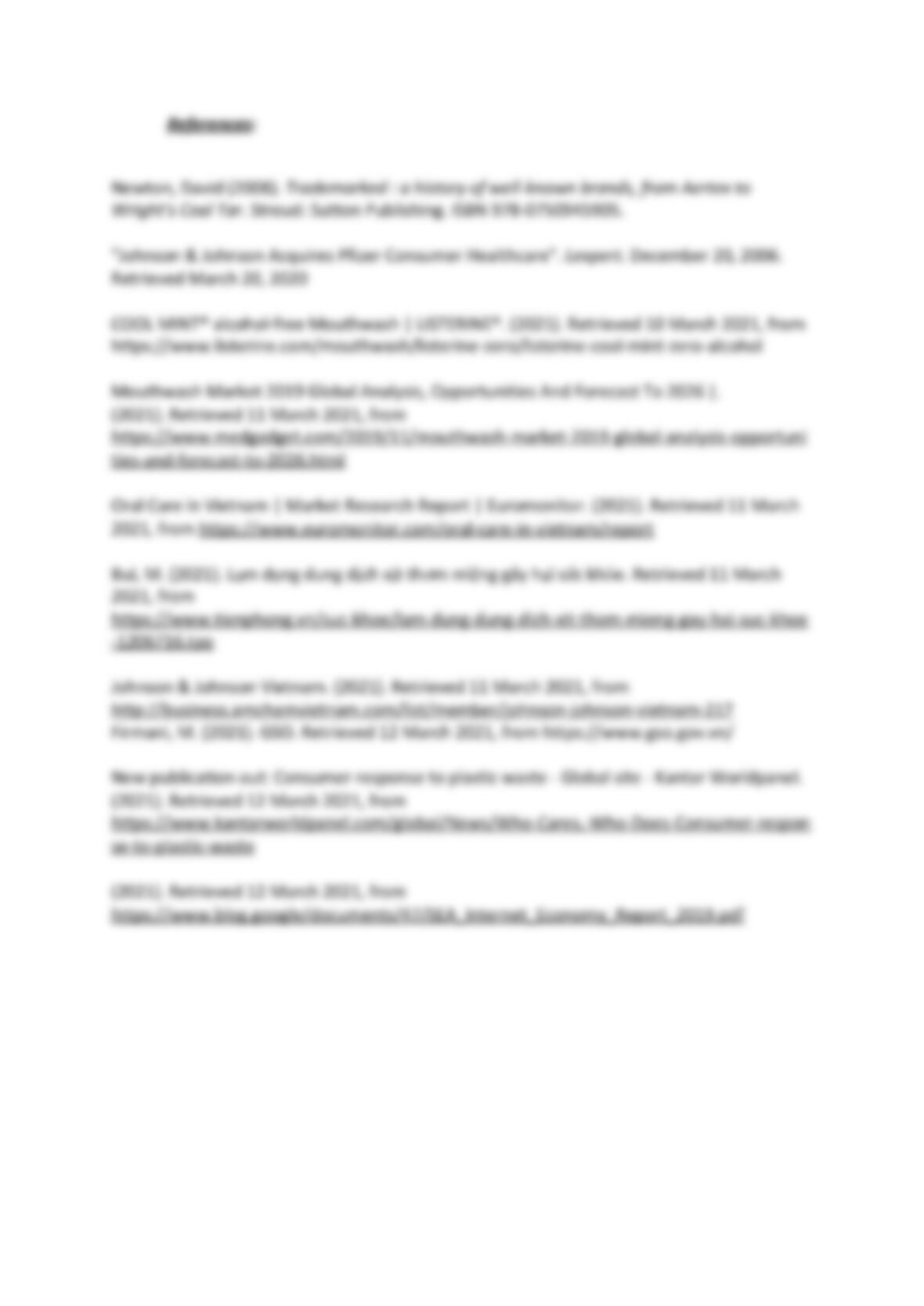
LISTERINE COOL MINT ZERO ALCOHOL MARKETING REPORT
BACHELOR OF BUSINESS ADMINISTRATION
In Principles of Marketing
By
Name: Nguyen Thi Ngoc Minh
Student ID: 31201029143
Class: DH46ISB-1
For
International School of Business – University Economics HCMC
March 2021
LISTERINE COOL MINT ZERO ALCOHOL MARKETING REPORT
In recent years, Listerine mouthwash is currently a reputable brand and trusted by many
consumers because of its excellent performance and relatively affordable price for the
majority, including Listerine Zero (Toplist, 2021). The actors and forces outside of marketing
management’s ability to build and maintain successful relationships with target customers
create a company’s marketing environment. As a result, marketers must be on the search
for environmental trends and opportunities. The position of Listerine Zero as a brand will be
examined in this report, as well as some important Micro and Macro environmental factors
that will influence the brand in Vietnam.
1. Brand background:
Listerine is an antiseptic mouthwash advertised in the United States with the slogan
“Kills germs that cause bad breath.” Listerine was invented in 1879 by Joseph
Lawrence, a chemist in St. Louis, Missouri, and was named for Joseph Lister, who
pioneered antiseptic surgery at the Glasgow Royal Infirmary in Scotland (David
Newton, 2008). Listerine was originally sold by the Lambert Pharmacal Company
(later Warner–Lambert), but since December 20, 2006, when Johnson & Johnson
purchased Pfizer’s consumer healthcare division, it has been developed and
distributed by Johnson & Johnson (Lexpert, 2006).
Listerine Zero, a new alcohol-free version of the formula, was introduced by Johnson
and Johnson in 2009.
2. Debrief:
–Product overview: In an alcohol-free mouthwash bottle, the boldest of
cleanse, less intense minty flavor. There are no alcoholic beverages. There

are no messes. For a healthy mouth, the zero-alcohol formula cleans deeply
to kill millions of bad breath germs. (Listerine, 2021). Size: 95ML, 500ML, 1LT,
1.5LT.
– STP:
Segmentation:
Personal Care – Oral Hygiene – Mouth Wash.
Target market:
For well-to-do families in urban, semi-urban areas that have
oral hygiene needs and children. (MBA Skool Team, 2020).
Positioning:
With the less strong minty flavors, alcohol-free mouthwash for
intense bad breath germ fighting.
3. Product analysis and competitor analysis:
a, Product analysis:
b, Competitor analysis:
– Indirect competitors:
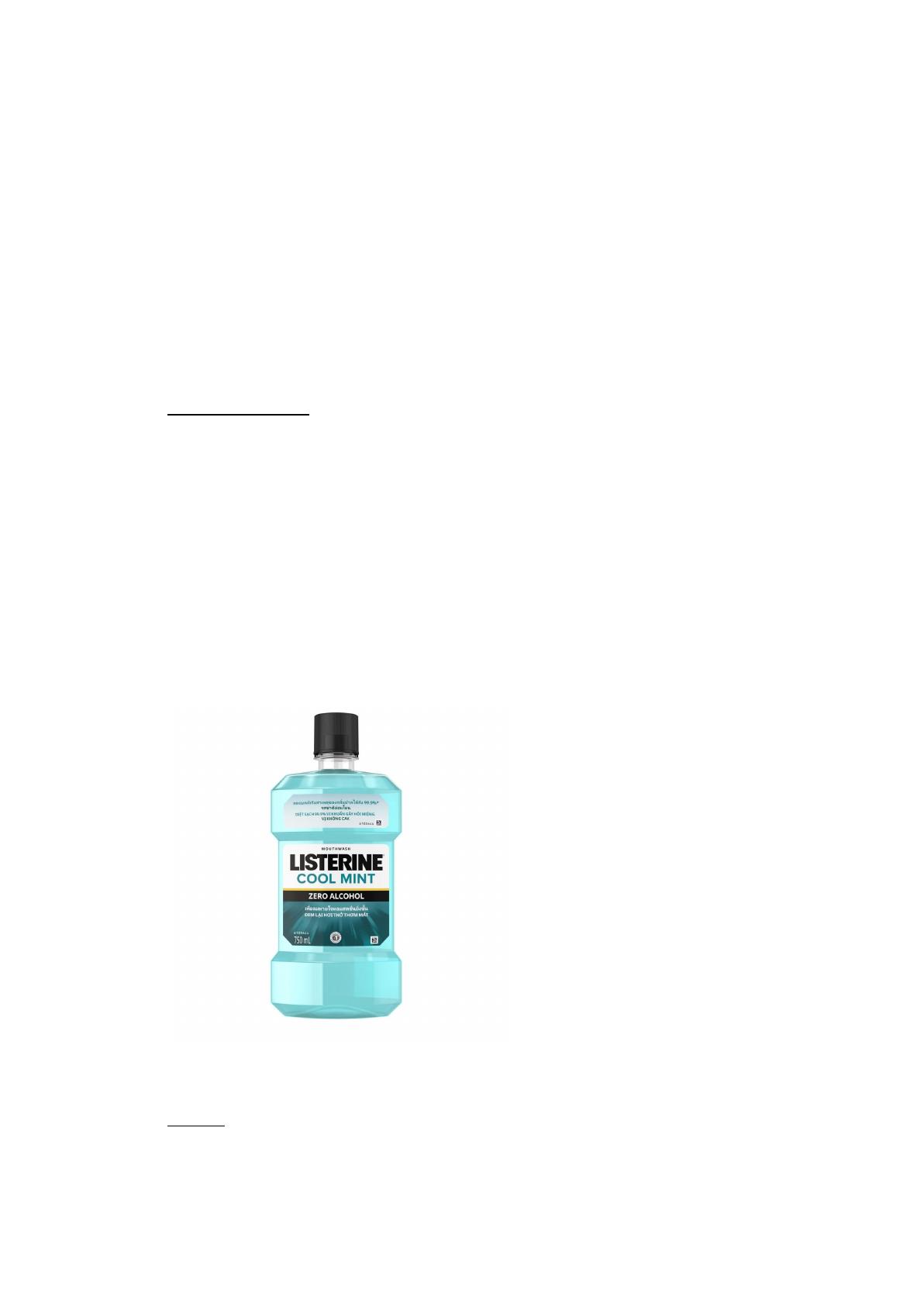
Toothbrushes and toothpaste:
essential but difficult to carry.
Strengths:
– The brand has been for a long time
in Vietnam.
– Positive consumer image.
– Excellent branding and
advertisements via TV
advertisements, social media and
print ads.
Weaknesses:
– It’s a poor alternative for
toothpaste, which holds a
substantial market share.
– Since it is mainly an urban product,
the target demographic is small.
– The price is quite high compared to
the toothpaste.
Opportunities:
– Growing brand recognition via social
media.
– Make organic products (a current
trend in the Vietnam’s
marketplace).
– The global demand for mouthwash
is primarily driven by rising
understanding of oral hygiene
(Wiseguy Research Consultants PVT
LTD, 2019).
Threats:
– COVID-19 has the greatest impact
on mouthwashes and toothbrushes.
Mouth fresheners are commonly
used before socializing or going to
work, so the lockdown and
continued limits are harming sales
(Euromonitor, 2020).
– In the news, there were reports that
Listerine could cause cancer.
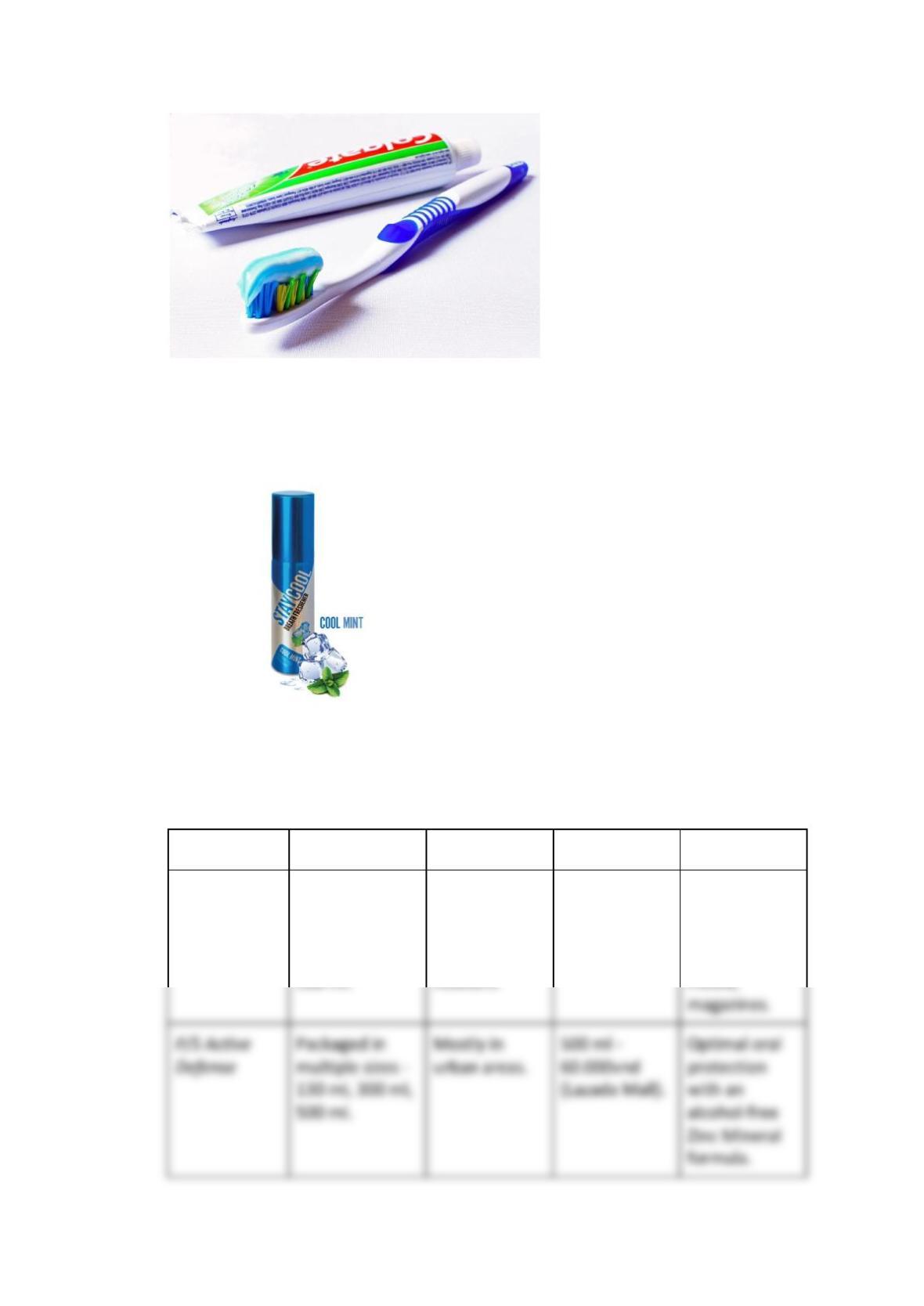
Breath fresheners:
not being used much by customers, there are still many concerns
about quality and chemicals (Bui Mai Huong, 2017).
– Direct competitors:
Product
Place
Price
Promotion
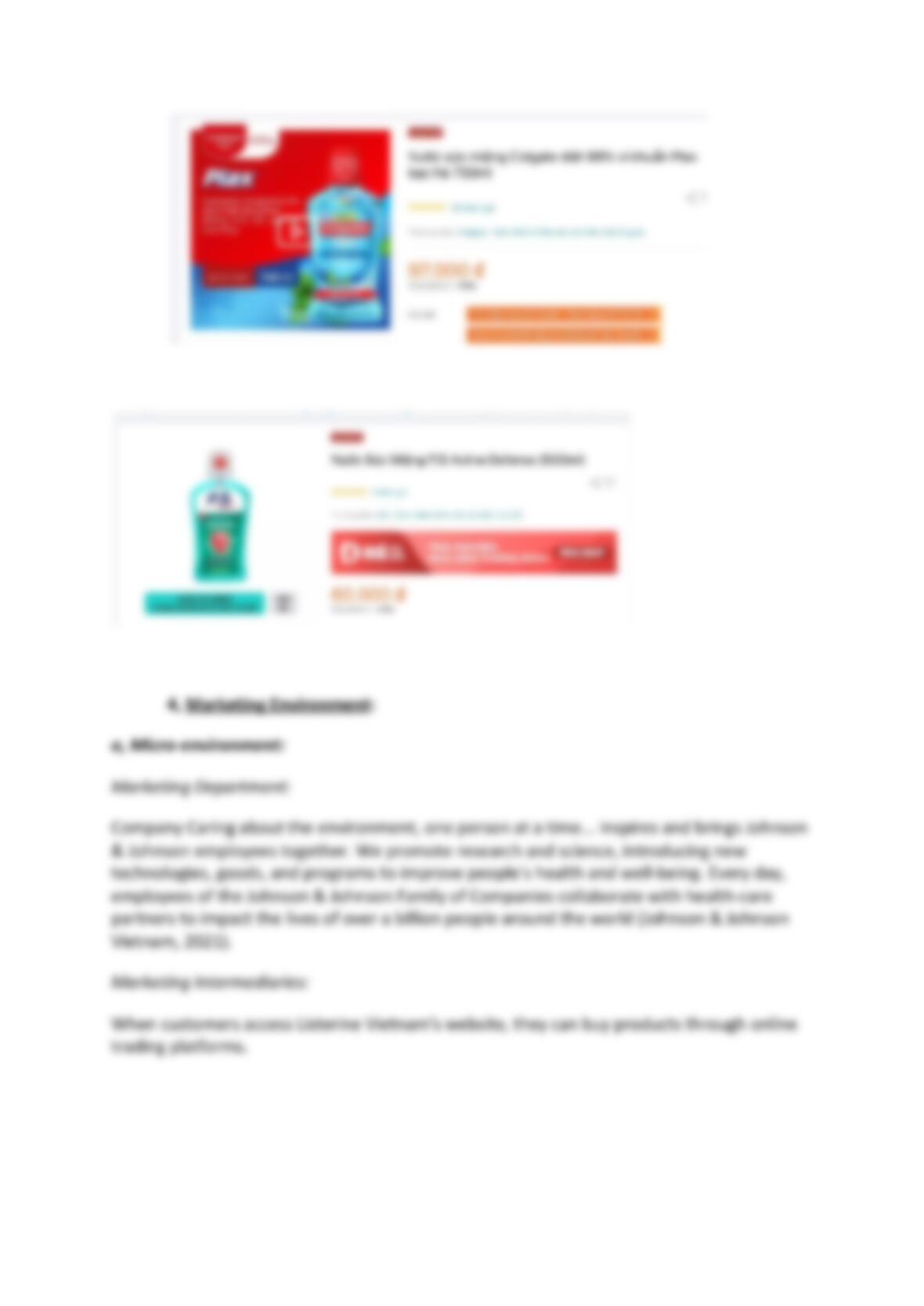
Colgate Plax
Packaged in
multiple sizes –
50 ml, 60 ml,
100 ml, 250 ml,
Widely
available in
urban areas
from malls to
750 ml –
75.000vnd
(Lazada Mall).
Help remove
99.9% germs
for 12 hours.
TV, social