Alliance Advertising 2
Table of Contents
Introduction 3
Situation Analysis 4
Company Analysis 5
Primary Research 7
Consumer Analysis 12
Market Analysis 15
Service Analysis 17
Competitive Analysis 19
Problems and Opportunities 21
Target Market Profile 29
Objectives 34
Budget 37
Marketing Communications Strategy Overview 40
Advertising Strategy 42
Creative Strategy 44
Media Strategy 51
Sales Promotions Strategies 64
Public Relations Strategies 67
Campaign Evaluation 73
Appendices 75
Alliance Advertising 3
Executive Summary
The central focus of this campaign is to raise awareness of Crime Prevention
Through Environmental Design (CPTED). Alliance Advertising firmly believes that
when people know about the program they will be more likely to renovate or
implement the program. Only with knowledge of the program will people be open to
adopt CPTED. Alliance Advertising’s campaign is devoted primarily to raising
awareness. Once appropriate awareness levels are reached, and then the campaign
can switch its focus to getting residents to implement CPTED.
The way CPTED has been previously marketed in Vermillion through word of mouth
and brochures. The previous focus was on landlords and home owners. Alliance
Advertising suggests broadening the scope by emphasizing renters as a target
market. It is the agency’s belief that if renters are aware of CPTED and ask for it,
landlords will be more likely to commit to a change.
Alliance Advertising suggests a budget that consists of three plans bronze, silver,
and gold; these plans range from $800 to $5,300. The agency suggests the “Silver
Plan” which ranges from $2,500 to $3,000. Alliance Advertising believes this would
fit within the client’s budget and offer an adequate amount of services.
Alliance Advertising’s creative strategy is keeping people safe through the
implementation of CPTED. The best way to do this is by raising awareness; the
channels the agency suggests target younger demographics. These channels include
social media, Volante, Internet domains, and radio ads.
The client specified the campaign should run within a year so Alliance Advertising
has executed a campaign to do so. The campaign will start January 1, 2013 and
conclude October 1, 2013.
Alliance Advertising 4
Alliance Advertising 5
Company Analysis
The Vermillion Police Department (VPD) is composed of 19 sworn and three non-
sworn persons. The VPD serves roughly ten thousand residents within a varied
community that is also home to the University of South Dakota (USD). Annually, the
VPD generates approximately 4,500 offense reports and either hosts or participates
in several community service programs each year. Together, the VPD officers
receive over a thousand hours of training yearly. The VPD is located at the
Vermillion/Clay County Public Safety Center, which is located at 15 Washington
Street in Vermillion, SD. The mission of the VPD is “to serve and protect”.
There are several key issues facing the VPD. These issues include, lack of trust, lack
of distinction between other law enforcement, lack of funding, and negative
attitudes toward police. As the researchers work to resolve these specific problems,
they will also look for opportunities to promote and expand support.
A major problem the VPD faces is a lack of trust. This is an issue because college
students look at the police department as the enemy. College students feel that the
police are trying to get them in trouble instead of protecting them. Most college
students do not call the police for assistance so they view it as a service that is only
there to give them tickets for various things. Having a CPTED program through the
VPD is a good way to get people to trust them; seeing that the VPD actually cares
about people will boost their perception about the organization.
A problem in Vermillion is that there are multiple police forces. There is the
Vermillion Police Department and there is also the University Police Department.
The problem occurs when university students are near campus and get pulled over
or stopped, they assume it is the VPD. Also, there is not a large distinction between
the two forces which causes confusion among the residents of Vermillion. Different
color police cars and uniforms will help differentiate them from UPD or other law
enforcements in the area. This poses a problem as it seems to inflate the actual
Alliance Advertising 6
numbers of Vermillion’s police force, and inability to distinguish one department
from another could result in the unintended associated of the two departments.
Lack of funding becomes an issue because for a police department to function
productively, an adequate budget is needed. The budget is created by the city and
distributed to all city departments. The budget is a problem the VPD cannot do
anything about, therefore creating the problem. Pushing for higher budget to
promote the CPTED maybe all it takes for the force to get more money to improve
police vehicles and uniforms.
Negative attitudes towards police are a problem because it is hard for citizens to see
the good in the VPD when all they want to see is the bad. Negative attitudes are
mainly caused by people getting into squabbles with the police when they feel they
were not at fault. College students have a negative attitude towards police because
they feel they are preventing them from having fun. VPD could ensure students that
they are just doing their job and not out just to catch students doing illegal activities.
They could ensure students by not always focusing all their attention on students
even though they are the majority of the population in Vermillion.
Alliance Advertising 7
Primary Research
Introduction
One of the leading factors in determining the quality of a community is its
crime rate; the perception of a city can change drastically depending on the level of
crime within a city. City planners are always looking for ways to improve the safety
of their communities and make their residents feel more secure. One way cities are
working to make their communities safer is by adopting a concept known as CPTED,
which stands for “Crime Prevention Through Environmental Design.” The idea of
CPTED is that through design and use of the surrounding environment it is possible
to deter crime. Some ways CPTED is utilized is by implementing better lighting,
building fences to make it harder for intruders to enter an area, and other methods
that have been proven to lower crime rates and make communities safer. CPTED has
been proven to deter crime in many different settings including city streets, parks,
and parking garages. The concept of CPTED is one that is helping fight against crime,
many cities across the United States are already utilizing CPTED and more are going
to follow with the success that it has shown.
Executive Overview
Research and collection of data was essential for determining the appropriate
methods to advertise the CPTED program for the Vermillion Police Department.
Primary research methods included gathering qualitative information in the form of
a personal interview and administered surveys. Convenience sampling was used
while distributing surveys, whereas the personal interview was scheduled and
predetermined. These methods helped Alliance Advertising gain an overall
impression of how safe Vermillion community members feel, as well as key safety
information about their homes. Secondary research was gathered through peer-
reviewed journal articles associated with CPTED programs. Analysis of the surveys
made it clear that many residents of Vermillion had no prior knowledge of the
CPTED program, or if their Landlord had implemented the program. The results of
Alliance Advertising’s research were necessary in order to implement a potentially

Alliance Advertising 8
successful advertising campaign for the Vermillion Police Department’s Crime
Prevention Through Environmental Design program.
Methods
Interview: Alliance Advertising conducted interviews with community members in
Vermillion. A brief interview with Vermillion police Sgt. Ben Nelson indicated the
majority of calls in the Vermillion area deal with property issues, including theft and
vandalism. Offenses relating to violent crime are relatively low. He admits that they
do have some problems with abandoned properties, but by and large residents take
care of their property. There are trouble areas with unmaintained trailers in the
East Duke area.
Selection of respondents/materials: The sampling method Alliance Advertising used
was convenience sampling. This was chosen because the people that were chosen to
participate in the agency’s surveys were convenient to the agency. Everyone that
was chosen to participate differed according to the group member. The strengths in
this method are participants were easy to find, two different classifications of
people, and the agency achieved results quickly. The weaknesses in this method is
lack of diversity in respondents and due to the quickness of the survey, respondents
could have not taken the survey seriously.
Procedures: The procedures used in the survey were semantic differential, Likert
scale, and matrix. The survey was written to be self-administered. Alliance
Advertising was responsible for coming up with survey questions to include in the
composite survey. The survey was created by Alliance Advertising and each team
member was responsible for handing out at least 15 surveys. Upon the collection of
the surveys, the results were compiled and then used to form the charts and make
conclusions.
The survey asked questions about the following:
Residents proximity to campus

Alliance Advertising 9
How safe people perceive themselves to be
How much people are willing to pay for CPTED certified residences
The presence of safety features such as lighting, landscaping, and locks
Data Analysis: Quantitative analysis was used to examine the type of data analysis in
the survey. This was necessary to compile and understand the information for the
agency’s research. Excel was used to enter the information as well as make the
graphs.
CPTED program:
In 1996, some twenty years after its inception, CPTED was catching on. At that time
Timothy Crowe, a criminologist and former director of the National Crime
Prevention Institute in Kentucky, began teaching CPTED classes across the country.
While teaching classes in St. Petersburg FL Crowe garnered some local media
attention.
The St. Petersburg Times covered Crowe and the beginning of a transition to CPTED
in the area. It may be useful to look to how towns in the past made this transition, to
better understand how non-CPTED adhering towns can more easily transition. In
the St. Petersburg area they began with classes and communication between
citizens and their local law enforcement. Crowe taught classes that and according to
the local paper “Those who attend his classes say they emerge with a new viewpoint
of their surroundings. Suddenly, they realize how the passive use of the physical
environment can reduce the opportunity for – and the fear of – crime” (Roche, 1996).
According to Timothy Crowe “It’s so simple that it seems complex, the essence is
looking at space around us from a completely different viewpoint” (Roche,
1996). He goes on to say “Once you get bit by the bug, it’s impossible not to think
about it, you sit in church, you check into a motel, you’re casually sitting in a lobby
and you think there’s a mistake right there. But you know there’s a way to make it
better” (Roche, 1996).
There are four main principles to CPTED according to McCormick:
1. Natural Surveillance: This is keeping the environment maintained so that
Alliance Advertising 10
other users, staff, and anyone who may pass by the park, trail or playground can
easily see people.
2. Natural Access Control: You want natural access ingress and egress
controlled by some means, such as a fence or a flowerbed. In other cases, a hedge or
a path could work. The important thing is that something should signal, “Walk here”
and “do not walk” there. Therefore, a person in a walking area should not look out of
place.
3. Territoriality; Territorial reinforcement is used to distinguish public and
private spaces. This can be done by a number of means, including signage,
flowerbeds and mowing. The idea is to show that someone owns and cares about
this space. A space that is not used for legitimate park entertainment can quickly be
used for some illegitimate, illegal or unwanted activity.
4. Maintenance: Parks should only build what they can maintain. Without
maintenance, a public area is inviting criminal behavior.
The article “Applying CPTED Principles” (2006) focuses on how when CPTED
is applied a park becomes much safer.
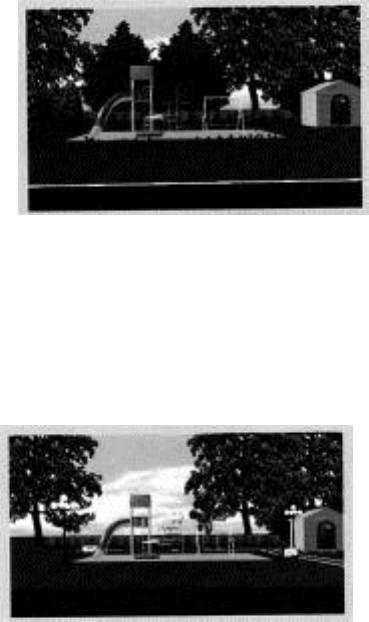
This picture shows a park that does well
at providing natural surveillance from the
parking lot, however there is a hedge to the
left that provides a great hiding spot. There
are no pathways so that makes access control
difficult. There is not a clear distinction of
where the parking lot ends and the play area begins. Also, the overgrowth of weeds
gives the part a feeling of not being cared for (Applying CPTED Principles, 2006).
This next picture shows some changes that were made to the playground
after some suggestions from the police.
The problematic trees and hedges have
been removed. Now there is a pathway present
so people know where to walk. Now there are
lights and benches. However, some of the
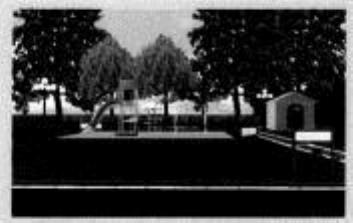
Alliance Advertising 11
territorial boundaries have been lost because of the removal of hedges so the end of
the playground is not easily determined (Applying CPTED Principles, 2006).
This third and final picture shows the same park but utilizing CPTED
methods. It has the proper plants and they are not overgrown; they have been
properly trimmed. Territorial reinforcement has been added with a fence and
vegetation (Applying CPTED Principles, 2006). The problematic hedge to the left
was replaced with a dwarf species. Now the
entire playground is visible without removing
all plants. Choosing the correct plants is as
important as maintaining them. Along the
pathways there is a low chain and post fence
along the front of the park, which will discourage foot and car traffic from getting
closer to the park. Along with the changes made in picture two, the fence and dwarf
hedge around the park, there was also a sign added to the entrance to inform the
public of who owns the park and the rules of the park (Applying CPTED Principles,
2006).
Conclusion
The results from the primary and secondary research collected have shown
Alliance Advertising, that the agency could have performed a different method of
data collection. Alliance Advertising chose convenience sampling, however, the
results may have been different. An example of this is would be the year participants
were born. Most members of Alliance Advertising surveyed students on the
University of South Dakota’s campus, which limited the age of people surveyed.
However, if members of Alliance Advertising would have gone to a place in the
community, such as Wal-Mart, the age of people surveyed would have been much
more diverse. The agency found that most people do not know what CPTED is and
Alliance Advertising feels it is very important to make citizens more aware of CPTED
in order to make the community get behind the program. Alliance Advertising also
found it very interesting that 50 percent of residents surveyed did not have eye
viewers in their doors. The agency feel that the research conducted reinforced the
agency’s views on how safe citizens perceive Vermillion to be.
Alliance Advertising 12
6%
19%
29%
27%
8% 11%
Figure 1: Quality of Lighting
Around Residence
Very Poor Poor Average
Good Exceptional N/A
Consumer Analysis
The Vermillion Police Department has a wide-variety of consumers that need their
assistance. The current and most apparent users of the VPD include college students
and permanent residents of Vermillion. These broad groups are those who need
them most during the college school year. The VPD also has people in need during
the summer for their protection. Crime is highest when college students come
during the school year because the population increases by more than 6,000 people.
This is why CPTED is such a needed program in the Vermillion community. The
CPTED program can help protect people from crime by doing the simple CPTED
certification requirements.
For consumers to invest in the CPTED program and the VPD for a permanent
solution they need to be motivated. Consumers often base their safety on how fast
the VPD can show up or how often they drive by their residences. CPTED and other
crime prevention programs are examples of how people can get involved in making
the community and their own homes safer. If the consumers feel that the VPD can
provide the best safety for their families then CPTED is a simple program ran
through the police department to ensure safety to one’s home. By motivating
Vermillion residents, this community can be a safer place to live and raise a family.
Many consumers may see the Vermillion Police Department as their only source to
keeping their families safe;
when in reality they have not
taken every precaution
available to protect their
family. People who live in
rented homes or apartments
feel they do not have adequate
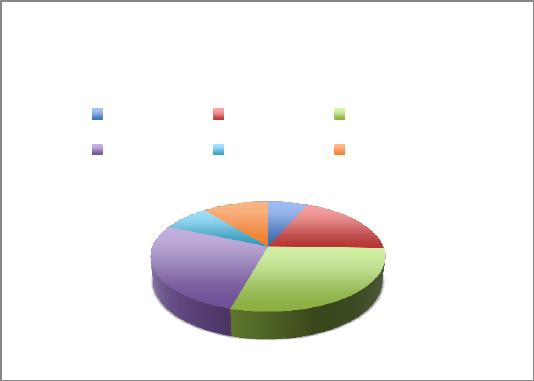
lighting. In Figure 1, “Quality of
Lighting Around Residence,”
which was taken from the

Alliance Advertising 13
5%
22%
32%
4% 0%
Figure 2: Feeling of Safety with
Landscaping Features
Very Unsafe Not Safe Unsure
Safe Very Safe n/a
survey of 100 people that was conducted, shows the feelings residents of Vermillion
have concerning the lighting outside of their homes.
In Figure 2, “Feeling of Safety with Landscaping Features” graph shows that people
who live in rented homes or apartments feel that landscaping techniques such as
bushes and rocks by windows
make them safer.
Consumers also have a wide-
variety of needs, wants,
problems, and interests when
it comes to dealing with the
Vermillion Police Department.