Chapter 10: Pricing
Products
What’s Ahead
Factors to Consider When Setting Prices
Internal Factors Affecting Pricing Decision
External Factors Affecting Pricing Decisions
General Pricing Approaches
Cost-Based Pricing
Value-Based Pricing
Competition-Based Pricing
Chapter Wrap-Up
What’s Ahead
For decades preceding 1995, Kellogg was beloved on Wall Street—it was a virtual money machine.
The cereal giant’s 1995 sales of $7 billion represented its fifty-first straight year of rising revenues.
Over the previous 30 years, Kellogg’s sales had grown at one and a half times the industry growth rate
and its share of the U.S. cereal market had consistently exceeded 40 percent. Over the preceding
decade, annual returns to shareholders had averaged 19 percent, with gross margins running as high as
55 percent. In 1995, Kellogg held a 42 percent worldwide market share, with a 48 percent share in
Asia and Europe and a mind-blowing 69 percent share in Latin America. Things, it seemed, could
only get better for Kellogg.
Behind these dazzling numbers, however, Kellogg’s cereal empire had begun to lose its luster. Much
of its recent success, it now appears, had come at the expense of cereal customers. Kellogg’s recent
gains—and those of major competitors General Mills, Post, and Quaker—had come not from
innovative new products, creative marketing programs, and operational improvements that added
value for customers. Instead, these gains had come almost entirely from price increases that padded
the sales and profits of the cereal makers.
Throughout most of the 1980s and early 1990s, Kellogg had boosted profit margins by steadily raising
prices on its Rice Krispies, Special K, Raisin Bran, and Frosted Flakes—often twice a year. For
example, by early 1996, a 14-ounce box of Raisin Bran that sold for $2.39 in 1985 was going for as
much as $4.00 to $5.00, but with little or no change in the costs of the materials making up the cereal
or its packaging. Since World War II, no food category had had more price increases than cereal. The
price increases were very profitable for Kellogg and the other cereal companies—on average, the
cereal makers were reaping more than twice the operating margins of the food industry as a whole.
However, the relentless price increases became increasingly difficult for customers to swallow.
So, not surprisingly, in 1994 the cereal industry’s pricing policies began to backfire as frustrated
consumers retaliated with a quiet fury. Cereal buyers began shifting away from branded cereals
toward cheaper private-label brands; by 1995, private labels were devouring 10 percent of the
American cereal market, up from a little more than 5 percent only five years earlier. Worse, many
Americans switched to less expensive, more portable handheld breakfast foods, such as bagels,
muffins, and breakfast bars. As a result, total American cereal sales began falling off by 3 to 4 percent
a year. Kellogg’s sales and profits sagged and its U.S. market share dropped to 36 percent. By early
1996, after what most industry analysts viewed as years of outrageous and self-serving pricing
policies, Kellogg and the other cereal makers faced a full-blown crisis.
Post Cereals was the first competitor to break away. Belated research showed that exorbitant pricing
was indeed the cause of the industry’s doldrums. “Every statistic, every survey we took only showed
that our customers were becoming more and more dissatisfied,” said Mark Leckie, then general
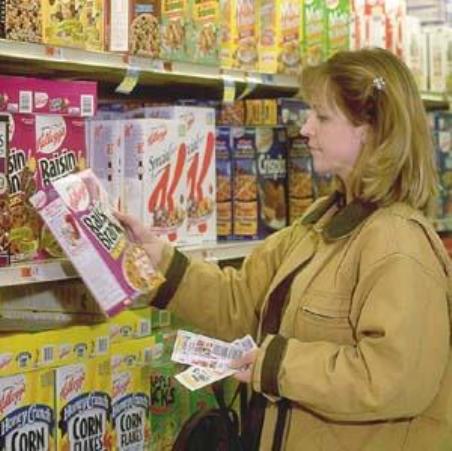
manager of Post Cereals. “You can see them walking down cereal aisles, clutching fistfuls of coupons
and looking all over the shelves, trying to match them with a specific brand.” To boost its soggy sales,
in April 1996 Post slashed the prices on its 22 cereal brands an average of 20 percent—a surprise
move that rocked the industry.
At first, Kellogg, General Mills, and Quaker held stubbornly to their premium prices. However, cereal
buyers began switching in droves to Post‘s lower-priced brands—Post quickly stole 4 points from
Kellogg’s market share alone. Kellogg and the others had little choice but to follow Post’s lead.
Kellogg announced price cuts averaging 19 percent on two-thirds of all brands sold in the United
States, marking the start of what would become a long and costly industry price war. In recanting their
previous pricing excesses, the cereal makers swung wildly in the opposite direction, caught up in
layoffs, plant closings, and other cost-cutting measures and fresh rounds of price cutting. “It reminds
me of one of those World War I battles where there’s all this firing but when the smoke clears you
can’t tell who won,” noted an industry analyst. In fact, it appears that nobody won, as the fortunes of
all competitors suffered.
Kellogg was perhaps the hardest hit of the major competitors. Post Cereal’s parent company,
consumer-foods powerhouse Philip Morris, derived only about 2 percent of its sales and profits from
cereals and could easily offset the losses elsewhere. However, Kellogg, which counted on domestic
cereal sales for 42 percent of its revenues and 43 percent of its operating profits, suffered enormously.
Its operating margins were halved, and even after lowering its prices, Kellogg’s revenues and profits
continued to decline.
Now, several years after the initial price rollbacks, Kellogg and the cereal industry are still feeling the
aftershocks. Entering the new millennium, the total American cereal market is growing at a meager 1
percent a year, private brands now capture an impressive 18 percent market share, and alternative
breakfast foods continue their strong growth. Kellogg’s market share has slumped to 32 percent, down

from 42 percent in 1988, and its sales and profits are flat. During the past several years, Kellogg has
watched its stock price languish while the stock market as a whole has more than tripled.
Recently, Kellogg and the other cereal titans have quietly begun pushing ahead with modest price
increases. The increases are needed, they argue, to fund the product innovation and marketing support
necessary to stimulate growth in the stagnant cereal category. But there’s an obvious risk. Consumers
have long memories, and if the new products and programs aren’t exciting enough, the higher prices
may well push consumers further toward less expensive private-label cereals and alternative breakfast
foods. “It’s almost a no-win situation,” says another analyst.
Despite its problems, Kellogg remains the industry leader. The Kellogg brand name is still one of the
world’s best known and most respected. Kellogg’s recent initiatives to cut costs, get reacquainted with
its customers, and develop innovative new products and marketing programs—all of which promise to
add value for customers rather than simply cutting prices—has Wall Street cautiously optimistic about
Kellogg’s future. But events of the past five years teach an important lesson. When setting prices, as
when making any other marketing decisions, a company can’t afford to focus on its own costs and
profits. Instead, it must focus on customers’ needs and the value they receive from the company’s total
marketing offer. If a company doesn’t give customers full value for the price they’re paying, they’ll go
elsewhere. In this case, Kellogg stole profits by steadily raising prices without also increasing
customer value. Customers paid the price in the short run—but Kellogg is paying the price in the long
run.1
All profit organizations and many nonprofit organizations must set prices on their products or
services. Price goes by many names:
Price is all around us. You pay rent for your apartment, tuition for your education, and a fee to your
physician or dentist. The airline, railway, taxi, and bus companies charge you a fare; the local utilities
call their price a rate; and the local bank charges you interest for the money you borrow. The price for
driving your car on Florida’s Sunshine Parkway is a toll, and the company that insures your car
charges you a premium. The guest lecturer charges an honorarium to tell you about a government
official who took a bribe to help a shady character steal dues collected by a trade association. Clubs or
societies to which you belong may make a special assessment to pay unusual expenses. Your regular
lawyer may ask for a retainer to cover her services. The “price” of an executive is a salary, the price
of a salesperson may be a commission, and the price of a worker is a wage. Finally, although
economists would disagree, many of us feel that income taxes are the price we pay for the privilege of
making money.2
In the narrowest sense, price is the amount of money charged for a product or service. More broadly,
price is the sum of all the values that consumers exchange for the benefits of having or using the
product or service. Historically, price has been the major factor affecting buyer choice. This is still
true in poorer nations, among poorer groups, and with commodity products. However, nonprice
factors have become more important in buyer-choice behavior in recent decades.
Throughout most of history, prices were set by negotiation between buyers and sellers. Fixed price
policies—setting one price for all buyers—is a relatively modern idea that arose with the development
of large-scale retailing at the end of the nineteenth century. Now, some one hundred years later, the
Internet promises to reverse the fixed pricing trend and take us back to an era of dynamic pricing—
charging different prices depending on individual customers and situations. The Internet, corporate
networks, and wireless setups are connecting sellers and buyers as never before. Web sites like
Compare.Net and PriceScan.com allow buyers to quickly and easily compare products and prices.
Online auction sites like eBay.com and Amazon.com make it easy for buyers and sellers to negotiate
prices on thousands of items—from refurbished computers to antique tin trains. At the same time, new
technologies allow sellers to collect detailed data about customers’ buying habits, preferences—even
spending limits—so they can tailor their products and prices.3
Price is the only element in the marketing mix that produces revenue; all other elements represent
costs. Price is also one of the most flexible elements of the marketing mix. Unlike product features
and channel commitments, price can be changed quickly. At the same time, pricing and price
competition is the number-one problem facing many marketing executives. Yet, as the chapter-
opening Kellogg example illustrates, many companies do not handle pricing well. The most common
mistakes are pricing that is too cost oriented rather than customer-value oriented; prices that are not
revised often enough to reflect market changes; pricing that does not take the rest of the marketing
mix into account; and prices that are not varied enough for different products, market segments, and
purchase occasions.
In this chapter and the next, we focus on the problem of setting prices. This chapter looks at the
factors marketers must consider when setting prices and at general pricing approaches. In the next
chapter, we examine pricing strategies for new-product pricing, product mix pricing, price adjustments
for buyer and situational factors, and price changes.
Factors to Consider When Setting Prices
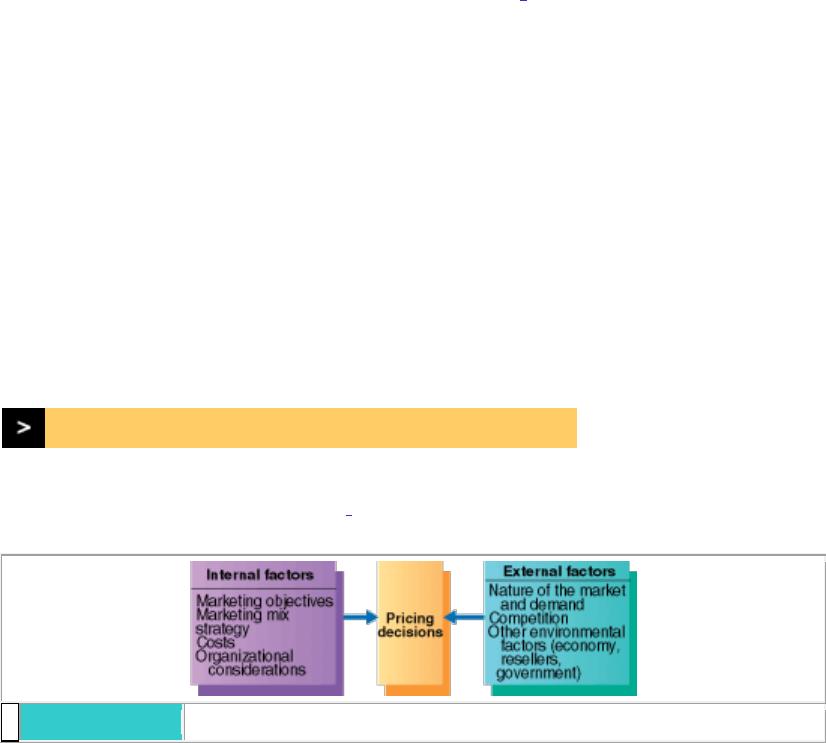
A company’s pricing decisions are affected by both internal company factors and external
environmental factors (see Figure 10.1).4
Figure 10.1
Factors affecting price decisions
INTERNAL FACTORS AFFECTING PRICING DECISION
Internal factors affecting pricing include the company’s marketing objectives, marketing mix strategy,
costs, and organizational considerations.
Marketing Objectives
Before setting price, the company must decide on its strategy for the product. If the company has
selected its target market and positioning carefully, then its marketing mix strategy, including price,
will be fairly straightforward. For example, if General Motors decides to produce a new sports car to
compete with European sports cars in the high-income segment, this suggests charging a high price.
Motel 6, Econo Lodge, and Red Roof Inn have positioned themselves as motels that provide
economical rooms for budget-minded travelers; this position requires charging a low price. Thus,
pricing strategy is largely determined by decisions on market positioning.
At the same time, the company may seek additional objectives. The clearer a firm is about its
objectives, the easier it is to set price. Examples of common objectives are survival, current profit
maximization, market share leadership, and product quality leadership.

Product-quality leadership: Maytag targets the higher quality end of the appliance market. Its ads use the
long-running slogan “Built to last longer” and feature Ol’ Lonely, the Maytag repairman.
Companies set survival as their major objective if they are troubled by too much capacity, heavy
competition, or changing consumer wants. To keep a plant going, a company may set a low price,
hoping to increase demand. In this case, profits are less important than survival. As long as their prices
cover variable costs and some fixed costs, they can stay in business. However, survival is only a short-
term objective. In the long run, the firm must learn how to add value that consumers will pay for or
face extinction.
Many companies use current profit maximization as their pricing goal. They estimate what demand
and costs will be at different prices and choose the price that will produce the maximum current profit,
cash flow, or return on investment. In all cases, the company wants current financial results rather than
long-run performance. Other companies want to obtain market share leadership. They believe that the
company with the largest market share will enjoy the lowest costs and highest long-run profit. To
become the market share leader, these firms set prices as low as possible.