Marketing Mix for PepsiCo and Coca-Cola
Chanda Kapemba
Marketing for Managers EBS5041
Term Project
May 2022
Graduate School of Business
The University of Zambia
INTRODUCTION
The soft drink industry has been around for a long time. It is fair to conclude that these companies
control a significant piece of the market. Soft drink consumption in urban culture has been quickly
increasing, with little indication that it will decrease in the coming years. The reason for this is that
soft drinks are commonly served at dinner parties and other occasions in urban areas (Christian
Gronroos, 1994). Marketers are working on new techniques to strengthen the manufacturing,
marketing, and transportation components of their soft drink industry and keep them on top.
Furthermore, the competition structure for such businesses differs significantly from that of other
businesses. The key win is determined by a company’s price, customer-centric attitude, and ability to
entice customers with creative approaches (Christian Gronroos, 1994).
Over the last few years, we’ve seen some of the most incredible advertising ever created, all aimed
at attracting customers to a single business. In today’s extremely competitive market, there are two
names that are synonymous with providing excellent service and, alternately, remaining at the top.
Coca Cola and Pepsi. These two corporations have seized every opportunity throughout the years to
exploit the weaknesses of the other (Haldipur, V.) (2015).
In this project, we’ll look at Pepsi and Coca-marketing Cola’s mix to see how they sell their products
to their customers. Not only that, but we’ll walk you through the process right up to the moment
where you pay for these products.
Pepsi Co.
Pepsi was launched in 1965 in New York. It makes non-alcoholic beverages and food processing
equipment. PepsiCo is a company that produces and manufactures carbonated beverages. It’s
available at supermarkets, restaurants, movie theatres, and vending machines. Caleb Bradham, a
pharmacist in New Bern, North Carolina, invented the drink in the 1890s (David Jobber, 2001). On
June 16, 1903, the brand was registered as a trademark. In 1988, Pepsi was introduced to the Indian
market. In 1988, PepsiCo established a joint venture in India with the Punjab government-owned
Punjab Agro Industrial Corporation (PAIC) and Volta’s India Limited (David Jobber, 2001). This joint
venture marketed and distributed Lehar Pepsi until 1991, when international brands were
permitted; PepsiCo bought out its partners and terminated the joint venture in 1994. Others believe
that Pepsi was barred from entering India in 1970 because it refused to give a list of its contents, and
that the restriction was removed in 1993, with Pepsi entering the market shortly after (David Jobber,
2001). These squabbles serve as a reminder of India’s tense relationship with large global
corporations. Some claim that PepsiCo and The Coca-Cola Company have been prominent targets in
part because they are well-known international corporations that attract a lot of attention (David
Jobber, 2001).
Coca-Cola
Coca-Cola is a carbonated soft drink that can be found in supermarkets, restaurants, and vending
machineries in every country The Coca-Cola Company in Atlanta, Georgia produces it. It was founded
in 1886. Coca-Cola claims to have distribution in over 200 countries (Prof. Elisante ole Gabriel, 2005).
Coca-Cola, the world’s largest soft drink company, returned to India in the 1990s after leaving in the
late 1970s due to the Foreign Exchange Regulation Act of 1973. Foreign firms were required to dilute
their shareholdings to 40% under the Act, which was intended to ‘Indianite’ them. Coca-Cola chose
to shut its activities in India rather than reducing its shareholdings to the statutory level set by the
Act (Prof. Elisante ole Gabriel, 2005).
Coca-Cola is the largest beverage company in India, with over 60% of the market share in carbonated
soft drinks (Prof. Elisante ole Gabriel, 2005).
Coca-Cola, the world’s largest soft drink company, returned to India in the 1990s after leaving its
operations in the late 1970s due to the Foreign Exchange Regulation Act of 1973. Foreign
corporations were required to dilute their shareholdings to 40% under the Act, which was intended
to ‘Indianize’ foreign companies. Coca-Cola chose to cease operations in India rather than reducing
its shareholdings to the statutory level set by the Act (Prof. Elisante ole Gabriel, 2005).
MARKETING MIX
The marketing mix refers to the combination of marketing tactics that a company employs to
achieve its marketing goals. These marketing instruments are divided into different categories in the
marketing mix. The four p’s, or product, pricing, location, and promotion, are used to classify and
categorize marketing (ZelalemAnley, 2011). Product design, quality, features, branding, and
packaging are among the most basic marketing tools. The price of a product, or how much buyers
pay for it, is an important marketing technique. Discounts, allowances, credit conditions, and the
payment period are all part of it (ZelalemAnley, 2011).
Another important component of the marketing mix is location. It also comprises the company’s
different actions aimed at making the product accessible and available to the customer.
Transportation facilities, distribution methods, coverage area, and other considerations all influence
the location (ZelalemAnley, 2011).
The fourth marketing mix tool is promotion, which encompasses all of the activities that a firm
engages in to convey and promote its product to its target market. Sales promotion, advertising,
sales force, public relations, and direct marketing are all examples of promotion (ZelalemAnley,
2011).
1. Product
SulekhaGoyat (2011) defines a product as anything that may be supplied to a market in exchange for
attention, acquisition, use, or consumption that might satisfy a demand or need. Product variety,
quality, design, features, brand name packaging, sizes, services, warranties, and returns should all be
addressed while developing a product strategy.
At three levels, the product offering can be adjusted to produce various market effects: the core
product, the tangible product, and the augmented product. A product is defined by the value it
provides to clients, not by its physical form. These advantages could be physical or psychological
(SulekhaGoyat, 2011).Features, quality, aesthetics, packaging, branding, and labeling are all
examples of tangible products. Additional services aspects such as after-sales service, extended
warranties, credit facilities, technical advice, and product trials are all examples of augmented
products (SulekhaGoyat, 2011).
The service component of the product offer can be broken down into two parts: core services, which
represent the primary benefit, and secondary services, which reflect both the tangible and
augmented product levels. The latter is best defined in terms of the method in which the service is
delivered (SulekhaGoyat, 2011).
Coca-Cola Product
Coca-Cola Company products are consumed in excess of 1.9 billion servings each day. Rather than
expanding across the food, snack, and beverage businesses, Coca-Cola has focused on developing a
beverage empire (Rustorm S. Davar, 1996). Coca-Cola divides its goods into two categories: sparkling
beverages (carbonated beverages) and still beverages (non-carbonated products). Sparkling
beverages accounted for about 63 percent of Coca-total Cola’s bottle/can sales in the fiscal year that
ended in 2020, and 70.6 percent of bottles/cans sold by volume (McKelvey, S. M. 2006).
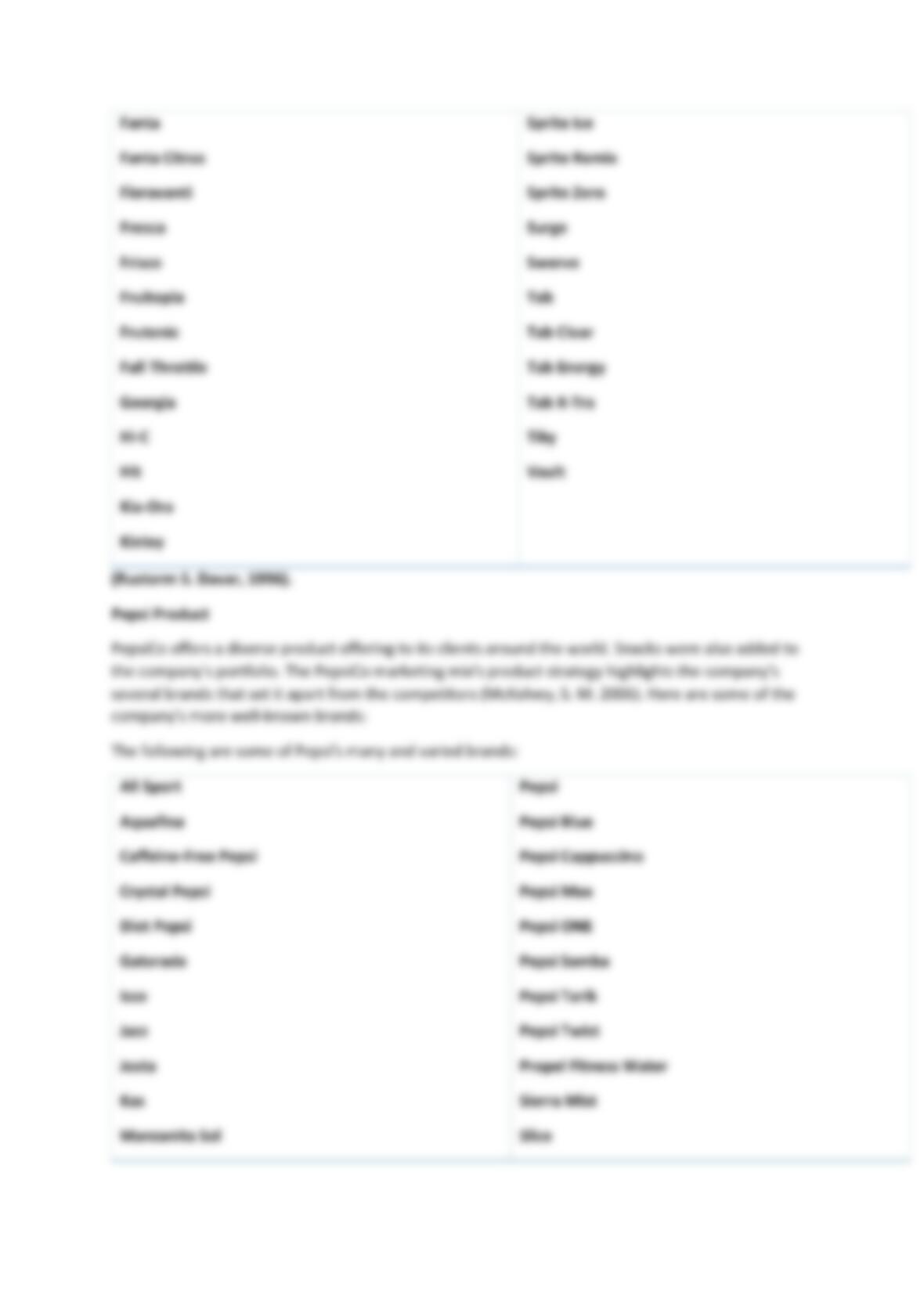
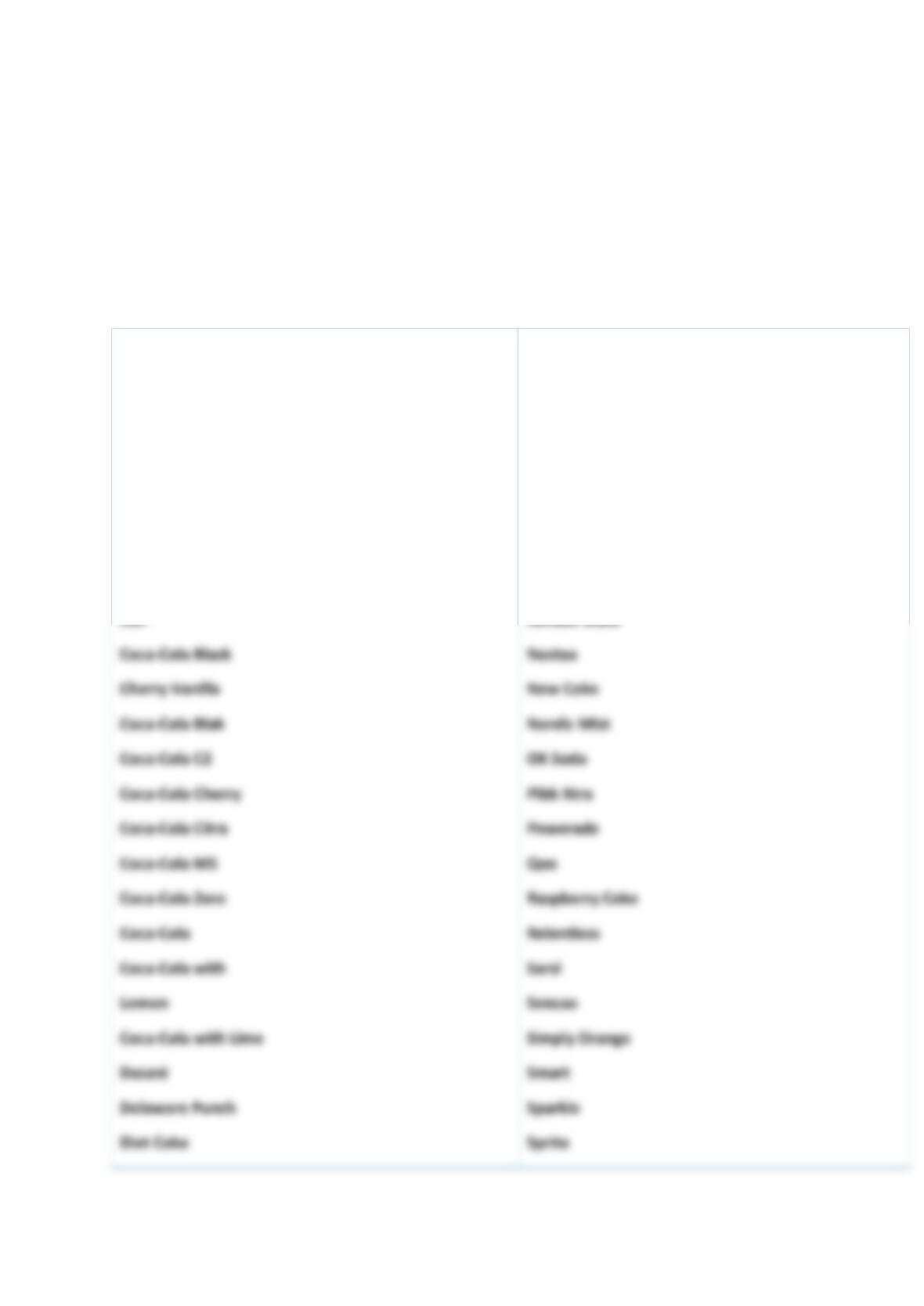
Coca-Cola is a multinational corporation with many different products. They’ve invented and
produced a variety of goods over the years, in addition to their main cola drinks. The following is a
list of Coca-Cola brands:
Appletiser
Aquarius
BPM Energy
Barq’s
Beat soda
Beverly
Cannings
Cheers
Lemon & Paeroa
Lift
Lift plus
Lilt
Manzana Lift
Mare Rosso
Mello Yello
Mezzo Mix